



April 2026: 0.71% (F grade)
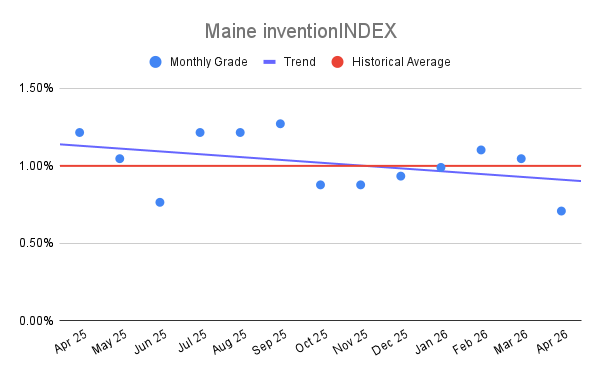
Maine inventionINDEX April 2026: 0.71% (F grade)
The inventionINDEX measures innovation output by comparing GDP growth with patent production growth.
Anything over C grade is positive sentiment; anything under C is negative outlook/sentiment. Using that sentiment, it is possible to observe trends over time, and also compare states/countries. In doing so, we can predict which states have the best chance to recover economically from the pandemic (or any other economic incident that may occur).
Maine inventionINDEX Scores – Last 12 months
| Month | inventionINDEX Score |
| April 2026 | 0.71% |
| Mar 26 | 1.05% |
| Feb 26 | 1.10% |
| Jan 26 | 0.99% |
| Dec 25 | 0.93% |
| Nov 25 | 0.88% |
| Oct 25 | 0.88% |
| Sep 25 | 1.27% |
| Aug 25 | 1.21% |
| Jul 25 | 1.21% |
| Jun 25 | 0.76% |
| May 25 | 1.05% |
| Apr 25 | 1.21% |
The Maine inventionINDEX score for April 2026 reflects a disappointing downturn, recording a 0.71 percent and an F rating. This performance represents a sharp decline from the relatively stable first quarter of the year, where the index held at a C-plus in February before beginning its current slide. When comparing this result to the same month in previous years, the volatility of the state’s innovation climate becomes clear. The current score is a significant regression from the 1.21 percent B rating seen in April 2025 and the 1.10 percent C-plus rating from April 2024. In fact, the current April performance effectively mirrors the low point observed in April 2023, suggesting a cyclical struggle to maintain momentum during the spring season.
Viewed through a broader historical lens, the last 60 months reveal that Maine is capable of reaching much higher heights than the current data suggests. The state hit a remarkable peak in March 2024 with a score of 1.78 percent and an A-plus rating, and it maintained several high-performing stretches throughout 2023 and 2025. However, the current 0.71 percent score places the state dangerously close to its historical floor of 0.65 percent, a level reached during several difficult months in 2021 and 2023. This recurring dip into the F and D-minus ranges indicates that while the state can produce bursts of high-level inventive activity, it lacks the institutional consistency required to stay in the upper tiers of the index for extended periods.
The positive outcomes associated with a higher inventionINDEX grade are vital for the long-term health of the Maine economy. When the index reaches the A or B ranges, it typically signals a period of intense creative output, characterized by a surge in patent filings and a high level of collaborative research and development. These scores often act as a beacon for venture capital firms and industrial partners looking for regions with high growth potential. A higher grade suggests that the local workforce is effectively transitioning new ideas into marketable assets, which in turn creates high-wage jobs and builds a resilient, technology-driven economic base that can withstand broader market fluctuations.
Conversely, the negative implications of a low score, such as the current F rating, are significant and multifaceted. A persistent score below 0.80 percent may indicate a lack of sufficient funding for local inventors or a bottleneck in the commercialization process for new technologies. If the index remains at this level, Maine risks a loss of intellectual capital as top researchers and entrepreneurs seek more supportive ecosystems in other states. Furthermore, a low rating can dampen investor confidence, making it increasingly difficult for startups to secure the seed money necessary for survival. Addressing these periods of stagnation is essential to prevent a permanent decline in the state’s competitive standing within the national innovation landscape.
Discussion:
In April, the Maine inventionINDEX scored a negative sentiment which was lower than the previous year’s average and underperformed the downward trend for the year. This is similar to the prior 12 months, which experienced a slight downward trend.
As the economy continues to stabilize in the post-pandemic era, it remains uncertain whether any backlog of applications still exists or if the department has returned to normal processing timelines. The inventionINDEX could also be affected by lingering consequences from the pandemic, such as company closures, reduced workforces, and limited R&D capabilities, which may still be impacting current operations.
Learn More:
Are you thinking of patenting any of your bright ideas? Did you know your research work could be eligible for the R&D Tax Credit and you can receive up to 14% back on your expenses? To find out more, please check out our free online eligibility test.
Swanson Reed’s Maine office provides R&D tax credit consulting and advisory services to Portland, Lewiston, Bangor, South Portland and Auburn.
Feel free to book a quick teleconference with one of R&D tax specialists if you would like to learn more about R&D tax credit opportunities.
Who We Are:
Swanson Reed is the largest Specialist R&D tax credit advisory firm in the United States. With offices nationwide, we are one of the only firms globally to exclusively provide R&D tax credit consulting services to our clients. We have been exclusively providing R&D tax credit claim preparation and audit compliance solutions for over 30 years.
Swanson Reed hosts daily free webinars and provides free IRS CE and CPE credits for CPAs. For more information please visit us at www.swansonreed.com/free-webinars or contact your usual Swanson Reed representative.
Are you eligible?

Why choose us?

Pass an Audit?

What is the R&D Tax Credit?
The Research & Experimentation Tax Credit (or R&D Tax Credit), is a general business tax credit under Internal Revenue Code section 41 for companies that incur research and development (R&D) costs in the United States. The credits are a tax incentive for performing qualified research in the United States, resulting in a credit to a tax return. For the first three years of R&D claims, 6% of the total qualified research expenses (QRE) form the gross credit. In the 4th year of claims and beyond, a base amount is calculated, and an adjusted expense line is multiplied times 14%. Click here to learn more.
Never miss a deadline again

Stay up to date on IRS processes

Discover R&D in your industry

R&D Tax Credit Preparation Services
Swanson Reed is one of the only companies in the United States to exclusively focus on R&D tax credit preparation. Swanson Reed provides state and federal R&D tax credit preparation and audit services to all 50 states.
If you have any questions or need further assistance, please call or email our CEO, Damian Smyth on (800) 986-4725.
Feel free to book a quick teleconference with one of our national R&D tax credit specialists at a time that is convenient for you.
R&D Tax Credit Audit Advisory Services
creditARMOR is a sophisticated R&D tax credit insurance and AI-driven risk management platform. It mitigates audit exposure by covering defense expenses, including CPA, tax attorney, and specialist consultant fees—delivering robust, compliant support for R&D credit claims. Click here for more information about R&D tax credit management and implementation.
Our Fees
Swanson Reed offers R&D tax credit preparation and audit services at our hourly rates of between $195 – $395 per hour. We are also able offer fixed fees and success fees in special circumstances. Learn more at https://www.swansonreed.com/about-us/research-tax-credit-consulting/our-fees/



Choose your state




