The United States Patent and Trademark Office recently granted Patent No. 12,618,291 for a “Pitch data processing system for horizontal directional drilling.” The patent was officially assigned to Underground Magnetics, Inc., an industry leader in horizontal directional drilling (HDD) locating systems based in Johnston, Iowa.
This innovative system is designed to significantly improve the accuracy and reliability of tracking underground boring tools during drilling operations. By utilizing a specialized series of signal processing components, the technology filters raw telemetry data to provide a much cleaner, more accurate reading of the drill head’s pitch profile.
Core Innovation of the Pitch Data Processing System
Horizontal directional drilling requires extreme precision to navigate underground obstacles and accurately install utility lines. Traditional systems often suffer from signal noise, vibrations, and erratic data spikes caused by harsh underground environments. The invention from Underground Magnetics, Inc. resolves this issue through a multi-stage filtering process. It features an underground transmitter equipped with an accelerometer that outputs a raw pitch signal. This signal is processed by an offset and range calibration unit, followed by a unique pitch speed limiter that establishes strict upper and lower limits on pitch change speed. Finally, a low pass filter attenuates frequencies above a specific cutoff threshold. This combination ensures that sudden, artificial spikes in data are eliminated, leaving operators with a smooth and highly reliable adjusted pitch signal to track the pilot bore profile precisely.
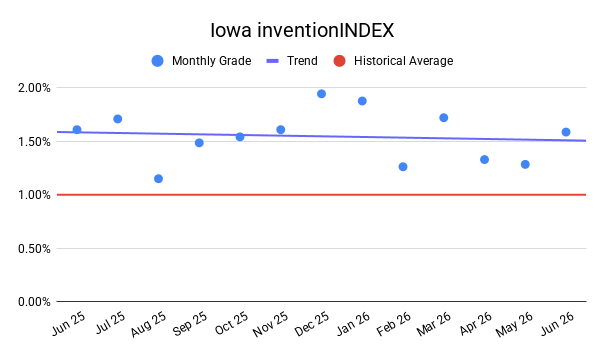
Iowa Patent of the Month Recognition for June 2026
Due to its significant technical advancement and industrial relevance, this breakthrough has won the Iowa Patent of the Month award for June 2026. Administered to highlight exceptional regional innovation, the award recognizes Underground Magnetics, Inc. for enhancing worker safety and efficiency in utility deployment. Operating out of Johnston, Iowa, the company exemplifies the state’s growing reputation as a powerhouse for industrial technology and precision engineering. This patent stands out as a prime example of how local Midwestern businesses are solving global infrastructure challenges, earning it the top spot for June 2026.
Practical Applications for the US R&D Tax Credit
From a commercial and financial perspective, the practical application and implementation of this patented system present excellent opportunities for companies to qualify for the United States Research and Development Tax Credit under Section 41 of the Internal Revenue Code. To be eligible, activities must satisfy a four-part test: they must serve a qualified purpose, rely on biological or physical sciences, eliminate technological uncertainty, and involve a process of experimentation. When directional drilling operators or manufacturing companies engage in integrating, testing, and scaling this pitch data processing system, they undergo a rigorous process of experimentation. Specifically, activities such as developing custom software to interface with the low pass filter, designing specialized calibration algorithms for varying soil compositions, and conducting hardware-in-the-loop testing to refine the pitch speed limiter limits are all qualified research expenses. These engineering endeavors aim to eliminate technological uncertainty regarding telemetry performance under extreme underground stresses, directly making the associated labor, supplies, and contractor costs eligible for valuable tax credits.