The Alternative Simplified Credit (ASC) is an optional R&D tax credit calculation method based on 10% of New Jersey research expenses that exceed 50% of the company's prior three-year average. This method eliminates the need for complex 1980s historical data, providing a streamlined compliance path for modern technology and biotechnology firms.
New Jersey’s implementation of the Alternative Simplified Credit (ASC) represents a critical evolution in the state’s fiscal policy, designed to align state-level innovation incentives with the streamlined administrative standards of the federal Internal Revenue Code. For decades, the primary hurdle for taxpayers seeking to claim the Research and Development (R&D) Tax Credit was the "Regular Research Credit" (RRC) method, which required a forensic reconstruction of financial records from 1984 through 1988 to establish a "fixed-base percentage." For many contemporary enterprises, especially those in the high-growth software and life sciences sectors that define the New Jersey innovation corridor, such documentation is frequently unattainable or irrelevant to current operational scales. The formal adoption of the ASC method for tax years beginning on or after January 1, 2018, via Assembly Bill 4202, effectively removed these historical barriers, allowing firms to leverage recent expenditure patterns to calculate their credits. This analysis explores the legal, administrative, and strategic dimensions of the ASC in New Jersey, providing a comprehensive guide for corporate taxpayers and professional advisors navigating the complexities of the New Jersey Corporation Business Tax (CBT).
Statutory Authority and the Legal Framework of N.J.S.A. 54:10A-5.24
The fundamental legal basis for the New Jersey Research and Development Tax Credit is codified under N.J.S.A. 54:10A-5.24. This statute permits a taxpayer to claim a credit against the tax imposed by the Corporation Business Tax Act (1945) for qualifying research activities conducted specifically within the borders of New Jersey. The law mandates that the credit amount is generally equal to 10% of the excess of qualified research expenses for the privilege period over the base amount, supplemented by 10% of basic research payments.
The integration of the ASC method into this statutory framework necessitated a specific alignment with federal standards. The New Jersey Legislature determined that for privilege periods beginning on and after January 1, 2018, the state would adopt the calculation methodologies outlined in Section 41 of the federal Internal Revenue Code. This adoption was not merely a matter of convenience but a strategic move to reduce the "compliance friction" that often deterred smaller firms from claiming the credit. By tethering the New Jersey credit to the federal calculation, the state ensured that any taxpayer capable of completing Federal Form 6765 would, by extension, possess the necessary data to complete New Jersey Form 306.
The legal evolution of this credit also reflects New Jersey’s focus on priority industries. While the standard carryforward for unused R&D credits is seven years, N.J.S.A. 54:10A-5.24b provides an extended 15-year carryforward for companies engaged in advanced computing, advanced materials, biotechnology, electronic device technology, environmental technology, and medical device technology. This distinction in the law underscores the state’s commitment to long-term research cycles, particularly in fields where commercialization may take a decade or more.
Summary of Statutory Rates and Carryforward Provisions| Provision Type | Statutory Reference | Standard Application | Priority Field Application |
|---|---|---|---|
| Basic Credit Rate | N.J.S.A. 54:10A-5.24(a) | 10% of excess QREs | 10% of excess QREs |
| Basic Research Rate | N.J.S.A. 54:10A-5.24(a) | 10% of payments | 10% of payments |
| Carryforward Duration | N.J.S.A. 54:10A-5.24(b) | 7 Years | 15 Years |
| Refundability | N.J.S.A. 54:10A-5.24(b) | Non-refundable | Non-refundable |
| Transferability | N.J.S.A. 34:1B-7.37 | Not applicable | Sellable at 80%+ value |
Administrative Guidance from the New Jersey Division of Taxation
The Division of Taxation provides the operational details for the ASC method through its official instructions and technical bulletins. The most authoritative source of guidance is Technical Bulletin TB-114, which was significantly revised in November 2025 to reflect recent federal and state changes.
The Mandatory Method Consistency RuleA cornerstone of New Jersey’s administrative guidance is the "Method Consistency" rule. Taxpayers are not permitted to "cherry-pick" different calculation methods for federal and state purposes. If a taxpayer elects the ASC method on Federal Form 6765, they are legally required to use the same method on New Jersey Form 306. This consistency must be maintained across the entire tax year. Should a taxpayer file an amended federal return that changes the calculation method—for instance, moving from the Regular Method to the ASC—they are strictly required to file an amended New Jersey CBT return to reflect this modification.
This rule also extends to adjustments made by the Internal Revenue Service. If a federal audit results in changes to the amount of qualifying expenses, the taxpayer must update their New Jersey filing accordingly. However, the Division of Taxation notes that adjustments to federal QREs will only impact the New Jersey credit to the extent that those expenses were for research conducted within New Jersey.
Guidance on Form 306 and the ASC Calculation (Part IV)Form 306, "Research and Development Tax Credit," is the primary vehicle for claiming the incentive. The form is structured to separate the two calculation paths. Part III is dedicated to the Regular Research Credit method, while Part IV is specifically for the Alternative Simplified Credit method.
For the ASC calculation in Part IV, the Division of Taxation instructs taxpayers to:
- Aggregate New Jersey-based QREs for the three taxable years preceding the current year.
- Calculate the average of those three years and divide by two (arriving at the 50% threshold).
- Subtract this base amount from the current year’s New Jersey QREs to determine the excess.
- Apply the 10% state rate to the resulting figure.
If the taxpayer is a member of a combined group, the guidance in TB-114 clarifies that the credit must be calculated at the member level but may be shared among the taxable members of the group. However, the sharing of these credits does not relieve the individual member from the requirement to sustain its own documentation of New Jersey-based activities.
The Mechanism of the Alternative Simplified Credit
The ASC method's mathematical structure is fundamentally different from the Regular method, focusing on the delta between current year activity and a rolling three-year average. This "incremental" approach ensures that the credit rewards companies for maintaining or increasing their research investments.
Mathematical Formula for the New Jersey ASCThe federal ASC rate is typically 14% of the excess QREs, but New Jersey applies its own statutory rate of 10%. The formula for the New Jersey ASC is expressed as follows:
Credit = 0.10 × (QRE_current - (0.50 × (QRE_n-1 + QRE_n-2 + QRE_n-3) / 3))
In instances where a taxpayer has no qualified research expenses in any one of the three preceding taxable years, the federal rule allows for a credit equal to 6% of the current year’s QREs. New Jersey taxpayers must follow this federal logic, which essentially provides a "floor" for new companies or those entering a research phase after a long hiatus.
Comparative Analysis of ASC vs. Regular Method Benefits| Scenario | Regular Method (RRC) Impact | ASC Method Impact |
|---|---|---|
| Missing 1980s Records | Ineligible or restricted to "Start-up" rates | Fully eligible based on recent data |
| High Gross Receipts | Reduces credit due to fixed-base % | No impact on credit calculation |
| Volatile R&D Spend | Can lead to high base amounts in peak years | Smoothed over 3-year rolling average |
| Startups (Pre-Revenue) | Complex calculation of gross receipt ratios | Simple calculation based only on spend |
Application of the Law to New Jersey Research Activities
To qualify for the ASC under New Jersey law, the expenditures must meet the federal "Four-Part Test" while also satisfying the state’s geographic nexus requirements. The application of the law is strict: only research conducted "in this State" is eligible for inclusion in the New Jersey Form 306.
Defining Qualified Research Expenses (QREs)The law identifies three primary categories of expenditures that constitute QREs:
- Wages: Includes W-2 compensation paid to employees for direct research, direct supervision, or direct support of research. New Jersey law excludes fringe benefits and non-taxed income from this calculation.
- Supplies: Tangible property (excluding land or depreciable assets) used in the research process. This often includes materials for prototypes and laboratory consumables.
- Contract Research: 65% of payments to third parties for research services performed on behalf of the taxpayer in New Jersey. For payments to qualified research consortia, this increases to 75%.
The "Substantially All" rule is a vital component of the wage calculation. If an employee spends 80% or more of their time on qualified research, 100% of their W-2 wages are includable as QREs. If they spend less than 80%, only the specific percentage of time allocated to research is eligible.
Geographic Nexus and the Challenge of Remote WorkThe Division of Taxation has issued specific guidance regarding the location of research activities. For the expenses to be included in the New Jersey base or credit year calculation, the services must be performed in New Jersey. With the rise of hybrid and remote work, this requirement has become more complex. TB-114 notes that if the location of where the benefit of a service was received cannot be substantiated by books and records, a "reasonable approximation" may be used, though the burden of proof remains with the taxpayer.
Detailed Example: Software Development Firm in Newark
To illustrate the application of the ASC method, consider "Newark Cloud Systems," a software firm founded in 2020. The company has no 1980s data and therefore must use the ASC (assuming they elected it federally).
Step 1: Data Gathering (New Jersey QREs)- 2021 NJ QREs: $500,000
- 2022 NJ QREs: $600,000
- 2023 NJ QREs: $700,000
- 2024 NJ QREs (Current Year): $1,200,000
The average of the prior three years is calculated:
($500,000 + $600,000 + $700,000) / 3 = $600,000.
Step 3: Determining the Base Amount (50% of Average)The base amount is 50% × $600,000 = $300,000.
Step 4: Calculating the Excess and the CreditCurrent QREs ($1,200,000) minus the base amount ($300,000) results in an excess of $900,000.
The New Jersey R&D Credit is 10% × $900,000 = $90,000.
Integration with Basic ResearchIf Newark Cloud Systems also paid $50,000 to the New Jersey Institute of Technology (NJIT) for basic research in 2024, they would receive an additional 10% credit on that amount ($5,000), for a total credit of $95,000. This credit can offset the firm's CBT liability but cannot reduce it below the statutory minimum tax, which is approximately $2,000 for a corporation of this size.
Impact of the "One Big Beautiful Bill Act" (OBBBA) on New Jersey R&D
The landscape of R&D taxation was significantly altered by the federal "One Big Beautiful Bill Act" (OBBBA), particularly regarding the treatment of IRC Section 174 expenditures. Federally, businesses are now required to amortize research and experimental expenditures over five years (for domestic research) or fifteen years (for foreign research), rather than expensing them immediately.
New Jersey’s Decoupling and the Immediate DeductionNew Jersey has taken a taxpayer-friendly stance by decoupling from the federal amortization requirement. According to TB-114 (Revised 2025), New Jersey allows a deduction for research and experimental expenditures in the same privilege period for which the New Jersey R&D credit is claimed. This creates a temporary timing difference between federal and state taxable income. Taxpayers must account for this difference on their CBT return by deducting expenditures in accordance with N.J.S.A. 54:10A-4(k)(11).
This decoupling is a major strategic advantage for New Jersey firms, as it allows for a 100% deduction of R&D costs in Year 1 for state tax purposes, even as those same costs are slowly amortized over five years for federal tax purposes. This immediate deduction enhances cash flow and reinforces New Jersey’s position as a premier location for research-intensive industries.
Summary of OBBBA-Related Terminologies and Impact| Old Federal Term | New OBBBA Term | NJ Regulatory Status |
|---|---|---|
| GILTI | Net Controlled Foreign Corp Tested Income (NCTI) | Adopted terminology for CBT |
| FDII | Foreign Derived Deduction Eligible Income (FDDEI) | Adopted terminology for CBT |
| Sec. 174 Amortization | Research & Experimental Expensing | Decoupled; immediate expensing allowed |
| Payroll Offset (41h) | Small Business Credit | NJ allows these QREs for CBT credit |
Special Provisions for Cannabis Licensees and Small Businesses
New Jersey’s R&D tax credit guidance includes unique provisions for emerging and historically restricted sectors.
The Cannabis Industry ExceptionUnder federal law (IRC Section 280E), cannabis businesses are prohibited from deducting standard business expenses or claiming most credits. However, New Jersey law explicitly diverges from this restriction. Registered cannabis licensees in New Jersey may claim research expenses for the state R&D credit, even if those expenses were disallowed at the federal level. This allows New Jersey-based cannabis firms to invest in product safety, agricultural efficiency, and pharmaceutical-grade delivery systems while benefiting from the same 10% credit as other industries.
The Small Business Payroll Credit ElectionFor privilege periods beginning on or after January 1, 2020, qualified small businesses (those with less than $5 million in gross receipts and no receipts for years prior to the 5-year period) can elect to use their federal R&D credit to offset the employer portion of Social Security taxes.
Crucially, New Jersey guidance clarifies that even if a small business elects this federal payroll offset (effectively "giving up" the federal income tax credit), they are still allowed to use those same expenses to calculate the New Jersey R&D credit against their CBT liability. This "best-of-both-worlds" scenario is particularly valuable for pre-revenue startups in the Princeton and Jersey City tech hubs.
Monetizing Credits: The NJEDA Technology Business Tax Certificate Transfer Program
Because the New Jersey R&D credit is non-refundable, it may seem less valuable to startups that have no current tax liability. To solve this, the New Jersey Economic Development Authority (NJEDA) manages a program that allows technology and biotechnology companies to sell their unused R&D credits for cash.
Program Parameters and Success MetricsThe Technology Business Tax Certificate Transfer Program (often called the NOL Program) enables unprofitable companies with fewer than 225 U.S. employees to sell their credits to profitable corporations for at least 80% of their face value.
| Metric | Program Detail |
|---|---|
| Total Annual Pool | $75 Million ($15M for Innovation/Opportunity Zones) |
| Lifetime Cap | $20 Million per business |
| Economic Impact | $28.1 Billion in direct/indirect impact in 2024 |
| ROI to State | $2 in tax revenue for every $1 in credits awarded |
| Survival Benefit | Survival rate of recipients is 72% (industry avg is 36%) |
In 2024, approximately $30 million in R&D credits were sold through this program, providing immediate liquidity to firms in the early stages of clinical trials or software development. This program essentially turns a "dead" tax attribute into working capital for equipment, salaries, and further research.
Audit and Compliance Standards for ASC Claims
While the ASC simplifies the base calculation, it does not reduce the documentation burden. The Division of Taxation emphasizes that taxpayers must maintain contemporaneous records to prove that their activities meet the criteria for "Qualified Research".
Documentation Best PracticesNew Jersey taxpayers should retain the following types of documentation for a minimum of four years:
- Technical Records: Lab notes, project plans, Jira/software logs, and records of failed experiments that demonstrate a process of experimentation.
- Financial Records: Detailed general ledger reports showing supplies purchased for specific R&D projects and 1099s for contract research.
- Personnel Records: Time-tracking data or "time studies" that show the percentage of each employee's time dedicated to qualified services.
- Intellectual Property: Patent applications, copyright registrations, or literature reviews that support the "Technological in Nature" requirement.
Beginning in October 2025, New Jersey launched a 24-month pilot program for the mediation of CBT controversies. This program offers a potential pathway for resolving disagreements over R&D credit eligibility or QRE quantification without resorting to lengthy and expensive litigation in the New Jersey Tax Court. This initiative reflects a broader trend toward more collaborative and efficient tax administration in the state.
Sector-Specific Impacts: Biotechnology and Software
The ASC method’s impact varies across New Jersey’s key industry sectors. In the biotechnology sector, which is characterized by high, consistent R&D spending over many years, the ASC method often provides a stable and predictable credit amount. A Case Study in Princeton showed that a biotechnology startup with $2.5 million in QREs claimed $250,000 in state credits using the ASC, a significant portion of which was eventually sold for cash to fund Phase II clinical trials.
In contrast, the software and "Information" sectors often see fluctuating research spends based on development cycles. For these firms, the ASC is "ideal" because it adapts to these fluctuations through its rolling average, whereas the Regular method might lock them into an unfavorable base amount based on a high-revenue year. Recent data shows that the "Information" sector (including web hosting and computer infrastructure) received the largest amount of R&D tax credit per recipient in the region, averaging approximately $191,000.
Economic Indicators and the New Jersey Invention Index
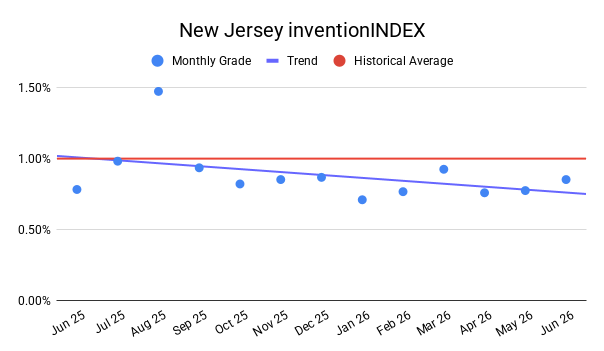
The performance of New Jersey’s R&D incentives is often measured by the "Invention Index," which tracks innovation output. As of November 2025, the New Jersey Invention Index score stood at 0.85%. While this indicates a "D grade" compared to historical highs of 1.47% in August 2025, it also signals a recovery from the critical lows seen in late 2024.
Policy experts suggest that the "D" rating reflects lingering pandemic effects, such as reduced workforces and limited lab capacities. However, the continued robustness of the R&D tax credit—particularly the ASC method and the NJEDA transfer program—is seen as a vital stabilizing force. The fact that survival rates for R&D credit recipients are double the industry average suggests that these tax incentives are functioning exactly as intended: as a financial bridge for innovators in a high-cost state.
Final Thoughts: Strategic Recommendations for Taxpayers
The Alternative Simplified Credit has matured into the "method of choice" for the majority of New Jersey’s innovation-driven companies. By providing a clear, three-year lookback period and removing the complexities of 1980s data, the ASC has democratized access to the R&D credit for startups and established tech firms alike.
For taxpayers to maximize the value of this credit, the following strategic actions are recommended:
- Verify Federal Election: Ensure that the federal R&D credit calculation method is optimized, as it dictates the state-level calculation.
- Leverage NJ Decoupling: Take advantage of the immediate Year 1 deduction for Section 174 expenses on the CBT return, even if those expenses are amortized for federal purposes.
- Evaluate Transferability: If the company is pre-revenue or unprofitable, initiate the NJEDA transfer application before the June deadline to monetize credits at 80%+ of their value.
- Audit Defense: Maintain a "Living Documentation" approach, capturing R&D activities in real-time rather than attempting to reconstruct them years later during an audit.
- Monitor Priority Fields: Confirm if the company’s activities fall under the "Priority Technology" categories to unlock the extended 15-year carryforward period.
By integrating these strategies into their broader tax planning, New Jersey businesses can effectively lower their cost of capital and maintain a competitive edge in one of the nation’s most vibrant research ecosystems. The ASC method, supported by the Division of Taxation’s updated guidance in TB-114, remains a powerful tool for converting scientific ingenuity into sustained corporate growth.