
MICHIGAN INVENTIONINDEX | DECEMBER 2025
December 2025: 1.49% (C+ grade)
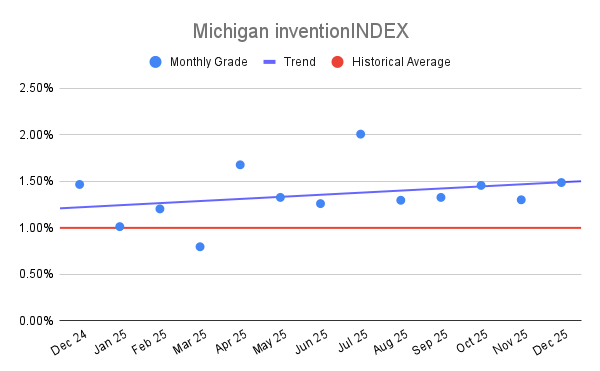
Michigan inventionINDEX December 2025: 1.49% (C+ grade)
The inventionINDEX measures innovation output by comparing GDP growth with patent production growth.
Anything over C grade is positive sentiment; anything under C is negative outlook/sentiment. Using that sentiment, it is possible to observe trends over time, and also compare states/countries. In doing so, we can predict which states have the best chance to recover economically from the pandemic (or any other economic incident that may occur).
Michigan inventionINDEX Scores – Last 12 months
| Month | inventionINDEX Score |
| December 2025 | 1.49% |
| Nov 25 | 1.30% |
| Oct 25 | 1.46% |
| Sep 25 | 1.33% |
| Aug 25 | 1.30% |
| Jul 25 | 2.01% |
| Jun 25 | 1.26% |
| May 25 | 1.33% |
| Apr 25 | 1.68% |
| Mar 25 | 0.80% |
| Feb 25 | 1.20% |
| Jan 25 | 1.01% |
| Dec 24 | 1.47% |
The December 2025 Michigan inventionINDEX score of 1.49% reflects a modest uptick from the previous month and signals a period of relative stability in the state’s innovation landscape. While this C+ rating indicates a respectable level of activity, it remains well below the historic highs observed in late 2023 and late 2024, when the index breached the 2.5% threshold. Compared to the broader sixty-month trajectory, the current score suggests that while the floor for innovation has risen significantly since the anomalous negative dip in July 2023, there is still considerable room for growth to return to the robust levels seen during peak periods of technological expansion.
Achieving higher grades, such as the A and B ratings seen periodically throughout the last five years, yields significant benefits for the regional economy. High scores typically correlate with increased patent filings, higher levels of venture capital investment, and a more vibrant ecosystem for startups. When the index moves toward the 3.0% range, as it did in September 2023, it serves as a powerful signal to global investors that Michigan is a leading hub for intellectual property development. This environment attracts top-tier talent and fosters a culture of continuous improvement, ensuring that the state remains competitive in an increasingly globalized and technology-driven marketplace.
Conversely, lower scores and grades carry negative implications that can hinder long-term prosperity. Periods marked by D or F ratings, such as the sharp decline observed in mid-2023, often indicate a stagnation in creative output or a lack of necessary resources for local inventors. A sustained low score can lead to a reduction in high-quality job creation and may cause the state to lose its brightest minds to more innovative regions. Furthermore, a decline in the inventionINDEX can discourage potential entrepreneurs from taking risks, creating a feedback loop where a lack of innovation leads to diminished economic interest, further depressing the index over time.
Looking ahead, the current 1.49% score positions Michigan at a crossroads where it has recovered from its lowest ebbs but has yet to recapture its full momentum. Maintaining a professional focus on the underlying factors that drive these scores will be essential for moving back into the A and B tiers. The historical data proves that the state is capable of reaching exceptional levels of inventive productivity, and the recent consistency throughout late 2025 suggests a solid foundation upon which to build. By analyzing these fluctuations, stakeholders can better understand the cyclical nature of innovation and implement strategies that encourage a more permanent upward trajectory for the state intellectual capital.
Discussion:
In December, the Michigan inventionINDEX scored a positive sentiment which was higher than the previous year’s average but underperformed the upward trend for the year. This is in contrast to the prior 12 months, which experienced a slight downward trend.
As the economy continues to stabilize in the post-pandemic era, it remains uncertain whether any backlog of applications still exists or if the department has returned to normal processing timelines. The inventionINDEX could also be affected by lingering consequences from the pandemic, such as company closures, reduced workforces, and limited R&D capabilities, which may still be impacting current operations.
Learn More:
Are you thinking of patenting any of your bright ideas? Did you know your research work could be eligible for the R&D Tax Credit and you can receive up to 14% back on your expenses? To find out more, please check out our free online eligibility test.
Swanson Reed’s Michigan office provides R&D tax credit consulting and advisory services to Detroit, Grand Rapids, Warren, Sterling Heights, Ann Arbor, Lansing, Flint, Dearborn, Livonia, Troy, Westland, Farmington Hills, Kalamazoo, Wyoming, Rochester Hills, Southfield, Taylor, Pontiac, St Clair Shores and Royal Oak.
Feel free to book a quick teleconference with one of R&D tax specialists if you would like to learn more about R&D tax credit opportunities.
Who We Are:
Swanson Reed is the largest Specialist R&D tax credit advisory firm in the United States. With offices nationwide, we are one of the only firms globally to exclusively provide R&D tax credit consulting services to our clients. We have been exclusively providing R&D tax credit claim preparation and audit compliance solutions for over 30 years.
Swanson Reed hosts daily free webinars and provides free IRS CE and CPE credits for CPAs. For more information please visit us at www.swansonreed.com/free-webinars or contact your usual Swanson Reed representative.
Are you eligible?

Why choose us?

Pass an Audit?

What is the R&D Tax Credit?
The Research & Experimentation Tax Credit (or R&D Tax Credit), is a general business tax credit under Internal Revenue Code section 41 for companies that incur research and development (R&D) costs in the United States. The credits are a tax incentive for performing qualified research in the United States, resulting in a credit to a tax return. For the first three years of R&D claims, 6% of the total qualified research expenses (QRE) form the gross credit. In the 4th year of claims and beyond, a base amount is calculated, and an adjusted expense line is multiplied times 14%. Click here to learn more.
Never miss a deadline again

Stay up to date on IRS processes

Discover R&D in your industry

R&D Tax Credit Preparation Services
Swanson Reed is one of the only companies in the United States to exclusively focus on R&D tax credit preparation. Swanson Reed provides state and federal R&D tax credit preparation and audit services to all 50 states.
If you have any questions or need further assistance, please call or email our CEO, Damian Smyth on (800) 986-4725.
Feel free to book a quick teleconference with one of our national R&D tax credit specialists at a time that is convenient for you.
R&D Tax Credit Audit Advisory Services
creditARMOR is a sophisticated R&D tax credit insurance and AI-driven risk management platform. It mitigates audit exposure by covering defense expenses, including CPA, tax attorney, and specialist consultant fees—delivering robust, compliant support for R&D credit claims. Click here for more information about R&D tax credit management and implementation.
Our Fees
Swanson Reed offers R&D tax credit preparation and audit services at our hourly rates of between $195 – $395 per hour. We are also able offer fixed fees and success fees in special circumstances. Learn more at https://www.swansonreed.com/about-us/research-tax-credit-consulting/our-fees/



Choose your state