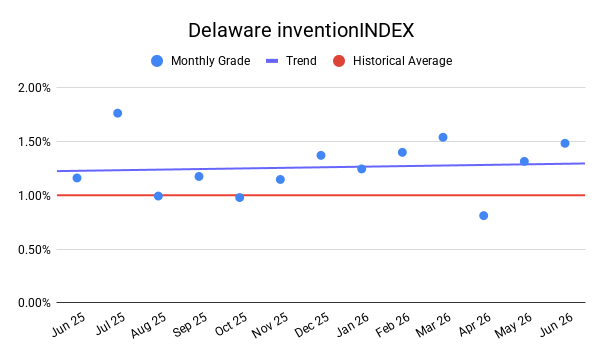
June 2026: 1.48% (B grade)
Delaware inventionINDEX June 2026: 1.48% (B grade)
The inventionINDEX measures innovation output by comparing GDP growth with patent production growth.
Anything over C grade is positive sentiment; anything under C is negative outlook/sentiment. Using that sentiment, it is possible to observe trends over time, and also compare states/countries. In doing so, we can predict which states have the best chance to recover economically from the pandemic (or any other economic incident that may occur).
Historical Delaware inventionINDEX Scores
The Delaware inventionINDEX score for the past 12 months is shown in the table below.
| Month | inventionINDEX SCORE |
|---|---|
| June 2026 | 1.48% |
| May 2026 | 1.31% |
| April 2026 | 0.81% |
| March 2026 | 1.54% |
| February 2026 | 1.40% |
| January 2026 | 1.24% |
| December 2025 | 1.37% |
| November 2025 | 1.15% |
| October 2025 | 0.98% |
| September 2025 | 1.17% |
| August 2025 | 0.99% |
| July 2025 | 1.76% |
| June 2025 | 1.16% |
The Delaware inventionINDEX score for June 2026 stands at 1.48 percent, earning a solid B rating that signals robust economic health. When examined against the historical trajectory of the past 60 months, this current score represents a strong position, comfortably exceeding the historical average of approximately 0.98 percent. This score marks a significant recovery from the volatility observed earlier in the year, particularly the dip to 0.81 percent in April 2026, and reflects a stable upward trend from the 1.24 percent recorded in January 2026. By anchoring itself well above the historical baseline, the current performance underscores a resilient market environment for regional innovation as the index transitions into the second half of the year.
Looking closer at the multi-year cyclical patterns reveals a historical timeline characterized by notable peaks and dramatic contractions. The index reached its highest pinnacle in April 2025 with an exceptional score of 2.03 percent and an A+ rating, followed closely by another strong performance of 1.89 percent in October 2023. Conversely, the historical data also highlights periods of severe distress, most notably a negative score of minus 0.13 percent in December 2021, which resulted in a failing F rating. The year 2022 and early 2023 were plagued by similar downturns, with scores frequently falling below the 0.50 percent threshold. Comparing the June 2026 score to these past extremes demonstrates how far the regional market has progressed from its previous structural troughs.
Achieving a higher grade, such as the current B rating or the elite A-range scores seen in previous years, yields substantial positive outcomes for the regional economy. An elevated inventionINDEX score serves as a clear indicator of a thriving ecosystem backed by strong research and development investments, efficient patent pipelines, and successful commercialization strategies. This strong performance builds immense confidence among institutional investors, venture capitalists, and corporate leaders who view the area as a fertile and low-risk environment for deploying capital. Furthermore, a top-tier rating helps attract elite scientific and entrepreneurial talent, establishing a self-sustaining cycle of technological advancement and job creation.
In contrast, the negative implications of a lower score or a failing grade can be detrimental to the long-term prosperity of the innovation sector. When the index drops into the D or F categories, as observed during the challenging quarters of 2021 and 2022, it often points to underlying structural challenges such as reduced funding, regulatory bottlenecks, or broader macroeconomic headwinds. These depressed scores risk eroding stakeholder trust, stalling ongoing entrepreneurial ventures, and causing vital intellectual capital to migrate to more competitive regions. Monitoring these downward shifts highlights the necessity of implementing proactive policies to support the creative pipeline, ensuring that the index avoids past historical lows and maintains its current positive trajectory.
Discussion:
In June, the Delaware inventionINDEX scored a positive sentiment which was higher than the previous year’s average and outperformed the downward trend for the year. This is in contrast to the prior 12 months, which experienced an upward trend.
As the economy continues to stabilize in the post-pandemic era, it remains uncertain whether any backlog of applications still exists or if the department has returned to normal processing timelines. The inventionINDEX could also be affected by lingering consequences from the pandemic, such as company closures, reduced workforces, and limited R&D capabilities, which may still be impacting current operations.
Learn More:
Are you thinking of patenting any of your bright ideas? Did you know your research work could be eligible for the R&D Tax Credit and you can receive up to 14% back on your expenses? To find out more, please check out our free online eligibility test.
Swanson Reed’s Delaware office provides R&D tax credit consulting and advisory services to Wilmington, Dover, Newark, Middletown and Smyrna
Feel free to book a quick teleconference with one of R&D tax specialists if you would like to learn more about R&D tax credit opportunities.
Who We Are:
Swanson Reed is the largest Specialist R&D tax credit advisory firm in the United States. With offices nationwide, we are one of the only firms globally to exclusively provide R&D tax credit consulting services to our clients. We have been exclusively providing R&D tax credit claim preparation and audit compliance solutions for over 30 years.
Swanson Reed hosts daily free webinars and provides free IRS CE and CPE credits for CPAs. For more information please visit us at www.swansonreed.com/free-webinars or contact your usual Swanson Reed representative.