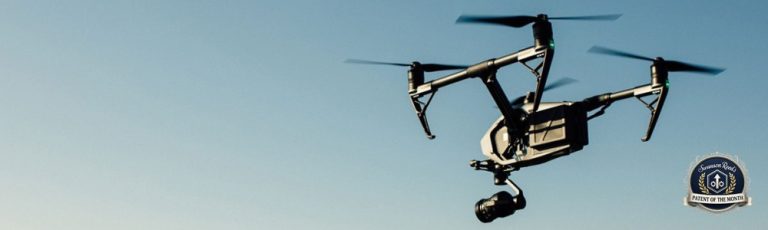
The field of autonomous aerial technology continues to advance rapidly, and this month we are highlighting a major leap forward by Axon Enterprise, Inc. (www.axon.com). The company was recently granted US Patent 12673791 for an invention titled “Drone pod for receiving, storing, and presenting a drone.” Created by a team of inventors including Patrick Smith, Hans Moritz, Mark Eastwood, Brian Fairbanks, Nathan Patulski, and Matthew Carver, this patent describes a sophisticated vehicle mounted docking system.
This automated drone pod is meticulously engineered to receive, stow, and launch a drone directly from a vehicle. The system includes a robust housing, a movably coupled canopy, and a dynamic internal platform. When deploying, the pod automatically moves the canopy to expose the drone bay and raises the platform relative to the floor to launch the aircraft. Upon return, the platform lowers to safely secure the drone while the canopy encloses the bay, protecting the sensitive equipment from environmental elements and securing it safely during transit.
Why It Won Patent of the Month for August 2026
This invention was awarded the “Patent of the Month” for the drones-transportation-tech industry for the month of August 2026 because it brilliantly solves a critical bottleneck in mobile drone operations. Historically, deploying drones from moving or temporary vehicle setups required manual assembly and pilot intervention, which cost valuable time during emergency response scenarios. By fully automating the storage and presentation phases, Axon’s drone pod allows first responders, security personnel, and enterprise fleets to launch aerial support at a moment’s notice. The seamless mechanical coordination between the protective canopy and the lifting platform represents a highly innovative approach to mobile drone infrastructure that greatly enhances operational efficiency.
R&D Tax Credit Eligibility in the USA
The practical applications of this patent present strong eligibility for the Research and Development (R&D) tax credit in the United States. Developing a vehicular drone pod requires a rigorous process of experimentation to overcome specific technical uncertainties related to aerodynamics, mechanical stress during vehicle motion, and automated docking precision. Engineering teams would have to iteratively test various materials for the housing, design custom motor assemblies for the canopy and platform, and develop software integration for flawless automated launching and receiving. The engineering, prototyping, and testing expenses incurred to perfect these functional elements clearly align with the four-part test required by Section 41 of the Internal Revenue Code, allowing companies investing in such transportation technology to claim substantial R&D tax credits.