The field of medical device design achieved a significant milestone with the official granting of U.S. Patent No. 12,648,869 for an Arm brace with adjustable permitted flexion. This groundbreaking invention was filed by Infusion Guardian LLC, an innovative medical technologies firm based out of Kailua, Hawaii. The newly patented device is designed to transform patient care by providing a highly customizable, mechanically secure method to restrict and regulate the range of motion at the elbow joint during critical recovery phases or specialized medical treatments.
According to the official patent documentation, the apparatus comprises an adjustable upper arm section and an adjustable lower arm section linked by a specialized stoppable hinge. This unique hinge incorporates a stop receiver engineered with precise slot detents, allowing a healthcare professional to insert a stopping tab at exact angular settings to manage permitted arm flexion. Furthermore, both the upper and lower arm sections can be adjusted from left to right to perfectly match the patient’s specific anatomy using an integrated ratchet mechanism. Because no active corporate website was identified for Infusion Guardian LLC during recent registry searches, the developer remains recognized under its official registration text as a premier emerging medical developer in the Pacific region.
Why the Invention is Exceptionally Innovative
The true innovation of this arm brace lies in its elegant solution to two long-standing problems in orthopedic bracing: precise range-of-motion control and universal anatomical adaptation. Traditional braces often rely on friction-based dials or complex external pins that can slip or require tedious tools to adjust. The stop receiver and slot-detent design patented by Infusion Guardian LLC ensures a positive mechanical lock. When the stopping tab is placed into a specific slot detent, it physically interacts with the edge of the hinge, eliminating any risk of slippage. This provides fail-safe protection against accidental over-flexion or over-extension, which is critical when safeguarding joint repairs or stabilizing an arm hosting an active intravenous line.
In tandem with the advanced hinge, the left-to-right ratchet mechanism represents a major engineering leap forward. Standard off-the-shelf braces frequently fail to accommodate variations in muscle bulk, swelling, or asymmetrical limb shapes, forcing clinics to rely on expensive custom-molded alternatives. The ratchet adjustments built directly into the upper and lower arm panels allow clinicians to widen or narrow the brace frame dynamically. This creates a secure, standardized system that offers custom-fit stability, maximizing compliance and minimizing patient discomfort during prolonged wear.
Hawaii State Patent of the Month: July 2026
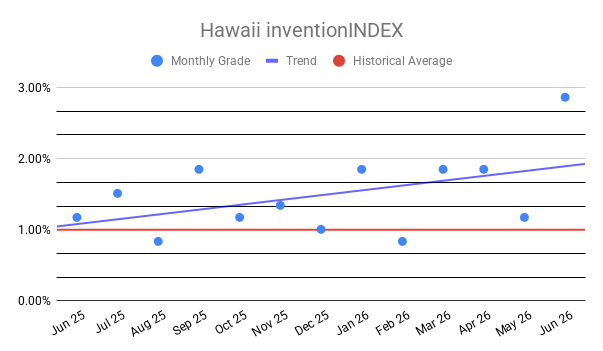
In recognition of its outstanding engineering and profound potential to enhance clinical outcomes, this device was awarded the prestigious Hawaii State Patent of the Month for July 2026. Granted early in the month on June 9, 2026, the patent stood out to state evaluators as an exemplary display of medical device innovation emerging directly from the Hawaiian Islands. Kailua-based Infusion Guardian LLC has demonstrated that cutting-edge biomedical development can thrive outside traditional continental tech hubs, bringing valuable intellectual property and prestige to the local technological landscape.
The committee honoring the invention noted that the device addresses an immediate, universal need in healthcare facilities worldwide. By mitigating the risks of device displacement and offering precise mechanical flexion boundaries, it directly supports safer patient mobility. This local recognition underscores Hawaii’s growing role in fostering high-value, impact-driven research and development that solves real-world medical challenges on a global scale.
U.S. R&D Tax Credit Eligibility and Practical Applications
To successfully leverage the practical applications of this patent for the United States Research and Development (R&D) Tax Credit under IRC Section 41, the engineering activities must fulfill a rigorous four-part framework. The development of the adjustable arm brace inherently satisfies these criteria through its systematic resolution of technical uncertainties. Specifically, the technical teams had to design, model, and iteratively prototype the mechanical tolerances of the slot-detent stop receiver to ensure it could withstand high physical stress without material failure. Evaluating alternative configurations for the left-to-right ratchet mechanism to guarantee smooth, multi-tiered structural scaling represents a clear process of experimentation. Furthermore, the work is fundamentally technical in nature, relying heavily on the principles of mechanical engineering, biomechanics, and material sciences to create an improved commercial business component. Consequently, expenses related to CAD modeling, stress-testing prototypes, evaluating material fatigue for the stopping tab, and conducting manufacturing trial runs are highly eligible to be claimed as qualified research expenses (QREs), allowing the company to recoup a substantial portion of its development expenditures.