The United States Patent and Trademark Office has officially granted patent number 12,629,560 to Skyhawke Technologies LLC, a prominent sports technology developer headquartered in Ridgeland, Mississippi. This major milestone protects their newly developed invention titled, “System and method for a golf super tag multifunction golf swing capture and analysis device.” Golf enthusiasts, instructors, and industry professionals can explore the company’s full ecosystem of training tools and tracking hardware by visiting their official website at skygolf.com.
This newly patented technology is designed to automatically capture, process, and analyze the intricate details of a golfer’s swing without requiring bulky external cameras or expensive launch monitors. By seamlessly attaching a lightweight, multi-sensor “Super Tag” to a golf club, the system delivers immediate, highly accurate feedback directly to a paired mobile device, setting a new standard for wearable sports analytics.
Why the Golf Super Tag Invention is So Innovative
The innovation behind patent 12,629,560 lies in its sophisticated integration of hardware, low-power processing, and spatial awareness algorithms. Traditional game-tracking devices often suffer from brief battery lives, manual input requirements, or inaccurate tracking. Skyhawke Technologies addresses these issues with several breakthrough features:
- Smart Light-Sensor Activation: To maximize battery efficiency, the device incorporates an integrated light sensor that dictates the processor’s wake-up state. When a club is resting inside a dark golf bag, the device remains in a deep sleep mode. The moment a player pulls the club into the light, the sensor triggers an automatic wake-up sequence, ensuring immediate readiness without manual power switches.
- Onboard Physics Engine: Instead of offloading raw data and taxing mobile device processors, the tag features an embedded processing unit that runs proprietary firmware algorithms. This internal physics engine instantly synthesizes data from an array of acceleration, rotation, and deceleration sensors to map out a precise, real-time 3D profile of the club’s motion dynamics.
- Automatic Club Identification: Each individual tag is encoded with a unique identification tag linked to a specific club description. Once awakened, this identity is transmitted back to the primary system memory or a paired smartphone, letting the application know precisely which club is in use at any given second.
- Magnetometer and Bearing Mapping: Utilizing an onboard magnetometer acting as a digital compass, the device can calculate a golfer’s intended bearing to a target on the course. By comparing this data to actual performance metrics and applying declination offset algorithms, the system generates and displays a highly detailed graphical overlay directly onto live course imagery.
- Anti-Rotation Mounting: To guarantee data integrity during high-speed impacts, the hardware features a rigid mounting mechanism designed explicitly to prevent the tag from rotating or shifting out of alignment on the club grip.
Why It Won Mississippi State Patent of the Month for June 2026
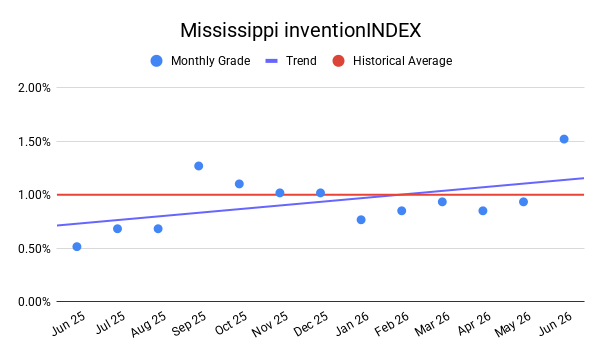
Skyhawke Technologies LLC has long been a crown jewel of the Mississippi technology sector, operating its globally recognized GameTraX 360 and SkyCaddie product lines out of Ridgeland. Following the official issuance of patent 12,629,560 in late May 2026, the invention was selected as Mississippi’s Patent of the Month for June 2026 due to its profound impact on consumer internet-of-things engineering and local economic prestige.
The award celebrates more than 15 years of continuous research and development conducted by Mississippi-based inventors Richard Root and Richard C. Edmonson. By bridging hard physical engineering with advanced mobile software, the project exemplifies the high-caliber tech innovation emerging from the state. It highlights how local engineering teams can successfully compete on a global stage, revolutionizing a multi-billion dollar sports market from right within the state borders.
U.S. Research and Development Tax Credit Eligibility
From an operational standpoint, the practical applications and technical developments required to bring this multi-sensor system to market represent ideal activities for the federal Research and Development (R&D) tax credit in the United States under Internal Revenue Code Section 41. To qualify for this lucrative incentive, a company’s activities must successfully satisfy a stringent four-part test. First, the project must possess a permitted purpose, which Skyhawke Technologies achieved by designing a completely new, lightweight hardware tag and an accompanying 3D swing-analysis software suite. Second, the engineering team had to eliminate severe technological uncertainty regarding how to accurately capture rapid club dynamics and orientation using micro-components without relying on external camera setups. Third, the firm engaged in a systematic process of experimentation, constructing numerous physical prototypes, evaluating different sensor combinations, calibrating the ambient light wake-up thresholds, and iteratively refining the firmware physics engine. Finally, the underlying research is fundamentally technological in nature, relying directly on principles of mechanical engineering, computer science, mathematics, and physics. Under this framework, qualified research expenses (QREs), including the wages of the software developers and hardware engineers, costs for testing materials, and cloud-simulation infrastructure expenses, can be utilized to claim substantial tax credits that offset federal liabilities.