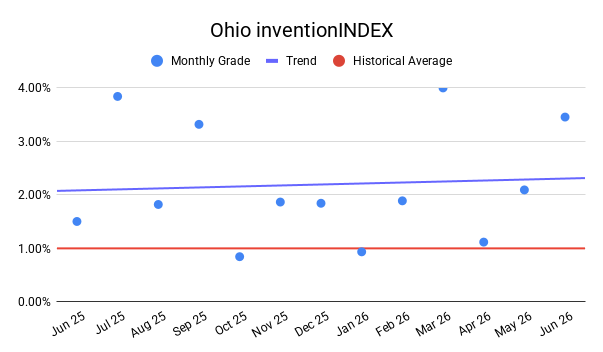
Each month, Swanson Reed recognizes outstanding innovation by granting the Patent of the Month award. For the month of September 2026, the Ohio state award goes to an impressive technological advancement in wearable mechanics and automated systems.
Company: Cincinnati Automation & Mechatronics LLC
Patent Number: 12696959
Title: Automatic retention apparatus
Why This Invention is Innovative
Wearable devices such as ski boots, prosthetics, and backpacks often require different levels of tightness depending on the user’s activity. A loose fit might be comfortable during periods of mild activity but can lead to a lack of control or safety risks during high-speed movements. The Automatic retention apparatus solves this problem by using sensors to monitor movement and environmental changes in real time. It features an integrated actuator and a rotating gear mechanism that automatically adjusts the tension of the wearable device many times per second. This eliminates the need for manual adjustments, ensuring an optimal, secure fit during intense physical exertion while relaxing the tension when the user is at rest.
Why It Won Patent of the Month
This invention was awarded the Swanson Reed Patent of the Month for Ohio state for the month of September 2026 because of its practical approach to automation in consumer and industrial products. Ohio has a deep history of manufacturing and mechanical development, and this patent represents an important step in integrating mechatronics with everyday wearables. By blending sensor technology, control logic, and mechanical actuators, the apparatus offers a reliable solution to a common physical challenge. It stands out for its potential to improve safety and comfort across a wide variety of applications, from sports equipment to medical orthotics without overstating its immediate market impact.
R&D Tax Credit Eligibility in the USA
The practical applications of this patent present excellent opportunities for companies to qualify for the Research and Development (R&D) tax credit in the USA. Integrating this automatic retention system into new products, such as smart orthotics or advanced athletic footwear, requires significant engineering effort. Companies would need to design custom control logic, experiment with sensor placement, and iteratively test prototypes to ensure the actuator responds accurately to sudden physical movements. These development activities directly aim to resolve technical uncertainties related to the system’s performance, durability, and integration. Because the process relies on the hard sciences and involves systematic trial and error, the associated costs for engineering wages, prototyping materials, and testing supplies would highly likely align with the eligibility criteria for the R&D tax credit.