The tech sector is buzzing following the official issuance of a pioneering patent to Bent Image Lab LLC. This newly unveiled intellectual property, titled “Real-time shared augmented reality experience,” outlines a unique infrastructure for collaborative spatial computing environments.
Registered as Patent Number 12,651,417, this breakthrough technology redefines how physical and virtual worlds intersect. By establishing a seamless bridge between local and remote users, the framework opens up new possibilities for multi-user interactions in immersive digital media.
Unpacking the Innovation
What makes this invention exceptionally innovative is its ability to unite users across disparate physical locations into a single, synchronized mixed-reality environment. Traditional augmented reality experiences require users to be co-located in the same physical room to share an interactive digital space. The architecture designed by Bent Image Lab overcomes this geographical restriction by coordinating two distinct groups of devices: on-site hardware and off-site hardware.
On-site devices capture real-world environments and overlay contextual data directly onto live video feeds. Simultaneously, off-site devices render a virtual counterpart, essentially a localized digital twin, of that exact physical location. The patent describes a sophisticated synchronization engine that updates environmental data in real time across all participating nodes. This ensures that a remote participant can interact with a virtual object and have that interaction accurately reflected on the screen of an on-site user with minimal spatial drift or lag.
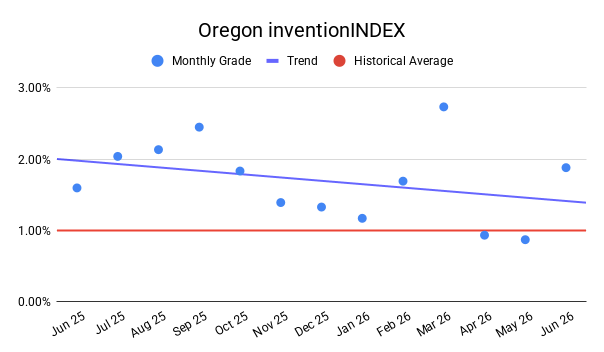
Oregon Patent of the Month for July 2026
Thanks to its profound technical merit and potential economic impact, this invention has been awarded the Oregon State Patent of the Month for July 2026. Headquartered in Portland, Oregon, Bent Image Lab has long been recognized as a powerhouse for creative animation, storytelling, and visual effects. This patent cements the studio’s transition into an advanced technology pioneer, highlighting Oregon’s expanding influence as a premier hub for spatial computing innovation.
The state selection committee honored the patent because it resolves a major bottleneck within the broader metaverse ecosystem: user isolation. Rather than forcing users into entirely artificial VR simulation bubbles or limiting AR interactivity to localized rooms, this framework bridges both formats. The committee praised the elegance of the synchronization pipeline, noting that its real-world implementation could fundamentally alter remote workforce collaboration, regional education programs, and interactive entertainment across the state and beyond.
U.S. R&D Tax Credit Eligibility
From a commercial perspective, businesses that actively develop, implement, or refine practical applications based on this patent framework may qualify for the federal Research and Development (R&D) Tax Credit under IRC Section 41. To meet the necessary four-part test, a company must demonstrate that its development activities are technological in nature, rely on computer science principles, and aim to eliminate technical uncertainty regarding a new or improved business component. For example, a software firm attempting to build a commercial application utilizing this synchronization model would inevitably face technical hurdles when engineering low-latency data pipelines to align disparate optical tracking data with remote 3D environmental meshes. The iterative process of programming custom computer vision algorithms, configuring cloud architecture to handle real-time synchronization, and running systematic simulation trials to minimize spatial drift qualifies as a process of experimentation, making the associated engineering wages, contractor costs, and supply expenses eligible for valuable tax incentives.