The industrial innovation ecosystem in Pennsylvania continues to hit new heights, highlighted by the latest recognition of a breakthrough automated technology. United States Patent No. 12,643,232, officially titled “System, apparatus, and method for improved location identification,” was granted on June 2, 2026, to Gecko Robotics, Inc. This newly issued patent establishes a novel framework designed to dramatically improve the localization tracking and operational data fidelity of inspection infrastructure components.
Invented by a collaborative engineering group consisting of Mayank Roy, Edward A. Bryner, Edwin H. Cho, Domenic P. Rodriguez, Benjamin A. Guise, Ryan Dickerhoff, Alberto Pinero, and Weston Bushyeager, the patented technology resolves a critical operational bottleneck. By deploying a combination of distinct position sensors coupled with an intelligent controller, the system computes highly accurate spatial descriptions for automated devices moving across varied surfaces. This precise location identification represents a major evolutionary step forward for automated non-destructive testing and asset management systems.
Why the Invention is So Innovative
The core innovation of Patent No. 12,643,232 lies in its advanced multi-sensor fusion architecture, which solves the pervasive challenge of tracking assets in GPS-denied or highly distorted industrial environments. Heavy-duty wall-climbing robots frequently operate deep inside steel boilers, storage tanks, and pressure vessels where satellite positioning signals cannot penetrate, and where magnetic anomalies or surface slippage can render standard wheel odometry highly unreliable. This invention overcomes these limitations by integrating a first position sensor and a second position sensor to provide independent position values, which are then evaluated and synchronized by a specialized controller to synthesize a highly accurate, real-time position description. This structural redundancy and computational refinement allow the robot to maintain an exact tracking path, ensuring that non-destructive testing sensors (such as ultrasonic or electromagnetic probes) log structural defects at their exact physical coordinates. Ultimately, this enables true predictive maintenance, allowing plant managers to monitor localized corrosion or pitting over multi-year intervals without the risk of spatial misalignment errors.
Winning Pennsylvania Patent of the Month for July 2026
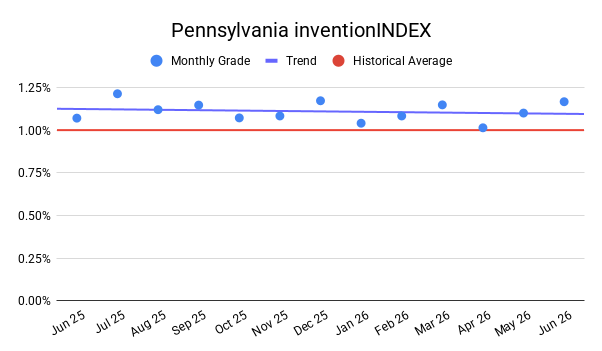
Because of its transformative impact on infrastructure reliability and workplace safety, this invention proudly secured the prestigious “Patent of the Month” award for the State of Pennsylvania in July 2026. Headquartered in Pittsburgh, Gecko Robotics represents the cutting edge of the state’s rapidly expanding advanced technology and robotics corridor. The award committee highlighted how this invention directly addresses critical national infrastructure vulnerabilities, allowing heavy industries like power generation, oil and gas, manufacturing, and defense to inspect hazardous assets without risking human lives in confined spaces. By providing a reliable, automated alternative to manual scaffolding inspections, the technology minimizes catastrophic failure risks and optimizes operational uptime across the commonwealth and beyond. This recognition celebrates the company’s technical excellence and solidifies Pennsylvania’s reputation as a premier global hub for meaningful, industrial-scale artificial intelligence and robotics breakthroughs.
U.S. R&D Tax Credit Eligibility and Practical Applications
The practical development and deployment of this multi-sensor positioning system provide a textbook scenario for claiming the United States Research and Development (R&D) Tax Credit under IRC Section 41. To qualify for this federal incentive, a company’s activities must fulfill the statutory Four-Part Test. First, the practical application of building an improved robotic location identification system satisfies the permitted purpose test by creating a brand-new, high-performance physical business component. Second, the development process directly addressed technical uncertainty regarding how to synthesize asynchronous data streams into sub-centimeter positioning coordinates without cumulative drift errors on vertical steel walls. Third, the engineering team systematically utilized a process of experimentation, deploying physical prototyping, simulation models, and iterative field testing to evaluate different sensor configurations and firmware control loops. Fourth, the work is fundamentally technological in nature, relying on principles of mechanical engineering, data science, and robotic sensor physics. As a result, the qualified research expenses associated with this project, including the wages of the engineering team, prototype fabrication costs, and testing supplies, are fully eligible to secure valuable R&D tax credits.