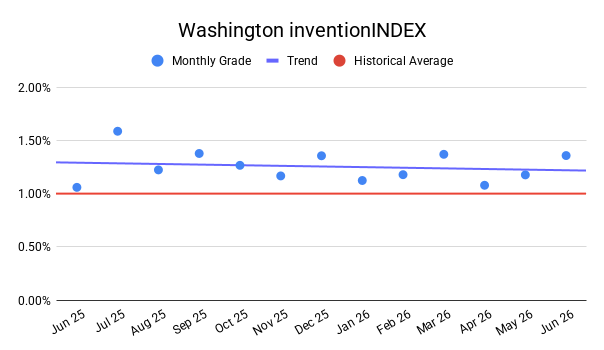
Lucomm Technologies, Inc. Wins Washington State Patent of the Month for June 2026 with Revolutionary Semantic Robotic Device System
The United States Patent and Trademark Office (USPTO) has officially granted a groundbreaking new patent to Lucomm Technologies, Inc., a pioneering technology firm based in Bellevue, Washington. Registered under patent number 12617080, the company’s newly protected asset is titled “Semantic robotic device system” and represents a massive leap forward in autonomous edge computing and artificial intelligence orchestration.
This innovative system is designed to fundamentally change how intelligent hardware interacts with complex environments by utilizing a semantic operating environment. At its core, the invention stores specific semantic goals and semantic profiles containing semantic artifacts, enabling an integrated processor to dynamically infer future behavioral actions through a mechanism known as affirmative semantic resonance.
Why the Invention is So Innovative
Traditional robotic systems rely heavily on brute-force machine learning models or rigid, pre-programmed logic paths that require immense computational overhead. The “Semantic robotic device system” developed by Lucomm Technologies flips this paradigm by introducing semantic factorizations and contextual intelligence directly at the edge. By evaluating “semantic artifacts” within predefined profiles, the system establishes an affirmative semantic resonance to dramatically reduce operational entropy. Furthermore, the processor generates optimized thin client presentation data representing these complex semantic relationships across distinct identities. This data is then transmitted to remote devices via an onboard transceiver, allowing powerful, real-time automation and cognitive execution without bogged-down, on-device computing hardware.
Washington State Patent of the Month: June 2026
Lucomm Technologies secured the prestigious Washington State Patent of the Month honors for June 2026 due to the sheer scalability and immediate disruptive potential of this architecture. Granted on May 5, 2026, this patent solves a massive bottleneck in the robotics industry: the high computational cost and latent response times of cloud-dependent AI. By shifting the focus to a composable semantic operating system, Washington’s tech sector celebrates a foundational asset that paves the way for advanced automation in logistics, healthcare, retail, and manufacturing. The state’s evaluation committee highlighted the framework’s unique ability to harmonize multi-device collaboration while maintaining ironclad data security via localized semantic routing, establishing Lucomm as a frontrunner in the next generation of industrial automation.
U.S. R&D Tax Credit Eligibility for Practical Applications
The practical integration and deployment of this semantic robotic device system qualify heavily for the United States Research and Development (R&D) Tax Credit under Internal Revenue Code Section 41. To successfully capture these significant tax incentives, companies utilizing or expanding upon Lucomm’s patent must satisfy a strict four-part test. First, the application must have a permissible purpose, aimed at creating or improving the performance, reliability, or quality of a commercial business component, such as an advanced warehouse fulfillment robot or an automated hospital navigation system. Second, the development process must eliminate technical uncertainty regarding the optimal software design and architectural capabilities required to calculate semantic drift and entropy in real time. Third, the engineering workflow must incorporate a structured process of experimentation, involving rigorous simulation, iterative software coding, and transceiver baseline benchmarking. Finally, the research must be technological in nature, relying explicitly on the core principles of computer science, data architecture, and electrical engineering. By documenting these structured software engineering pipelines and operational trials, businesses can confidently claim qualified research expenses, including specialized engineer wages and cloud-based testing configurations, to achieve substantial tax relief.