

Vermont R&D Tax Credit Overview
The Vermont Research and Development Tax Credit provides financial incentives for businesses conducting qualified research within the state. Governed by V.S.A. Title 32, Chapter 151, § 5930ii, the credit is generally equal to 27% of the federal tax credit allowed for expenditures made in Vermont. It applies to C-Corporations, S-Corporations, LLCs, and partnerships, offering a 10-year carryforward period for unused nonrefundable credits.
| Glossary Term | Definition |
|---|---|
| Research and Development Tax Credit | State tax incentive designed to encourage businesses to invest in technical innovation within Vermont. |
| V.S.A. Title 32, Chapter 151, § 5930ii | The specific Vermont statute providing the legal authority and framework for the R&D tax credit. |
| Eligible Research and Development Expenditures | Costs incurred for research activities conducted in Vermont that qualify for the tax credit calculation. |
| Qualified Research Expenses (QREs) | Specific eligible costs, including wages, supplies, and contract research, used to calculate the credit. |
| Internal Revenue Code Section 41 (IRC § 41) | Federal tax code section defining qualified research, which Vermont adopts as the basis for eligibility. |
| Federal Tax Credit Allowed (IRC § 41(a)) | The amount of federal R&D credit generated, which serves as the baseline for the Vermont credit. |
| Taxpayer of This State | An individual or entity subject to Vermont income tax and eligible to claim the credit. |
| Tax Imposed Under This Chapter (Income Taxes) | Vermont state income taxes against which the Research and Development Tax Credit can be applied. |
| Nonrefundable Tax Credit | A credit that can reduce tax liability to zero but cannot result in a cash refund. |
| Credit Carryforward | The ability to apply unused tax credits from the current year to future tax years. |
| Ten (10) Year Carryforward Period | The specific duration (10 years) that unused Vermont R&D credits remain valid for future use. |
| Credit Amount (27% of Federal Credit) | The Vermont credit value, calculated as 27 percent of the allowed federal research tax credit. |
| Apportionment (QREs Made Within This State) | Allocating the credit based on the portion of qualified research expenses incurred specifically within Vermont. |
| Activities Conducted in the State of Vermont | Research work physically performed within Vermont borders, a requirement for claiming the state credit. |
| Taxable Year | The fiscal or calendar year for which the tax return is filed and credits claimed. |
| Department of Taxes | The Vermont state agency responsible for administering tax laws and processing R&D credit claims. |
| Publication of Claimant Names | State requirement to publicly list the names of taxpayers who claim the R&D tax credit. |
| Annual Publication of List | The yearly release of a report by the Department of Taxes identifying R&D credit beneficiaries. |
| Calendar Year (for Publication) | The 12-month period used for compiling and reporting the list of tax credit claimants. |
| C-Corporations (Eligible Entities) | Standard corporations that are subject to double taxation but eligible to claim Vermont R&D credits. |
| S-Corporations (Eligible Entities) | Pass-through entities where income and credits flow to shareholders to avoid corporate-level taxation. |
| LLCs (Eligible Entities) | Limited Liability Companies that can pass R&D tax credits through to their members or owners. |
| Partnerships (Eligible Entities) | Business structures where partners share profits, losses, and tax credits, including the R&D credit. |
| Individual Income Tax (Applicable Tax) | Personal income tax liability against which pass-through R&D credits can be applied by owners. |
| Corporate Income Tax (Applicable Tax) | Tax levied on corporate profits which can be reduced by the Vermont R&D tax credit. |
| Pass-through Entities (Credit Allocation) | Entities that distribute income and tax credits to owners rather than paying tax directly. |
| Form BA-404 (Tax Credits Earned, Applied, Expired, and Carried Forward) | The specific Vermont tax form used to report and track business income tax credits. |
| Form IN-119 (Nonrefundable Credits for Individuals) | The form used by individuals to claim their share of nonrefundable credits from pass-through entities. |
| Claim Period Qualified R&D Expenses | The specific timeframe during which eligible research expenses were incurred for the tax claim. |
| In-house Research Expenses | Internal costs for R&D, such as employee wages and supplies used directly in research. |
| Contract Research Expenses | Payments made to third parties (contractors) to perform qualified research on behalf of the taxpayer. |
| Wages for Qualified Services | Salaries paid to employees for performing, supervising, or supporting qualified research activities. |
| Supplies Used in the Conduct of Qualified Research | Tangible property (excluding land/depreciable assets) consumed during the research and experimentation process. |
| Qualified Services (Conducting/Supervising/Supporting Research) | Direct research work, direct supervision, or direct support of research activities eligible for the credit. |
| Qualified Research (Four-Part Test) | Research meeting IRS criteria: permitted purpose, technological nature, elimination of uncertainty, and process of experimentation. |
| Permitted Purpose (New/Improved Business Component) | Research intended to create a new or improve an existing product, process, or software. |
| Elimination of Uncertainty | Research aimed at discovering information to resolve technical uncertainty regarding capability, method, or design. |
| Process of Experimentation | A systematic evaluation of alternatives to eliminate technical uncertainty and achieve a result. |
| Technological in Nature | Research relying on principles of hard sciences like engineering, physics, biology, or computer science. |
| Business Component | Any product, process, software, technique, formula, or invention held for sale, lease, or license. |
| New or Improved Business Component | A business component whose performance, reliability, or quality is enhanced through research activities. |
| Physical or Biological Sciences | Fields of science (physics, chemistry, biology) that must underpin the research for it to qualify. |
| Engineering or Computer Science | Technical disciplines often involved in qualified research for software or hardware development. |
| Research After Commercial Production (Exclusion) | Activities occurring after a product is ready for commercial use, which are excluded from qualification. |
| Adaptation of Existing Business Component (Exclusion) | Modifying an existing product for a specific customer's need, which does not qualify as research. |
| Duplication of Existing Business Component (Exclusion) | Reverse engineering or reproducing an existing product, which is excluded from the R&D tax credit. |
| Social Sciences, Arts, or Humanities (Exclusion) | Research in non-technical fields like economics or sociology, which is ineligible for the R&D credit. |
| Funded Research (Exclusion) | Research paid for by another party (grant or contract) where the taxpayer retains no rights/risk. |
| Property Subject to Depreciation (Exclusion from Supplies) | Capital assets like machinery or buildings whose costs cannot be claimed as supply expenses. |
| Government-Funded Research (Exclusion) | Research activities funded by any government entity, which are excluded from eligible credit calculations. |
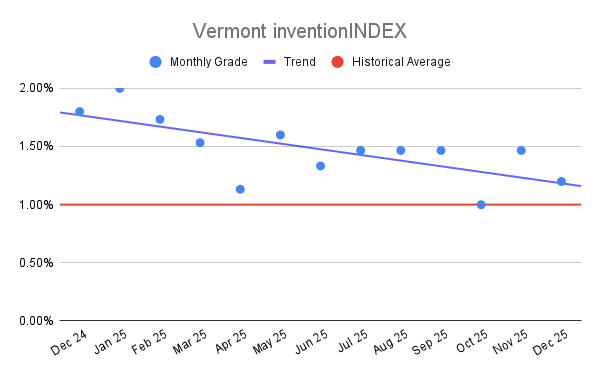 Vermont inventionINDEX December 2025:
  Vermont inventionINDEX November
