

What is the Adaptation Exclusion in the Vermont R&D Tax Credit?
The adaptation of an existing business component exclusion is a statutory provision that disqualifies tax credit claims for activities that merely modify or customize products to meet specific customer requirements without resolving new technical uncertainties. For Vermont taxpayers, this ensures that the 27 percent state-level incentive is reserved for projects necessitating a genuine process of experimentation, rather than routine engineering or customization. This exclusion aligns with Federal IRC § 41 standards, requiring businesses to demonstrate that they faced unresolved engineering challenges beyond standard practice.
The adaptation of an existing business component exclusion serves as a statutory barrier preventing tax credit claims for activities that merely modify or customize products to meet specific customer requirements without resolving new technical uncertainties. Within the Vermont tax system, this federal exclusion ensures that routine engineering, no matter how complex the specifications, is disqualified from the significant 27 percent state-level incentive unless it necessitates a genuine process of experimentation.
The broader analysis of this exclusion requires a multi-layered understanding of how Vermont’s tax code, specifically 32 V.S.A. § 5930ii, interacts with Internal Revenue Code (IRC) Section 41. Vermont provides one of the most competitive research incentives in the United States by offering a nonrefundable credit equal to 27 percent of the federal credit amount attributable to qualified research expenditures (QREs) conducted within the state’s borders. However, because the Vermont credit is strictly a “piggyback” incentive, its definition of what constitutes “qualified research” is entirely dependent on the federal four-part test and the eight statutory exclusions outlined in IRC § 41(d)(4). The adaptation exclusion, located at IRC § 41(d)(4)(B), represents a particularly contentious area of compliance for Vermont manufacturers, software developers, and engineering firms who frequently perform work for specific clients. For these taxpayers, the challenge lies in documenting that their development efforts involved more than “routine customization” and actually addressed technical uncertainties regarding the capability, methodology, or appropriate design of a business component.
Legislative and Statutory Framework of the Vermont Research and Development Tax Credit
The Vermont Research and Development Tax Credit was authorized under 32 V.S.A. § 5930ii to incentivize local innovation and support high-wage employment in the technology and manufacturing sectors. The state’s commitment to this program is reflected in the high prorated rate, which ranks among the top in the nation, and the generous 10-year carryforward period that allows businesses to utilize credits against future income tax liabilities even during periods of low profitability or high reinvestment.
Evolution of the Credit and State Conformity
Vermont’s R&D credit has undergone various adjustments since its inception to balance fiscal responsibility with economic competitiveness. Historically, the credit was set at 30 percent of the federal amount, but for tax years beginning on or after January 1, 2014, the rate was reduced to 27 percent. Despite this reduction, the mechanism remains a pure conformity model where the eligibility is determined by federal standards. This means that the Vermont Department of Taxes does not create its own definitions for research; instead, it relies on the IRS and the Treasury Department’s interpretations of “qualified research”.
The dependency on federal standards is explicitly stated in the filing instructions for Schedule BA-404, the form used to claim the credit. Taxpayers are required to first claim the federal R&D tax credit under IRC § 41 before they are eligible for the Vermont counterpart. This “locked” relationship ensures that any activity excluded at the federal level, such as the adaptation of an existing business component, is automatically disqualified for Vermont tax purposes.
Financial and Administrative Metrics of the Vermont Incentive
The Vermont incentive is nonrefundable, meaning it can only be applied to reduce an existing tax liability rather than resulting in a direct payment from the state. It applies broadly to personal income, business, or corporate income tax, making it accessible to a wide range of entity types, including C-corporations, S-corporations, and LLCs.
| Feature | Vermont R&D Tax Credit Specification | Reference Source |
|---|---|---|
| Credit Rate | 27% of the federal credit for Vermont-based QREs | 1 |
| Carryforward | 10 years for unused portions | 1 |
| Refundability | Nonrefundable; applies to income tax only | 1 |
| Eligibility Gate | Must first claim the federal credit under IRC § 41 | 3 |
| Calculation Method | Hypothetical federal credit on Vermont-only data | 1 |
The Four-Part Test as the Prerequisite for Avoiding Exclusion
Before analyzing the adaptation exclusion, one must understand the “Four-Part Test” that all activities must satisfy to be considered qualified research. The adaptation exclusion only becomes relevant if the activities theoretically meet these four criteria. The Department of Taxes and the IRS use these tests to determine if an activity is truly “innovative” or merely “business as usual”.
The Section 174 Test: Elimination of Uncertainty
The first requirement is that the expenditures must be eligible for treatment as expenses under IRC § 174. This means the activities must be intended to discover information that would eliminate uncertainty concerning the development or improvement of a product. Uncertainty exists if the information available to the taxpayer does not establish the capability or methodology for developing or improving the product, or its appropriate design.
In the context of adaptation, if a Vermont engineer is modifying an existing design and already knows the methodology and capability to do so—even if the work is difficult—the “uncertainty” requirement is not met, and the project fails the first test.
The Technological Information Test
The research must be undertaken for the purpose of discovering information which is “technological in nature”. This means the process of experimentation must fundamentally rely on principles of the physical or biological sciences, engineering, or computer science. Vermont guidance emphasizes that activities intended for “aesthetic” or “cosmetic” purposes are never technological in nature.
The Business Component Test
The taxpayer must intend to apply the information being discovered to develop a new or improved “business component” of the taxpayer. A business component is defined as any product, process, computer software, technique, formula, or invention to be held for sale, lease, license, or used in the taxpayer’s trade or business. The adaptation exclusion specifically targets this test, as it asks whether the “new” business component is truly new or merely an adaptation of an “existing” one.
The Process of Experimentation Test
Substantially all of the activities (meaning at least 80 percent) must constitute elements of a process of experimentation. This involves a systematic process designed to evaluate one or more alternatives to achieve a result where the appropriate design is uncertain at the beginning of the research. The adaptation exclusion is often triggered when a taxpayer’s activities are seen as “routine configuration” rather than an evaluative process of trial and error.
Deep Analysis of the Adaptation Exclusion: IRC § 41(d)(4)(B)
The adaptation of existing business component exclusion states that the term “qualified research” does not include any research related to the adaptation of an existing business component to a particular customer’s requirement or need. This provision is designed to filter out the high volume of engineering work that businesses perform as a service to their clients which, while technically demanding, does not advance the state of technology or resolve fundamental uncertainties.
Defining “Adaptation” versus “Innovation”
The core of the adaptation exclusion is the distinction between modifying an existing product and developing a new or improved one. Treasury Regulation § 1.41-4(c)(3) provides that the exclusion applies to activities relating to adapting an existing business component to a particular customer’s requirement or need. Crucially, the regulations clarify that the exclusion does not apply solely because a business component is intended for a specific customer.
For example, if a Vermont-based aerospace company designs a completely new turbine engine specifically for one aircraft manufacturer, the fact that there is only one customer does not trigger the adaptation exclusion. However, if the company takes an existing engine and simply changes the mounting brackets to fit that customer’s aircraft, that activity is likely excluded as a mere adaptation.
Technical Risk and the Failure to Experiment
The presence of technical risk—the possibility that the development objectives may not be achieved—is a strong indicator that an activity is not merely an adaptation. If a project involves customization that can be accomplished using known materials, methods, and designs that the company has regularly used in the past, the level of technical uncertainty is considered insufficient. Vermont revenue office guidance, mirroring federal standards, looks for evidence of “unresolved engineering challenges” rather than “site-specific modifications”.
The Preamble of T.D. 9104 and Regulatory Interpretation
The IRS and the Treasury Department have stated that the adaptation exclusion does not cover research activities that otherwise satisfy the general requirements for qualified research. This interpretation suggests that the exclusion is a “safety net” to catch activities that might seem like research but are actually just “application engineering”.
For Vermont taxpayers, this means that the burden of proof is on the business to show that the customer’s request required them to enter a “state of uncertainty”. If the company can prove it had to perform a process of experimentation to meet the customer’s needs, the adaptation exclusion is generally overcome.
Local State Revenue Office Guidance and Vermont-Specific Rules
The Vermont Department of Taxes provides several layers of guidance that clarify how the R&D tax credit and its exclusions are applied. This guidance ranges from formal statutes to instructional documents and public reports.
Schedule BA-404 and the Recomputed Credit
The primary guidance for claiming the credit is the instructions for Schedule BA-404. Because Vermont only allows the credit for activities performed “within Vermont,” taxpayers with multi-state operations must perform a “hypothetical federal credit” calculation.
The Department requires taxpayers to:
- Identify all Vermont-sourced QREs (wages, supplies, and contract research).
- Adjust the expenditure amount downward if any grants or public assistance were received for the project.
- Compute a hypothetical federal credit using only the Vermont-apportioned QREs.
- Apply the 27 percent state multiplier to this hypothetical amount.
This recomputation process is a critical audit point. If a Vermont auditor finds that a project included in the hypothetical calculation was actually an “adaptation” of an existing business component, the entire credit amount for that project will be disallowed, and the state credit will be reduced accordingly.
Transparency and Public Reporting (Act 73)
Vermont is unique in its requirement that the Department of Taxes publish an annual report of all companies claiming the R&D tax credit. This report, known as RP-1298, lists the names of claimants and is intended to promote public oversight. For taxpayers, this transparency emphasizes the need for accurate documentation. If a company is publicly listed as claiming a million-dollar credit for activities that are subsequently determined to be non-qualifying “adaptations,” it creates significant compliance and reputational risk.
Interaction with the Enterprise Zone Program
In addition to the general R&D credit, Vermont has specialized rules for businesses in Enterprise Zones. These businesses may be eligible for credits if they advance knowledge or improve processes within designated areas. The guidance for this program specifically excludes “customer-specific costs” from the definition of eligible expenses, which is a direct application of the adaptation exclusion at the state policy level.
| Vermont Guidance Document | Key Compliance Information | Reference Source |
|---|---|---|
| Schedule BA-404 Instructions | Requirements for recomputed credit and in-state proration | 1 |
| RP-1298 Annual Report | Public disclosure of all R&D credit claimants | 1 |
| Enterprise Zone Guidelines | Explicit exclusion of “customer-specific costs” | 25 |
| 32 V.S.A. § 5930ii | Statutory authority and 27% rate mandate | 1 |
| Form CO-411 Instructions | Linkage between corporate returns and R&D credits | 11 |
Judicial Precedents and Case Law Analysis
Because Vermont follows federal law, judicial decisions from the U.S. Tax Court and Federal Circuit Courts provide the most nuanced understanding of the adaptation exclusion. These cases serve as the “road map” for Vermont auditors when they examine a taxpayer’s claim.
Betz v. Commissioner: The “Exact Copy” Rule
In Betz v. Commissioner (T.C. Memo. 2023-84), the court analyzed a company that designed and manufactured air pollution control systems. The court held that costs associated with one project were excluded under the adaptation exclusion because the systems were “exact copies” of previous designs with only “minor, site-specific modifications”.
The court’s reasoning in Betz is a warning to Vermont manufacturers: if you are simply resizing a machine to fit a customer’s factory floor, you are “adapting” an existing component, not creating a new one. The existence of technical uncertainty requiring investigative activities to resolve is the “critical factor” for demonstrating that development is not a mere adaptation.
Trinity Industries, Inc. v. United States: Refinement of Preliminary Designs
The Trinity Industries case established that the adaptation exclusion applies when a taxpayer performs a “refinement of a preliminary design” provided by the customer. If the customer does most of the “thinking” and the taxpayer merely performs the “doing,” the activity is an adaptation.
For Vermont engineering firms, this means that work performed under a “Build-to-Print” contract, where the customer provides detailed specifications and blueprints, is almost certainly excluded under IRC § 41(d)(4)(B). To qualify, the taxpayer must demonstrate that they had to create the “capability, methodology, or appropriate design” that did not previously exist.
Grigsby v. United States: Defining the Business Component
The recent decision in Grigsby emphasizes the need for taxpayers to clearly define the “business component” at the outset of the research. If the taxpayer fails to identify a specific, new business component and instead groups all customer work into a single broad category, the IRS (and the Vermont Department of Taxes) will likely apply the adaptation exclusion to the entire group. This underscores the importance of the “shrinking-back” rule, which allows a taxpayer to salvage a claim by focusing on a specific sub-component that meets the tests even if the overall product is an adaptation.
The Shrinking-Back Rule: A Strategy for Overcoming Adaptation Exclusions
The “shrinking-back” rule, found in Treasury Regulation § 1.41-4(b)(2), is the most powerful tool for Vermont taxpayers facing an adaptation challenge. It provides that if the requirements for qualified research cannot be satisfied when applied at the level of the entire product (the discrete business component), the tests should be applied to the “most significant subset of elements” of that product.
Mechanism of the Shrinking-Back Rule
The process involves “shrinking back” the analysis from the final product to its constituent parts—sub-assemblies, components, or even the most basic elements—until a part is reached that satisfies the four-part test.
In an adaptation context, this works as follows:
- Level 1 (The Full Product): A Vermont custom machine shop builds a new assembly line for a client. Because the line is based on an existing design but sized for the client’s facility, it is an “adaptation” at the product level.
- Level 2 (The Sub-Component): To make the line work, the shop has to develop a new, high-speed robotic arm with a unique vacuum-sealing mechanism that the shop has never built before.
- Application: Even though the assembly line itself is excluded as an adaptation, the research activities related to the new robotic arm can be “shrunk back” and claimed as qualified research.
Importance for Vermont Manufacturers
Many Vermont businesses operate as “specialty” manufacturers where every project is for a specific customer. Without the shrinking-back rule, almost all of their work would be disqualified by the adaptation exclusion. By meticulously documenting the specific “technically uncertain” components of a larger customer project, these firms can safely claim the R&D credit while complying with Vermont revenue office guidance.
Mathematical Modeling and Calculation of the Vermont Credit
The Vermont R&D tax credit is calculated using a specific methodology that accounts for the state’s high 27 percent rate and its strict “in-state” requirement. For multi-state taxpayers, the calculation involves a “Vermont-only” hypothetical federal credit.
The Basic Formula
The state credit (CVT) is a function of the federal credit (CFED) as applied to Vermont QREs:
$$C_{VT} = 0.27 \times C_{FED(VT-Only)}$$
Where CFED(VT-Only) is the amount of federal credit that would be allowed if the taxpayer only had Vermont expenditures.
The Role of the Base Amount
Under the Regular Research Credit method, the credit is 20 percent of the excess of QREs over a “base amount”. Vermont requires the use of a Vermont-specific base amount.
For a taxpayer with history in Vermont:
- Fixed-Base Percentage: (Sum of prior 4 years VT QREs) / (Sum of prior 4 years VT Gross Receipts).
- Base Amount: (Fixed-Base %) $\times$ (Average VT Gross Receipts for prior 4 years).
- Minimum Base: The base amount cannot be less than 50 percent of the current year’s QREs.
The Impact of Disallowed Adaptation Costs
If a Vermont auditor identifies $100,000 in wages that are deemed “adaptation” of an existing business component, those wages are removed from the current year’s Vermont QREs.
The impact on the credit (CVT) would be:
$$\Delta C_{VT} = 0.27 \times [0.20 \times 100,000] = 5,400$$
This formula shows that for every $100,000 in costs excluded as “adaptation,” a Vermont taxpayer loses $5,400 in state tax credits, plus the associated federal tax credit loss (which is significantly higher).
Sector-Specific Application of the Adaptation Exclusion in Vermont
Vermont’s diverse economy means the adaptation exclusion is applied differently depending on the industry. The Department of Taxes looks for specific indicators of “adaptation” versus “innovation” in each sector.
Manufacturing and Industrial Machinery
In the manufacturing hub of Burlington and the surrounding counties, companies often perform “custom engineering” for global clients. The adaptation exclusion is the primary hurdle for these firms.
Guidance for Manufacturers:
- Excluded: Adjusting layouts, sizing machinery for a specific factory, utilizing different materials that the company regularly works with, and cosmetic changes.
- Qualified: Developing new functionalities, improving performance specifications beyond standard limits, and enhancing reliability in extreme environments that were not previously addressed.
Software and Cloud Computing
Vermont’s growing tech sector frequently deals with “software customization”. Treasury Example 3 explicitly excludes customizing a general ledger platform for a specific customer.
Guidance for Software Firms:
- Excluded: Modifying data fields, configuring existing modules, and creating new report formats for a client.
- Qualified: Solving technical problems related to data throughput at scale, developing new algorithms for predictive analytics, and integrating disparately coded systems where the interface design is uncertain.
Agriculture and Biotechnology
In agriculture, R&D credits are used for developing drought-resistant crops or new biotech formulations.
Guidance for Ag-Firms:
- Excluded: Standard planting using proven techniques, even if the crop is for a specific customer’s unique need.
- Qualified: Engineering new varieties with extended shelf life or analyzing how biochar amendments affect microbial activity in specific soil cycles over multiple years.
Documentation and Defense Against the Adaptation Exclusion
To sustain a claim for the Vermont R&D tax credit, a taxpayer must be able to prove that their project was not an adaptation of an existing business component. Documentation should be “contemporaneous,” meaning it was created during the time the research was performed.
Essential Documentation Elements
The Vermont Department of Taxes, following IRS audit techniques, expects a taxpayer to provide a “nexus” between their expenses and the research activities.
- Project Description: A clear statement of the new or improved business component and why it is distinct from existing components.
- Uncertainty Log: Records identifying the technical uncertainties (capability, method, or design) that existed at the start of the project.
- Alternative Analysis: Evidence that the taxpayer evaluated more than one alternative, such as design reviews, modeling results, or failed prototype tests.
- Scientific Method Evidence: Documentation showing that the process of experimentation relied on hard science or engineering principles.
Audit Risk and the 10-Year Window
Because Vermont allows a 10-year carryforward, documentation must be retained for at least 10 years, plus the length of any open tax years (typically 3 additional years). Vermont audits frequently focus on the “proration accuracy” and whether the activities claimed were truly research or just customer service.
Comprehensive Example: The Vermont “Green-Filter” Case Study
To see how the adaptation exclusion applies in a real-world Vermont context, consider the case of Maple-Flow Systems, a hypothetical company in Middlebury, Vermont.
The Scenario
Maple-Flow Systems designs and builds automated maple syrup filtration systems. In 2024, they had two major projects for local sugarhouses.
Project 1: The “Small-Batch” Adaptation
A local producer requested a standard Model-500 filter unit but needed it to be 20 percent smaller to fit on a portable trailer.
- Activities: Maple-Flow engineers used existing CAD drawings and “shrunk” the frame of the machine. They used thinner stainless steel to reduce weight.
- Analysis: This is an excluded adaptation. Sizing an existing business component for a specific customer’s space requirement does not involve technical uncertainty. The company knew how to resize the frame and weld thinner steel based on prior experience.
Project 2: The “High-Viscosity” Innovation
A large commercial producer requested a system that could filter syrup with a 15 percent higher viscosity than any current system on the market, which would allow for faster processing during high-flow sap runs.
- Activities: Maple-Flow identified that their current pump technology would fail under this viscosity. They had to design a new impeller with a unique blade geometry and test three different high-torque motor configurations to find one that didn’t overheat. They performed fluid dynamics simulations and built a dedicated test rig to evaluate the prototypes.
- Analysis: This qualifies as research. The project was for a specific customer, but it addressed a “technical uncertainty” (pump capability and impeller design) that Maple-Flow did not have the methodology to solve at the outset. They conducted a “process of experimentation” relying on engineering principles to achieve a “new or improved function and performance”.
The Tax Result
When filing their Vermont return, Maple-Flow Systems will exclude all wages and supplies from Project 1. They will include the QREs from Project 2 on Schedule BA-404. If audited, they will provide the fluid dynamics reports and the failed impeller prototypes from Project 2 to prove that it was an innovation and not a mere adaptation of the Model-500.
Interactions with Federal Tax Changes: Amortization and Section 174
Beginning in tax year 2022, a major change occurred at the federal level that directly affects Vermont R&D claimants. Under the Tax Cuts and Jobs Act (TCJA), research and experimental expenditures must now be amortized over five years (15 years for foreign research) instead of being deducted immediately.
The Amortization Requirement and Adaptation
For Vermont taxpayers, the definition of what constitutes a “Section 174 expense” has become even more critical. If an activity is an “adaptation” of an existing business component, it is NOT a Section 174 expense.
This leads to a “double-edged sword” in tax planning:
- If it is Research: You get the 27 percent Vermont credit, but you MUST amortize the expenses over five years for federal and state income tax purposes.
- If it is Adaptation: You lose the 27 percent Vermont credit, but you can generally deduct the full cost as a standard business expense (wages or COGS) in the current year.
Vermont revenue office guidance requires that the state tax treatment follow the federal amortization rules. Therefore, a Vermont business must decide whether the value of the 27 percent credit outweighs the cost of delaying the deduction. This decision hinges entirely on the “adaptation” vs. “innovation” analysis.
Future Outlook and State Policy Trends
The Vermont Research and Development Tax Credit remains a cornerstone of the state’s economic development policy. However, several factors suggest that the adaptation exclusion will face increased scrutiny in the coming years.
Increased Audit Sophistication
The Vermont Department of Taxes has signaled a commitment to transparency and compliance through its annual transparency list and legislative reporting requirements. As state revenue offices become more sophisticated, they are increasingly looking beyond the “titles” of projects and examining the underlying engineering logs to identify non-qualifying adaptation.
Potential Legislative Adjustments
While the 27 percent rate is currently indefinite, the Vermont legislature frequently reviews tax credits to ensure they provide a sufficient return on investment. If the state determines that too many “routine customization” projects are being claimed, there may be future legislative pushes to tighten the definitions or introduce a separate state-level “innovation test” that goes beyond federal conformity.
| Policy Trend | Expected Impact on Vermont Taxpayers | Reference Source |
|---|---|---|
| Federal Conformity | Continued reliance on IRS Section 41 interpretations | 1 |
| Amortization Focus | Increased complexity in the R&D deduction vs. credit tradeoff | 28 |
| Transparency (Act 73) | Public reporting of claimants will discourage aggressive claims | 1 |
| Audit Focus | Shift toward examining engineering logs and technical risk | 1 |
Strategic Recommendations for Professional Peers
For CPAs, tax attorneys, and R&D consultants advising Vermont clients, the adaptation exclusion must be managed as a primary risk factor.
Implementation of R&D Tax Credit Best Practices
- The “Customer Intent” Narrative: Always draft a project narrative that explains why the customer’s request required a “departure from standard practice.” If the narrative sounds like a “service order,” the auditor will treat it as adaptation.
- Utilization of the 80% Rule: If a project is 80 percent research and 20 percent adaptation, the “substantially all” rule allows you to claim 100 percent of the costs. Conversely, if a project is only 50 percent research, you must allocate only the research portion.
- Base Amount Accuracy: Ensure that the Vermont-only base amount is calculated correctly on BA-404. Errors in the base amount are often used by the state to invalidate the entire credit during an audit.
- Contractual Analysis: Review all “Master Service Agreements” (MSAs). If the contract says the taxpayer is being paid for “engineering services” rather than “developing a product,” it provides the state with ammunition to argue for the adaptation exclusion.
Summary of the Adaptation Exclusion in the Vermont Context
The “Adaptation of Existing Business Component” exclusion is a sophisticated legal mechanism that ensures the Vermont R&D tax credit is reserved for true technological advancement. By adhering to federal IRC § 41 standards, Vermont maintains a consistent but rigorous framework for distinguishing between routine customization and innovative experimentation. Taxpayers must look to Treasury Regulations, judicial precedents like Betz, and local revenue office guidance such as Schedule BA-404 to navigate this landscape. Success in claiming the credit requires not only a high level of engineering expertise but also a meticulous documentation strategy that identifies and isolates technical uncertainty from the routine demands of customer-driven service. As Vermont continues to position itself as a hub for precision manufacturing and green technology, the ability to effectively manage the adaptation exclusion will remain a critical skill for the state’s business community and their professional advisors.
Who We Are:
Swanson Reed is one of the largest Specialist R&D Tax Credit advisory firm in the United States. With offices nationwide, we are one of the only firms globally to exclusively provide R&D Tax Credit consulting services to our clients. We have been exclusively providing R&D Tax Credit claim preparation and audit compliance solutions for over 30 years. Swanson Reed hosts daily free webinars and provides free IRS CE and CPE credits for CPAs.
Are you eligible?

Why choose us?

Pass an Audit?

What is the R&D Tax Credit?
The Research & Experimentation Tax Credit (or R&D Tax Credit), is a general business tax credit under Internal Revenue Code section 41 for companies that incur research and development (R&D) costs in the United States. The credits are a tax incentive for performing qualified research in the United States, resulting in a credit to a tax return. For the first three years of R&D claims, 6% of the total qualified research expenses (QRE) form the gross credit. In the 4th year of claims and beyond, a base amount is calculated, and an adjusted expense line is multiplied times 14%. Click here to learn more.
Never miss a deadline again

Stay up to date on IRS processes

Discover R&D in your industry

R&D Tax Credit Preparation Services
Swanson Reed is one of the only companies in the United States to exclusively focus on R&D tax credit preparation. Swanson Reed provides state and federal R&D tax credit preparation and audit services to all 50 states.
If you have any questions or need further assistance, please call or email our CEO, Damian Smyth on (800) 986-4725.
Feel free to book a quick teleconference with one of our national R&D tax credit specialists at a time that is convenient for you.
R&D Tax Credit Audit Advisory Services
creditARMOR is a sophisticated R&D tax credit insurance and AI-driven risk management platform. It mitigates audit exposure by covering defense expenses, including CPA, tax attorney, and specialist consultant fees—delivering robust, compliant support for R&D credit claims. Click here for more information about R&D tax credit management and implementation.
Our Fees
Swanson Reed offers R&D tax credit preparation and audit services at our hourly rates of between $195 – $395 per hour. We are also able offer fixed fees and success fees in special circumstances. Learn more at https://www.swansonreed.com/about-us/research-tax-credit-consulting/our-fees/



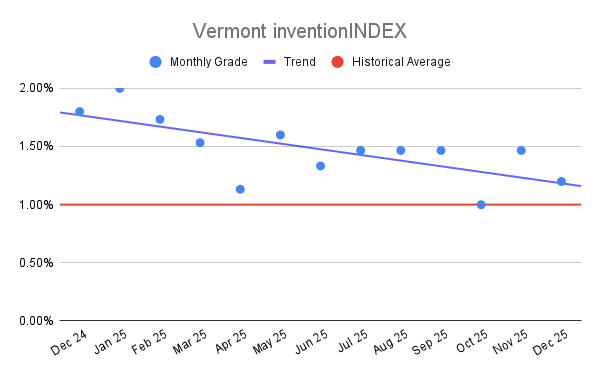 Vermont inventionINDEX December 2025:
  Vermont inventionINDEX November
