

Quick Answer: What is the Duplication Exclusion in Vermont?
The Duplication of Existing Business Component Exclusion (IRC § 41(d)(4)(C)) prohibits Vermont taxpayers from claiming R&D tax credits for activities that involve reproducing an existing product or process through reverse engineering, physical examination, or by following existing plans and blueprints. To qualify for the Vermont R&D credit (32 V.S.A. § 5930ii), a business must demonstrate that its research involves independent experimentation to resolve technical uncertainty, rather than merely replicating a competitor's established technology.
The duplication of an existing business component exclusion prohibits taxpayers from claiming R&D credits for activities that involve reproducing a product or process through reverse engineering or physical replication. This statutory limitation ensures that Vermont’s fiscal incentives are targeted exclusively at original technological advancements rather than the mere imitation of established commercial technologies.
Introduction to the Statutory Landscape of Innovation Incentives
The Vermont Research and Development (R&D) tax credit, codified under 32 V.S.A. § 5930ii, represents a cornerstone of the state's economic policy intended to foster a robust ecosystem for high-tech manufacturing, biotechnology, and software development. To maintain administrative efficiency and legal clarity, Vermont has structured its R&D credit to mirror the federal standards established under Internal Revenue Code (IRC) § 41. This relationship of conformity means that the definitions, qualifications, and, crucially, the exclusions found in federal law are directly applicable to Vermont taxpayers. Among these exclusions, the "duplication of existing business component" serves as a critical boundary, distinguishing between activities that contribute to the collective pool of human knowledge and those that merely seek to replicate existing private property for commercial gain.
Under 32 V.S.A. § 5930ii(a), an eligible taxpayer in the State of Vermont is entitled to a credit against their state income tax liability equal to 27 percent of the federal tax credit allowed for "eligible research and development expenditures" as defined under 26 U.S.C. § 41(a). The geographic nexus is strictly enforced: only expenditures conducted within the State of Vermont qualify for the 27 percent multiplier. This creates a dual-layered compliance burden where a taxpayer must first satisfy the rigorous "four-part test" and the various statutory exclusions at the federal level before reapplying those standards to their Vermont-based activities.
The duplication exclusion, located specifically in IRC § 41(d)(4)(C), acts as a gatekeeper. It prevents the credit from subsidizing "reverse engineering"—the process of taking apart a competitor's product to see how it works and then building a replica. From a policy perspective, Vermont recognizes that while reverse engineering may be a legitimate business strategy for gaining market share, it does not represent the type of "innovation" that justifies a 27 percent state subsidy. The state's interest lies in supporting the discovery of new information and the resolution of technical uncertainties that have not been previously solved.
Defining the Business Component and the Scope of Qualified Research
The analysis of the duplication exclusion must begin with an understanding of what the law considers a "business component." Under IRC § 41(d)(2)(B), a business component is defined as any product, process, computer software, technique, formula, or invention that is intended to be held for sale, lease, or license, or used by the taxpayer in their trade or business. The Vermont R&D credit is not applied to a company's aggregate spending but is instead evaluated on a component-by-component basis. This granularity is essential because a single project may involve multiple business components, some of which may be innovative and others which may be duplicative.
For example, if a Vermont-based aerospace firm is developing a new type of drone, the drone itself is a product business component. However, the specialized manufacturing process used to assemble the drone is a separate process business component. If the firm replicates the drone's aerodynamic shape from a competitor (duplication) but develops a proprietary, innovative battery management system, the duplication exclusion may apply to the airframe research while the battery research remains potentially qualifying.
The Four-Part Test as a PrerequisiteBefore any exclusion is even considered, a research activity must navigate the "four-part test" prescribed by IRC § 41(d)(1). Vermont's Department of Taxes adheres strictly to these federal benchmarks.
| Test Component | Statutory Requirement | Implementation Focus |
|---|---|---|
| Section 174 Test | Expenditure must qualify as a research and experimental cost. | Must be incurred in connection with the taxpayer's trade or business and represent research in the experimental or laboratory sense. |
| Technological in Nature | The process of experimentation must rely on hard sciences. | Must be based on principles of physics, biology, chemistry, engineering, or computer science. |
| Business Component Test | Research must be for a new or improved function, performance, reliability, or quality. | The intended result must be a specific improvement to a product or process. |
| Process of Experimentation | Substantially all activities must involve evaluating alternatives. | Requires a systematic trial-and-error process to eliminate technical uncertainty regarding capability, method, or design. |
The duplication exclusion serves to invalidate a claim even if these four tests are seemingly met. A taxpayer might argue they are using "engineering" (technological in nature) to "evaluate alternatives" (process of experimentation) for an "improved valve" (business component), but if those alternatives are merely different ways to copy an existing Swiss valve via physical measurement, the duplication exclusion overrides the qualification.
Dissecting the Duplication of Existing Business Component (Exclusion)
The statutory language of IRC § 41(d)(4)(C) explicitly states that the term "qualified research" shall not include "any research related to the reproduction of an existing business component (in whole or in part) from a physical examination of the business component itself or from plans, blueprints, detailed specifications, or publicly available information with respect to such business component". This definition is adopted by reference in Vermont's tax guidance and audit procedures.
The Three Pillars of ReproductionThe exclusion rests on three primary methods of information gathering that negate the "discovery" requirement of qualified research:
- Physical Examination: This is the classic "reverse engineering" scenario where a taxpayer acquires a competitor’s product, takes it apart (tear-down analysis), and uses those measurements to recreate the product. The IRS and Vermont Department of Taxes view this as a mechanical or forensic activity rather than an innovative one.
- Plans and Blueprints: Using existing technical documentation—whether acquired through legal purchase, licensing, or other means—to build a component removes the element of "technical uncertainty" required for a credit. If the roadmap already exists in the form of a blueprint, there is no "uncertainty" regarding the design or method of achieving the result.
- Publicly Available Information: This includes utilizing detailed specifications from patents, technical manuals, or scientific publications that outline how to construct a specific, existing component. While a taxpayer may use public knowledge to inform their own research, they cannot use it as the sole basis for reproducing a component and then claim tax credits for the associated labor costs.
It is vital for Vermont practitioners to distinguish between "benchmarking" and "reproduction." Treasury Regulation § 1.41-4(c)(4) provides a safe harbor: "This exclusion does not apply merely because the taxpayer examines an existing business component in the course of developing its own business component".
| Activity | Characterization | Eligibility |
|---|---|---|
| Reverse Engineering | Replication of a competitor's specific design to create a copy. | Excluded (Duplication) |
| Competitive Benchmarking | Testing a competitor's product to set performance goals for a new, different design. | Potentially Qualifying |
| Functional Analysis | Studying an existing part to understand its failure points before designing a new solution. | Potentially Qualifying |
| Blueprint Re-creation | Following an existing set of plans to manufacture a part for a new market. | Excluded (Duplication) |
A Vermont manufacturer of industrial pumps may purchase a competitor’s pump to measure its flow rate and energy consumption. This data is used to set a goal: "We must design a pump that is 15% more efficient than this model." The subsequent research to achieve that 15% gain is qualifying innovation, even though it started with an examination of a competitor's product. However, if the manufacturer uses those measurements to build an identical pump to sell as a cheaper alternative, the exclusion applies.
Vermont Revenue Office Guidance and Regulatory Application
The Vermont Department of Taxes does not operate in a vacuum; its guidance is built upon the foundation of federal law while adding specific state-level administrative requirements. Taxpayers must look to the instructions for Form BA-404, Technical Bulletins, and the annual R&D reports to understand how the duplication exclusion is applied locally.
Form BA-404 and the Recomputation RequirementTo claim the Vermont R&D credit, a taxpayer must file Form BA-404 (Tax Credits Earned, Applied, Expired, and Carried Forward). The instructions for the R&D section of this form are critical: they state that "your expenditures must be eligible for and receive the federal tax credit to claim the Vermont tax credit". This "receive" language implies that if the federal credit is disallowed upon audit—perhaps due to the duplication exclusion—the Vermont credit is automatically vulnerable.
For businesses operating in multiple states, Vermont requires a "recomputed" credit calculation. This means the taxpayer must take their total federal QREs and isolate only those incurred in Vermont. The duplication exclusion must be applied during this isolation phase. If a company's federal claim included $1 million in QREs, $200,000 of which was for reverse engineering conducted in a Vermont lab, that $200,000 must be stripped out before calculating the Vermont credit, even if it was mistakenly included in the federal return.
Grant and Assistance AdjustmentsAnother unique aspect of Vermont guidance found in the BA-404 instructions is the requirement to adjust the basis expenditure downward if the taxpayer received grants or assistance for the project. This is relevant to the duplication exclusion because "funded research" is another primary exclusion under IRC § 41(d)(4)(H). If a Vermont business is hired by a client to "reproduce" a part and is paid for that effort, the activity is disqualified twice: first as duplication and second as funded research.
Calculation Methodology: The Prorated ApproachVermont uses a prorated method to determine the state credit, which simplifies the process for those already compliant with federal rules but leaves no room for state-level deviations from federal exclusions. The calculation for a standard Vermont C-Corporation or pass-through entity is as follows:
- Identify all Vermont-based QREs (wages, supplies, and 65% of contract research).
- Exclude any activities that fall under the duplication or other § 41(d)(4) exclusions.
- Calculate a "hypothetical federal credit" using these Vermont-only QREs. This involves applying either the Regular Credit method or the Alternative Simplified Credit (ASC) method to the Vermont data.
- Multiply this hypothetical federal credit by 27 percent.
The mathematical formula for the Vermont credit ($C_{VT}$) can be represented using LaTeX as:
$$C_{VT} = 0.27 \times \text{Hypothetical Federal Credit}$$
In this equation, the "Excluded Expenditures" specifically includes any costs associated with the reproduction of existing business components through reverse engineering or physical examination.
The Role of Documentation and Audit Defense in Vermont
The Vermont Department of Taxes emphasizes that "accurate documentation is essential to avoid compliance issues". During an audit, Vermont auditors look for the same contemporaneous records required by the IRS. To defend against a charge of duplication, a Vermont business must be able to prove that its engineering efforts were focused on resolving new technical uncertainties rather than replicating a known design.
Audit Selection and Discrepancy IndicatorsVermont's audit FAQs indicate that a business may be selected for audit if "the figures you reported on returns vary from what might be expected" or if the Department has data indicating a "potential discrepancy". For R&D credits, this often means checking the consistency between federal Form 6765 and Vermont Form BA-404.
If a Vermont company's primary business model is "re-manufacturing" or "aftermarket parts," an auditor is likely to scrutinize R&D claims for the duplication exclusion. The auditor will request:
- Project Lists and Descriptions: Detailed narratives of what was being researched for each business component.
- Employee Logs: Evidence of who performed the work and what their technical background is.
- Laboratory Notes and Prototypes: Evidence of the trial-and-error process (modeling, simulation, testing) that occurred.
A critical concept for defending an R&D claim against a duplication exclusion is the "shrinking back" rule (Treas. Reg. § 1.41-4(b)(2)). If a taxpayer cannot prove that an entire product was innovative (perhaps because the overall form was a duplication), they can "shrink back" their claim to the specific elements that were innovatively developed.
For example, a Vermont company might build a specialized oven for the semiconductor industry. The external housing and the heating coils might be a direct duplication of a competitor's model (excluded). However, the company might have developed a unique, software-driven air circulation system that ensures perfectly even heat distribution. While the oven as a whole might be a duplication, the air circulation system is an innovative sub-component. The taxpayer can claim the R&D costs associated with the circulation system even if the rest of the oven's design was reproduced.
Comparative Analysis: Duplication versus Adaptation
One of the most frequent areas of confusion in Vermont R&D audits is the distinction between the Duplication exclusion and the Adaptation exclusion (IRC § 41(d)(4)(B)). Both disqualify activities, but they target different types of non-innovative work.
| Feature | Duplication Exclusion | Adaptation Exclusion |
|---|---|---|
| Statutory Root | IRC § 41(d)(4)(C) | IRC § 41(d)(4)(B) |
| Primary Target | Reproduction of a competitor's product. | Customization for a specific customer. |
| Mechanism | Reverse engineering, tear-downs, blueprints. | Tweaking existing products to meet a client's request. |
| Policy Goal | Preventing credit for copying existing tech. | Preventing credit for routine customer service/sales engineering. |
| Example | Measuring a competitor's valve to build a copy. | Adjusting a software interface's color and layout for a specific client. |
In the Vermont context, the adaptation exclusion is frequently cited in the software industry. If a Burlington-based software firm takes its standard accounting package and modifies the database schema to fit a specific customer's legacy system, that is adaptation and is excluded. If that same firm sees a competitor's proprietary encryption method and tries to replicate it by analyzing the competitor's software code (physical examination of the "business component"), that is duplication and is also excluded.
Public Transparency and the Vermont Claimant List
A unique feature of Vermont’s R&D tax credit is the "Transparency List." Under 32 V.S.A. § 5930ii(c), the Department of Taxes is required to publish a list every year containing the names of taxpayers who claimed the R&D credit. This report is published annually by January 15.
This public disclosure has significant implications for companies navigating the duplication exclusion. Because competitors, researchers, and the public can see who is claiming the credit, there is an informal level of "peer review". A company that is widely known for producing generic, low-cost copies of existing technologies may face reputational or regulatory scrutiny if it appears on a list of R&D claimants. This transparency serves as a deterrent against the "aggressive" claiming of reverse engineering costs as R&D.
Historical Data on Vermont ClaimantsThe Department's reports (such as RP-1298) show a consistent use of the credit by Vermont's manufacturing and tech sectors.
| Report Year | Publication Code | Content Focus |
|---|---|---|
| 2024 | RP-1298-2024 | List of companies that claimed the R&D credit in CY 2023. |
| 2023 | RP-1298-2023 | List of companies that claimed the R&D credit in CY 2022. |
| 2021 | RP-1298-2021 | Analysis of claims filed in CY 2021. |
| 2019 | RP-1298-2019 | Analysis of claims filed in CY 2019. |
These reports indicate that millions of dollars in credits are claimed annually, reinforcing the importance of proper exclusion analysis to protect the state’s revenue.
The Impact of Federal Tax Reform on Vermont R&D Credits
Recent changes to federal tax law, specifically the Tax Cuts and Jobs Act (TCJA) and the subsequent Reconciliation Act of 2025, have fundamentally altered the landscape for R&D spending, which in turn affects the Vermont credit.
IRC Section 174 AmortizationStarting in 2022, federal law required that domestic research and experimental expenses be capitalized and amortized over five years, rather than expensed immediately. Because Vermont has not "decoupled" from this federal change, the deduction for R&D is factored into a corporate taxpayer's Vermont taxable income over a longer period.
While this changes the timing of the tax benefit, it does not change the calculation of the 27% R&D credit itself, which is still based on the amount of credit allowed in the taxable year. However, the "Reconciliation Act of 2025" may allow for a retroactive deduction for certain small businesses, which could lead to a short-term reduction in Vermont tax revenue as companies catch up on previously capitalized expenses.
Coordination of Taxable YearsFor Vermont auditors, the transition to amortization means that the documentation for the duplication exclusion must be maintained for an even longer duration. Since the benefit of a research project is now spread over five years (or fifteen for foreign research), the "audit window" effectively shifts. A Vermont taxpayer must ensure that the "experimental nature" of their work is documented well enough to survive an inquiry that might occur years after the initial research was conducted.
Detailed Example: The "Green-Flow" Turbine Project
To illustrate the nuanced application of the duplication exclusion in Vermont, consider the hypothetical case of Montpelier Advanced Energy (MAE), a startup focused on small-scale hydroelectric components.
Scenario BackgroundMAE wants to enter the market for micro-hydro turbines. A competitor in Canada manufactures the "Hydro-Pro 500," which is the current industry leader. MAE's engineers believe they can produce a similar turbine but optimized for the specific water chemistry found in Vermont's Green Mountain streams.
Phase 1: Physical Acquisition and Measurement (Excluded)MAE purchases a Hydro-Pro 500. They use a 3D laser scanner to create a digital twin of the turbine's impeller. They also use a spectrometer to determine the exact stainless steel alloy used by the Canadian firm.
- Analysis: This activity is purely forensic. It involves the "physical examination of the business component itself" to create a "digital blueprint".
- Credit Impact: All wages for the scanning technicians, the cost of the turbine used for destruction, and the lab fees for the spectrometry are excluded under IRC § 41(d)(4)(C).
During their examination, MAE realizes the competitor's turbine corrodes quickly in high-acidity water. MAE's engineers set out to develop a new polymer coating that can bond to the metal and resist pH fluctuations. They don't know which polymer will work or if it will affect the turbine's balance. They test twelve different formulations over six months.
- Analysis: This is a "new function" (corrosion resistance). There is "technical uncertainty" (which polymer bonds best). There is a "process of experimentation" (the 12 formulations).
- Credit Impact: The wages for the chemical engineers and the supplies used in the coating tests are qualifying QREs.
MAE decides to manufacture the turbine impeller using a new "3D Metal Printing" technique rather than the competitor's "Investment Casting." They have to develop new printer parameters to ensure the impeller doesn't warp during the cooling phase.
- Analysis: The manufacturing process is a "separate business component". Even if the shape of the impeller was a duplication (from Phase 1), the process of creating it via 3D printing is a new and innovative technique that requires its own experimentation.
- Credit Impact: The engineering time spent resolving the warping issue is qualifying QRE for the process business component.
Assume the following costs were all incurred in Vermont:
- Phase 1 (Duplication): $50,000
- Phase 2 (Coating R&D): $100,000
- Phase 3 (Process R&D): $150,000
- Total Project Cost: $300,000
- Total Vermont QREs: $250,000 (Phase 2 + Phase 3)
Calculation (using the ASC hypothetical method at 6% for a startup):
- Vermont-only QRE: $250,000.
- Hypothetical Federal Credit: $250,000 × 0.06 = $15,000.
- Vermont R&D Credit: $15,000 × 0.27 = $4,050.
If MAE had included the $50,000 from Phase 1, their Vermont credit would have been $4,860. During an audit, the Vermont Department of Taxes would disallow the $810 difference because Phase 1 was a "reproduction" from "physical examination".
Future Policy and Economic Implications for Vermont
The duplication exclusion is not just a technicality; it is a vital safeguard that directs Vermont's limited tax expenditures toward activities with the highest social return.
Incentivizing High-Value InnovationBy excluding reverse engineering, Vermont encourages firms to move "up the value chain". Companies that might have been content to produce generic versions of out-of-state products are instead incentivized to solve original problems, which leads to patents, higher-paying jobs, and a more resilient economy. The "Direct Loan Program" and "Small Business Loan Program" in Vermont often complement these R&D efforts, providing capital for the equipment needed to conduct original research.
The Role of REAP Zones and Geographic IncentivesFor businesses located in Rural Economic Area Partnership (REAP) Zones, the R&D credit can be combined with other incentives like the "Machinery and Equipment Tax Credit". In these rural areas, the pressure to "duplicate" existing technologies can be high due to limited access to original R&D hubs. However, the strict enforcement of the duplication exclusion ensures that even in rural zones, the focus remains on genuine technological discovery.
Emerging Technologies: AI and SimulationAs artificial intelligence (AI) and digital simulation become standard in Vermont's tech industry, the definition of "physical examination" may evolve. If an AI model is trained on a competitor's publicly available blueprints to "generate" a new design, is that duplication? Current federal and Vermont law would likely say yes, as the source of the information is "plans, blueprints, or publicly available information". Taxpayers using generative design must be able to show that the "uncertainty" they are solving is not one that was already solved by the input data.
Summary of Vermont Filing and Compliance Steps
To ensure a sustainable R&D credit claim that respects the duplication exclusion, a Vermont taxpayer should follow a structured approach.
| Step | Action | Reference |
|---|---|---|
| 1. Identification | Segregate activities by business component. | IRC § 41(d)(2) |
| 2. Filtering | Apply the § 41(d)(4) exclusions, specifically looking for any reverse engineering or replication work. | IRC § 41(d)(4) |
| 3. Apportionment | Isolate only those QREs incurred within Vermont borders. | 32 V.S.A. § 5930ii |
| 4. Calculation | Recompute the federal credit using Vermont-only QREs. | BA-404 Instructions |
| 5. Documentation | Maintain lab notes, project charters, and time logs for the 10-year carryforward window. | Audit FAQs |
| 6. Reporting | File Form BA-404 with the Vermont Income Tax Return (CO-411, BI-471, etc.). | Form BA-404 |
Final Thoughts: The Strategic Importance of the Duplication Exclusion
The duplication of an existing business component (exclusion) is a foundational element of the Vermont R&D tax credit that prevents the subsidization of imitation. By mandating that research must be "undertaken for the purpose of discovering information which is technological in nature," the law requires a leap into the unknown. Reproduction, by its very definition, is a journey into the known.
For the Vermont Department of Taxes, the exclusion is a tool for fiscal responsibility, ensuring that the 27 percent credit is an investment in the state’s future rather than a refund for forensic engineering. For the taxpayer, it is a reminder that the highest rewards—both in the market and in the tax code—are reserved for those who choose to innovate rather than replicate.
Ultimately, the synergy between Vermont's 27 percent rate and the rigorous federal standards of IRC § 41 creates a high-standard, high-reward environment. Navigating this environment successfully requires a deep understanding of where "reproduction" ends and "innovation" begins. As the state’s economy continues to shift toward knowledge-based sectors, the duplication exclusion will remain a vital instrument in defining the true meaning of Vermont-made excellence.
Who We Are:
Swanson Reed is one of the largest Specialist R&D Tax Credit advisory firm in the United States. With offices nationwide, we are one of the only firms globally to exclusively provide R&D Tax Credit consulting services to our clients. We have been exclusively providing R&D Tax Credit claim preparation and audit compliance solutions for over 30 years. Swanson Reed hosts daily free webinars and provides free IRS CE and CPE credits for CPAs.
Are you eligible?

Why choose us?

Pass an Audit?

What is the R&D Tax Credit?
The Research & Experimentation Tax Credit (or R&D Tax Credit), is a general business tax credit under Internal Revenue Code section 41 for companies that incur research and development (R&D) costs in the United States. The credits are a tax incentive for performing qualified research in the United States, resulting in a credit to a tax return. For the first three years of R&D claims, 6% of the total qualified research expenses (QRE) form the gross credit. In the 4th year of claims and beyond, a base amount is calculated, and an adjusted expense line is multiplied times 14%. Click here to learn more.
Never miss a deadline again

Stay up to date on IRS processes

Discover R&D in your industry

R&D Tax Credit Preparation Services
Swanson Reed is one of the only companies in the United States to exclusively focus on R&D tax credit preparation. Swanson Reed provides state and federal R&D tax credit preparation and audit services to all 50 states.
If you have any questions or need further assistance, please call or email our CEO, Damian Smyth on (800) 986-4725.
Feel free to book a quick teleconference with one of our national R&D tax credit specialists at a time that is convenient for you.
R&D Tax Credit Audit Advisory Services
creditARMOR is a sophisticated R&D tax credit insurance and AI-driven risk management platform. It mitigates audit exposure by covering defense expenses, including CPA, tax attorney, and specialist consultant fees—delivering robust, compliant support for R&D credit claims. Click here for more information about R&D tax credit management and implementation.
Our Fees
Swanson Reed offers R&D tax credit preparation and audit services at our hourly rates of between $195 – $395 per hour. We are also able offer fixed fees and success fees in special circumstances. Learn more at https://www.swansonreed.com/about-us/research-tax-credit-consulting/our-fees/



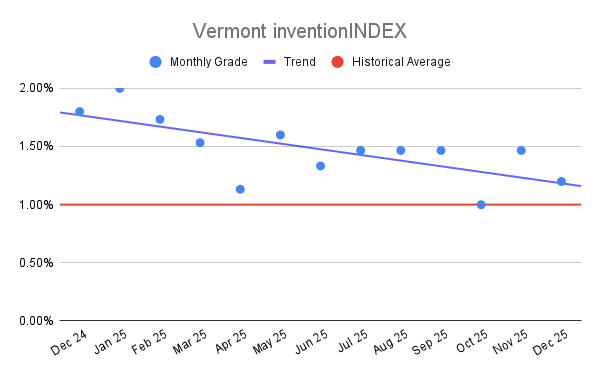 Vermont inventionINDEX December 2025:
  Vermont inventionINDEX November
