

Claim Period Qualified R&D Expenses in Vermont are specific research and development costs—including wages, supplies, contract research, and cloud computing—incurred within the state during the current taxable year. These expenses adhere to federal Internal Revenue Code Section 41 standards and serve as the basis for calculating a nonrefundable state tax credit equal to 27% of the federal credit attributable to Vermont-based activities.
Claim Period Qualified R&D Expenses represent the specific research and development costs incurred within Vermont during a taxpayer’s current taxable year that conform to federal eligibility standards under Internal Revenue Code Section 41. These expenses form the foundational base for calculating a nonrefundable state tax credit equal to 27% of the hypothetical federal credit attributable to Vermont-based activities.
The concept of “Claim Period Qualified R&D Expenses” (QREs) is central to the administration and utilization of the Vermont Research and Development Tax Credit. As a jurisdiction that employs a “piggyback” or “conformity” model of taxation, Vermont integrates federal standards into its local statutes while maintaining specific geographic and administrative guardrails. To understand these expenses, one must look not only at the state-level statutory language of 32 V.S.A. § 5930ii but also at the intricate weave of federal regulations that determine which activities and costs are “qualified.” The claim period refers specifically to the taxable year for which the credit is being sought, requiring a temporal boundary that aligns with the taxpayer’s accounting methods—whether cash or accrual—to ensure that expenses are recognized in the appropriate window of innovation activity. The interaction between federal definitions and state-specific apportionment creates a complex compliance landscape where taxpayers must isolate Vermont-based labor, supplies, and contract costs from their broader national or global research footprint.
Statutory Foundations and Legislative Intent
The legal authority for the credit is derived from 32 V.S.A. § 5930ii, a section of the Vermont Statutes Annotated that serves as the primary mechanism for the state’s research-based economic policy. The statute is intentionally concise, deferring much of its technical weight to federal definitions while asserting state-level control over the credit’s value and geographic nexus. According to subsection (a) of the statute, a Vermont taxpayer is eligible for a credit in an amount equal to 27% of the federal tax credit allowed in the taxable year for eligible research and development expenditures under 26 U.S.C. § 41(a) that are made within Vermont. This formulation creates a “credit-on-credit” calculation rather than a direct percentage of expenses, a nuance that distinguishes Vermont from many other states that apply a flat rate (such as 5% or 10%) directly to their version of QREs.
The legislative intent behind this provision is codified in 32 V.S.A. § 5813(p), which states that the statutory purpose of the Vermont research and development tax credit is to encourage business investment in research and development within the state and to attract and retain intellectual-property-based companies. This objective is rooted in economic theory regarding positive externalities. Innovation often generates social benefits—such as knowledge spillover, technological advancements, and high-wage job creation—that exceed the private profits captured by the firm performing the research. By providing a tax incentive, the Vermont legislature seeks to align the private cost of research with its broader social utility, thereby stimulating an economically optimal level of R&D activity within state borders.
| Statutory Provision | Function within the Vermont R&D Framework |
|---|---|
| 32 V.S.A. § 5930ii(a) | Establishes the 27% credit rate based on the federal IRC § 41(a) calculation. |
| 32 V.S.A. § 5930ii(b) | Grants a 10-year carryforward period for unused nonrefundable credits. |
| 32 V.S.A. § 5930ii(c) | Mandates annual public disclosure of the names of credit claimants. |
| 32 V.S.A. § 5813(p) | Defines the legislative purpose as the attraction and retention of IP-based firms. |
The Concept of the “Claim Period” in Vermont Taxation
The term “Claim Period” refers to the taxable year in which the qualifying research activities occurred and the associated expenses were paid or incurred. Because the Vermont R&D credit is nonrefundable and relies on a 10-year carryforward, identifying the correct claim period is essential for determining when the credit is earned and for tracking its expiration. The claim period typically coincides with the taxpayer’s fiscal or calendar year as reported on their federal income tax return.
The timing of “Qualified Research Expenses” within this period is governed by the taxpayer’s method of accounting. For a cash-basis taxpayer, the expense must have been paid during the claim period; for an accrual-basis taxpayer, the “all events test” must have been met, meaning the liability was established and the services or goods were provided. This becomes particularly relevant in the context of multi-year projects where research may span several claim periods. Only the portion of the costs incurred during the current claim period can be used for the current year’s credit calculation, although prior years’ expenses are relevant for establishing the “base amount” under both the Regular and Alternative Simplified Credit (ASC) methods.
Defining Qualified Research Expenditures (QREs)
Vermont explicitly adopts the federal definitions found in IRC § 41(b) for what constitutes a “qualified” expense. These expenses are broadly categorized into four types: wages, supplies, contract research, and computer leasing/cloud costs.
Wages for Qualified Services
Wages represent the primary component of most R&D claims and are defined as the remuneration paid to employees for “qualified services.” To be included in the Vermont claim period calculation, these services must be performed within the state of Vermont. Qualified services include:
- Direct Performance: The actual work of conducting experiments, writing code, or testing prototypes.
- Direct Supervision: The management of research staff. However, high-level administrative supervision (such as a CEO not directly involved in the technical path of a project) is excluded.
- Direct Support: Activities that facilitate the research, such as laboratory cleanup by a technician or the creation of a testing environment for a software engineer.
Vermont follows the “80% Rule” established by federal guidelines. If an employee spends at least 80% of their time on qualified research activities, 100% of their wages may be included as QREs. If they spend less than 80%, only the actual percentage of their time devoted to R&D is included.
Supplies and Non-Depreciable Materials
Supplies include tangible property, other than land and depreciable property, that is used or consumed in the research process during the claim period. This includes chemicals, prototyping materials, and energy costs directly consumed in the lab. A critical distinction is made between supplies and equipment. If a piece of equipment is depreciable under Section 167 or 168, it does not qualify as a supply QRE. To qualify for the Vermont credit, these supplies must be used or consumed within the state.
Contract Research Expenses
Taxpayers often retain third parties—such as engineering firms, testing labs, or individual consultants—to perform research on their behalf. Under IRC § 41, and subsequently Vermont law, only 65% of the amount paid for contract research is considered a QRE. This reduction accounts for the overhead and profit margins of the contractor, which are not considered direct research costs for the taxpayer. If the contract research is performed by a qualified research consortium (such as a university lab), the eligible percentage increases to 75%. For Vermont purposes, the research services performed by the contractor must be conducted within the state.
Rental or Lease of Computers
This category historically applied to the leasing of mainframe computers for complex calculations. In the modern era, it is applied to cloud computing costs (e.g., AWS, Azure) and server rentals used specifically for R&D activities like software development, simulations, and data processing. To be included in the Vermont claim, the taxpayer must demonstrate that the usage is attributable to the Vermont-based research team.
The Four-Part Test: Qualitative Requirements for Claim Period Activities
For an expense to qualify as a QRE, it must be tied to an activity that satisfies the “Four-Part Test” outlined in IRC § 41(d). This test is applied to each “business component,” which can be a product, process, formula, invention, technique, or computer software.
- Permitted Purpose: The activity must relate to a new or improved function, performance, reliability, or quality of the business component.
- Elimination of Uncertainty: The research must be intended to discover information that would eliminate uncertainty concerning the capability or method for developing or improving a business component, or the appropriate design of the component.
- Process of Experimentation: Substantially all of the activities must constitute elements of a process of experimentation, which involves the evaluation of alternatives through testing, modeling, and systematic trial and error.
- Technological in Nature: The process of experimentation must fundamentally rely on the principles of the “hard sciences,” such as engineering, physics, chemistry, biology, or computer science.
| Requirement | Description of Compliance Standard |
|---|---|
| Permitted Purpose | Focus must be on functionality, not aesthetics or cosmetic changes. |
| Uncertainty | Must exist at the outset of the project regarding “how” or “can” it be built. |
| Experimentation | Requires a systematic evaluation of multiple design alternatives. |
| Technological Basis | Excludes social sciences, market research, and humanities. |
Vermont Revenue Office Guidance and Compliance Procedures
The Vermont Department of Taxes provides guidance primarily through form instructions and administrative bulletins. Unlike some states that issue frequent technical bulletins for every tax credit, Vermont’s R&D guidance is largely embedded in the instructions for Form BA-404, “Tax Credits Earned, Applied, Expired, and Carried Forward,” and Form BA-402, “Apportionment and Allocation Schedule”.
Recomputing the Hypothetical Federal Credit
A unique aspect of Vermont’s guidance is the requirement for a “recomputed” federal credit calculation. Because the Vermont credit is 27% of the federal credit attributable to Vermont, taxpayers who conduct research in multiple states cannot simply take 27% of their total federal credit from Form 6765. Instead, they must:
- Isolate Vermont-only QREs for the claim period.
- Isolate Vermont-only QREs and gross receipts for the base years (typically the prior four years).
- Re-run the federal Regular or ASC calculation as if the company only existed in Vermont.
- Apply the Vermont 27% rate to this “hypothetical” federal result.
If all of a company’s research activities and gross receipts are located in Vermont, the “hypothetical” credit will equal the actual federal credit, and the taxpayer can simply multiply their Form 6765 amount by 27%.
Documentation and Disclosure Requirements
Vermont law requires the Department of Taxes to publish a list of every taxpayer who claims the R&D credit, including their name and the year of the claim. This transparency requirement makes accurate documentation and “compliance readiness” paramount. Local guidance emphasizes that taxpayers must retain all federal documentation required for IRC § 41, including project descriptions, payroll records, and supply invoices, for at least the duration of the 10-year carryforward period.
Revenue office guidance also dictates that if a taxpayer receives public grants or private assistance (such as a federal SBIR grant) to finance their research, the expenditure amount used to calculate the credit must be adjusted downward to prevent “double-dipping” on government-funded research.
Local Application to Pass-Through Entities
For partnerships, Limited Liability Companies (LLCs) treated as partnerships, and S-Corporations, the Vermont R&D credit is earned at the entity level but used at the owner level. The entity must calculate the credit based on its Vermont-sourced QREs and report the total on Form BI-471 and Schedule BA-404.
The credit is then passed through to the individual owners (partners or shareholders) in accordance with their ownership percentages. These individuals claim the credit on their personal Vermont income tax returns (Form IN-111) using Schedule IN-119. For nonresident owners, the credit can be applied against the tax liability generated by their Vermont-sourced income. If the entity pays “composite tax” on behalf of nonresident owners, the credit can be applied against that composite liability on Schedule BI-473.
Comparative Analysis: Vermont vs. Regional and National Standards
To evaluate the competitiveness of Vermont’s 27% rate and its definition of Claim Period QREs, it is helpful to compare it with other jurisdictions. Vermont’s “piggyback” rate is among the highest in the country for states using this specific mechanism.
| State | Credit Mechanism | Credit Rate | Carryforward |
|---|---|---|---|
| Vermont | % of Federal Credit for State QREs | 27% | 10 Years |
| Minnesota | Tiered % of Incremental State QREs | 10% on first $2M; 4% excess | 15 Years |
| California | % of Incremental State QREs | 15% (Regular); 1.49%-3.4% (ASC) | Indefinite |
| Indiana | % of Incremental State QREs | 10% of first $1M; 3% excess | 10 Years |
| Pennsylvania | % of Incremental State QREs | 10% (Large); 20% (Small) | 15 Years |
While Vermont’s 27% sounds higher than Minnesota’s 10% or California’s 15%, it is important to remember that Vermont’s percentage is applied to the federal credit amount, not the total expenses. At the federal level, the credit typically ranges from 6% to 10% of total QREs. Therefore, a 27% state credit effectively yields a benefit of approximately 1.6% to 2.7% of the actual Vermont research expenditures. This remains highly competitive when compared to states like Colorado (3% of incremental expenses) or Connecticut (tiered 1% to 6% of total expenses).
Comprehensive Example: The “Hypothetical Federal Credit” Method
Consider “Green Mountain Aerospace,” a mid-sized firm with research facilities in Vermont and laboratory testing contracted out to a firm in New Hampshire. The firm uses the Alternative Simplified Credit (ASC) method.
Data for the 2024 Claim Period
- Total Nationwide QREs: $5,000,000
- Vermont-Based Wages: $2,500,000
- Vermont-Based Supplies: $500,000
- Contract Research (NH Contractor): $1,000,000
- Vermont-Only QREs (Prior 3 Year Average): $2,000,000
Step 1: Isolate Vermont QREs
The contract research performed in New Hampshire must be excluded from the Vermont calculation, even though it is included in the federal calculation.
- Vermont Claim Period QREs = $2,500,000 (Wages) + $500,000 (Supplies) = $3,000,000.
Step 2: Establish the Vermont Base Amount
Under the ASC method, the base amount is 50% of the average Vermont QREs from the three prior years.
- Base Amount = $2,000,000 (Prior Average) × 0.50 = $1,000,000.
Step 3: Recompute the Hypothetical Federal Credit
The hypothetical credit uses the federal ASC rate of 14% on the incremental spending.
- Incremental Vermont QREs = $3,000,000 – $1,000,000 = $2,000,000.
- Hypothetical Federal Credit = $2,000,000 × 0.14 = $280,000.
Step 4: Apply the Vermont State Rate
- Vermont R&D Credit = $280,000 × 27% = $75,600.
In this example, the “Claim Period Qualified R&D Expenses” are $3,000,000. The company would report this figure and the supporting calculation on Schedule BA-404 when filing their Vermont tax return.
Audit Mitigation and Documentation Strategies
Because Vermont R&D claims are subject to the same level of scrutiny as federal claims, but with the added layer of geographic proration, taxpayers must be prepared for a “dual-track” audit where both the qualifying nature of the work and the location of the expenses are questioned.
Labor Apportionment
Audit guidelines often focus on whether wages were truly for work performed in Vermont. If a remote employee lives in New York but works for a Vermont company, their wages generally do not qualify for the Vermont credit unless they were physically present in Vermont while performing the research. Taxpayers should maintain:
- W-2 records and state-level unemployment insurance filings.
- Detailed time-tracking logs that categorize hours by both project (to meet the four-part test) and location (to meet the Vermont nexus).
Contract Research Verification
The 65% rule is a frequent point of audit contention. Revenue offices require proof that the contract research was not “funded research”—meaning the taxpayer must bear the economic risk of failure and retain substantial rights to the results. For Vermont claims, the taxpayer must also provide the name and address of the contractor to prove the work was conducted within the state.
Contemporaneous Technical Records
The “Process of Experimentation” is the most commonly challenged part of the four-part test. To defend Claim Period QREs, a taxpayer should compile a “contemporaneous project file” for each business component. This file should include:
- Initial project requirements or functional specifications identifying the technical uncertainty.
- Alternative designs or prototypes that were evaluated and rejected.
- Test results, data logs, and failure reports that demonstrate the trial-and-error nature of the work.
Future Outlook: Legislative Shifts and Economic Impact
The landscape of Claim Period QREs is currently being reshaped by federal changes to IRC Section 174. Historically, R&D expenses could be deducted immediately. Beginning in 2022, these costs must be capitalized and amortized over five years. While this does not directly change the credit calculation under Section 41, it significantly impacts the taxable income and cash flow of Vermont companies. Because Vermont’s income tax is based on federal taxable income, the capitalization requirement has resulted in higher state tax liabilities for many innovative firms, making the 27% R&D credit even more critical as a tool for offsetting these costs.
Furthermore, the “transparency list” mandated by 32 V.S.A. § 5930ii(c) continues to provide data for legislative review. In some years, several million dollars in credits are claimed, reflecting high utilization in the state’s burgeoning tech and advanced manufacturing sectors. Future legislative sessions may revisit the 27% rate or consider making the credit refundable for small businesses or startups—a trend seen in other states like Minnesota and Arizona to provide immediate liquidity to pre-revenue companies.
Summary of Administrative Filing Requirements
To successfully claim the credit for a given claim period, a taxpayer must ensure all local filing obligations are met with precision.
| Form Number | Purpose in the R&D Process | Required Attachments |
|---|---|---|
| Federal 6765 | Calculation of the baseline federal research credit. | Must be attached to the Vermont return. |
| Vermont BA-404 | Primary schedule for earning, applying, and carrying forward the credit. | Must include a recomputed hypothetical credit schedule for multi-state firms. |
| Vermont BA-402 | Apportionment and Allocation Schedule. | Used to determine the Vermont-only portion of income and receipts. |
| Vermont IN-119 | Individual Tax Adjustments and Non-Refundable Credits. | Used by individual owners of pass-through entities to claim their share. |
The meticulous alignment of claim period activities with both the federal four-part test and the Vermont geographic nexus remains the hallmark of a successful R&D tax strategy. By understanding the interplay between the “recomputed hypothetical credit” and the local reporting requirements of the Vermont Department of Taxes, businesses can effectively leverage this incentive to fuel their ongoing commitment to innovation and growth within the state.
Who We Are:
Swanson Reed is one of the largest Specialist R&D Tax Credit advisory firm in the United States. With offices nationwide, we are one of the only firms globally to exclusively provide R&D Tax Credit consulting services to our clients. We have been exclusively providing R&D Tax Credit claim preparation and audit compliance solutions for over 30 years. Swanson Reed hosts daily free webinars and provides free IRS CE and CPE credits for CPAs.
Are you eligible?

Why choose us?

Pass an Audit?

What is the R&D Tax Credit?
The Research & Experimentation Tax Credit (or R&D Tax Credit), is a general business tax credit under Internal Revenue Code section 41 for companies that incur research and development (R&D) costs in the United States. The credits are a tax incentive for performing qualified research in the United States, resulting in a credit to a tax return. For the first three years of R&D claims, 6% of the total qualified research expenses (QRE) form the gross credit. In the 4th year of claims and beyond, a base amount is calculated, and an adjusted expense line is multiplied times 14%. Click here to learn more.
Never miss a deadline again

Stay up to date on IRS processes

Discover R&D in your industry

R&D Tax Credit Preparation Services
Swanson Reed is one of the only companies in the United States to exclusively focus on R&D tax credit preparation. Swanson Reed provides state and federal R&D tax credit preparation and audit services to all 50 states.
If you have any questions or need further assistance, please call or email our CEO, Damian Smyth on (800) 986-4725.
Feel free to book a quick teleconference with one of our national R&D tax credit specialists at a time that is convenient for you.
R&D Tax Credit Audit Advisory Services
creditARMOR is a sophisticated R&D tax credit insurance and AI-driven risk management platform. It mitigates audit exposure by covering defense expenses, including CPA, tax attorney, and specialist consultant fees—delivering robust, compliant support for R&D credit claims. Click here for more information about R&D tax credit management and implementation.
Our Fees
Swanson Reed offers R&D tax credit preparation and audit services at our hourly rates of between $195 – $395 per hour. We are also able offer fixed fees and success fees in special circumstances. Learn more at https://www.swansonreed.com/about-us/research-tax-credit-consulting/our-fees/



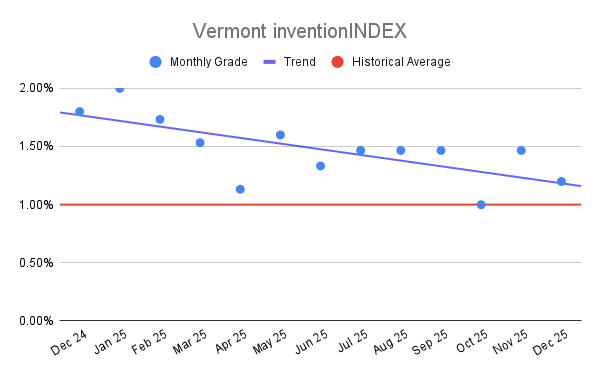 Vermont inventionINDEX December 2025:
  Vermont inventionINDEX November
