

The Vermont Research and Development Tax Credit is a nonrefundable incentive that allows eligible entities to reduce their state income tax liability by 27 percent of the federal research credit amount attributable to activities conducted within Vermont. For Limited Liability Companies, these credits are generally not used at the entity level but instead pass through to the individual or corporate members to be claimed on their respective Vermont tax returns.
The statutory framework governing this incentive is primarily found in 32 V.S.A. § 5930ii, which establishes the eligibility and calculation parameters for taxpayers engaged in qualified research activities within the state. While historical references often point to 32 V.S.A. § 5930z, that specific section was repealed effective January 1, 2019, as part of a broader legislative effort to consolidate and clarify the state’s tax expenditure programs. The current law provides a direct piggyback mechanism on the federal credit provided by Internal Revenue Code (IRC) § 41, but it modifies the federal base to include only those expenditures and receipts properly allocable to Vermont. This necessitates a complex re-computation of the federal credit using a hypothetical federal model that excludes all out-of-state activities, ensuring the state only subsidizes innovation occurring within its borders. For Limited Liability Companies (LLCs), the classification of the business for federal tax purposes—whether as a partnership, S-corporation, or disregarded entity—dictates the administrative path for claiming the credit, requiring strict adherence to the guidance provided by the Vermont Department of Taxes through Technical Bulletins and specific form instructions.
The Legal Framework of 32 V.S.A. § 5930ii and Historical Context
The Research and Development Tax Credit is an essential pillar of Vermont’s economic development strategy, specifically designed to encourage business investment in research and development and to attract intellectual-property-based companies. The legislation, authorized under Subchapter 11L of Chapter 151, Title 32 of the Vermont Statutes, provides a clear mandate for the Department of Taxes to administer a nonrefundable credit for taxpayers of this State.
The evolution of the statute reflects changes in Vermont’s fiscal priorities. Before the enactment of Section 5930ii, research incentives were sometimes part of broader development programs. The repeal of 32 V.S.A. § 5930z, which was historically categorized under affordable housing and developmental tax credits, marked a transition toward a more specialized and transparent R&D incentive structure. The current statute, Section 5930ii, was amended significantly in 2013 and 2014 to adjust the credit rate to its current 27 percent level and to introduce a mandatory reporting requirement for the Department of Taxes. Under the reporting mandate, the Department must publish a list of all taxpayers who claimed the credit each year, which serves as a public audit of the program’s utilization.
For an LLC, being an eligible entity means qualifying as a taxpayer under the definitions provided in 32 V.S.A. § 5811. In the context of pass-through entities, the LLC itself is an entity that files an information return, but the legal taxpayer entitled to the credit is the person or corporation subject to the taxes imposed by Chapter 151. This distinction is critical for understanding that while the LLC earns the credit through its Vermont research activities, the taxpayer who claims the credit is the member who receives the allocation via Schedule K-1VT.
| Statutory Provision | Function | Legal Requirement |
|---|---|---|
| 32 V.S.A. § 5930ii(a) | Eligibility | Taxpayer must be eligible for federal credit under 26 U.S.C. § 41(a). |
| 32 V.S.A. § 5930ii(b) | Carryforward | Unused credits may be carried forward for 10 years. |
| 32 V.S.A. § 5930ii(c) | Reporting | Department of Taxes must publish a list of claimants by Jan 15 annually. |
| 32 V.S.A. § 5813(p) | Purpose | To encourage investment in R&D and attract IP-based firms. |
The Meaning of LLCs as Eligible Entities
In Vermont tax jurisprudence, an LLC is an eligible entity if it satisfies the criteria for a business entity as recognized for federal tax purposes. This generally includes any organization that is not properly classified as a trust or otherwise subject to special treatment under the IRC. The flexibility of the LLC structure allows it to be classified as a partnership, an association taxable as a corporation, or a disregarded entity separate from its owner.
Pass-Through Classification and the Flow of Credits
Most multi-member LLCs operating in Vermont are treated as partnerships for tax purposes. As such, they do not pay the state’s corporate income tax but instead pass their income, losses, and credits to their members. For the purpose of the Vermont R&D credit, the LLC is the entity performing the research, but it is not the entity that ultimately utilizes the credit to offset tax liability. Instead, the credit flows through to the members’ individual income tax returns (Form IN-111) or corporate income tax returns (Form CO-411).
Disregarded Entities
A single-member LLC (SMLLC) that does not elect to be treated as a corporation is considered a disregarded entity. For Vermont R&D tax credit purposes, the activities of the SMLLC are treated as activities of the owner. If the owner is an individual, the research expenditures are reported directly on the individual’s Vermont tax return, and the SMLLC is not required to file a separate Form BI-471 unless it has other filing obligations. If the owner is a corporation, the SMLLC’s activities are included in the corporation’s consolidated or separate return.
Series LLCs
Vermont tax guidance and federal regulations treat each series of a series LLC as a separate entity. Consequently, if an LLC is structured with different series performing distinct research projects, each series must separately determine its eligibility for the federal R&D credit and then calculate its own Vermont-specific credit based on its own in-state expenditures. This requires meticulous bookkeeping to ensure that wages and supplies are correctly attributed to the specific series that is claiming the credit.
Revenue Office Guidance: Filing and Documentation Requirements
The Vermont Department of Taxes provides exhaustive guidance on the mechanics of claiming the R&D credit, primarily through the instructions for Form BA-404, Form BI-471, and Schedule K-1VT. Compliance with this guidance is mandatory, as the Department reserves the right to deny credits if the supporting documentation is incomplete.
Form BA-404: Tax Credits Earned and Applied
Form BA-404 is the master schedule for tracking all nonrefundable tax credits in Vermont. Any LLC that earns an R&D credit, or any member who applies a carryforward credit, must complete this form and attach it to their return. The form tracks:
Amount Carried Forward from Prior Years: Credits that were earned but not used due to insufficient tax liability in previous years.
Amount Earned in the Current Year: The result of the 27 percent calculation based on the hypothetical federal credit.
Amount Applied in the Current Year: The portion of the credit used to reduce the current year’s tax liability.
Amount Carried Forward to Future Years: The remaining credit balance after current applications and any expirations (though the R&D credit has a 10-year window before expiration).
Form BI-471: Business Income Tax Return
For LLCs classified as pass-through entities, Form BI-471 is the primary filing vehicle. This return was substantially reworked in 2023 to improve accountability and administration. The LLC reports its total income and the credits it has generated. The R&D credit is not applied against the entity’s minimum tax ($250 for most entities) but is instead distributed to members. However, if the LLC elects to file a composite return for its nonresident members, the credit may be applied on Form BI-471 at the entity level to reduce the tax the LLC is paying on behalf of those members.
Schedule K-1VT: The Pass-Through Link
The LLC is required to provide each member with a Schedule K-1VT, which serves as the official record of the Vermont-source income and credits allocated to that member. For the R&D credit, the LLC must enter the member’s share of the credit on this schedule. If the member is another pass-through entity (a tiered structure), that entity must further distribute the credit to its own owners.
Mandatory Federal Documentation
Because the Vermont credit is tied to the federal credit, the Department of Taxes requires taxpayers to include a copy of the federal Form 6765 (Credit for Increasing Research Activities) with their Vermont filing. If the federal credit was based on activities in multiple states, the taxpayer must provide a recomputed calculation that isolates the Vermont-only activities.
Technical Bulletin 06 and Pass-Through Entities
Technical Bulletin 06 (TB-06) is a critical piece of guidance for any LLC claiming tax credits in Vermont. It outlines the requirements for estimated tax payments that pass-through entities must make on behalf of their nonresident members.
Under TB-06, an LLC must remit quarterly estimated payments for its nonresident members based on the Vermont-source income distributed to them. The presence of an R&D credit can significantly complicate this process. While the R&D credit will eventually reduce the member’s tax liability, the LLC is generally still required to make the estimated payments throughout the year unless it can establish that the credit will fully offset the liability. If the LLC overpays these estimated taxes, the 2023 updates to the rules allow the Department to either refund the overpayment to the entity or apply it to the next year’s estimated tax account, a change from the previous practice of only distributing overpayments to individual member accounts.
TB-06 also addresses the safe harbor provisions. To avoid penalties for underpayment of estimated taxes on behalf of nonresidents, the LLC must pay at least 90 percent of the current year’s liability or 100 percent of the prior year’s liability. The calculation of this liability must take into account the projected R&D credit.
The Federal Nexus: Applying IRC § 41 Standards in Vermont
Vermont’s R&D tax credit relies entirely on the definitions of qualified research and qualified research expenditures (QREs) found in IRC § 41. To be eligible for the Vermont credit, the activities must first pass the federal four-part test.
The Four-Part Test in a Local Context
Permitted Purpose: The research must be intended to develop a new or improved business component, such as a product, process, or software. For a Vermont LLC, this might include developing a new dairy processing technique or a specialized software platform for agricultural management.
Elimination of Uncertainty: The taxpayer must demonstrate technical uncertainty regarding the capability, method, or design of the business component.
Process of Experimentation: The activities must involve a systematic process of evaluating alternatives, such as modeling, simulation, or trial and error.
Technological in Nature: The research must rely on the principles of physical or biological sciences, engineering, or computer science.
Qualified Research Expenditures (QREs)
Vermont strictly limits the credit to QREs incurred within the state. These expenditures are divided into:
Wages: Payments to employees for the direct performance, supervision, or support of research. The guidance clarifies that if an employee works only partially in Vermont, their wages must be prorated for the time spent on research activities within the state.
Supplies: Tangible property (other than land or depreciable property) used in the research process in Vermont.
Contract Research: 65 percent of the amount paid to third parties for research conducted in Vermont. If a Vermont LLC hires a consultant in New York, those expenses are excluded from the Vermont credit calculation, even if the research benefits the Vermont business.
Calculation Methodology and the Hypothetical Federal Model
The calculation of the Vermont R&D credit is not a simple percentage of the federal credit taken. Instead, it is 27 percent of a hypothetical federal credit that would have been allowed if the taxpayer’s research was conducted exclusively in Vermont.
The Proration and Re-computation Process
Vermont allows taxpayers to use either the Regular method or the Alternative Simplified Credit (ASC) method, matching whichever method they chose for their federal return. However, the base amount used in these calculations must be adjusted.
For the Regular Method, the taxpayer must determine a Vermont-only fixed-base percentage. This involves identifying Vermont-source QREs and Vermont-source gross receipts for the relevant prior tax years. For the ASC Method, the taxpayer must identify the average Vermont-only QREs for the three preceding years.
The formula for the Vermont R&D Credit is:
$$Credit\_{VT} = 0.27 \\ imes Credit\_{Federal\\\\\\_Hypothetical}$$
Where $Credit\_{Federal\\\\\\_Hypothetical}$ is calculated using federal rules (IRC § 41) applied solely to Vermont QREs and receipts.
| Calculation Method | Federal Formula Basis | Vermont Adjustment |
|---|---|---|
| Regular Method | 20% of QREs over Base Amount | Base Amount uses VT Gross Receipts only |
| ASC Method | 14% of QREs over 50% of 3-yr Avg | Average uses VT QREs only |
| Proration | Total nationwide credit | Ignored; re-computed for VT-only |
Start-up Rules
For new LLCs that do not have prior years of data, Vermont follows the federal start-up rules. A fixed-base percentage of 3 percent is typically assigned for the first five years, which then phases into a more complex calculation based on actual historical data by year ten. This ensures that new Vermont-based innovation is supported from its inception.
The Enterprise Zone (EZ) Program R&D Credit
Beyond the general R&D tax credit found in Section 5930ii, Vermont has historically offered research incentives through its Enterprise Zone program. While Section 5930ii provides a 27 percent credit based on federal rules, the EZ program provides a distinct state-level incentive.
EZ Credit Mechanics
Eligible businesses located in one of Vermont’s 16 designated enterprise zones (areas with high unemployment or low per capita income) can earn a 3 percent state income tax credit for the increase in their annual research and development expenses compared to the average of the previous two years.
The EZ credit has different administrative requirements:
Presence Requirement: The business must have been located in the same enterprise zone for at least three years.
Claim Period: The credit must be claimed in increments of 25 percent each year over a four-year period.
Pre-certification: Businesses must submit a pre-certification application to the local enterprise zone administrator and receive a tax credit certificate.
For many LLCs, the Section 5930ii credit is more lucrative due to its 27 percent rate and simpler calculation tied to federal rules. However, in some instances, a business might qualify for both, though double-dipping—claiming two credits for the same dollar of expenditure—is generally restricted by the underlying principle of preventing multiple tax benefits for the same activity.
Comprehensive Example: Multi-Member LLC in Vermont
To illustrate the interplay between state law, revenue office guidance, and the actual tax filing process, consider the following example of a Vermont-based technology firm.
Company Profile: Green Mountain Robotics LLC
Green Mountain Robotics is an LLC classified as a partnership for tax purposes. It operates in Winooski, Vermont, but also has a small testing facility in New Hampshire. It has three members:
Member 1: Vermont Resident (50% ownership)
Member 2: New York Resident (25% ownership)
Member 3: New York Resident (25% ownership)
Step 1: Identification of QREs
The LLC calculates its federal QREs for the current year. It determines that out of $1,000,000 in total research wages, $800,000 were paid to employees working in the Winooski, Vermont facility. All $100,000 of research supplies were used in Vermont. The LLC also paid $200,000 to a contractor in New Hampshire to perform specialized testing.
| Expense Type | Total Federal QRE | Vermont QRE | Exclusion Reason |
|---|---|---|---|
| Wages | $1,000,000 | $800,000 | $200,000 for NH-based employees |
| Supplies | $100,000 | $100,000 | N/A |
| Contract Research | $130,000 (65% of $200k) | $0 | Research performed outside VT |
| Total QRE | $1,230,000 | $900,000 |
Step 2: Re-computation of Federal Credit (ASC Method)
The LLC uses the ASC method. Its average Vermont QREs for the prior three years were $700,000.
Vermont Current QRE: $900,000
Vermont Base (50% of $700,000): $350,000
Vermont Incremental QRE: $900,000 – $350,000 = $550,000
Hypothetical Federal Credit: $550,000 x 14% = $77,000
Step 3: Calculation of Vermont R&D Credit
The Vermont credit is 27 percent of the hypothetical federal credit.
Vermont State Credit: $77,000 x 27% = $20,790
Step 4: Administrative Filing by the LLC
The LLC files Form BI-471 and attaches:
Form BA-404, reporting the $20,790 credit earned.
A copy of federal Form 6765.
A detailed schedule showing the $900,000 Vermont QRE calculation.
The LLC also issues Schedule K-1VTs to its members.
Member 1 (VT Resident): Allocated $10,395 in R&D credit.
Member 2 (NY Resident): Allocated $5,197.50 in R&D credit.
Member 3 (NY Resident): Allocated $5,197.50 in R&D credit.
Step 5: Application by Members
Member 1 uses the $10,395 credit to reduce their Vermont personal income tax on Form IN-111. If Member 1’s tax is only $8,000, they pay $0 tax and carry forward the remaining $2,395 to next year.
For the New York residents (Members 2 and 3), the LLC was required by TB-06 to make estimated payments on their behalf throughout the year. The LLC can use the R&D credit to justify reducing these estimated payments or can claim the credit on a composite return filed for the nonresidents. If the nonresidents file their own Vermont returns, they will use the credit to offset the tax on their share of the LLC’s income and likely receive a refund of the estimated taxes the LLC paid for them.
Compliance, Audits, and Record Retention
The Vermont Department of Taxes emphasizes that accurate record-keeping is the cornerstone of a successful R&D credit claim. Because the credit is based on federal rules, state auditors often focus on the proration and apportionment accuracy.
Audit Guidelines
Taxpayers should retain documentation for at least as long as federal rules require—typically 3 to 7 years—but specifically for the Vermont credit, it is prudent to keep records for the entire 10-year carryforward window. Documentation must include:
Payroll Records: Showing wages paid to employees and their job descriptions.
Location Records: Evidence that the research activity occurred in Vermont (e.g., employee timesheets with location data).
Supply Invoices: Documentation of research-related supplies purchased and used in the state.
Technical Proof: Documents that satisfy the federal four-part test, such as project plans, testing logs, and laboratory notebooks.
If a taxpayer cannot provide this documentation upon audit, the Department may deny the credit, and the taxpayer will be liable for the unpaid tax plus interest and penalties. For LLCs, an audit of the entity’s credits can trigger audits of all the members’ personal returns, as the adjustments to the entity’s credits must be reflected in the members’ tax liabilities.
The Public Transparency List
One unique aspect of the Vermont R&D credit is the transparency requirement under 32 V.S.A. § 5930ii(c). Each year, the Department of Taxes publishes a list of the names of all taxpayers who claimed the credit. For a pass-through LLC, this often results in the names of individual members appearing on a public government document if they claimed the credit on their personal returns. This policy is designed to promote public oversight of tax expenditures and can be a consideration for members of closely-held LLCs who value privacy.
Final Thoughts: Strategic Value of the R&D Credit for Vermont LLCs
The Vermont Research and Development Tax Credit is a powerful fiscal tool for innovative Limited Liability Companies. By offering a 27 percent credit based on federal standards, Vermont provides a state-level subsidy that is significantly higher than many other states. For an LLC, being an eligible entity involves not only performing qualified research but also navigating a complex administrative landscape that includes federal re-computation, pass-through reporting via K-1VT, and compliance with the estimated payment requirements of Technical Bulletin 06.
The shift from the now-repealed Section 5930z to the current Section 5930ii has created a more specialized and rigorous incentive that is directly tied to technological advancement. While the administrative burden of calculating a hypothetical federal credit is not insignificant, the 10-year carryforward provision ensures that even early-stage LLCs that are not yet profitable can build a valuable tax asset that will support their future growth. By aligning with federal IRC § 41 standards, Vermont provides a predictable and robust environment for businesses engaged in the systematic process of experimentation that drives the modern economy. For the Vermont LLC, the R&D tax credit is more than just a reduction in tax; it is a clear signal of the state’s commitment to attracting and retaining the intellectual-property-based companies that are critical to its long-term economic prosperity.
Who We Are:
Swanson Reed is one of the largest Specialist R&D Tax Credit advisory firm in the United States. With offices nationwide, we are one of the only firms globally to exclusively provide R&D Tax Credit consulting services to our clients. We have been exclusively providing R&D Tax Credit claim preparation and audit compliance solutions for over 30 years. Swanson Reed hosts daily free webinars and provides free IRS CE and CPE credits for CPAs.
Are you eligible?

Why choose us?

Pass an Audit?

What is the R&D Tax Credit?
The Research & Experimentation Tax Credit (or R&D Tax Credit), is a general business tax credit under Internal Revenue Code section 41 for companies that incur research and development (R&D) costs in the United States. The credits are a tax incentive for performing qualified research in the United States, resulting in a credit to a tax return. For the first three years of R&D claims, 6% of the total qualified research expenses (QRE) form the gross credit. In the 4th year of claims and beyond, a base amount is calculated, and an adjusted expense line is multiplied times 14%. Click here to learn more.
Never miss a deadline again

Stay up to date on IRS processes

Discover R&D in your industry

R&D Tax Credit Preparation Services
Swanson Reed is one of the only companies in the United States to exclusively focus on R&D tax credit preparation. Swanson Reed provides state and federal R&D tax credit preparation and audit services to all 50 states.
If you have any questions or need further assistance, please call or email our CEO, Damian Smyth on (800) 986-4725.
Feel free to book a quick teleconference with one of our national R&D tax credit specialists at a time that is convenient for you.
R&D Tax Credit Audit Advisory Services
creditARMOR is a sophisticated R&D tax credit insurance and AI-driven risk management platform. It mitigates audit exposure by covering defense expenses, including CPA, tax attorney, and specialist consultant fees—delivering robust, compliant support for R&D credit claims. Click here for more information about R&D tax credit management and implementation.
Our Fees
Swanson Reed offers R&D tax credit preparation and audit services at our hourly rates of between $195 – $395 per hour. We are also able offer fixed fees and success fees in special circumstances. Learn more at https://www.swansonreed.com/about-us/research-tax-credit-consulting/our-fees/



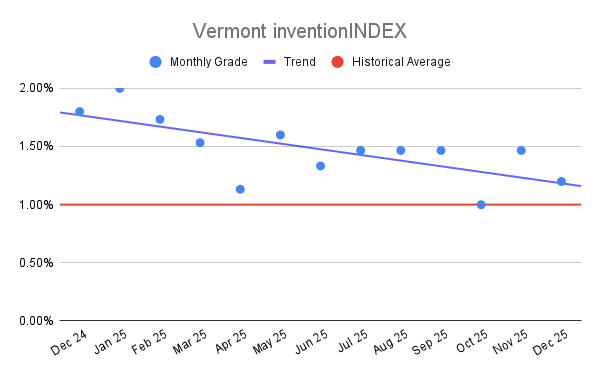 Vermont inventionINDEX December 2025:
  Vermont inventionINDEX November
