

The Vermont Department of Taxes is the central administrative authority responsible for overseeing the state’s revenue systems and implementing the Research and Development tax credit as authorized under 32 V.S.A. § 5930ii. It provides the essential regulatory framework, technical guidance, and reporting forms required for taxpayers to claim a nonrefundable credit equal to 27 percent of the federal incentive for qualified research activities conducted within the state.
The Administrative Essence of the Vermont Department of Taxes
The Vermont Department of Taxes serves as the primary arbiter of state fiscal policy, functioning as the bridge between the legislative intent of the General Assembly and the practical application of the tax code for businesses and individuals. In the context of the Research and Development (R&D) tax credit, the Department’s role is multi-dimensional, encompassing the duties of a regulator, an educator, and a public reporter. Its authority is rooted in the broader mandate to ensure that every member of society contributes their proportional share toward the expense of state protection, while simultaneously managing a suite of tax expenditures designed to stimulate specific economic behaviors, such as innovation and capital investment.
The Department is led by the Commissioner of Taxes, who is tasked with the interpretation of complex statutes and the promulgation of rules that define how taxpayers interact with the state’s tax base. For the R&D tax credit specifically, the Department does not operate in a vacuum but rather through a sophisticated framework of federal conformity. This means the Department must maintain a continuous and nuanced understanding of the Internal Revenue Code (IRC), particularly 26 U.S.C. § 41, as the Vermont credit is structurally tied to the federal definitions of qualified research and eligible expenditures.
Beyond simple revenue collection, the Department manages the Vermont Taxpayer Assistance Window and provides a repository of technical bulletins and formal rulings that clarify the state’s position on various tax treatments. In the realm of R&D, this involves detailing how multi-state corporations must apportion their expenses to isolate those activities occurring strictly within Vermont’s borders. The Department’s administrative oversight ensures that the R&D credit—which represents a significant tax expenditure of several million dollars annually—is utilized in a manner that adheres to the statutory goal of attracting and retaining intellectual-property-based companies.
The Statutory Architecture of the Research and Development Tax Credit
The legal foundation for the Vermont R&D credit is found in 32 V.S.A. § 5930ii, a statute that reflects the state’s strategic desire to compete in the high-tech and manufacturing sectors. Originally enacted in 2009 during a special session of the legislature, the credit was designed to provide a piggyback incentive to the existing federal R&D tax credit. The current iteration of the law, which became effective on January 1, 2014, sets the credit rate at 27 percent of the federal credit amount attributable to Vermont-based research.
The statute is remarkably concise but carries profound implications for the Department’s administrative procedures. Subsection (a) establishes the eligibility criteria, linking the state credit to the federal tax credit allowed under 26 U.S.C. § 41(a). Subsection (b) provides for a ten-year carryforward period, acknowledging that R&D-heavy firms—particularly startups—may not have immediate tax liability to offset but require long-term incentives to remain in the state. Subsection (c) introduces a unique transparency requirement, mandating that the Department publish an annual list of all claimants, thereby placing the R&D credit in a different category of public disclosure than most other confidential tax filings.
The legislative intent behind this structure is explicitly detailed in 32 V.S.A. § 5813, which provides a comprehensive list of the statutory purposes for various tax expenditures. The purpose of the R&D credit is to encourage business investment in research and development within Vermont and to attract and retain intellectual-property-based companies. This mission statement serves as the guiding principle for the Department of Taxes when it issues guidance or conducts audits.
| Statutory Authority | Provision Detail | Administrative Application |
|---|---|---|
| 32 V.S.A. § 5930ii(a) | 27% Credit Rate | Recomputation of hypothetical federal credit based on VT QREs. |
| 32 V.S.A. § 5930ii(b) | 10-Year Carryforward | Tracking of unused credits on Schedule BA-404. |
| 32 V.S.A. § 5930ii(c) | Transparency List | Annual publication of claimant names by January 15. |
| 32 V.S.A. § 5813(p) | Statutory Purpose | Justification for the credit’s impact on VT’s tech sector. |
| 26 U.S.C. § 41 | Federal Definition | Requirement for activities to meet the IRS “Four-Part Test.” |
Local State Revenue Office Guidance and Procedural Standards
The Vermont Department of Taxes provides guidance primarily through its official instructions for various tax schedules and, occasionally, through technical bulletins. Because the R&D credit is so closely aligned with federal law, much of the Department’s guidance focuses on the mechanics of the recomputation and the apportionment of research activities.
The Recomputation Requirement
A critical piece of guidance from the Department of Taxes is the requirement that the Vermont credit cannot be calculated by simply taking 27 percent of the final number on a taxpayer’s federal Form 6765, unless 100 percent of the research was conducted in Vermont. If a taxpayer has research expenditures in multiple states, the Department requires a hypothetical recomputation. This means the taxpayer must act as if Vermont were the only state where research occurred and apply all federal rules—including those for the base amount and the choice of the Regular Method or the Alternative Simplified Credit (ASC)—to Vermont-only data.
The Department of Taxes highlights that Vermont does not create its own separate base rules; it strictly follows the federal Section 41 rules but requires them to be applied to Vermont-sourced Qualified Research Expenditures (QREs) and Vermont-sourced gross receipts. This ensures that the state is only incentivizing the incremental increase of research activity within its own geography, rather than subsidizing a company’s global expansion.
Form BA-404 and Compliance Documentation
To claim the credit, the Department directs taxpayers to use Schedule BA-404, titled “Vermont Tax Credits Earned, Applied, Expired and Carried Forward”. This form serves as the central ledger for all nonrefundable credits. The Department’s instructions for BA-404 emphasize that specific documentation must be attached to the return to substantiate an R&D claim. Failure to provide these attachments can lead to the immediate denial of the credit during initial processing.
The essential documentation includes:
- Federal Form 6765: A copy of the credit for increasing research activities as filed with the IRS.
- Breakdown of Expenditures: A spreadsheet or detailed statement showing the total federal QREs and the specific portion attributable to Vermont.
- Recomputed Calculation: A worksheet showing the hypothetical federal credit calculation based solely on the Vermont expenditures.
- Grant Disclosures: If a taxpayer has received public or private grants (such as NASA or SBIR funds) to support the research, the Department requires that the basis for the credit calculation be adjusted downward by the amount of that assistance.
Apportionment and Income Sourcing
For corporations and other entities with activity outside of Vermont, the Department requires Schedule BA-402, the Apportionment and Allocation Schedule. This is where the Department’s guidance on Business Income vs. Non-Apportionable Income becomes relevant. The R&D credit is generally limited to the tax liability attributable to the Vermont-apportioned income of the business.
The Department has issued specific regulations (e.g., Reg. § 1.5833-1) regarding the allocation and apportionment of income. A major shift in this guidance occurred in 2023 when the state transitioned to a single sales factor apportionment method. This means that the Everywhere receipts of a company are compared against its Vermont-sourced receipts to determine the percentage of its global income that Vermont may tax—and thus, the maximum amount of tax that the R&D credit can offset in a given year.
Technical Application of the Federal “Four-Part Test” in Vermont
The Department of Taxes adopts the IRS “Four-Part Test” to define what constitutes Qualified Research. The Department’s reliance on these federal standards provides a consistent set of rules for taxpayers, but the in-state requirement adds a layer of complexity to the application.
- The Permitted Purpose Test: The research must be intended to develop a new or improved business component, which the Department defines as any product, process, computer software, technique, formula, or invention held for sale, lease, or license, or used by the taxpayer in its trade or business.
- The Elimination of Uncertainty Test: The taxpayer must demonstrate that the activities were intended to discover information that would eliminate uncertainty concerning the development or improvement of the business component. This means that if the solution was already known or could be determined through standard engineering practices, the Department may challenge the credit.
- The Process of Experimentation Test: Substantially all of the activities must constitute elements of a process of experimentation, which involves the evaluation of alternatives through modeling, simulation, or systematic trial and error. The Department requires documentation showing that various designs or methods were tested and rejected.
- The Technological in Nature Test: The process of experimentation must fundamentally rely on the principles of the physical or biological sciences, engineering, or computer science. Market research, consumer surveys, and aesthetic research are expressly excluded by the Department, as they are not technological.
Defining Qualified Research Expenditures (QREs)
The Department’s guidance on what costs can be included in the Vermont recomputation mirrors the federal definitions of QREs but restricts them geographically.
| QRE Category | Eligibility Requirements | Vermont-Specific Guidance |
|---|---|---|
| Wages | Must be “qualified services” (performing, supervising, or supporting research). | Only wages taxable in Vermont for employees working in VT are eligible. |
| Supplies | Tangible materials used or consumed in the research process. | Excludes land and depreciable property; must be used in a VT facility. |
| Contract Research | 65% of payments to third parties for qualified research. | The contractor must physically perform the research within Vermont. |
| Computer Rental | Costs for leasing computers used exclusively for research. | Often applies to cloud-based server costs for software development. |
Detailed Analysis of the Transparency and Reporting Requirements
Under 32 V.S.A. § 5930ii(c), the Vermont Department of Taxes is mandated to publish an annual list containing the names of the taxpayers who have claimed the R&D credit during the most recently completed calendar year. This provision is a significant departure from the standard confidentiality of tax returns and serves several administrative and policy functions.
First, it acts as a mechanism for public accountability. Because the R&D credit is a tax expenditure—meaning it represents revenue that the state has chosen not to collect—the legislature believes the public has a right to know which entities are benefiting from the policy. Second, it allows the Department of Economic Development and the Agency of Commerce and Community Development to track the success of their efforts to attract intellectual-property-based companies.
For taxpayers, this means that claiming the Vermont R&D credit is a public act. Professional practitioners advise their clients that they must be prepared for their participation to be public knowledge, which reinforces the need for rigorous documentation. If a company is listed as a claimant but cannot support its claim during a subsequent audit, the resulting disallowance—and potential for public scrutiny—can be a significant reputational risk. The Department’s annual reports, such as RP-1298, typically show a diverse range of industries, from aerospace and manufacturing to software development and biotechnology.
Comparative Analysis: The General R&D Credit vs. The Enterprise Zone Incentive
The Department of Taxes also oversees a distinct, though often confused, incentive related to research: the Enterprise Zone (EZ) R&D Tax Credit. While the general credit under § 5930ii is available statewide and provides a 27 percent match of the federal credit, the EZ credit is a targeted geographic tool.
The Enterprise Zone program is designed for businesses located in 16 designated zones characterized by high unemployment, low per capita income, or slow population growth. Under this program, eligible businesses can earn a 3 percent state income tax credit for the increase in their annual R&D expenses compared to the previous two years.
Key differences in administrative guidance between the two credits include:
- Approval Process: The general credit is claimed directly on the tax return via BA-404. The EZ credit requires a pre-certification application to the local enterprise zone administrator and a subsequent tax credit certificate from the Department of Taxes.
- Utilization: The general credit is 27 percent of a hypothetical federal amount and can be carried forward for 10 years. The EZ credit must be claimed in four equal installments (25% each) over four years.
- Exclusions: Both credits exclude land and equipment, but the EZ credit has stricter presence requirements, necessitating three years of operation within the zone to qualify.
This dual-pathway system allows the Department of Taxes to incentivize research broadly across the state while providing additional, specialized support for innovation in economically distressed areas.
The Impact of State Apportionment Reform on Credit Utilization
A vital context for understanding the Department of Taxes’ guidance is the 2023 shift to “single sales factor” apportionment for all business income. Previously, Vermont used a multi-factor formula involving property, payroll, and sales. The move to a single sales factor aligns Vermont with modern tax trends but has profound implications for how the R&D credit is used by multi-state taxpayers.
Under the new guidance, a company’s tax liability is determined entirely by where its customers are located. If a company does 100 percent of its research in Vermont (generating a large R&D credit) but sells 95 percent of its products to customers in New York and Massachusetts, its Vermont tax liability will be relatively small. Since the R&D credit is nonrefundable and can only offset Vermont tax liability, the company may find itself generating credits far in excess of what it can use in the current year.
This highlights the importance of the ten-year carryforward provision managed by the Department. The Department’s guidance on Schedule BA-404 requires taxpayers to meticulously track these Carryforward Amounts from Prior Years in Column A to ensure that they are not lost. The single sales factor reform essentially makes Vermont a tax haven for research-heavy companies that export their products, as the R&D credit can effectively eliminate the modest tax liability generated by in-state sales.
Procedural Example: Hypothetical Recomputation and Apportionment
To demonstrate how the Department of Taxes applies the law and its guidance in a practical scenario, consider “AeroVT,” a manufacturer of composite aircraft parts based in Rutland, Vermont, with research labs in both Vermont and California.
Phase 1: Identifying Qualified Research Expenditures (QREs)
In the current tax year, AeroVT has $4,000,000 in total QREs nationwide. However, the Department of Taxes requires that only the Vermont-based portion be used for the state credit. AeroVT’s breakdown is as follows:
- Vermont-Based Wages: $1,200,000 (Researchers physically located in Rutland).
- Vermont-Based Supplies: $300,000 (Composite resins used in the Rutland lab).
- California-Based Wages: $2,500,000 (Excluded from the Vermont calculation).
- Total Vermont QREs: $1,500,000.
Phase 2: The Hypothetical Federal Recomputation
AeroVT must now calculate what its federal credit would have been if its only QREs were the $1,500,000 spent in Vermont. Assuming AeroVT uses the federal Alternative Simplified Credit (ASC) method, it must look at its prior three years of Vermont-only QREs.
If AeroVT’s average Vermont QREs for the prior three years was $1,000,000, the calculation follows the federal ASC formula:
- Current VT QREs: $1,500,000.
- Base (50% of 3-year average): $500,000.
- Incremental Increase: $1,000,000 ($1,500,000 – $500,000).
- Hypothetical Federal Credit: $1,000,000 × 14% = $140,000.
Phase 3: Applying the Vermont Rate
Once the hypothetical federal credit of $140,000 is established, AeroVT applies the statutory rate administered by the Department of Taxes.
Vermont R&D Credit = $140,000 × 27% = $37,800
Phase 4: Filing and Documentation
AeroVT enters $37,800 on Line 1 of Schedule BA-404. Along with its income tax return (e.g., Form CO-411), AeroVT must attach:
- A copy of its federal Form 6765 showing the $4,000,000 nationwide claim.
- A spreadsheet showing the $1,500,000 Vermont breakdown.
- The recomputation worksheet showing the $37,800 result.
If AeroVT has a total Vermont tax liability of $50,000 (after apportionment on BA-402), it can use the full $37,800 credit to reduce its current tax bill to $12,200. If its liability was only $20,000, it would pay $0 and carry forward the remaining $17,800 for up to ten years.
Unitary Group Administration and Credit Sharing
The Vermont Department of Taxes provides specialized guidance for Unitary Businesses, which are groups of related companies that operate as a single economic unit. Under Act 148 and subsequent rulemaking, the Department requires a single Schedule BA-404 to be filed for the entire unitary group, even if multiple entities within the group earned credits.
A nuanced point in the Department’s guidance is how these credits are applied against the group’s tax liability. Generally, tax credits are limited to a percentage of the tax attributable to the income generated by the entity authorized for the credit. This creates a silo effect where the R&D credit earned by Company A in a unitary group cannot necessarily be used to offset the tax liability generated by Company B’s sales, unless specific combined filing exceptions apply.
The Department’s instructions for Form CO-411 and Schedule CO-421 (Unitary Affiliate Schedule) are essential for navigating these rules. Taxpayers must provide a statement that breaks down the combined totals on Schedule BA-404 by each individual entity to ensure that the credit follows the earner. This administrative requirement prevents large corporate groups from shifting credits arbitrarily between subsidiaries to maximize their tax benefit.
Audit Red Flags and the Department’s Compliance Strategy
The Department of Taxes utilizes its audit authority to protect the integrity of the R&D tax credit program. Through formal rulings and compliance guidance, the Department has identified several red flags that may trigger a more in-depth review of an R&D claim.
- Excessive Officer Wages: Including 100 percent of a CEO or CTO’s wages as QREs is a frequent point of contention. The Department requires proof that the officer was directly performing or supervising the research, rather than performing general administrative or fundraising duties.
- Inconsistent Apportionment: If a company’s payroll factor on Schedule BA-402 shows that only 10 percent of its employees are in Vermont, but it claims 90 percent of its R&D wages were Vermont-sourced, the Department will likely demand a detailed payroll audit.
- Lack of Project Records: If a company cannot provide the “Business Component” names and types, as now required by the expanded federal Form 6765 (Sections E and G), the Vermont Department will likely find the claim unsubstantiated.
- Double-Dipping with Grants: The Department explicitly warns against claiming the credit on expenditures that were already funded by state or federal grants. A failure to disclose such funding is considered a significant compliance violation.
The Department’s audit guidelines suggest that taxpayers should retain R&D documentation for at least three to seven years, and ideally for the entire ten-year carryforward window, as the validity of a “carried forward” credit can be questioned in any year it is actually applied against tax.
Economic Policy Implications: Vermont’s Comparative Standing
The Department of Taxes’ administration of the 27 percent credit rate places Vermont among the most aggressive states in the nation for research incentives. For comparison, many states offer credits ranging from 5 percent to 15 percent of QREs, or a smaller percentage of the federal credit.
| State | R&D Credit Mechanism | Vermont Comparison |
|---|---|---|
| Vermont | 27% of federal credit (Prorated) | High-tier rate; focuses on VT-sourced QREs. |
| Minnesota | 10% of first $2M; 4% above | Tiered rate favors smaller, incremental growth. |
| Arizona | 24% of first $2.5M; 15% above | High rate with refundable options for small firms. |
| Maryland | Evaluation-based approval | Requires pre-approval; more restrictive than VT. |
| Florida | 10% of excess QREs | Focused on targeted sectors like biotech. |
The Vermont Department of Taxes’ guidance emphasizes simplicity through its alignment with federal IRC § 41, which reduces the administrative burden for taxpayers compared to states that require a completely separate state-level calculation. This simplicity coupled with high rates is a deliberate policy choice by the General Assembly, executed by the Department, to make Vermont an attractive destination for high-value intellectual property development.
Final Thoughts: Synthesizing the Department’s Administrative Legacy
The Vermont Department of Taxes is not merely a passive recipient of tax returns; it is an active steward of a strategic economic incentive designed to bolster the state’s future in the knowledge economy. By maintaining a high 27 percent credit rate, enforcing rigorous recomputation and apportionment standards, and adhering to a unique transparency mandate, the Department ensures that the R&D credit under 32 V.S.A. § 5930ii is both a powerful business tool and a fiscally responsible program.
The Department’s role in providing clear guidance—particularly on the transition to single sales factor apportionment and the nuances of unitary group filing—is vital for the professional tax community. As federal tax laws continue to evolve, the Department’s commitment to conformity and administrative clarity will remain the cornerstone of Vermont’s innovation strategy. For businesses operating in the state, the R&D tax credit represents more than just a line item on Schedule BA-404; it is a testament to Vermont’s investment in the scientific and technological advancements that will drive its economic prosperity for years to come.





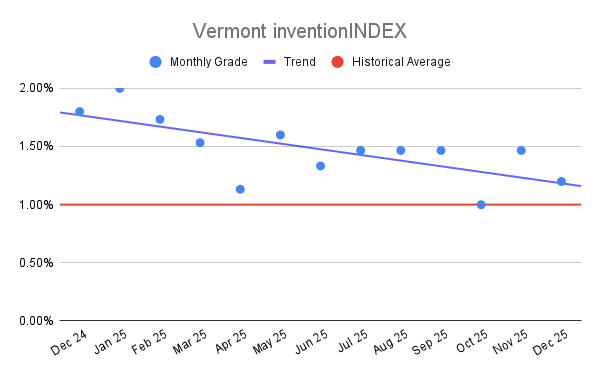 Vermont inventionINDEX December 2025:
  Vermont inventionINDEX November
