

In the context of the Vermont Research and Development tax credit, engineering and computer science represent the foundational “hard sciences” required to transform routine business activities into qualified research. Under 32 V.S.A. § 5930ii, these disciplines are defined by the systematic application of their core principles to resolve technical uncertainties during the creation or improvement of business components.
The legislative framework governing the Vermont Research and Development (R&D) tax credit is designed to serve as a powerful economic catalyst, specifically targeting the growth of intellectual-property-based industries within the state’s borders. By providing a nonrefundable credit equal to 27 percent of the federal credit allowed for in-state expenditures, Vermont incentivizes a rigorous, scientifically-driven approach to innovation. This incentive structure is not merely a subsidy for technical labor; it is a statutory recognition of the “positive externalities” generated when private firms invest in the discovery of new technological information. In the professional domains of engineering and computer science, this translates to a requirement that any qualifying activity must move beyond the mere application of existing knowledge and instead engage in a documented process of experimentation aimed at overcoming specific technical hurdles.
The meaning of engineering in this regulatory environment is anchored in the physical and biological sciences, requiring a level of investigation that seeks to improve the functionality, performance, or reliability of tangible products and manufacturing processes. Conversely, the meaning of computer science is defined by the advancement of algorithmic complexity, data structures, and software architecture. For software development to be recognized as a computer science activity under the law, it must bypass the exclusions for routine coding and aesthetic design, focusing instead on the resolution of uncertainties inherent in complex systems integration, scalability, or novel computational methods. This report provides an exhaustive analysis of these definitions, the specific guidance issued by the Vermont Department of Taxes, and the mechanical application of the law through practical examples and case studies.
Statutory Authority and the Evolution of 32 V.S.A. § 5930ii
The primary legal authority for the credit is found in 32 V.S.A. § 5930ii, a section that explicitly links the state’s tax benefits to the federal standards set forth in 26 U.S.C. § 41. The statute stipulates that a taxpayer is eligible for a credit against the tax imposed by the state in an amount equal to 27 percent of the federal tax credit allowed in the taxable year for eligible R&D expenditures made within Vermont. This percentage has seen historical adjustments, notably being reduced from 30 percent to the current 27 percent for tax years beginning on or after January 1, 2014.
The law also provides for a robust 10-year carryforward period, allowing businesses to apply unused credits to future income tax liabilities. This is particularly critical for startups in the engineering and computer science sectors, where initial years may be characterized by high R&D spending without immediate profitability. The statute further mandates a level of transparency unique to Vermont, requiring the Department of Taxes to publish an annual list of taxpayers who have claimed the credit. This “Transparency List” serves as a public oversight mechanism, ensuring that the state’s investment in innovation is documented and verifiable.
| Statutory Component | Detail | Legal Reference |
|---|---|---|
| Credit Percentage | 27% of the federal credit attributable to Vermont | 32 V.S.A. § 5930ii(a) |
| Federal Alignment | Piggybacks on IRC § 41 standards | 32 V.S.A. § 5930ii(a) |
| Carryforward Period | 10 years for unused portions | 32 V.S.A. § 5930ii(b) |
| Claimant Disclosure | Annual publication of names of all credit earners | 32 V.S.A. § 5930ii(c) |
| Qualifying Activity Location | Must be conducted within the borders of Vermont | 32 V.S.A. § 5930ii(a) |
The administrative philosophy of the Vermont Department of Taxes emphasizes simplicity through federal alignment. Rather than creating a separate state-specific “base amount” for the credit calculation, Vermont utilizes a prorated share of the federal credit, effectively adopting the federal government’s rigorous definitions of what constitutes “qualified research”. This means that the “meaning” of engineering and computer science in Vermont is inextricably tied to the federal four-part test, but with a strict geographical constraint: only those activities and expenditures occurring within Vermont qualify for the 27 percent multiplier.
The Four-Part Test: The Definitional Core of Engineering and Computer Science
For a taxpayer to successfully claim that their work constitutes engineering or computer science in the eyes of the Vermont revenue office, the activity must satisfy the four-part test derived from IRC § 41(d). This test serves as the analytical sieve that separates qualifying research from non-qualifying business activities.
The Technological in Nature Requirement
This first part of the test defines the disciplinary boundaries of the credit. The research must fundamentally rely on the principles of the “hard sciences,” such as physical or biological science, engineering, or computer science. In a professional engineering context, this requires the application of mechanics, thermodynamics, or materials science to solve a problem. In the computer science realm, the activity must rely on data science, algorithm design, or computational theory. Activities based on the social sciences, economics, or humanities are explicitly excluded from the definition. This distinction is vital for Vermont firms; for instance, a software company cannot claim the credit for user-experience (UX) research that focuses on human psychology, but it can claim for the engineering required to reduce the latency of the software that delivers that UX.
The Permitted Purpose Requirement
The second part of the test mandates that the research must be undertaken for the purpose of discovering information that would be useful in the development of a new or improved “business component”. A business component is broadly defined as any product, process, software, technique, formula, or invention that is held for sale, lease, or license, or is used in the taxpayer’s trade or business. The “meaning” here is functional: the research must aim to improve the performance, reliability, quality, or functionality of the component. Engineering efforts to make a machine more durable or computer science efforts to make a database more secure are classic examples of meeting this requirement.
The Elimination of Uncertainty Requirement
The third component of the test is the presence of technical uncertainty. The taxpayer must demonstrate that, at the beginning of the research activity, the information available did not establish the capability or method for developing or improving the business component, or the appropriate design of that component. This is the “Section 174 Test”. In engineering, uncertainty might exist regarding whether a new alloy can withstand specific environmental stressors. In computer science, it might involve whether a specific machine learning model can achieve the required accuracy with a limited dataset. If the solution is commercially available or can be reached through routine engineering or coding, the uncertainty is considered non-existent, and the credit is denied.
The Process of Experimentation Requirement
The final part of the test requires that substantially all of the activities constitute a process of experimentation. This is defined as a systematic evaluation of one or more alternatives to achieve the desired result, typically involving trial and error, modeling, simulation, or the refinement of hypotheses. For a Vermont engineer, this might involve building and testing multiple prototypes. For a software developer, this involves iterative coding cycles, unit testing, and rigorous debugging to overcome the technical uncertainties identified in the previous step.
Local Revenue Office Guidance and Documentation Standards
The Vermont Department of Taxes provides technical guidance primarily through tax form instructions, specifically for Form BA-404 and its associated schedules. This guidance is designed to ensure that the 27 percent credit is only applied to the portion of the federal credit that is truly “Vermont-sourced”.
The Requirement for Federal Form 6765 and Form BA-404
A taxpayer claiming the Vermont R&D credit must first calculate and claim the federal R&D credit using IRS Form 6765. The state credit is not an independent calculation from the ground up; it is a derivative of the federal filing. Vermont Schedule BA-404 must be completed and attached to the state income tax return (such as Form CO-411 for corporations or IN-111 for individuals).
Revenue office guidance for Form BA-404 emphasizes several critical points:
- Recomputation for Multi-State Entities: If a company conducts R&D in multiple states, it cannot simply apply 27 percent to its total federal credit. It must provide a recomputed credit calculation based only on the expenditures that occurred in Vermont. This is known as the “hypothetical federal credit” calculation.
- Documentation Retention: While businesses are not required to submit all R&D logs with their return, they must retain documentation for at least 3 to 7 years, aligned with federal standards. This documentation must support the proration accuracy and prove that the activities occurred in-state.
- Authorization Documents: For certain credit types listed on BA-404, authorization from other state agencies is required; however, the R&D credit (Line 1 or Line 3 depending on the form version) generally requires a detailed description of the activity and a calculation schedule to be kept on file.
Audit Guidelines and the “Substantially All” Rule
State audits in Vermont focus heavily on the “proration accuracy”. This involves verifying that the wages, supplies, and contract research costs claimed were actually incurred for work performed within the state’s borders. Auditors also look for the “substantially all” rule (often the 80% rule), which requires that at least 80 percent of a business component’s research activities involve a process of experimentation. If a project falls below this threshold, the entire project may be disqualified.
| Document Category | Required Evidence for Vermont R&D Credit | Source/Audit Focus |
|---|---|---|
| Financial Records | Payroll registers, general ledger detail for R&D supplies | Proration Accuracy |
| Federal Filing | Copy of IRS Form 6765 (Credit for Increasing Research Activities) | Eligibility Foundation |
| Project Records | Technical specs, design logs, Innovation Logs, meeting minutes | Four-Part Test |
| Experimental Data | Prototype photos, testing protocols, trial-and-error results | Process of Experimentation |
| Contracts | Invoices and agreements for third-party research (65% eligible) | Risk and Rights |
Meaning of Computer Science: Software Development and the IUS High Threshold
In the realm of computer science, Vermont tax law distinguishes between software developed for commercial sale and software developed for “Internal Use” (IUS). This distinction carries significant weight, as IUS must pass a more stringent “High Threshold of Innovation” test to qualify for the credit.
Defining Internal Use Software (IUS)
IUS is defined as software developed by a taxpayer for its own use in general and administrative functions. These functions include human resources, financial management (payroll, bookkeeping), and other back-office support services. Conversely, software is not considered IUS if it is developed to be commercially sold, leased, licensed, or if it facilitates interactions with third parties (such as customers or vendors).
For IUS to qualify as R&D, it must satisfy the standard four-part test plus three additional “High Threshold” criteria:
- Innovation: The software must be intended to be innovative, resulting in a reduction in cost or improvement in speed that is substantial and economically significant.
- Significant Economic Risk: The taxpayer must commit substantial resources to the development, and there must be substantial uncertainty that those resources will be recovered within a reasonable period.
- Commercial Availability: A comparable third-party software must not be available for purchase, lease, or license in the commercial market.
Computer Science vs. Routine IT Activities
Professional guidance from the revenue office and expert advisors clarifies that “computer science” in R&D does not include routine IT maintenance.
| Non-Qualifying Software Activities | Qualifying Computer Science Research |
|---|---|
| Routine debugging and post-launch bug fixes | Development of novel machine learning algorithms |
| Cosmetic UI tweaks or stylistic choices | Overcoming scalability hurdles in cloud architecture |
| Data migration or hardware setup | Engineering zero-trust cybersecurity frameworks |
| Basic customization of off-the-shelf software | Designing new data pipelines for real-time processing |
| Sales demos or market analysis | Creating prototypes to test system interoperability |
For software companies in Vermont, such as those in the FinTech or SaaS sectors, the “meaning” of computer science is thus the act of engineering the engine of the software, not just the interface.
Meaning of Engineering: Prototypes, Manufacturing, and Materials
Engineering for the Vermont R&D credit is broadly interpreted but strictly documented. It covers activities beginning with the development of concepts and extending to the point where a product or process is ready for commercial release.
The Role of Prototypes and Trials
A core component of qualifying engineering is the design and development of prototypes. In a typical Vermont manufacturing scenario, a company might seek to develop a new “Flexible Manufacturing System” (FMS). The engineering team encounters uncertainties regarding the appropriate design of electronic interfaces and the integration of legacy systems. The “meaning” of engineering here is the work done to resolve these uncertainties through the creation of a series of prototypes and the subsequent analysis of trial data.
Advanced Manufacturing and Process Engineering
Engineering also encompasses the improvement of manufacturing processes. If a Vermont-based machine shop develops a new technique for precision machining that involves technical risk and a process of experimentation, the labor and material costs associated with that development qualify. This is particularly relevant for businesses in the Vermont Rural Economic Area Partnership (REAP) Zones or enterprise zones, where the state provides additional incentives for capital-intensive manufacturing research.
Engineering in the Life Sciences
For Vermont’s biotech and medical device firms, engineering often overlaps with biological sciences. Qualifying research includes the development of diagnostic tools or medical devices where the “meaning” of engineering is the application of mechanical and electrical principles to ensure safety, reliability, and precision in a medical context.
Calculating the Vermont Credit: The Hypothetical Federal Method Example
To illustrate the mechanical application of the Vermont R&D tax credit law, we must examine a hypothetical scenario involving a software firm with operations in both Vermont and Massachusetts. This example demonstrates how the “meaning” of in-state activity is enforced through the calculation.
Scenario: Vermont-Based SaaS Provider
A software company, “Green Mountain Tech,” develops a new AI-driven analytics platform. It employs 10 developers: 6 in its Burlington, Vermont office and 4 working remotely from Massachusetts.
Step 1: Identify Total Nationwide QREs
The company spends $1,000,000 on developer wages and $200,000 on cloud hosting costs for experimentation.
Total Nationwide QREs = $1,200,000.
Step 2: Apportion QREs to Vermont
Only the wages of the 6 Vermont developers qualify for the Vermont credit calculation.
Vermont Wages = $600,000.
Vermont Cloud Costs (used for VT-based experimentation) = $100,000.
Total Vermont QREs = $700,000.
Step 3: Establish the Vermont-Only Base Amount
Assume the company uses the federal Alternative Simplified Credit (ASC) method. To calculate the Vermont credit, it must determine its average Vermont QREs for the three preceding years.
Prior 3-Year Average VT QREs = $400,000.
ASC Base (50% of the 3-year average) = $200,000.
Step 4: Compute the Hypothetical Federal Credit for Vermont
Incremental Vermont QREs = $700,000 – $200,000 = $500,000.
Hypothetical Federal Credit (ASC rate of 14%) = $500,000 \times 0.14 = $70,000.
Step 5: Apply the Vermont 27% Rate
Vermont R&D Tax Credit = $70,000 \times 0.27 = $18,900.
Result: Green Mountain Tech earns an $18,900 nonrefundable credit to offset its Vermont corporate income tax. If its tax bill is only $10,000, the remaining $8,900 can be carried forward for 10 years.
Calculation Logic Table: Multi-State vs. In-State
| Calculation Step | Federal (Nationwide) | Vermont (In-State Only) |
|---|---|---|
| QRE Identification | $1,200,000 | $700,000 |
| Base Calculation | Based on nationwide history | Based on VT-only history |
| Federal Credit | $1,200k – Base \times 14% | $700k – Base \times 14% |
| Vermont Multiplier | N/A | 27% of VT-hypothetical |
| Carryforward | 20 Years (Federal) | 10 Years (Vermont) |
Case Study: Manufacturing Innovation in Burlington
A real-world example of this process is found in a multi-year look-back study conducted for a manufacturing company in Burlington, Vermont. This company engaged in various research activities from 2018 through 2020, focusing on the development of new product concepts and manufacturing process improvements.
By identifying its qualifying research activities (QRAs) and calculating its QREs specifically for its Vermont operations, the company was able to recover significant tax benefits.
| Tax Year | Total VT QREs | Federal Credit Portion | Vermont State Credit (27%) |
|---|---|---|---|
| 2018 | $859,199 | $85,920 | $23,198 |
| 2019 | $927,935 | $92,793 | $25,054 |
| 2020 | $1,002,170 | $100,217 | $27,059 |
| Total | $2,789,304 | $278,930 | $75,311 |
The “meaning” of engineering in this case was the iterative refinement of product designs that allowed the company to move from a conceptual stage to a commercially releasable product. The documentation provided to support this claim included design logs, testing results, and detailed payroll allocations for the engineers involved in the project.
Special Considerations: Pass-Through Entities and Unitary Groups
Vermont revenue guidance provides specific instructions for different entity types, ensuring the credit is applied correctly regardless of business structure.
Pass-Through Treatment (S-Corps, Partnerships, LLCs)
For entities that do not pay tax at the corporate level, the R&D credit is distributed to the owners (shareholders, partners, or members) in the same proportion as income distributions. These owners then report the credit on their individual Vermont returns (Form IN-111) using Schedule IN-112 or IN-119. This allows small engineering firms and software consultancies organized as LLCs to pass the benefit of their research directly to their owners.
Unitary Combined Reporting
For larger corporations that are part of a unitary group, Vermont requires a combined return. Guidance for Schedule BA-404 states that if multiple entities within a unitary group are reporting credits, a single Schedule BA-404 should be attached, combining all credit amounts. However, a critical limitation exists: the credit may generally only be applied to offset the tax of the specific entity that was authorized to earn the credit, although unitary groups are treated as a single taxpayer for income calculation purposes. This requires careful “separate company” income and tax statements within the consolidated filing.
The Convergence of Engineering and Computer Science: IoT and Systems Integration
In many modern Vermont R&D projects, the distinction between engineering and computer science becomes blurred, particularly in fields like the Internet of Things (IoT) or advanced medical robotics. In these instances, the revenue office looks for the “shrink-back” rule, which allows the taxpayer to apply the four-part test to a smaller sub-component of a project if the project as a whole does not qualify.
Study Case: Building Management System Integration
A study case involving the integration of design, CRM, and accounting software into a single building project management system illustrates this convergence. The research focused on whether a management system could be designed to manage all aspects of a building project by integrating disparate software functions. The “meaning” of the activities involved:
- Engineering: Designing the electronic interfaces and hardware components.
- Computer Science: Developing new software models to increase functionality and automating complex workflows.
- Experimentation: Building a prototype model and conducting trials to analyze whether the theoretical design phase could be realized in a functional system.
This holistic approach to R&D highlights how Vermont’s credit supports multi-disciplinary innovation where engineering and computer science work in tandem to create sophisticated business components.
Exclusions and Pitfalls in Engineering and Computer Science Claims
To maintain the integrity of the credit, the law and associated guidance establish clear boundaries for what is not considered R&D.
Statutory Exclusions
Under federal rules adopted by Vermont, several categories of activity are explicitly disqualified:
- Research after Commercial Production: Once a product is ready for commercial release, further activities are generally considered maintenance or production, not research.
- Adaptation of Existing Components: Routine customization of an existing product for a specific customer’s requirements does not qualify.
- Foreign Research: Any research performed outside the United States is excluded. This is especially important for Vermont software firms that may use offshore developers; their wages are 0% eligible for both federal and state credits.
- Funded Research: If the taxpayer is being paid by a third party to conduct research and does not retain substantial rights or bear the financial risk, the research is considered “funded” and is excluded.
Common Pitfalls in Computer Science
In the computer science sector, many businesses mistakenly believe that all “coding” is R&D. Common mistakes that lead to audit adjustments include claiming:
- User support and troubleshooting.
- Market research or surveys.
- Routine web development using standard libraries and tools.
- Pre-production planning that does not involve technical uncertainty.
The Economic Impact and Future Outlook of the Credit
The Vermont R&D tax credit is a significant part of the state’s tax expenditure budget, costing millions of dollars in foregone revenue each year to drive high utilization in tech and manufacturing sectors. A review by the Office of Revenue Analysis found that every dollar of investment in the credit returned $3.76 in state revenues, illustrating its effectiveness as an economic tool.
Future Regulatory Trends
Businesses should be aware of emerging trends in the R&D landscape, such as the modifications to IRS Form 6765 for the 2024 and 2025 tax years. The IRS is increasingly requiring qualitative information, such as the identification of specific business components, the number of components generating QREs, and the specific technical unknowns being addressed. Because Vermont follows federal standards, these reporting requirements will effectively become part of the Vermont documentation burden.
Additionally, the “One Big Beautiful Bill Act” (OBBBA) enacted in 2025 has modified IRC Section 174 to permit the immediate expensing of domestic R&D costs, a change from previous requirements to capitalize and amortize those costs over five years. This shift improves the cash-flow profile for Vermont engineering and computer science firms, making the R&D credit even more valuable.
Final Thoughts: Navigating the Intersection of Disciplinary Expertise and Tax Law
For the professional engineer or computer scientist in Vermont, the R&D tax credit is more than a financial incentive; it is a framework that rewards the scientific method. The “meaning” of these disciplines in the context of the law is defined by the rigorous pursuit of technical truth through experimentation.
Success in claiming the credit requires a dual commitment to technical innovation and administrative precision. Businesses must not only push the boundaries of what is possible in their fields but also meticulously document every step of that journey—from the identification of initial technical uncertainties to the final analysis of experimental data. By understanding the specific guidance of the Vermont Department of Taxes, particularly regarding the “hypothetical federal credit” and the unique transparency requirements, Vermont firms can secure the capital needed to fuel the next generation of technological breakthroughs.
The Vermont Research and Development tax credit, with its 27 percent rate and 10-year carryforward, stands as a testament to the state’s commitment to innovation. For the engineers and computer scientists driving this progress, it provides a vital bridge between the costs of discovery and the rewards of a successful, commercially viable product.





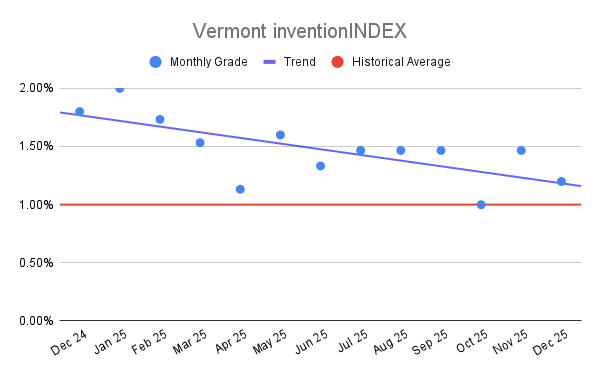 Vermont inventionINDEX December 2025:
  Vermont inventionINDEX November
