

What is the Elimination of Uncertainty for the Vermont R&D Tax Credit?
Elimination of uncertainty is a fundamental requirement for the Vermont Research and Development Tax Credit (32 V.S.A. § 5930ii). It necessitates that a taxpayer’s activities be intended to discover information to resolve technical unknowns regarding the capability, method, or appropriate design of a new or improved business component. This standard aligns with federal IRC § 41 and § 174 regulations, ensuring that qualifying research addresses a legitimate technological gap rather than routine engineering or aesthetic improvements.
Elimination of uncertainty refers to the systematic objective of discovering information to resolve technical unknowns regarding the capability, method, or optimal design of a new or improved business component. Under Vermont tax law, this standard is satisfied when the available technical information at the project’s inception does not establish the necessary means to achieve the desired development or improvement.
The concept of the elimination of uncertainty serves as the foundational pillar for qualifying research and development (R&D) activities at both the federal and state levels. In the specific jurisdiction of the State of Vermont, this principle is inextricably linked to the federal definitions provided under the Internal Revenue Code (IRC). The Vermont Research and Development Tax Credit, authorized under 32 V.S.A. § 5930ii, is structured as a “piggyback” credit, meaning its eligibility and core definitions are derived directly from federal standards established in IRC § 41 and § 174. Consequently, understanding the elimination of uncertainty requires an integrated analysis of federal statutory language, Treasury Regulations, and specific Vermont administrative guidance. The standard necessitates that a taxpayer demonstrate an intent to discover information that would resolve a technical gap. This gap is categorized into three specific domains: the capability of the taxpayer to develop the component, the method by which the development will occur, or the appropriate design of the final business component. Within the Vermont landscape, the Department of Taxes requires taxpayers to mirror these federal standards while maintaining a strict nexus to activities performed within the geographical boundaries of the state. This report provides an exhaustive examination of the elimination of uncertainty standard, its interaction with Vermont’s administrative rules, and the practical implications for businesses seeking to leverage this significant tax incentive.
Statutory Foundations and Vermont Regulatory Alignment
The Vermont Research and Development Tax Credit provides a nonrefundable incentive equal to 27% of the federal tax credit allowed for the taxable year, specifically for “eligible research and development expenditures” conducted within the state. The governing statute, 32 V.S.A. § 5930ii, explicitly leverages the federal rules in determining what constitutes a qualified research expenditure (QRE). This legal symmetry ensures that the “Elimination of Uncertainty” test, often referred to as the “Section 174 Test,” is the primary filter through which all Vermont R&D claims must pass.
The reliance on federal code means that any significant change at the federal level, such as those introduced by the Tax Cuts and Jobs Act (TCJA) of 2017, reverberates through the Vermont tax landscape. Historically, Section 174 permitted the immediate deduction of R&D expenses. However, starting in 2022, businesses were required to capitalize and amortize these costs over five years for domestic research and fifteen years for foreign research. While this change impacts the timing of deductions and increases taxable income in the short term, it does not alter the fundamental definition of the elimination of uncertainty as a qualifying criterion for the R&D credit under Section 41. For Vermont taxpayers, this necessitates a dual focus: ensuring activities meet the technical uncertainty standard to qualify for the 27% credit while simultaneously managing the amortization requirements for state and federal income tax purposes.
| Feature | Vermont R&D Tax Credit | Federal R&D Tax Credit (IRC § 41) |
|---|---|---|
| Statutory Authority | 32 V.S.A. § 5930ii | 26 U.S.C. § 41 |
| Credit Rate | 27% of the federal credit for Vermont QREs | 20% (Regular) or 14% (ASC) |
| Uncertainty Standard | Derived from IRC § 174 | Defined in Treas. Reg. § 1.174-2 |
| Carryforward Period | 10 Years | 20 Years |
| Refundability | Nonrefundable | Nonrefundable (except for specific small business payroll offsets) |
| Documentation | Federal Form 6765 + Vermont Schedule BA-404 | Federal Form 6765 |
The interplay between these statutes creates a rigorous environment for taxpayers. To claim the Vermont credit, a business must first establish eligibility for the federal credit, which includes passing the “Four-Part Test” where the elimination of uncertainty is the second requirement. The Vermont Department of Taxes emphasizes that if a taxpayer’s federal credit is disallowed due to a failure to prove technical uncertainty, the state credit is automatically invalidated. This makes the federal audit guidelines and Treasury Regulations the primary source of interpretative authority for Vermont revenue officers.
Defining the Elimination of Uncertainty Standard
The elimination of uncertainty test requires that the taxpayer’s research activities be intended to discover information that would resolve technical unknowns. These unknowns must exist at the outset of the project and must relate specifically to the business component being developed or improved. A business component is defined broadly as any product, process, software, technique, formula, or invention held for sale, lease, or license, or used in the taxpayer’s trade or business.
The Triple-Pronged Framework of Technical Uncertainty
Administrative guidance and judicial interpretation have clarified that technical uncertainty must fall into one or more of three distinct categories. These categories provide the framework for revenue officers to evaluate the legitimacy of a research project:
- Uncertainty of Capability: This represents the most fundamental level of technical risk. It occurs when a taxpayer is unsure whether a desired objective is even possible under the current laws of science or within the constraints of available technology. For example, a Vermont biotechnology firm attempting to synthesize a novel protein for a pharmaceutical application may face capability uncertainty if the chemical reactions required have never been successfully performed.
- Uncertainty of Method: In many instances, the taxpayer knows that a result is achievable but does not know the specific methodology or “how-to” required to reach it. This involves uncertainty regarding the steps, sequences, or specific technical approaches needed to realize the improvement. An aerospace manufacturer in Vermont may know it is possible to create a lighter turbine blade but may be uncertain about the precise cooling methods or additive manufacturing sequences required to maintain structural integrity.
- Uncertainty of Appropriateness of Design: This is the most common form of uncertainty encountered by commercial enterprises. It acknowledges that while a taxpayer knows they can build a product and knows the general method, they do not know the optimal or appropriate design to meet specific performance requirements, tolerances, or functional specifications. A software development team in Vermont building a new database architecture might face design uncertainty regarding how to structure the data schema to support thousands of concurrent users without latency.
The Distinction Between Technical and Economic Uncertainty
A critical distinction maintained by the Vermont Department of Taxes and the IRS is that the uncertainty must be technological in nature. It cannot be based on business, economic, or aesthetic factors. Uncertainty regarding whether a product will sell, whether a design is visually appealing to a customer, or whether a project will be profitable does not qualify as technical uncertainty. The gap must be one that can only be bridged through a process of experimentation rooted in the “hard sciences,” such as engineering, physics, chemistry, biology, or computer science. If the solution to a problem is already known or can be found in the public domain, the activity does not qualify, regardless of the difficulty or cost associated with implementing the known solution.
Relationship Between Section 174 and Section 41
While both Section 174 and Section 41 utilize the elimination of uncertainty as a touchstone, they serve different functions in the tax code. Section 174 governs the treatment of “Research and Experimental” (R&E) expenditures—determining whether they are amortized or deducted—while Section 41 provides a credit for “Qualified Research Expenses” (QREs).
For an expense to be eligible for the Vermont R&D credit, it must first satisfy the Section 174 test. This means the activity must be intended to discover information to eliminate uncertainty. However, not all Section 174 expenses qualify for the Section 41 credit. For instance, indirect costs like overhead, utilities, and depreciation are subject to Section 174 amortization but are generally excluded from the calculation of QREs for the Section 41 (and thus Vermont) credit, which primarily focuses on direct wages, supplies, and a percentage of contract research.
| Expense Category | Subject to § 174 Amortization | Included in § 41 / VT Credit (QREs) |
|---|---|---|
| Direct R&D Wages | Yes | Yes |
| R&D Supplies (Consumed) | Yes | Yes |
| In-State Contract Research | Yes (100%) | Yes (typically 65%) |
| R&D Overhead/Utilities | Yes | No |
| Patent Attorney Fees | Yes | No |
| Depreciation on R&D Equipment | Yes | No |
| Foreign Research Wages | Yes (15-yr amortization) | No |
The “One Big Beautiful Bill Act” (OBBBA) of 2025 has introduced further complexity, as it proposes a return to full expensing for domestic R&D costs, potentially allowing businesses to retroactively amend filings from 2022 through 2024 to recover tax paid under the mandatory amortization rules. For Vermont taxpayers, this emphasizes the importance of maintaining precise records that separate in-state activities (eligible for the 27% state credit) from out-of-state or foreign activities (which may only be eligible for federal amortization/deduction benefits).
Vermont Local State Revenue Office Guidance
The Vermont Department of Taxes provides guidance primarily through its official forms, instructions, and legislative reports. Unlike some larger states, Vermont does not frequently issue separate “Technical Bulletins” solely for R&D; instead, it embeds specific procedural requirements within the instructions for Schedule BA-404, Tax Credits Earned, Applied, Expired, and Carried Forward.
Procedural Requirements for Claiming the Credit
To successfully claim the credit in Vermont, a taxpayer must adhere to several state-specific administrative procedures that emphasize the nexus between the expenditure and the elimination of uncertainty:
- Federal Reciprocity: The taxpayer must first claim the federal R&D tax credit for the same taxable year. The Vermont credit is explicitly a derivative of the federal allowance, and state revenue officers rely on federal determinations of “qualified research”.
- Documentation Attachment: A copy of the federal Form 6765, Credit for Increasing Research Activities, must be attached to the Vermont tax return (Form BI-471 for business income, CO-411 for corporations, or the appropriate individual income tax form).
- Proration and Nexus: If the federal credit was earned based on expenditures occurring both inside and outside of Vermont, the taxpayer must provide a detailed breakdown of the expenditures. They must recompute a “hypothetical federal credit” based only on the Vermont-sourced QREs. This recomputation requires the taxpayer to apply federal “base amount” rules or “ASC” averages to the Vermont-specific data subset.
- Adjustment for Assistance: Any grants or assistance received for financing the research (from public or private sources) must be subtracted from the expenditure basis before calculating the credit. This is a crucial step to ensure the state is not providing a credit for research already funded by government grants, such as those from NASA or the NSF.
- Public Transparency: Vermont law (32 V.S.A. § 5930ii(c)) requires the Department of Taxes to publish an annual report containing the names of all taxpayers who claimed the R&D credit. This highlights the state’s focus on public oversight and the necessity for accurate, defensible claims.
Calculation Methodology and the “Hypothetical Federal Credit”
Vermont allows taxpayers to use either the Regular Research Credit method or the Alternative Simplified Credit (ASC) method, provided the method chosen matches the one used on the federal return. The calculation of the Vermont credit follows this formula:
$$Vermont\ R\&D\ Credit = 0.27 \times (Hypothetical\ Federal\ Credit\ on\ VT\ QREs)$$
The “hypothetical federal credit” is determined by identifying Vermont-specific wages, supplies, and contract research, and applying the federal calculation logic (including base amounts or prior-year averages) exclusively to those figures. This requires businesses to maintain separate cost centers for in-state versus out-of-state research activities.
| Calculation Component | Regular Method | Alternative Simplified Credit (ASC) |
|---|---|---|
| Credit Rate (Federal Base) | 20% | 14% |
| Base Amount Source | Historical Gross Receipts & QREs (1984-1988) | Average QREs of 3 Prior Tax Years |
| Vermont Application | 27% of the 20% incremental credit | 27% of the 14% incremental credit |
| Startup Rules | Federal startup rules apply (3% fixed-base) | 6% of current QREs if no prior 3-year history |
The Four-Part Test: Contextualizing Uncertainty
The elimination of uncertainty is not an isolated requirement; it is the second stage of the “Four-Part Test” mandated by IRC § 41. To be eligible for the Vermont credit, an activity must meet all four criteria simultaneously. Failure to meet the uncertainty standard often stems from a failure to properly define the “Permitted Purpose” or a lack of a documented “Process of Experimentation”.
Permitted Purpose (Business Component Test)
The activity must relate to a new or improved business component. The goal of the research must be to improve the functionality, performance, reliability, or quality of that component. If the project’s goal is purely aesthetic, cosmetic, or seasonal, it fails this initial test, and any subsequent “uncertainty” regarding its design is considered non-qualifying for the credit. For example, a Vermont furniture manufacturer experimenting with a new wood stain color for purely visual reasons would not qualify, but experimenting with a new chemical formulation for a fire-resistant coating would.
Elimination of Uncertainty (Section 174 Test)
As the central focus of this analysis, the taxpayer must intend to resolve a technical unknown. The standard is one of intent and technical knowledge gaps. The research does not have to be successful to qualify; the taxpayer simply must show they were attempting to solve a technical problem where the solution was not readily available through standard engineering practices. Successful issuance of a patent is considered conclusive evidence that a taxpayer has discovered information intended to eliminate uncertainty, though a patent is not a prerequisite for the credit.
Process of Experimentation
Once a technical uncertainty is identified, the taxpayer must engage in a systematic process to evaluate alternatives. This often involves modeling, simulation, prototyping, or iterative trial-and-error. A linear design process where the outcome is certain from the start is not experimentation. Recent tax court cases have emphasized that performing routine calculations on available data does not constitute experimentation because the necessary information was effectively already known. The process must involve identifying potential solutions, testing them, analyzing the results, and refining the hypothesis.
Technological in Nature
The process of experimentation must fundamentally rely on the “hard sciences.” This ensures the credit supports genuine technical innovation rather than social science research, market studies, or management efficiency surveys. Activities that rely on subjective preferences or artistic design are excluded.
Administrative and Judicial Interpretation of Uncertainty
The Vermont Department of Taxes, like the IRS, has increased its focus on the documentation used to substantiate the elimination of uncertainty. “Contemporaneous documentation”—records created at the time the research was performed—is the absolute gold standard for audit defense.
Audit Triggers and the “Shrinking-Back” Rule
Taxpayers frequently encounter issues during audits if they define their projects too broadly. If a Vermont-based manufacturer treats an entire factory upgrade as a single “R&D project,” they may struggle to show that “substantially all” (80% or more) of the activities were experimental. In such cases, the “Shrinking-Back Rule” allows the analysis to move to smaller sub-components—such as a specific new robotic arm sensor or a unique chemical formula—to see if those individual elements meet the four-part test.
Common audit pitfalls related to the uncertainty standard include:
- Vague Project Descriptions: Providing only high-level business objectives (e.g., “we want to be more efficient”) without describing the specific technical challenges or “knowledge gaps” that required scientific inquiry.
- Routine Customization: Adapting an existing product to a specific customer’s needs using known methods is generally excluded as “routine customization”.
- Post-Production Research: Activities occurring after “commercial production” has begun are generally excluded unless the taxpayer can demonstrate that significant technical uncertainty remained regarding the product’s performance or if unexpected flaws required a return to the experimental phase.
Illustrative Example: Software and Manufacturing in Vermont
To demonstrate the application of these rules within the Vermont context, consider the following detailed scenarios involving a hypothetical technology firm and a specialized manufacturer.
Case 1: Software Development (SaaS Provider in Burlington)
The Project: “VT-Logic,” a Burlington-based software company, seeks to develop a proprietary machine-learning algorithm to predict supply chain disruptions for Vermont’s agricultural sector.
Elimination of Uncertainty:
- Capability: VT-Logic is unsure if a neural network can accurately process the highly variable, small-sample-size data characteristic of local organic farms.
- Method: The team is uncertain which weighting factors in the algorithm will produce the highest predictive accuracy for extreme weather events.
- Design: Uncertainty exists regarding the appropriate architecture for real-time data ingestion from heterogeneous IoT sensors across the state.
Process of Experimentation:
VT-Logic develops four different algorithmic models. They run simulations against historical Vermont weather and crop data (iterative modeling) and perform A/B testing on data ingestion speeds. They log every “bug” and every refinement to the code (contemporaneous documentation).
Vermont Credit Application:
VT-Logic calculates its QREs, consisting of the wages of its Vermont-based developers. They complete Schedule BA-404, calculating 27% of the federal credit attributable to these Burlington-based activities. They ensure they exclude marketing, training, and routine server maintenance, which do not address technical uncertainty.
Case 2: Specialized Manufacturing (Advanced Composites in Rutland)
The Project: “Rutland Composites” aims to develop a new “Bio-Resin” for use in high-performance skis. The resin must be 100% biodegradable but maintain the same flexural strength as traditional petroleum-based epoxy.
Elimination of Uncertainty:
- Capability: The engineering team does not know if a bio-derived polymer can achieve the molecular bonding required for extreme cold-weather use.
- Method: Uncertainty exists regarding the curing temperature and pressure cycles needed to prevent delamination of the ski layers.
- Design: The optimal thickness of the resin layer to balance weight and durability is unknown at the project’s outset.
Process of Experimentation:
The team creates several “pilot models” and prototypes. They subject these to mechanical stress tests and thermal cycling in a laboratory environment. They use the scientific method to evaluate which bio-resin formulation survives the most “simulated ski runs” before failure.
Vermont Credit Application:
Rutland Composites identifies its Vermont-based QREs: the wages of the fabrication technicians (direct support) and the chemical engineers (direct research), and the cost of the raw materials consumed during the destruction of prototypes. They file Form BA-404, recomputing the federal credit using only these Rutland-based expenses to determine the 27% state credit amount.
Documentation Standards for Vermont Revenue Officers
For Vermont businesses, the difference between a successful credit claim and a disallowed one often rests on the quality of the “Technical Narrative.” Revenue officers look for specific evidence that the taxpayer faced a “Knowledge Gap”.
Essential Documentation Components
| Document Type | Purpose in Addressing Uncertainty |
|---|---|
| Project Research Plan | Outlines the technical objectives and the specific unknowns identified at the outset. |
| Design Iterations | CAD drawings or software version histories that show how the design changed to resolve uncertainties. |
| Testing Logs & Reports | Records of failed tests, prototypes that broke, or code that didn’t scale; these prove a process of experimentation was necessary. |
| Meeting Minutes | Notes from technical meetings where alternative solutions were discussed and evaluated. |
| W-2 & Payroll Records | Used to tie specific, qualified technical personnel to the R&D projects. |
| Invoices for Supplies | Documentation showing that materials were purchased and consumed in the experimental process. |
Vermont revenue guidance stresses that “activity-level” documentation is superior to “project-level” documentation. This means that instead of just saying “Project A was R&D,” the taxpayer should be able to show that “Employee X spent 20 hours in October testing the thermal resistance of Prototype Y to solve the delamination uncertainty”.
Legislative Context: The 2014 Amendment and Beyond
The Vermont Research and Development Tax Credit has undergone significant changes since its inception. Originally added in 2009, it was amended in 2013 (effective January 1, 2014) to lower the rate from 30% to the current 27%. This 27% rate remains among the highest prorated rates in the United States, making Vermont an attractive destination for high-tech manufacturing and software development.
However, the “transparency” requirement is a unique aspect of Vermont law. Under 32 V.S.A. § 5930ii(c), the Department of Taxes must publish the names of credit recipients every January 15. This serves a dual purpose: it allows for public oversight of state tax incentives and encourages businesses to maintain high standards of compliance to avoid the public scrutiny of a disallowed or controversial claim.
Strategic Implications of Section 174 Amortization
The requirement to amortize Section 174 expenses (5 years for domestic, 15 years for foreign) has significantly altered the cash-flow dynamics for Vermont’s innovative firms. Prior to 2022, a startup could deduct its R&D costs immediately, creating a net operating loss (NOL) that could be carried forward for 20 years. Under current amortization rules, these same companies may find themselves with “phantom profits” on paper—and a resulting tax bill—even if they are cash-flow negative.
For Vermont taxpayers, this makes the 27% R&D credit even more vital. While they must amortize the deduction, they can still take the credit in the year the expense is incurred, provided they meet the elimination of uncertainty standard. This creates a powerful combination: the credit provides immediate tax relief (reducing the dollar-for-dollar liability), while the amortization of the deduction spreads the taxable income impact over several years.
Final Thoughts: Synthesizing the Uncertainty Standard for Vermont
The elimination of uncertainty is the fundamental gatekeeper of the Vermont Research and Development Tax Credit. It distinguishes between ordinary business improvement and genuine technical innovation. For a Vermont business, the ability to claim this lucrative 27% credit depends on a rigorous, two-fold approach: first, identifying a legitimate technical unknown regarding capability, method, or design; and second, documenting the systematic process of experimentation used to resolve that unknown.
By adhering to federal IRC Section 41 and 174 standards, Vermont provides a stable and predictable framework for innovation. However, the state’s high credit rate and public disclosure requirements necessitate a higher degree of diligence in record-keeping. As federal laws continue to evolve with initiatives like the OBBBA of 2025, Vermont taxpayers must stay informed on how these changes affect the timing of their deductions and the calculation of their state credits. Ultimately, the elimination of uncertainty standard ensures that Vermont’s tax dollars are used to incentivize the risky, technical problem-solving that leads to new products, improved processes, and a more competitive state economy. Practitioners should ensure that every R&D claim is supported by a clear narrative of the “Technical Unknown” and a detailed “Paper Trail of Discovery” to survive the scrutiny of both state and federal revenue offices.
Who We Are:
Swanson Reed is one of the largest Specialist R&D Tax Credit advisory firm in the United States. With offices nationwide, we are one of the only firms globally to exclusively provide R&D Tax Credit consulting services to our clients. We have been exclusively providing R&D Tax Credit claim preparation and audit compliance solutions for over 30 years. Swanson Reed hosts daily free webinars and provides free IRS CE and CPE credits for CPAs.
Are you eligible?

Why choose us?

Pass an Audit?

What is the R&D Tax Credit?
The Research & Experimentation Tax Credit (or R&D Tax Credit), is a general business tax credit under Internal Revenue Code section 41 for companies that incur research and development (R&D) costs in the United States. The credits are a tax incentive for performing qualified research in the United States, resulting in a credit to a tax return. For the first three years of R&D claims, 6% of the total qualified research expenses (QRE) form the gross credit. In the 4th year of claims and beyond, a base amount is calculated, and an adjusted expense line is multiplied times 14%. Click here to learn more.
Never miss a deadline again

Stay up to date on IRS processes

Discover R&D in your industry

R&D Tax Credit Preparation Services
Swanson Reed is one of the only companies in the United States to exclusively focus on R&D tax credit preparation. Swanson Reed provides state and federal R&D tax credit preparation and audit services to all 50 states.
If you have any questions or need further assistance, please call or email our CEO, Damian Smyth on (800) 986-4725.
Feel free to book a quick teleconference with one of our national R&D tax credit specialists at a time that is convenient for you.
R&D Tax Credit Audit Advisory Services
creditARMOR is a sophisticated R&D tax credit insurance and AI-driven risk management platform. It mitigates audit exposure by covering defense expenses, including CPA, tax attorney, and specialist consultant fees—delivering robust, compliant support for R&D credit claims. Click here for more information about R&D tax credit management and implementation.
Our Fees
Swanson Reed offers R&D tax credit preparation and audit services at our hourly rates of between $195 – $395 per hour. We are also able offer fixed fees and success fees in special circumstances. Learn more at https://www.swansonreed.com/about-us/research-tax-credit-consulting/our-fees/



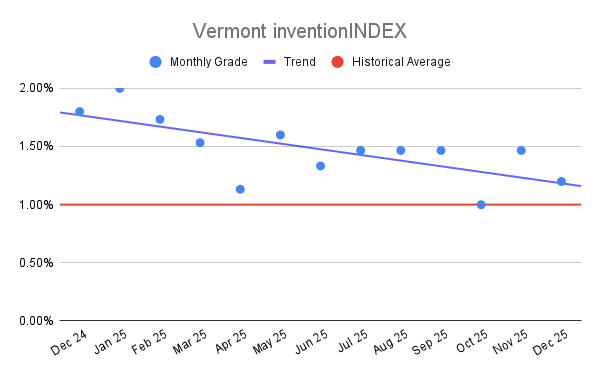 Vermont inventionINDEX December 2025:
  Vermont inventionINDEX November
