

The Vermont Research and Development Tax Credit (32 V.S.A. § 5930ii) strictly excludes “funded research”—activities financed by grants, contracts, or third parties where the taxpayer does not bear the financial risk or retain substantial rights. To comply, businesses must calculate a “downward adjustment” on Form BA-404, subtracting any government or private assistance from their qualified research expenditures (QREs). This ensures the 27% state credit only incentivizes private, at-risk capital investment in innovation.
Government-funded research refers to activities where the financial risk is borne or the intellectual property rights are retained by a third-party sponsor, rendering those costs ineligible for tax credits. In Vermont, taxpayers must adjust their qualified research expenditure base downward by the amount of any grants or contractual payments received to ensure the state’s 27% credit only subsidizes private capital risk.
The Statutory Architecture of Vermont R&D Incentives
The Vermont Research and Development Tax Credit, codified under 32 V.S.A. § 5930ii, serves as a significant fiscal instrument designed to foster a climate of technological advancement and industrial competitiveness within the state. Established as a “piggyback” credit, it is inextricably linked to the federal standards set forth in Section 41 of the Internal Revenue Code (IRC). This linkage ensures that Vermont’s tax policy remains harmonized with national definitions of innovation while allowing the state to offer one of the most aggressive prorated credit rates in the country—currently set at 27% of the federal credit attributable to Vermont-based activities.
The legislative intent behind this provision is explicitly articulated in 32 V.S.A. § 5813(p), which identifies the statutory purpose as encouraging business investment in research and development and attracting intellectual-property-based companies. By leveraging federal definitions, Vermont simplifies the compliance burden for multi-state enterprises while maintaining a rigorous standard for what constitutes “qualified research.” However, this reliance on federal law also imports the full suite of federal exclusions, most notably the government-funded research exclusion found in IRC § 41(d)(4)(H).
Evolution of the Credit Rate and Legislative Refinements
The Vermont R&D credit has undergone strategic adjustments to align with state budgetary priorities and economic development goals. Prior to January 1, 2014, the credit was offered at a higher rate of 30% of the federal credit. The subsequent reduction to 27% reflects a calibrated approach to maintaining a high-value incentive while ensuring fiscal sustainability. Despite the slight decrease, the credit remains a cornerstone of Vermont’s business tax environment, applicable against personal income tax, business income tax, and corporate income tax.
| Period | Statutory Credit Rate | Applicability | Carryforward Period |
|---|---|---|---|
| Pre-2014 | 30% of Federal Credit | Personal/Corporate Tax | 10 Years |
| 2014-Present | 27% of Federal Credit | Personal/Corporate Tax | 10 Years |
| Enterprise Zone (EZ) | 3% of R&D Increase | Specific Geographic Zones | 4-Year Claim Window |
The credit is nonrefundable, meaning it can only offset a taxpayer’s actual Vermont tax liability for the year. However, its value is preserved through a robust 10-year carryforward provision, allowing businesses to utilize credits generated during capital-intensive research phases against future income as they reach commercial maturity.
The Theoretical Underpinnings of the Funded Research Exclusion
The funded research exclusion is rooted in the principle of “incentive alignment.” The primary objective of the R&D tax credit is to incentivize businesses to commit private capital to projects where the outcome is technically uncertain. When a third party—whether a government agency, a non-profit foundation, or a private client—pays for the research, that third party is the one bearing the financial risk and, theoretically, the one who should be incentivized. If the performing taxpayer were also allowed to claim a credit for these same expenses, it would result in “double-dipping,” where the government subsidizes the same dollar of research twice.
Under IRC § 41(d)(4)(H), which Vermont adopts in full, qualified research specifically excludes “any research to the extent funded by any grant, contract, or otherwise by another person (or governmental entity)”. This definition creates a clear boundary between research performed for one’s own benefit and research performed as a service for another party. In the context of Vermont’s innovation economy, this distinction is critical for software developers, aerospace engineers, and biotechnology firms that frequently engage in “contract research” for larger entities or federal agencies.
The Dual-Prong Test for Funding
To determine whether research is “funded” and thus excluded from the credit, tax authorities and the courts apply a two-part test derived from Treasury Regulation § 1.41-4A(d). This test evaluates the economic reality of the research agreement rather than the labels used by the parties.
The Financial Risk Standard
The financial risk standard asks a fundamental question: Who loses money if the technology fails to work? If the taxpayer performing the research is entitled to payment regardless of the technical success of the project, they do not bear the financial risk. In such cases, the research is “funded” because the performing taxpayer is effectively being paid for their labor and time rather than their innovation.
Contracts are generally categorized into two postures regarding risk:
- Cost-Plus or Time and Materials Contracts: These are typically considered “funded” research. Because the client pays for all hours worked and materials used, the performing business is guaranteed to recoup its costs, even if the research fails to produce a viable product.
- Fixed-Price or Milestone-Based Contracts: These may be considered “unfunded” if the taxpayer only receives payment upon the successful achievement of technical benchmarks. If the taxpayer fails to resolve the technical uncertainty, they receive no payment and must absorb the losses.
The Substantial Rights Standard
The substantial rights standard examines the ownership and control of the resulting intellectual property (IP). Even if a taxpayer bears the financial risk, the research is excluded if they do not retain “substantial rights” in the results. If the contract transfers all IP, patents, and usage rights to the funding entity, the performer has no right to exploit the innovation they created, and therefore, the state has no interest in subsidizing the activity for that performer.
To satisfy this standard, the taxpayer does not need exclusive ownership. Retaining a non-exclusive, royalty-free right to use the research results in their own trade or business is usually sufficient to be considered “unfunded”. However, mere “incidental benefits,” such as the increased knowledge or “know-how” gained by the staff, do not constitute substantial rights.
Vermont Department of Taxes: Local Regulatory Guidance
The Vermont Department of Taxes provides guidance primarily through tax form instructions, technical bulletins, and administrative reports. These documents clarify how the state’s 27% credit interacts with the federal funding exclusion and how taxpayers must document their compliance.
Form BA-404 and the “Downward Adjustment” Requirement
The most direct guidance regarding funded research is found in the instructions for Schedule BA-404, Vermont Tax Credits. For the 2024 tax year and prior, the instructions explicitly state: “If you have received grants or assistance for financing the expenditures from any other public or private source, the basis expenditure amount for the credit calculation must be adjusted downward to account for the assistance”.
This “downward adjustment” is a critical compliance step for Vermont taxpayers. It requires a granular analysis of all revenue streams associated with research projects. If a business receives a $100,000 grant from the Vermont Agency of Transportation (AOT) to develop a new paving material, and the total cost of the research is $150,000, the business must subtract the $100,000 grant from its qualified research expenditures (QREs). Only the $50,000 in “unfunded” costs—the portion for which the business was at risk—can be used to calculate the credit.
The Recomputed Credit Calculation Methodology
Vermont utilizes a unique calculation method to ensure that the credit is only applied to in-state activities. Because the Vermont credit is a percentage of the federal credit, but only for Vermont expenses, taxpayers cannot simply take 27% of their federal Form 6765 amount if they have research in other states.
Instead, the Department of Taxes requires a “hypothetical federal credit” recomputation. The process involves:
- Isolation: Identify all research activities conducted within Vermont.
- Exclusion: Remove any expenditures that were funded by third-party grants or contracts.
- Apportionment: Determine the Vermont-specific wages, supplies, and contract research costs (typically 65% of third-party contractor costs).
- Recomputation: Calculate a “mock” federal credit as if the Vermont-only expenses were the taxpayer’s only research expenses nationwide. This includes applying federal base amount rules or the Alternative Simplified Credit (ASC) method to the Vermont data.
- Application: Multiply this hypothetical federal credit by 27% to determine the final Vermont R&D tax credit.
| Step | Action | Regulatory Source |
|---|---|---|
| 1 | Identify Vermont QREs | 32 V.S.A. § 5930ii(a) |
| 2 | Subtract Grants/Funding | BA-404 Instructions |
| 3 | Recompute Federal Credit | Form BA-404 / Schedule RD |
| 4 | Apply 27% Factor | 32 V.S.A. § 5930ii(a) |
Audit Guidelines and Documentation Standards
The Vermont Department of Taxes emphasizes that taxpayers must maintain robust documentation to support their R&D claims. Audit guidelines suggest that businesses retain research-related records for at least the 10-year carryforward window to verify the legitimacy of the credits being applied.
For the funded research exclusion, the state focuses on the “proration accuracy” and the “nature of expenditures”. Taxpayers must be prepared to provide:
- Contracts: All agreements with clients or government agencies to prove the taxpayer bore the financial risk.
- IP Documentation: Proof that the taxpayer retains the right to use the research results.
- Grant Award Letters: Detailed documentation of any assistance received to ensure the “downward adjustment” was properly calculated.
Case Law: Federal Interpretations Applied to Vermont
As Vermont law directly mirrors IRC § 41, the body of federal case law regarding funded research serves as the primary interpretive authority for Vermont tax audits. Recent court decisions have highlighted the increasing complexity of determining whether a research project is “funded.”
The “Contingent on Success” Doctrine: Fairchild and Perficient
The landmark case Fairchild Industries, Inc. v. United States established the “contingent on success” test. The court ruled that if a taxpayer is only paid upon the successful completion of a project, they bear the financial risk. However, in the more recent Perficient Inc. case, the court ruled against the taxpayer, finding that even if a contract has “rejection clauses,” the research is funded if the payment structure is fundamentally based on time and milestones rather than the resolution of technical uncertainty.
This distinction is vital for Vermont’s software sector. A developer performing work under a “Master Services Agreement” (MSA) must ensure that individual statements of work (SOWs) are structured so that payment depends on solving the “technical uncertainty” (e.g., creating a new algorithm) rather than just delivering a specified number of code hours.
The Fixed-Price Evolution: System Technologies and Populous
For many years, the IRS and state authorities argued that any fixed-price contract was inherently “funded” because the total price was known in advance. However, System Technologies, Inc. v. Commissioner (2025) and Populous Holdings, Inc. v. Commissioner (2019) have shifted this landscape. The courts in these cases found that fixed-price contracts actually place more risk on the performer, as they are responsible for all cost overruns if the research takes longer than expected to resolve technical hurdles.
In Vermont, where manufacturing and engineering firms often work on fixed-price government or commercial contracts, these cases provide a powerful defense for claiming the R&D credit, provided the taxpayer retains substantial rights to the IP.
Substantial Rights and the “Know-How” Trap: Dynetics
The Dynetics case (2015) serves as a warning for taxpayers who believe that merely learning how to do something new constitutes “substantial rights”. The court ruled that “incidental benefits” like increased staff knowledge are not enough to pass the test. A Vermont company must be able to show that it can use the actual results of the research (e.g., the specific data, the developed prototype, or the source code) in its future business without needing the funder’s permission.
| Landmark Case | Year | Core Issue | Vermont Compliance Impact |
|---|---|---|---|
| Fairchild Industries | 1995 | Risk / Contingency | Established the “payment contingent on success” rule. |
| Lockheed Martin | 2000 | Substantial Rights | Non-exclusive rights are sufficient for credit eligibility. |
| Dynetics | 2015 | Incidental Benefits | Skills gained are not “substantial rights”. |
| Perficient Inc. | 2021 | Contract Terms | Time-based billing is usually “funded” regardless of quality clauses. |
| System Technologies | 2025 | Fixed-Price Risk | Fixed-price contracts can qualify as “unfunded” research. |
Vermont-Specific Funding Entities and Grant Contexts
The application of the funding exclusion in Vermont is most frequently seen in projects funded by state agencies or specialized funds. Understanding how these entities operate is essential for identifying excluded research.
The Vermont Agency of Transportation (AOT) Research Program
The AOT regularly funds research related to planning, design, and construction of transportation systems. The agency utilizes a “Qualified Researcher List” (QRL) and selects performers through a competitive solicitation process. Because AOT research projects result in legally binding agreements between the state and the researcher, these are almost universally considered “funded” from the perspective of the researcher.
Businesses on the QRL must be careful not to include wages for AOT-funded projects in their Vermont R&D tax credit calculation unless they can prove that they bore the cost of overruns and retained rights to use the findings in private-sector applications.
The Vermont Health IT-Fund
Established under 32 V.S.A. § 10301, this fund provides grants and loans to promote medical health care information technology. If a medical software company receives a grant from this fund to develop an electronic health information system, that grant represents a “downward adjustment” to their QREs. If the grant covers 100% of the research costs, the business is entitled to $0 in Vermont R&D tax credits for that project.
The “Assistance” Definition in BA-404
The Vermont Department of Taxes uses the broad term “assistance” in its instructions. This suggests that even non-traditional funding—such as state-subsidized equipment loans or forgivable loans from the Vermont Entrepreneur’s Seed Capital Fund (under 32 V.S.A. § 5830b)—might be viewed as a form of funding that reduces the eligible R&D credit base.
Comprehensive Illustration: The Aerospace Prototype Case
To demonstrate the application of these rules, consider an illustrative example involving a specialized aerospace manufacturer located in Essex Junction, Vermont.
Project Background: The “Solar-Wing” Initiative
“Essex Aerospace” (EA) is developing a new type of lightweight solar-integrated wing for unmanned aerial vehicles (UAVs). The total project cost is $2,000,000. All activities are performed by Vermont-based engineers.
EA’s funding for this $2,000,000 project comes from three sources:
- Federal SBIR Grant: EA received a $500,000 Small Business Innovation Research (SBIR) grant from the Department of Defense. The grant is paid upfront to cover laboratory costs.
- Commercial Partnership: EA entered into a $500,000 contract with a major drone manufacturer. The contract specifies that EA will be paid for its time and materials, and the drone manufacturer will own all patents.
- Self-Funding: EA invests $1,000,000 of its own retained earnings. EA bears the full risk of this $1,000,000 and retains the rights to use the resulting “Solar-Wing” data in its other product lines.
Analysis of Funded vs. Unfunded Research
- Federal SBIR Grant ($500,000): This is clearly “funded” research under IRC § 41(d)(4)(H). It must be adjusted downward from the Vermont credit base.
- Commercial Partnership ($500,000): This fails the risk standard (paid for time/materials) and the substantial rights standard (client owns patents). This is “funded” research and must be excluded.
- Self-Funding ($1,000,000): This is “unfunded” qualified research. Essex Aerospace bears the risk and retains the rights.
Vermont Tax Credit Calculation
EA must now calculate its credit based only on the $1,000,000 of unfunded research.
- Identify Unfunded VT QREs: $1,000,000.
- Determine Base Amount: Following the federal startup rules (as this is a new line of research), EA uses a 3% fixed-base percentage. Assuming average annual Vermont gross receipts of $5,000,000.
- $Base Amount = $5,000,000 * 0.03 = $150,000$
3. Recompute Hypothetical Federal Credit:
- $Excess QREs = $1,000,000 – $150,000 = $850,000$
- $Federal Credit Rate (Regular Method) = 20\%$
- $Hypothetical Federal Credit = $850,000 * 0.20 = $170,000$
4. Apply Vermont 27% Rate:
- $Vermont R&D Tax Credit = $170,000 * 0.27 = $45,900$
Essex Aerospace can claim a $45,900 credit on its Vermont tax return to offset its corporate tax liability. Any amount exceeding their tax bill can be carried forward to next year.
Strategic Compliance and Administrative Oversight
Navigating the funded research exclusion in Vermont requires a proactive stance on documentation and a sophisticated understanding of the recomputed credit methodology.
The Transparency Requirement
Under 32 V.S.A. § 5930ii(c), the Vermont Department of Taxes is required to publish a list of all claimants of the R&D credit each year. This public disclosure increases the scrutiny on credit claims. If a company is widely known to be a “contract research organization” (CRO) that works primarily on client-funded projects, but it appears on the transparency list with a large credit claim, it may trigger an inquiry from the Department regarding its “unfunded” project base.
Unitary Reporting and Internal Funding
For businesses that are part of a unitary group, Vermont generally follows the “combined reporting” rules. If one member of a unitary group provides funding to another member for research, this is typically not considered “funded research” in the sense of the exclusion, because the economic risk and the rights remain within the same single business enterprise. However, the taxpayer must still meticulously allocate the Vermont-based QREs on Schedule BA-402 and Schedule BA-404 to ensure the credit is applied to the correct entity’s liability.
Best Practices for Vermont Claimants
To successfully defend an R&D claim against the funded research exclusion, Vermont taxpayers should:
- Analyze all Revenue Streams: Compare total research spending against total research-related revenue (grants, client payments, assistance).
- Isolate Vermont Activity: Ensure that the 27% rate is only applied to the Vermont-apportioned recomputed federal credit.
- Review Legal IP Rights: Ensure that all master agreements for research services include a clause allowing the performing company to retain “substantial rights” (at least a non-exclusive license) in the research results.
- Maintain Contemporary Documentation: Keep project-specific records that link time-tracking to technical uncertainty rather than simple “deliverable” deadlines.
Final Thoughts
The government-funded research exclusion is a vital mechanism in the Vermont tax code that ensures public incentives are reserved for businesses that contribute their own “at-risk” capital to the state’s innovation economy. By adopting the federal IRC § 41 standards, Vermont maintains a rigorous definition of qualified research that prizes technical risk and intellectual ownership.
The guidance from the Vermont Department of Taxes—particularly the “downward adjustment” required on Form BA-404—serves as a clear directive for taxpayers to scrutinize their funding sources. As federal case law continues to refine the boundaries of “financial risk” and “substantial rights,” Vermont businesses must adapt their contractual postures and documentation practices to safeguard their credits. Ultimately, the 27% Vermont R&D tax credit remains a powerful tool for growth, provided that the underlying research is a true investment in the performer’s future rather than a service performed for the benefit of another.
Who We Are:
Swanson Reed is one of the largest Specialist R&D Tax Credit advisory firm in the United States. With offices nationwide, we are one of the only firms globally to exclusively provide R&D Tax Credit consulting services to our clients. We have been exclusively providing R&D Tax Credit claim preparation and audit compliance solutions for over 30 years. Swanson Reed hosts daily free webinars and provides free IRS CE and CPE credits for CPAs.
Are you eligible?

Why choose us?

Pass an Audit?

What is the R&D Tax Credit?
The Research & Experimentation Tax Credit (or R&D Tax Credit), is a general business tax credit under Internal Revenue Code section 41 for companies that incur research and development (R&D) costs in the United States. The credits are a tax incentive for performing qualified research in the United States, resulting in a credit to a tax return. For the first three years of R&D claims, 6% of the total qualified research expenses (QRE) form the gross credit. In the 4th year of claims and beyond, a base amount is calculated, and an adjusted expense line is multiplied times 14%. Click here to learn more.
Never miss a deadline again

Stay up to date on IRS processes

Discover R&D in your industry

R&D Tax Credit Preparation Services
Swanson Reed is one of the only companies in the United States to exclusively focus on R&D tax credit preparation. Swanson Reed provides state and federal R&D tax credit preparation and audit services to all 50 states.
If you have any questions or need further assistance, please call or email our CEO, Damian Smyth on (800) 986-4725.
Feel free to book a quick teleconference with one of our national R&D tax credit specialists at a time that is convenient for you.
R&D Tax Credit Audit Advisory Services
creditARMOR is a sophisticated R&D tax credit insurance and AI-driven risk management platform. It mitigates audit exposure by covering defense expenses, including CPA, tax attorney, and specialist consultant fees—delivering robust, compliant support for R&D credit claims. Click here for more information about R&D tax credit management and implementation.
Our Fees
Swanson Reed offers R&D tax credit preparation and audit services at our hourly rates of between $195 – $395 per hour. We are also able offer fixed fees and success fees in special circumstances. Learn more at https://www.swansonreed.com/about-us/research-tax-credit-consulting/our-fees/



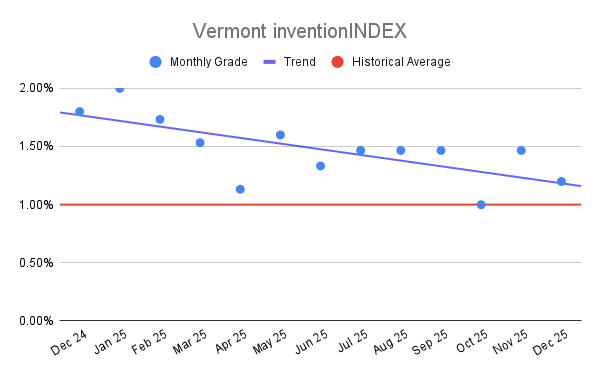 Vermont inventionINDEX December 2025:
  Vermont inventionINDEX November
