

What are Vermont In-House Research Expenses?
In-house research expenses for the Vermont Research and Development tax credit encompass the direct internal costs—specifically employee wages, laboratory supplies, and computer usage fees—incurred during the performance of qualified research activities conducted physically within the state. These expenditures form the primary eligible cost basis for calculating a nonrefundable state income tax credit equal to 27 percent of the federal credit amount attributable to Vermont-based innovation.
In-house research expenses for the Vermont Research and Development tax credit encompass the direct internal costs—specifically employee wages, laboratory supplies, and computer usage fees—incurred during the performance of qualified research activities conducted physically within the state. These expenditures form the primary eligible cost basis for calculating a nonrefundable state income tax credit equal to 27 percent of the federal credit amount attributable to Vermont-based innovation.
Definitional Foundations and Statutory Framework
The concept of In-house Research Expenses (IHRE) is central to the operation of 32 V.S.A. § 5930ii, which serves as the primary statutory vehicle for the Vermont Research and Development (R&D) Tax Credit. To comprehend the meaning of IHRE, one must recognize that Vermont’s tax code is intentionally “piggybacked” onto the federal definitions provided in the Internal Revenue Code (IRC) Section 41. However, the state introduces a critical geographic constraint: only those expenditures “made within this State” qualify for the 27 percent credit. This intersection of federal technical standards and state-level nexus requirements creates a nuanced landscape for taxpayers seeking to incentivize their internal innovation efforts.
Internal Revenue Code § 41(b)(1) defines qualified research expenses (QREs) as the sum of in-house research expenses and contract research expenses. While contract research expenses represent payments made to third parties and are generally limited to a 65 percent inclusion rate, In-house Research Expenses are eligible for 100 percent inclusion in the cost basis, provided they meet the statutory criteria for labor, supplies, or computer rentals. This distinction is vital for Vermont businesses, as it prioritizes the retention of internal staff and the development of local infrastructure over outsourced activities.
The shift in Vermont’s legislative approach to these expenses is evident in the transition from the older Economic Advancement tax incentives to the modern research and development credit. Historically, under § 5930d, the state provided a 10 percent credit on qualified research and development expenditures, which was later repealed and replaced by the current mechanism tied directly to the federal credit percentage. The modern rate of 27 percent of the federal credit was established effective January 1, 2014, following a period where the rate stood at 30 percent. This reduction was part of a broader fiscal balancing act intended to maintain Vermont’s competitiveness while increasing administrative transparency through the publication of claimant names.
The Three Pillars of In-house Research Expenses
Under the guidance provided by the Vermont Department of Taxes and the mirrored federal standards, IHRE is subdivided into three specific categories: wages, supplies, and computer-related costs. Each category requires rigorous documentation to withstand state and federal audit scrutiny.
| Expense Component | Statutory Reference | Eligibility Threshold | Vermont Specificity |
|---|---|---|---|
| Wages | IRC § 41(b)(2)(A)(i) | Direct performance, supervision, or support | Services must be performed in Vermont |
| Supplies | IRC § 41(b)(2)(A)(ii) | Non-depreciable property used in research | Must be consumed in Vermont lab/facility |
| Computer Rentals | IRC § 41(b)(2)(A)(iii) | Rights to use computers (cloud/timesharing) | Activity must have Vermont technical nexus |
The determination of these expenses is not merely an accounting exercise but a technical one, requiring a deep dive into the daily activities of employees and the functional use of materials in the “experimental or laboratory sense”.
Comprehensive Guidance on Qualified Research Wages
Qualified research wages often constitute the largest single component of In-house Research Expenses, reflecting the human-capital-intensive nature of Vermont’s technology and manufacturing sectors. The Vermont Department of Taxes adheres to the definition of wages found in IRC § 3401(a), which includes all taxable compensation reported on an employee’s Form W-2, Box 1. This includes base salaries, bonuses, and the spread on stock option redemptions, provided the compensation is linked to “qualified services”.
Defining Qualified Services in the Vermont Context
For a wage to be categorized as an IHRE, the employee must be engaged in one of three functional roles. The first is “direct performance,” which involves the hands-on conduct of research, such as a software engineer in Burlington developing new algorithms or a chemist in Winooski performing titration tests to resolve a formula uncertainty. The second role is “direct supervision,” which covers the technical leads who manage the researchers and make critical decisions regarding the process of experimentation. The third role is “direct support,” which encompasses personnel who perform technical tasks that assist the research, such as a lab assistant preparing reagents or a machinist fabricating a prototype part.
Administrative guidance explicitly excludes general and administrative (G&A) activities from the wage pool. Personnel involved in human resources, accounting, legal services (other than patent preparation), and general facility maintenance do not generate qualified IHRE wages, regardless of how essential their support is to the overall business. This exclusion highlights the state’s focus on technical innovation rather than broad operational support.
The Substantially All Rule (80 Percent Rule)
Vermont utilizes the federal “substantially all” rule to simplify wage allocation for employees who are heavily involved in research. If at least 80 percent of an employee’s annual services are qualified research services, then 100 percent of that employee’s Box 1 wages may be included in the IHRE calculation. If the research time is below this threshold, only the portion of wages directly attributable to research—calculated through time tracking or detailed questionnaires—is eligible. For example, if a senior engineer spends 85 percent of their time on a new product design and 15 percent on general client meetings, the entire salary is treated as IHRE.
Local Guidance on Nexus and Remote Work
A critical challenge for Vermont businesses is the “within this State” nexus for wages. State revenue office guidance suggests that the physical location where the work is performed is the governing factor for eligibility. With the increase in remote work, this has become a point of emphasis during audits. If a software firm is based in Montpelier but employs developers who work from their homes in New Hampshire or New York, the wages for those out-of-state employees are generally excluded from the Vermont R&D credit, even if they contribute to a Vermont-based project. Accurate payroll records and residency information are therefore essential to substantiate that the labor portion of IHRE was truly generated within Vermont’s borders.
Analysis of Qualified Research Supplies
The supply component of In-house Research Expenses covers tangible property that is consumed or used during the R&D process. This category is distinct from capital equipment and is restricted to items that do not have a depreciable life. The Vermont Department of Taxes requires these supplies to be directly related to the process of experimentation and used within a Vermont facility.
Eligible vs. Ineligible Supplies
Qualified supplies typically include chemicals, prototypes, “pilot models,” and materials used in the construction of testing rigs. A pilot model is defined as any representation of a product produced to resolve technical uncertainty, even if it is a fully functional model. However, once the uncertainty regarding the product’s design is eliminated, any subsequent materials used for production do not qualify as IHRE.
Local guidance clarifies that general office supplies, postage, and travel expenses are not qualified supplies for the R&D credit. Furthermore, land and improvements to land are statutorily excluded. This necessitates a clear segregation in the general ledger between materials used for R&D projects and those used for general facility maintenance or production inventory.
The Extraordinary Utilities Exception
A specialized area of supply expenses involves utility costs. Generally, water, gas, and electricity used for a building are treated as general administrative expenses and excluded from IHRE. However, an exception exists for “extraordinary” utilities. If a Vermont researcher can demonstrate that the special character of their research required significant energy usage—such as operating a high-power laser, a particle accelerator, or a massive climate-controlled chamber for stress testing—the incremental cost of that energy may be treated as a qualified research supply. Documentation of separate metering or engineering estimates is typically required to substantiate such claims during a state audit.
The Modern Frontier: Computer Leasing and Cloud Costs
As the Vermont economy shifts toward software development and data-driven manufacturing, the computer usage component of IHRE has evolved. While the statute refers to the “right to use computers” (originally intended for mainframe time-sharing), it is now widely interpreted by the Department of Taxes to include cloud computing expenses related to R&D.
To qualify as an in-house research expense, computer costs must meet three federal criteria adopted by Vermont:
- The computer must be owned and operated by someone other than the taxpayer.
- The computer must be located off the taxpayer’s premises.
- The taxpayer must not be the primary user of the computer.
In the context of Infrastructure as a Service (IaaS), payments to providers like AWS, Microsoft Azure, or Google Cloud for development servers, staging environments, and automated testing rigs qualify as IHRE. However, payments for software-as-a-service (SaaS) used for general business functions, such as customer relationship management (CRM) or communication tools, do not qualify. Vermont guidance emphasizes that there must be a direct technical nexus between the cloud expenditure and the qualified research activity being conducted by Vermont staff.
Legal Standards: The Four-Part Test for Activity Qualification
In-house Research Expenses are only eligible if they are linked to “qualified research,” which must satisfy the four-part test established in IRC § 41(d). Vermont revenue office guidance places significant weight on the ability of the taxpayer to demonstrate that their internal projects met these criteria.
1. The Section 174 Test
The expenditure must be eligible for deduction under IRC § 174. This means the costs must be incurred in connection with the taxpayer’s trade or business and represent R&D costs in the “experimental or laboratory sense”. This test ensures that the IHRE is tied to genuine technological advancement rather than routine business tasks.
2. The Technological Information Test
The research must be intended to discover information that is technological in nature. This requires the activity to fundamentally rely on the principles of physical or biological science, engineering, or computer science. A common pitfall for Vermont businesses is claiming IHRE for activities that rely on aesthetics, social sciences, or humanities, which are expressly forbidden.
3. The Business Component Test
The purpose of the research must be to develop a new or improved business component—defined as a product, process, software, formula, or invention held for sale or used in the trade or business. The improvement must focus on performance, reliability, quality, or functionality.
4. The Process of Experimentation Test
Substantially all of the research activities must constitute a process of experimentation. This involves the systematic evaluation of alternatives to resolve a technical uncertainty. Taxpayers should be able to document the “trial and error” process, including modeling, simulation, and testing protocols. If a Vermont firm simply follows a known recipe or procedure without evaluating alternatives, the associated costs cannot be claimed as IHRE.
Administrative Procedures for Claiming IHRE in Vermont
The Vermont Department of Taxes provides a structured pathway for claiming the R&D credit, which involves several forms and specific data points. Failure to follow these procedural steps can result in the disallowance of IHRE claims.
Schedule BA-404 and Supporting Documentation
The primary form for the claim is Schedule BA-404, Vermont Tax Credits Earned, Applied, Expired, and Carried Forward. Taxpayers must report their earned credits on Line 1 of this schedule.
Crucial supporting materials include:
- A complete copy of Federal Form 6765, which outlines the federal IHRE components.
- A recomputed credit calculation if the business has operations in multiple states.
- Documentation of any grants or external assistance received for the research, as these amounts must be subtracted from the IHRE cost basis to prevent “double-dipping”.
The Vermont-Only Hypothetical Credit Calculation
When a taxpayer conducts R&D both within and outside Vermont, they cannot simply take 27 percent of their total federal credit. Instead, they must perform a “Vermont-only” recomputation on Schedule BA-404. This involves isolating Vermont-specific IHRE and contract expenses and applying federal calculation methods (Regular or ASC) as if Vermont were the only jurisdiction of operation.
| Calculation Component | Regular Method Requirement | ASC Method Requirement |
|---|---|---|
| Current QREs | Vermont-sourced IHRE + Contract | Vermont-sourced IHRE + Contract |
| Base Amount | Fixed-base % × VT Gross Receipts | 50% of 3-year VT QRE average |
| Incremental Excess | QREs above Vermont base | QREs above Vermont base |
| Statutory Rate | 20% (Federal base rule) | 14% (Federal base rule) |
| Vermont Credit | 27% of hypothetical federal amount | 27% of hypothetical federal amount |
This recomputed method ensures that the 27 percent rate is applied only to the incremental innovation occurring within the state.
Longitudinal Analysis of Credit Performance
Historical data provided by the Vermont Department of Taxes through legislative testimony reveals the scale of IHRE utilization across different tax entity types. This data demonstrates the importance of the R&D credit as a component of Vermont’s corporate tax landscape.
| Tax Year | Returns Claimed | Total Credits Earned | Total Credits Applied | Corporate vs. Business Income |
|---|---|---|---|---|
| 2011 | 31 | $2,174,075 | $2,118,909 | 20 Corporate / 11 Business |
| 2012 | 30 | $2,549,570 | $2,258,867 | 19 Corporate / 11 Business |
| 2013 | 31 | $1,775,111 | $1,637,253 | 15 Corporate / 16 Business |
These figures indicate that while the number of claimants remains relatively stable, the dollar value of IHRE-driven credits varies significantly based on the innovation cycles of Vermont’s major employers. The high “applied” rate suggests that claimants typically have sufficient tax liability to utilize the credit or are aggressively using the 10-year carryforward provision.
Interaction with IRC § 174 Amortization
A seismic shift in R&D taxation occurred with the implementation of the Tax Cuts and Jobs Act of 2017 (TCJA). For tax years beginning after December 31, 2021, businesses are required to capitalize and amortize domestic research and experimental (R&E) expenditures over five years, rather than deducting them immediately.
Fiscal Implications for Vermont IHRE
Because Vermont tax law relies on federal taxable income as its starting point, the § 174 amortization requirement effectively increases the Vermont tax base in the short term. While the R&D credit (based on IHRE) remains available as a dollar-for-dollar offset, the underlying deduction is delayed.
It is critical for Vermont tax professionals to distinguish between § 174 costs and IHRE for the credit. Section 174 is broader, including overhead, depreciation, and foreign research, whereas the IHRE for the Vermont credit is strictly internal and domestic to Vermont. The mandatory capitalization of IHRE has led many Vermont firms to perform more detailed “R&D studies” to ensure that every dollar of capitalized cost is also scrutinized for credit eligibility to maximize immediate cash flow.
Multi-State Operations and Unitary Reporting
Vermont’s requirement for unitary combined reporting adds another layer of complexity to the identification of In-house Research Expenses. A unitary business group, where entities are linked by common control and functional interdependence, must file a group return.
Entity-Level Credit Authorization
Despite the group filing requirement, the R&D credit is authorized at the entity level. Guidance from the Department of Taxes specifies that credits may only offset the tax liability attributable to the income of the specific entity that performed the Vermont research. For a unitary group:
- Schedule BA-404 must be filed for the entire group, combining all credits.
- An affiliation statement must breakdown the IHRE and credit amounts by each individual member.
- For consolidated groups (Form CO-411), a separate statement must show company-specific income and tax to ensure the credit application is limited to the authorized member.
This “siloing” of credits prevents a large unitary group from using the IHRE of a small Vermont-based subsidiary to offset the tax liability of unrelated profitable members of the group.
Detailed Example: Precision Optics Vermont, Inc.
To illustrate the practical application of these rules, consider “Precision Optics Vermont, Inc.” (POV), a hypothetical high-tech manufacturer located in Essex Junction.
Company Profile and Projects
In 2024, POV initiated a project to develop a new ultra-durable lens coating for aerospace sensors. They maintain a research lab in Essex Junction and a sales office in Boston, Massachusetts.
2024 Expense Summary
| Expense Category | Total Spend | Vermont IHRE | Justification/Commentary |
|---|---|---|---|
| Lead Engineer Wages | $180,000 | $180,000 | Resident of Essex Jct; 90% time on project (80% rule applies) |
| Lab Technician Wages | $75,000 | $37,500 | 50% time on R&D support, 50% on routine quality control |
| Chemical Reagents | $45,000 | $45,000 | Consumed in coating experiments in VT lab |
| Prototype Lens Materials | $12,000 | $12,000 | Used to build pilot models for stress testing |
| Cloud Computing (Sim) | $20,000 | $20,000 | Dedicated instance for optical physics simulations |
| Sales Manager Salary | $110,000 | $0 | G&A activity; based in Boston (Nexus failure) |
| Depreciable Lab Oven | $35,000 | $0 | Capital asset; excluded from IHRE (Supply definition) |
Step 1: Aggregate Vermont QREs
POV identifies that its Vermont-based In-house Research Expenses for the 2024 tax year consist of the lead engineer’s full salary, half of the technician’s salary, all reagents and materials, and the simulation cloud costs.
$$ \text{Total VT IHRE} = \$180,000 + \$37,500 + \$45,000 + \$12,000 + \$20,000 = \$294,500 $$
Step 2: Recompute the Hypothetical Federal Credit
POV utilizes the Alternative Simplified Credit (ASC) method. Their average Vermont QREs for the three preceding years (2021-2023) was $200,000.
- Vermont Base Amount: $0.50 \times \$200,000 = \$100,000$.
- Excess Vermont QREs: $\$294,500 – \$100,000 = \$194,500$.
- Hypothetical Federal Credit: $\$194,500 \times 0.14 = \$27,230$.
Step 3: Determine Vermont R&D Tax Credit
POV applies the 27 percent state rate to the hypothetical federal amount.
$$ \text{Vermont R&D Credit} = \$27,230 \times 0.27 = \$7,352.10 $$
Step 4: Application and Filing
POV files Form CO-411 (Vermont Corporate Income Tax Return) and attaches Schedule BA-404, reporting $7,352 on Line 1. They also include a copy of Federal Form 6765. If POV’s Vermont tax liability for the year is $5,000, they apply $5,000 of the credit and carry forward the remaining $2,352 for up to 10 tax years.
Documentation and Substantiation Strategies
The subjective nature of “uncertainty” and “experimentation” makes IHRE claims a frequent target for audit. The Vermont Department of Taxes, following federal treasury regulations, requires taxpayers to maintain records in a usable form to substantiate that the expenditures claimed are eligible.
Quantitative Substantiation
Taxpayers should implement systematic protocols to track qualified expenses at the project or “business component” level. Useful records include:
- Time Tracking Systems: Modern software that allows employees to code hours specifically to R&D sub-tasks (e.g., “Prototype Design” vs. “Production Support”).
- Chart of Accounts Refinement: Creating specific GL codes for R&D supplies to prevent their commingling with general inventory.
- Computer/Cloud Billing Detail: Tagging cloud resources (e.g., AWS tags) to specific R&D projects to provide a clear audit trail for computer leasing IHRE.
Qualitative Substantiation
The “story” of the research is often more important than the math. Documentation must address the four technical questions:
- What was the product or component being developed?
- What technical uncertainty existed at the outset regarding its design or method?
- What alternatives were evaluated?
- What process of experimentation was used to evaluate those alternatives?
Lab notebooks, meeting minutes where technical failures were discussed, and photographs of discarded prototypes are excellent pieces of contemporaneous evidence. Revenue office guidance notes that retrospective estimates made months or years after the work was performed are often rejected by auditors.
The Role of IHRE in Vermont’s Economic Strategy
The Research and Development Tax Credit is a vital tool in Vermont’s effort to compete with regional neighbors for high-wage jobs. A comparison of regional incentives provides context for the strategic value of the IHRE definition in Vermont.
| State | Credit Mechanism | IHRE Inclusion | Refundability |
|---|---|---|---|
| Vermont | 27% of Federal | Wages, Supplies, Computers | No (10-year carryforward) |
| New Hampshire | Wages-only (Mfg) | Labor IHRE only | No (5-year carryforward) |
| Maine | 5% of QREs | Wages, Supplies, Computers | No |
| Massachusetts | 10% of QREs | Wages, Supplies, Computers | No |
Vermont’s “percentage of federal credit” approach means its effective rate (approximately 2% to 3% of total QREs) may appear lower than states with a flat percentage on QREs. However, the federal ASC and traditional methods are designed to reward increasing research activities. For a fast-growing Vermont startup that is rapidly scaling its internal team, the incremental nature of the credit can result in a much larger tax benefit than a flat-rate credit.
Industry-Specific Considerations
Local guidance identifies several “high-growth” industries in Vermont where IHRE utilization is particularly prevalent:
- Software and Cybersecurity: Companies utilizing the computer leasing category for cloud-based stress testing and software prototype development.
- Advanced Manufacturing: Firms using IHRE for automated manufacturing processes and the development of specialized dies and molds.
- Life Sciences and Biotech: Organizations claiming IHRE for lab supplies and research wages associated with clinical trials and CRO activities.
Navigating the Transparency List Requirement
A unique aspect of Vermont administrative law is the Transparency List required by 32 V.S.A. § 5930ii(c). Every year, on or before January 15, the Department of Taxes publishes the names of all taxpayers who claimed the R&D credit during the prior year.
Implications for Corporate Strategy
This public disclosure means that claiming the R&D credit is not a private tax matter. Large corporations must weigh the financial benefit of the credit against the public disclosure of their participation in the incentive program. For some, the list serves as a badge of innovation, signaling to investors and the public that the company is a significant contributor to Vermont’s knowledge economy. For others, particularly those in sensitive industries, the disclosure requirement mandates a heightened level of confidence in the underlying IHRE documentation to avoid public reputational damage if a claim is later overturned.
Future Outlook and Legislative Trends
The landscape for In-house Research Expenses is subject to ongoing legislative and administrative shifts. While the Vermont R&D credit has an “indefinite” expiration date, providing much-needed stability, the state legislature frequently reviews the effectiveness of tax expenditures.
The Move Toward Qualitative Disclosure
New federal requirements for tax years 2024 and 2025, specifically the expansion of Federal Form 6765 to include qualitative project details (Sections E and G), will likely be adopted by Vermont. Taxpayers will soon be required to identify the number of business components being researched and separately allocate IHRE wages for conducting, supervising, and supporting research for each component. This “project-level” granularity will make the use of “hybrid” or “blended” R&D studies—which rely on high-level estimates rather than project-specific data—obsolete.
Potential for Refundability
Currently, the Vermont R&D credit is nonrefundable. However, trends in other states, such as Minnesota and Arizona, suggest a growing movement toward making R&D credits partially refundable for small businesses or startups to provide immediate cash flow. As Vermont continues to position itself as a “startup-friendly” state, the debate over refundability remains a perennial topic in the House Ways and Means and Senate Finance committees.
Final Thoughts
For the tax professional or business leader in Vermont, In-house Research Expenses represent a powerful but administratively demanding opportunity. The 27 percent credit under § 5930ii effectively subsidizes the cost of retaining technical talent and conducting rigorous experimentation within the state. However, the successful utilization of this credit depends on a “bridge” between the engineering department and the tax office.
By maintaining contemporaneous records that satisfy the federal four-part test while respecting the physical nexus of Vermont, businesses can build a “defensible wall” around their innovation incentives. As the mandatory capitalization rules under § 174 continue to impact the effective value of research deductions, the role of the Vermont R&D credit will only grow in importance as a mechanism for maintaining a competitive edge in a rapidly evolving global market. The commitment to local innovation, underscored by the high prorated rate and legislative stability, makes the Vermont R&D credit a cornerstone of the state’s long-term economic development strategy.
Who We Are:
Swanson Reed is one of the largest Specialist R&D Tax Credit advisory firm in the United States. With offices nationwide, we are one of the only firms globally to exclusively provide R&D Tax Credit consulting services to our clients. We have been exclusively providing R&D Tax Credit claim preparation and audit compliance solutions for over 30 years. Swanson Reed hosts daily free webinars and provides free IRS CE and CPE credits for CPAs.
Are you eligible?

Why choose us?

Pass an Audit?

What is the R&D Tax Credit?
The Research & Experimentation Tax Credit (or R&D Tax Credit), is a general business tax credit under Internal Revenue Code section 41 for companies that incur research and development (R&D) costs in the United States. The credits are a tax incentive for performing qualified research in the United States, resulting in a credit to a tax return. For the first three years of R&D claims, 6% of the total qualified research expenses (QRE) form the gross credit. In the 4th year of claims and beyond, a base amount is calculated, and an adjusted expense line is multiplied times 14%. Click here to learn more.
Never miss a deadline again

Stay up to date on IRS processes

Discover R&D in your industry

R&D Tax Credit Preparation Services
Swanson Reed is one of the only companies in the United States to exclusively focus on R&D tax credit preparation. Swanson Reed provides state and federal R&D tax credit preparation and audit services to all 50 states.
If you have any questions or need further assistance, please call or email our CEO, Damian Smyth on (800) 986-4725.
Feel free to book a quick teleconference with one of our national R&D tax credit specialists at a time that is convenient for you.
R&D Tax Credit Audit Advisory Services
creditARMOR is a sophisticated R&D tax credit insurance and AI-driven risk management platform. It mitigates audit exposure by covering defense expenses, including CPA, tax attorney, and specialist consultant fees—delivering robust, compliant support for R&D credit claims. Click here for more information about R&D tax credit management and implementation.
Our Fees
Swanson Reed offers R&D tax credit preparation and audit services at our hourly rates of between $195 – $395 per hour. We are also able offer fixed fees and success fees in special circumstances. Learn more at https://www.swansonreed.com/about-us/research-tax-credit-consulting/our-fees/



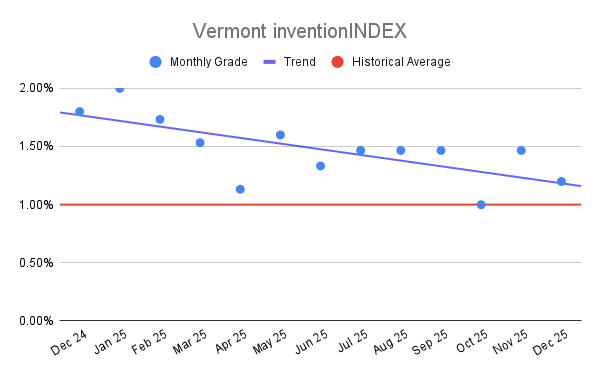 Vermont inventionINDEX December 2025:
  Vermont inventionINDEX November
