

A business component is defined as any product, process, software, technique, formula, or invention intended for commercial use that undergoes development to improve its functionality, performance, reliability, or quality. Under Vermont law, these components must satisfy the federal four-part test while the qualifying expenditures are strictly localized to activities conducted within the state’s geographic boundaries.
The Vermont Research and Development (R&D) Tax Credit represents a sophisticated intersection of state and federal tax policy, designed to incentivize high-value innovation within the Green Mountain State. Established under 32 V.S.A. § 5930ii, the credit is not a standalone state incentive but is instead deeply integrated with the federal research credit provisions of Internal Revenue Code (IRC) § 41. This structural alignment necessitates that any business seeking to claim the Vermont credit must first master the federal definitions and requirements, particularly the concept of a “business component.” In the Vermont regulatory environment, the business component is the fundamental unit of analysis upon which all claims are built; it is the specific project or endeavor that must withstand the scrutiny of both state and federal auditors to prove that a taxpayer is engaged in more than routine business activities.
The legislative intent behind the Vermont credit, which was first introduced in 2009 and became effective for tax years 2011 and beyond, was to create a competitive advantage for Vermont-based manufacturers, software developers, and biotechnology firms. Originally set at 30% of the federal credit amount, the rate was subsequently adjusted to 27% for tax years beginning in 2014. This high prorated rate places Vermont among the top states in the nation for R&D incentives, yet the complexity of the “business component” requirement remains a significant hurdle for many taxpayers. Understanding this requirement involves deconstructing the definition of a business component into its constituent parts—product, process, computer software, technique, formula, or invention—and evaluating each against the “new or improved” standard.
The Statutory Definition and Scope of Business Components
Under the guidance provided by the Vermont Department of Taxes and the foundational federal statutes, a business component is not merely a generalized idea of innovation but a specific tangible or intangible asset that the taxpayer intends to hold for sale, lease, or license, or use in its own trade or business. This dual-purpose definition—allowing for both products sold to customers and internal processes used by the company—ensures that the credit supports both the external market competitiveness and internal operational efficiency of Vermont firms. For a manufacturer in Burlington or a software house in Montpelier, the identification of these components is the first step in a “look-back study” or a current-year tax planning session.
The definition provided in IRC § 41(d)(2)(B) is intentionally broad, yet it is constrained by the requirement that each component must be analyzed individually. The law does not permit the aggregation of disparate activities into a single “innovation” claim. Instead, the taxpayer must establish a nexus between specific expenditures (wages, supplies, and contract research) and a clearly defined business component. This granularity is essential because a taxpayer might have multiple projects running simultaneously; some may qualify as “new or improved,” while others may be disqualified as “routine maintenance” or “adaptation”.
| Category of Business Component | Definition and Vermont-Specific Examples |
|---|---|
| Product | Any discrete item intended for sale, lease, or license. Examples include a new medical imaging device or a specialized aerospace valve manufactured in a Vermont REAP zone. |
| Process | A sequence of steps used in a trade or business. This includes a new lean manufacturing workflow designed to reduce waste in a Vermont candy factory or a proprietary chemical treatment for timber. |
| Computer Software | Applications or operating systems. This encompasses Vermont-based startups developing SaaS platforms for building management or internal-use software for financial forecasting. |
| Technique | A specific systematic procedure or method used to achieve a result, often found in engineering or material sciences within Vermont’s green-tech sector. |
| Formula | A mathematical or chemical relationship. Examples include a new food recipe with enhanced shelf-life or a proprietary alloy used in specialized manufacturing. |
| Invention | A novel creation providing a new technical solution, which may or may not be patented, such as a new type of renewable energy storage system. |
The “new or improved” standard dictates that the development effort must aim to enhance the business component in one of four specific ways: its function, performance, reliability, or quality. It is not enough for a product to be “different” or “new to the catalog”; it must be “improved” in a technical sense. A Vermont furniture maker who changes the aesthetic design of a chair to follow current market trends is generally not engaged in qualified R&D. However, if that same maker develops a new structural joint that uses advanced composite materials to increase the chair’s weight capacity while reducing its mass, they are developing an “improved business component” focused on performance and reliability.
The Four-Part Test in the Vermont Regulatory Context
The Vermont Department of Taxes, through its administrative guidance and the instructions for Form BA-404, mandates that every qualifying research activity meet the rigorous federal “Four-Part Test”. This test serves as the analytical filter that separates routine business expenses from the high-risk, high-reward activities the credit is intended to support. For Vermont practitioners, the application of this test must be documented contemporaneously to survive a state audit, which often focuses on the “proration accuracy” of in-state versus out-of-state activities.
The Permitted Purpose Test
The Permitted Purpose Test, often referred to as the Business Component Test, requires that the research be conducted with the intent to develop a new or improved business component that improves function, performance, reliability, or quality. In Vermont, this often applies to manufacturing process improvements where a company seeks to integrate automation or “Industry 4.0” technologies into an existing production line. The “purpose” must be technical. If the primary goal of the development is aesthetic (making a product look better) or related to market research (determining if consumers like the product), it fails this test.
The implications of this test are profound for Vermont’s small-to-midsized enterprises (SMEs). A company does not need to achieve a “breakthrough” that is new to the entire industry; the standard is whether the information discovered is new to the taxpayer. This “subjective” standard allows Vermont companies to claim the credit when they catch up to competitors by developing their own proprietary versions of existing technologies, provided they face their own technical uncertainties during the development process.
The Technological in Nature Test
The research must fundamentally rely on the principles of the “hard” sciences, such as engineering, physics, chemistry, biology, or computer science. Vermont’s focus on this test often eliminates claims from firms in the “soft” sciences, such as psychology, management studies, or economics. However, Vermont’s burgeoning biotechnology and software sectors are ideally positioned here. For example, a Burlington-based biotech firm using CRISPR technology to improve the cold-hardiness of agricultural crops is clearly operating within the biological sciences.
A key nuance in this test is that the taxpayer must demonstrate that the development of the business component relied upon these principles. This means that “innovation” through trial-and-error that is purely aesthetic or behavioral is excluded. The Vermont Department of Taxes looks for evidence that the company’s technical staff (engineers or scientists) were the primary drivers of the activity, as opposed to marketing or sales staff.
The Elimination of Uncertainty Test
To satisfy this part of the test, the taxpayer must demonstrate that, at the outset of the research, the information available did not establish the capability, the methodology, or the appropriate design for developing the business component. This is the “technical risk” requirement. If a Vermont engineer can open a standard handbook and find the exact answer to a design problem, there is no uncertainty, and thus no qualified research.
In Vermont, this test is often the site of contention during audits. Auditors may argue that a project was merely “complex” rather than “uncertain.” To counter this, businesses must document the specific “technical unknowns” they faced. For instance, a Vermont software company developing a new blockchain-based voting system might be certain they can build it (capability) but uncertain which encryption algorithm will provide the necessary transaction speed while maintaining security (appropriate design).
The Process of Experimentation Test
The final and most demanding hurdle is proving that “substantially all” of the research activities involved a process of experimentation. The IRS and Vermont Department of Taxes generally interpret “substantially all” as 80% or more of the activities related to the business component. This process requires the identification of alternatives, the evaluation of those alternatives through modeling, simulation, or trial-and-error, and the refinement or discarding of those alternatives based on technical results.
Vermont revenue office guidance suggests that “vague descriptions or generalized R&D labels” will not suffice. Instead, taxpayers must be able to produce documentation such as testing logs, failure reports, and meeting minutes where different designs were debated based on experimental data. This is particularly relevant for the “shrink-back rule,” which allows a taxpayer to “shrink back” to a smaller subcomponent of a larger project if the larger project fails the 80% rule but the subcomponent passes it.
Local State Revenue Office Guidance: The Vermont Proration Method
The most critical local guidance for Vermont taxpayers is the requirement to recompute the federal credit using only in-state qualified research expenditures (QREs) and gross receipts. While the definition of a business component remains federal, the calculation of the credit is localized. Vermont practitioners must be aware that the state credit is 27% of a hypothetical federal credit.
Recomputing the Base Amount
For companies already compliant with IRC § 41, Vermont simplifies the process by mirroring federal definitions but requires a separate state-specific calculation. This involves:
- Identifying Vermont QREs: Wages paid to Vermont employees (documented via W-2), supplies used in Vermont (excluding land and depreciable property), and 65% of contract research performed by entities within Vermont.
- Determining the Vermont Base Amount: Taxpayers must identify Vermont-sourced QREs and gross receipts for the prior four tax years to establish a state-specific fixed-base percentage.
- Hypothetical Credit Calculation: The taxpayer applies the federal incremental rate (typically 20% for the Regular Method or 14% for the ASC) to the excess of current Vermont QREs over the Vermont base amount.
- Final Credit Determination: The resulting figure is multiplied by the 27% Vermont statutory rate.
The complexity of this “state-only” recomputation is where many errors occur. The Vermont Department of Taxes requires that taxpayers exclude all non-Vermont expenses and receipts from this recomputation. If a Vermont firm has engineers in Massachusetts, their wages are excluded from the state calculation, even if the business component they are developing is the same.
| Calculation Method | Federal Statutory Rate | Vermont Prorated Rate (Effective) | Carryforward |
|---|---|---|---|
| Regular Method | 20% of QREs over Base | 5.4% of VT QREs over Base (20% x 27%) | 10 Years |
| ASC Method | 14% of QREs over 50% Avg | 3.78% of VT QREs over 50% Avg (14% x 27%) | 10 Years |
Administrative Procedures and Filing Guidance
To claim the credit, Vermont businesses generally file Form BA-404, “Vermont Research and Development Tax Credit,” alongside their corporate or personal income tax return. The Department of Taxes also requires the attachment of the Federal Form 6765. Importantly, for unitary combined groups, Vermont treats the group as a single taxpayer for reporting purposes, meaning the combined income and credits of the group must be reported on a single return, with a statement breaking down the totals by entity.
The Department of Taxes maintains a high level of transparency. Under 32 V.S.A. § 5930ii(c), the department publishes an annual list containing the names of all taxpayers who have claimed the credit during the most recent calendar year. This “Transparency List” serves as a public ledger and increases the social and administrative pressure on companies to ensure their “business component” claims are defensible and accurate.
The “New or Improved” Business Component in Practice: A Vermont Example
To fully articulate how these laws apply, we must examine a detailed scenario involving a Vermont-based company. Consider “Maple Systems Inc.”, a custom software and manufacturing firm located in the Northeast Kingdom. Maple Systems identified a critical inefficiency in the way local timber mills tracked resource yield and moisture content during the kiln-drying process.
Identifying the Business Component
The company set out to develop the “Kiln-Master 5000”, an integrated hardware and software system (the Business Component) designed to optimize drying cycles. This project fits the “Product” category as it is intended for sale to external mills. The goal was to improve the Performance (speed of drying) and Quality (prevention of wood warping) of the kiln process (the Permitted Purpose).
Applying the Four-Part Test
Maple Systems’ development path reflects the core requirements of the Vermont credit:
- Elimination of Uncertainty: At the beginning of 2024, the engineers were uncertain if off-the-shelf moisture sensors could survive the 180-degree kiln environment while maintaining a ± 0.1% accuracy (Design Uncertainty). They were also uncertain how to write an algorithm that could account for the variable density of different maple species (Methodology Uncertainty).
- Technological in Nature: The project relied heavily on Computer Science (for the algorithm), Electrical Engineering (for the sensor hardening), and Material Science (to understand wood fiber behavior).
- Process of Experimentation: The engineers developed three different prototype sensor housings. They ran “burn-in” tests (Trial and Error) where two designs melted. They used computer simulations to model heat dissipation (Modeling). Finally, they refined the third design using a ceramic composite (Refinement of Alternatives).
Quantitative Application and Proration
Maple Systems incurred the following expenses, all within the state of Vermont:
- Wages: $250,000 for three developers in Newport, VT.
- Supplies: $15,000 in specialized sensor components destroyed during testing.
- Contract Research: $40,000 paid to a University of Vermont (UVM) engineering lab to validate the ceramic composite (of which 65%, or 26,000, is qualified).
- Total Vermont QREs: $291,000.
Using the ASC Method (14% hypothetical federal rate, assuming no prior R&D history for this startup, making the base 50% of current QREs):
- Incremental QREs: 291,000 – 145,500 = 145,500.
- Hypothetical Federal Credit: 145,500 x 14% = 20,370.
- Vermont R&D Credit: 20,370 x 27% = 5,499.90.
Maple Systems would file Form BA-404, claim the $5,500 credit, and attach their federal Form 6765 to substantiate the claim. They would then be listed on the Department of Taxes’ annual transparency report the following January.
Exclusions and Administrative Boundaries
The “new or improved business component” definition is also defined by what it is not. Both Vermont and federal guidelines specify several activities that are strictly excluded from the credit, even if they involve significant technical effort.
Post-Commercial Production
Any research conducted after the beginning of commercial production of the business component is disqualified. This boundary is often a “cliff” for Vermont manufacturers. Once the first unit is sold or the product is ready for sale, subsequent activities like routine troubleshooting, periodic tool updates, or “debugging” in a maintenance context are no longer qualified. However, if the company identifies a fundamental design flaw and returns to the “experimental stage” to develop a new version (e.g., Kiln-Master 5000 v2.0), that subsequent work can qualify as a separate business component.
Adaptation of Existing Business Components
Activities related to adapting an existing business component to meet a particular customer’s requirements or needs are not qualified research. This is particularly relevant for Vermont’s “job shops” and custom manufacturers. If a customer asks a Vermont firm to make an existing valve 2 inches wider, and the firm does so using standard engineering techniques, this is “adaptation,” not “improvement” in a qualified sense.
Duplication and Reverse Engineering
Reproducing an existing business component, in whole or in part, from a physical examination, plans, blueprints, or publicly available information is excluded. Even if a Vermont company goes through a complex process to “re-invent” a competitor’s product, it is not discovering “new information” as defined by the law.
Funded Research
Any research to the extent funded by any grant, contract, or otherwise by another person or governmental entity is disqualified. For Vermont firms participating in federal SBIR or STTR grants, this means the portion of their wages and supplies paid for by the grant cannot be used to claim the Vermont state credit. To claim the credit, the taxpayer must maintain “substantial rights” to the research and bear the “financial risk” of the research being unsuccessful.
Audit Defensibility and Future Reporting Requirements
As the Vermont Department of Taxes increasingly audits R&D claims, the focus has shifted toward “qualitative substantiation.” In the past, many companies aggregated expenses across broad categories; however, new federal and state trends require “thinking in terms of qualified business components”.
The 2024 and 2025 Form 6765 Changes
Significant changes to Federal Form 6765, effective for tax year 2024 and mandatory for most in 2025, will fundamentally alter how Vermont businesses report their innovation. Section G of the new form requires:
- A list of each business component by name and type.
- A clear description of the information sought to be discovered and the alternatives evaluated.
- A breakdown of wages (separated by direct research, supervision, and support), supplies, and contract research per business component.
These changes mean that “vague descriptions” or “generalized R&D labels” are no longer just a risk during an audit; they will now result in a deficient tax filing. Vermont taxpayers must implement robust time-tracking systems that allow them to allocate employee hours to specific projects in real-time.
Documentation Retention and the Statute of Limitations
Vermont audit guidelines recommend retaining R&D documentation for at least as long as federal rules require, typically 3 to 7 years. However, because the R&D credit has a 10-year carryforward window, companies should maintain documentation for any year where an unused credit is generated until that credit is fully exhausted or expires.
Supporting records should include:
- General ledgers and charts of accounts electronically formatted for audit review.
- W-2 forms and payroll registers to verify in-state wage proration.
- Blueprints, technical drawings, and prototype photographs (the “Innovation Log”).
- Contract agreements with third parties to prove “financial risk” and “ownership of rights”.
Synergy with Other Vermont Incentives: The Enterprise Zone Credit
While the 27% credit is the primary R&D incentive in Vermont, it is important to distinguish it from the Vermont Enterprise Zone (EZ) R&D Tax Credit. Under the EZ program, eligible businesses located in one of 16 designated enterprise zones (typically areas with high unemployment or low per-capita income) can earn a 3% state income tax credit for the increase in their annual R&D expenses compared to the previous two years.
The EZ credit has different mechanics:
- It requires three years of presence in the same enterprise zone.
- The credit must be claimed 25% each year for four years.
- It requires a pre-certification application to the local enterprise zone administrator.
For many Vermont firms, the 27% “General” R&D credit is more lucrative and easier to calculate because it ties directly to the federal Form 6765. However, businesses in distressed areas should evaluate both programs, though they must ensure they are not “double-dipping” by claiming the same expenditure twice across different state credit programs unless explicitly allowed.
Future Outlook: Section 174 Amortization and Vermont Conformity
A significant headwind for Vermont innovators is the change to IRC Section 174, which, beginning in 2022, eliminated the option to immediately deduct R&D expenditures. Instead, taxpayers must now capitalize and amortize domestic R&D costs over five years (and 15 years for foreign R&D).
The “One Big Beautiful Bill” (OBBBA) of 2025 has introduced a new Section 174A which may restore some expensing for domestic R&D, but the interaction with state law remains complex. Since Vermont’s corporate tax base is linked to federal taxable income, these federal amortization rules directly affect the Vermont tax liability. Vermont businesses must carefully coordinate their R&D credit claims (under Section 41) with their R&D amortization (under Section 174) to ensure they are maximizing their cash flow in an era of higher effective tax rates for innovative companies.
Final Thoughts
The “New or Improved Business Component” is not merely a technicality; it is the cornerstone of the Vermont R&D Tax Credit. For a claim to be successful, it must be supported by a narrative of technical uncertainty, a process of scientific experimentation, and a clear improvement in the functionality or performance of a specific product or process.
As Vermont continues to publish its annual list of claimants and refine its audit procedures, the “burden of proof” rests entirely with the taxpayer. By following the state revenue office’s guidance on proration and recomputation, and by maintaining a “compliance-ready” posture through real-time documentation, Vermont businesses can unlock the full value of this 27% credit, driving both their own growth and the broader economic vitality of the state.
The transition toward granular, project-level analysis required by the new Form 6765 should be viewed not just as an administrative burden, but as a strategic opportunity for Vermont companies to better manage their R&D portfolios and prove the true value of their contributions to the “Green Mountain” innovation economy. In this context, the business component remains the essential link between the lab bench, the factory floor, and the tax return.





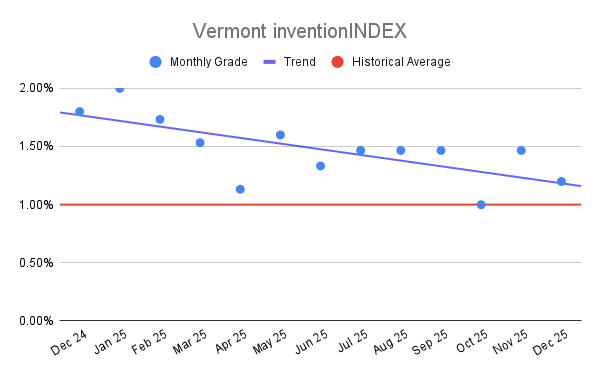 Vermont inventionINDEX December 2025:
  Vermont inventionINDEX November
