

The Research After Commercial Production exclusion refers to the statutory disqualification of research expenses incurred once a business component is developed to the point of meeting its basic functional and economic requirements for sale or use. In the Vermont context (32 V.S.A. § 5930ii), this exclusion ensures that the state’s 27% R&D tax credit incentivizes only the resolution of technical uncertainty, rather than the costs of ongoing manufacturing, routine software maintenance, or production logistics.
The Vermont Research and Development Tax Credit, codified under 32 V.S.A. § 5930ii, represents a critical intersection of state economic policy and federal tax law conformity. To understand the “Research After Commercial Production” exclusion within this framework, one must analyze the dual layers of authority: the specific Vermont statutes and administrative guidance issued by the Vermont Department of Taxes, and the federal Internal Revenue Code (IRC) Section 41, to which Vermont strictly adheres. This exclusion serves as a chronological “bright line” that separates the phase of experimentation from the phase of commercial exploitation. While the credit is designed to reward the risk-taking inherent in developing new technologies, it is not intended to subsidize the standard operational costs of a business that has successfully brought a product to market. This technical report provides an exhaustive examination of the legal definitions, regulatory interpretations, and administrative procedures surrounding this exclusion, with a specific focus on its application for Vermont-based taxpayers.
Statutory Foundation of the Vermont R&D Tax Credit
The authority for the Vermont Research and Development Tax Credit is found in 32 V.S.A. § 5930ii, which states that a taxpayer shall be eligible for a credit against the tax imposed under the chapter in an amount equal to 27 percent of the amount of the federal tax credit allowed in the taxable year for eligible research and development expenditures under 26 U.S.C. § 41(a) that are made within Vermont. This statutory construction creates a “piggyback” relationship where the state credit is inherently dependent on the federal definitions of “qualified research” and “qualified research expenditures” (QREs).
Vermont’s legislative intent is to encourage innovation within the state’s borders, particularly in high-growth sectors like biotechnology, aerospace, and software development. The credit is nonrefundable and applies to personal income tax, business income tax, or corporate income tax liabilities. One of the most significant features of the Vermont credit is its high proration rate; at 27% of the federal credit amount, it ranks among the most generous state R&D incentives in the United States. However, this generosity is balanced by a strict adherence to federal exclusionary rules, including the exclusion for research conducted after the commencement of commercial production.
| Attribute | Vermont Statutory Specification (32 V.S.A. § 5930ii) |
|---|---|
| Credit Rate | 27% of the federal credit allowed for Vermont-based QREs |
| Federal Conformity | Direct alignment with IRC § 41 definitions and exclusions |
| Eligible Expenditures | Wages, supplies, and 65-75% of contract research conducted in VT |
| Carryforward | 10 years for unused credit amounts |
| Refundability | Nonrefundable; cannot reduce tax liability below zero |
| Transparency | Annual public disclosure of all credit claimants by name |
The Federal Conformity Principle and the Four-Part Test
Because the Vermont credit is a percentage of the federal credit allowed under 26 U.S.C. § 41(a), any activity that fails to qualify at the federal level is automatically disqualified at the state level. The fundamental test for qualification is the “Four-Part Test,” which sets the threshold for what constitutes research before any exclusions are applied.
The first requirement is the Section 174 Test, which dictates that the expenditures must be eligible for treatment as expenses under Section 174 of the IRC. This means the costs must be incurred in connection with the taxpayer’s trade or business and represent research and development costs in the experimental or laboratory sense. The second requirement is the Technological in Nature Test, which mandates that the research fundamentally relies on principles of the physical or biological sciences, engineering, or computer science. The third requirement is the Business Component Test, which requires that the research be undertaken for the purpose of discovering information intended to be useful in the development of a new or improved business component of the taxpayer. Finally, the Process of Experimentation Test requires that substantially all of the activities constitute a systematic process designed to evaluate one or more alternatives to achieve a result where the capability, method, or appropriate design is uncertain at the beginning.
The “Research After Commercial Production” exclusion acts as a temporal limit on the Process of Experimentation Test. Once the “appropriate design” has been established and the component is “ready for use,” the process of experimentation is deemed to have concluded.
Defining Research After Commercial Production
The exclusion for research after commercial production is codified in IRC § 41(d)(4)(A) and detailed in Treasury Regulation § 1.41-4(c)(2). The regulation states that qualified research does not include any research conducted after the beginning of commercial production of a business component. A business component is considered developed to the point where it is ready for commercial production when it is ready for use or meets the basic functional and economic requirements of the taxpayer.
This definition creates two distinct hurdles for taxpayers. First, the “functional” requirement refers to the technical specifications necessary for the product to perform its intended task. Second, the “economic” requirement refers to the cost-effectiveness and marketability of the product. If a Vermont manufacturer develops a functional prototype of a medical device, but it costs $50,000 to produce a unit that can only be sold for $10,000, the research may continue into the manufacturing process itself to achieve economic viability.
The “Ready for Use” Standard
The “ready for use” standard is a factual determination. In many industries, this coincides with the “General Availability” date or the “Release to Manufacturing” (RTM) date. For software companies operating in Vermont, this often occurs when a stable version is pushed to production or made available for customer download. Activities occurring after this point are presumed to be non-qualifying production or maintenance activities unless the taxpayer can demonstrate that they have started a new process of experimentation for a new or improved business component.
Deemed Post-Production Activities
Treasury Regulation § 1.41-4(c)(2) and associated IRS audit guidelines identify specific activities that are per se deemed to occur after the beginning of commercial production. These activities are ineligible for the Vermont R&D tax credit.
| Deemed Post-Production Activity | Definition and Impact on Credit Qualification |
|---|---|
| Preproduction Planning | Developing logistical plans, scheduling, and resource allocation for mass manufacturing once the design is finalized. |
| Tooling Up | The preparation, acquisition, or setup of machinery, dies, and molds for the production line. |
| Trial Production Runs | Initial operation of the production line to ensure the manufacturing process functions correctly. |
| Troubleshooting | Activities directed at detecting and resolving faults in production equipment or the manufacturing process itself. |
| Data Accumulation | Gathering performance data from the production process that does not relate to a new process of experimentation. |
| Debugging | Fixing minor flaws or bugs in a product or software that do not require fundamental design changes. |
Administrative Guidance from the Vermont Department of Taxes
The Vermont Department of Taxes provides guidance through various channels, including form instructions, technical bulletins, and formal rulings. While the Department does not issue its own exhaustive manual on federal exclusions, it explicitly directs taxpayers to follow federal IRC § 41 standards and provides a framework for how these standards are audited in Vermont.
Form BA-404 and Credit Documentation
The primary mechanism for claiming the R&D credit is Schedule BA-404, “Tax Credits Earned, Applied, Expired, and Carried Forward”. The instructions for BA-404 mandate that taxpayers must attach a copy of their federal Form 6765, “Credit for Increasing Research Activities,” to their state return. This requirement ensures that the Vermont auditor can compare the total federal QREs with the Vermont-apportioned QREs.
If a taxpayer’s federal credit is challenged by the IRS due to the “Research After Commercial Production” exclusion, the taxpayer is legally required to notify the Vermont Department of Taxes and adjust their state credit accordingly. The Department emphasizes that the credit is limited to “eligible research and development expenditures… which are made within Vermont”. This necessitates a rigorous internal accounting system that can separate Vermont-based experimentation costs from post-production costs that may occur at the same facility.
Technical Bulletin 13 and Historical Guidance
Vermont Technical Bulletin 13 (TB-13) and other administrative publications clarify the state’s broader approach to tax exemptions and credits. While TB-13 primarily addresses sales and use tax exemptions, it reinforces the principle that “research and development” is a distinct phase of activity that precedes “manufacturing” or “commercial use”. For example, Vermont law provides sales tax exemptions for machinery and equipment used in research and development. If a machine is moved from the R&D lab to the production floor, it may lose its R&D exemption, mirroring the transition of labor costs into the “Research After Commercial Production” exclusion for the income tax credit.
The Transparency List and Audit Risk
Under 32 V.S.A. § 5930ii(c), the Department of Taxes must publish an annual list of all taxpayers who have claimed the R&D credit. This level of transparency is unique to Vermont and increases the audit profile of claimants. Auditors frequently look at the “R&D Credit List” (e.g., RP-1298) in conjunction with employment growth data. A company that claims significant R&D credits while simultaneously reporting high numbers of “production” employees to other state agencies (such as the Agency of Commerce and Community Development for VEGI credits) may trigger an inquiry into whether post-production activities were improperly included in the R&D claim.
Application of the Exclusion in Manufacturing and Software
The “Research After Commercial Production” exclusion manifests differently depending on the industry. In Vermont, where high-tech manufacturing and software dominate the R&D landscape, these nuances are critical for compliance.
The Manufacturing Lifecycle
In a manufacturing environment, the exclusion typically triggers at the point where the “pilot model” is finalized. Expenditures related to the design and development of prototypes are generally qualified. However, once those prototypes lead to a design that meets the taxpayer’s basic functional and economic requirements, the R&D phase ends.
For example, a Vermont-based aerospace component manufacturer might spend years developing a new turbine blade. The costs of materials, engineering wages, and testing during this phase are QREs. However, once the turbine blade is certified for flight and the company begins “tooling up” the factory to produce 1,000 units, the costs of those factory workers, the molds for mass production, and the trial runs of the assembly line are excluded. If the company later discovers a manufacturing defect and spends time “troubleshooting” the assembly line, those costs are also excluded under IRC § 41(d)(4)(A).
The Software Development Lifecycle
For software development, the “Research After Commercial Production” exclusion is often referred to as the “post-release” exclusion. Software development is inherently iterative, leading to frequent questions about whether a new feature is a continuation of original research or a post-production maintenance activity.
Activities such as “debugging” are explicitly excluded. In the context of software, debugging refers to the process of identifying and correcting errors in code that has already been deployed. This is viewed as verification and validation that the software works as intended, rather than a process of experimentation to resolve a technological uncertainty. Similarly, “routine data collection” and “efficiency surveys” conducted on a live software platform are excluded.
However, if a Vermont software firm releases Version 1.0 of an application and then begins work on Version 2.0, which introduces a fundamentally new encryption algorithm or a new method of data processing that requires a new process of experimentation, the Version 2.0 activities can qualify. The key is to demonstrate that Version 2.0 is a new business component and not merely an update to Version 1.0.
The “Shrinking Back” Rule: A Crucial Regulatory Mitigation
One of the most complex aspects of the Research After Commercial Production exclusion is the “Shrinking Back” rule found in Treasury Regulation § 1.41-4(b)(2). This rule allows taxpayers to apply the qualified research tests at a more granular level if the entire product fails to qualify.
If a taxpayer cannot meet the four-part test for a whole product (perhaps because it is already in commercial production), they may “shrink back” the analysis to a sub-component, a discrete process, or a specific sub-assembly. This is vital when a company is conducting R&D on a specific part of a larger system that is already on the market.
For instance, a Vermont vehicle manufacturer may have a truck model in commercial production. While the truck is being sold, the engineers are conducting R&D on a new, experimental hydrogen fuel cell to replace the existing diesel engine. Even though the truck itself is in commercial production (disqualifying any work on the truck’s chassis, tires, or cabin), the “Shrinking Back” rule allows the company to isolate the research activities related to the hydrogen fuel cell sub-component and claim those as QREs for the Vermont R&D tax credit.
Example Scenario: Green Mountain Robotics
To illustrate the application of the Research After Commercial Production exclusion and the Vermont tax calculation, consider the following example of “Green Mountain Robotics” (GMR), a fictitious company based in Essex Junction, Vermont.
Year 1: Conceptualization and Prototyping (2024)
GMR initiates the “Project Alpine” to develop a new autonomous snow-clearing robot for municipal sidewalks.
- Activity: Engineers develop three different chassis designs using new lightweight alloys. They use systematic trial and error to determine which alloy provides the best strength-to-weight ratio for cold-weather performance.
- Costs: $500,000 in Vermont wages; $50,000 in supplies.
- Qualification: All costs qualify. There is significant uncertainty regarding the design and material science.
Year 2: Final Design and Commencement of Production (2025)
By July 2025, GMR finalizes the design. The Alpine-1 robot successfully clears a test sidewalk in Burlington and meets the municipal safety and cost requirements.
- August – October 2025: GMR spends $100,000 on “tooling up” a small assembly line and $50,000 on “trial production runs” to ensure the robots can be built at scale.
- November – December 2025: GMR sells its first 10 units to the Town of Stowe. During this time, they find a small code error in the navigation software and spend $20,000 on “debugging.”
- Qualification Analysis: The $500,000 in Year 1 remains qualified. However, for Year 2, the $100,000 for tooling up, the $50,000 for trial runs, and the $20,000 for debugging are all excluded under the Research After Commercial Production rule.
Vermont Credit Calculation
Assuming GMR uses the Alternative Simplified Credit (ASC) method and had zero prior-year QREs for simplicity (allowing them to use the 6% rate for the first year).
$$VT\ Credit = (Total\ QREs \times 6\%) \times 27\%$$
For 2024:
- VT QREs = $550,000.
- Hypothetical Federal Credit = $550,000 \times 6% = $33,000.
- Vermont R&D Tax Credit = $33,000 \times 27% = $8,910.
For 2025:
If GMR erroneously included the $170,000 of post-production costs, a Vermont auditor would disallow that portion, potentially resulting in a tax assessment, penalties, and interest.
Audit Guidelines and Documentation Standards in Vermont
The Vermont Department of Taxes maintains the right to audit R&D claims, focusing on the accuracy of the proration and the eligibility of the activities. Audit guidelines emphasize that the taxpayer bears the “burden of proof” to demonstrate that their activities constitute qualified research and are not subject to any exclusions.
Required Documentation for Vermont Claimants
Taxpayers claiming the credit must maintain contemporaneous records that distinguish R&D activities from production activities. Recommended documentation includes:
- Project narratives and laboratory notebooks showing the timeline of experimentation.
- Employee time-tracking records that specifically allocate hours to R&D projects versus production or maintenance tasks.
- General ledger accounts for R&D supplies that are distinct from standard inventory accounts.
- Design review documents and “phase-gate” approval records that mark the point where a product moves from “Development” to “Production”.
Vermont Audit Strategy
Vermont auditors typically begin by reviewing the federal Form 6765 and comparing it with the Schedule BA-404. They may request “Project Lists” to identify any projects that have reached the commercial production stage. If a project has been in the credit pool for multiple years, the auditor will scrutinize the “Process of Experimentation” in the later years to ensure it has not shifted into “debugging” or “troubleshooting”.
For unitary businesses, auditors will ensure that the “hypothetical federal credit” only includes Vermont-sourced QREs. This prevents a multistate corporation from inadvertently claiming 27% of its national credit on its Vermont return.
| Audit Issue | Vermont Revenue Office Focus |
|---|---|
| Proration Accuracy | Ensuring only Vermont-based wages and supplies are included in the 27% calculation. |
| Activity Qualification | Verifying the “Four-Part Test” is met before exclusions are applied. |
| Commercial Readiness | Pinpointing the date a business component met functional and economic requirements. |
| Consistency Rule | Ensuring the base period and current period QREs are calculated using the same definitions. |
| Transparency Check | Comparing public Transparency List data with the actual tax returns filed. |
Comparative Analysis: Vermont vs. Federal Exclusionary Landscape
While Vermont conforms to the federal definition of the Research After Commercial Production exclusion, the impact of this exclusion can be amplified by state-specific rules.
The 10-Year Carryforward Constraint
The federal R&D credit features a 20-year carryforward period, whereas the Vermont credit is limited to 10 years. This makes the “Research After Commercial Production” exclusion more consequential in Vermont. If a taxpayer spends several years in the R&D phase but takes too long to reach commercial production, they may find themselves with significant carryforward amounts that expire before the product generates enough Vermont tax liability to be offset.
Unitary Reporting and the Apportionment Factor
Vermont uses a “Single Sales Factor” for apportioning income for most business entities. However, the R&D credit is calculated based on the location of the expenditures. This disconnect means that a company could have high Vermont sales (and thus high Vermont tax liability) but very low Vermont R&D credits if its actual research facility is located out of state. Conversely, a company with an R&D lab in Vermont but no sales in the state will generate credits it cannot use. In both cases, the proper exclusion of post-production costs is essential to avoid overstating the credit and incurring penalties.
The Future of Vermont R&D Compliance: Act 148 and Federal Shifts
Recent changes in Vermont law and federal tax policy are shaping the future of the R&D credit. Act 148 of 2022 mandated new rulemaking for corporate income tax, which could clarify the Department’s stance on credit administration. Additionally, the transition from Section 174 expensing to mandatory 5-year amortization (15 years for foreign research) at the federal level has significant implications for Vermont.
While Section 174 amortization is a “timing” issue rather than a “qualification” issue, it changes how companies track their R&D costs. Vermont auditors are expected to look more closely at the classification of costs as “specified research or experimental expenditures” (SREs) to ensure they align with the QREs claimed for the credit. The “Research After Commercial Production” exclusion will remain the primary filter used to prevent SREs that have transitioned into “Cost of Goods Sold” from being improperly claimed for the tax credit.
Detailed Analysis of Excluded “Adaptation” vs. “Commercial Production”
A common point of confusion is the distinction between the “Adaptation Exclusion” (IRC § 41(d)(4)(B)) and the “Research After Commercial Production Exclusion” (IRC § 41(d)(4)(A)). While related, they address different flaws in credit eligibility.
The Adaptation Exclusion applies when a company takes an existing product and modifies it to meet a specific customer’s needs. This is excluded because the core technical uncertainty of the product has already been resolved; the work is merely a custom configuration.
The Research After Commercial Production Exclusion applies once the product itself is ready for the general market, even if no customer-specific modifications are being made. In a Vermont tax audit, the Department may use both exclusions together. For instance, if a Vermont software firm develops a base software package (completing commercial production) and then spends months adapting it for a specific Vermont utility company, the initial development costs might be QREs, but all subsequent adaptation costs and post-release debugging costs would be disallowed under these respective exclusions.
Final Thoughts
The Research After Commercial Production exclusion is a sophisticated legal mechanism that protects the integrity of the Vermont Research and Development Tax Credit. By requiring a “Process of Experimentation” that precedes “Commercial Production,” the law ensures that state tax benefits are tied to true technological advancement. For Vermont taxpayers, the high 27% credit rate offers a significant competitive advantage, but it carries a corresponding requirement for meticulous documentation and a deep understanding of the transition points in the product development lifecycle.
To maintain compliance and maximize the value of the Vermont R&D credit, businesses should:
- Establish a clear “Ready for Use” milestone in their project management systems that aligns with the “Basic Functional and Economic Requirements” of the taxpayer.
- Utilize the “Shrinking Back” rule to isolate qualifying research on sub-components even after the primary product has entered the production phase.
- Implement contemporaneous time-tracking and expense allocation that clearly separates “prototyping” and “designing” from “tooling up,” “trial production,” and “debugging”.
- Carefully monitor the 10-year carryforward period, ensuring that credits generated during the R&D phase are utilized effectively as the product moves into the commercial production and sales phase.
- Ensure that all Vermont-based QREs are accurately identified and documented, as the state’s transparency requirements and audit standards prioritize the geographic nexus of the research.
By navigating these regulatory waters with precision, Vermont’s innovative companies can continue to leverage state incentives to drive the next generation of technological breakthroughs while avoiding the pitfalls of post-production tax adjustments.
Who We Are:
Swanson Reed is one of the largest Specialist R&D Tax Credit advisory firm in the United States. With offices nationwide, we are one of the only firms globally to exclusively provide R&D Tax Credit consulting services to our clients. We have been exclusively providing R&D Tax Credit claim preparation and audit compliance solutions for over 30 years. Swanson Reed hosts daily free webinars and provides free IRS CE and CPE credits for CPAs.
Are you eligible?

Why choose us?

Pass an Audit?

What is the R&D Tax Credit?
The Research & Experimentation Tax Credit (or R&D Tax Credit), is a general business tax credit under Internal Revenue Code section 41 for companies that incur research and development (R&D) costs in the United States. The credits are a tax incentive for performing qualified research in the United States, resulting in a credit to a tax return. For the first three years of R&D claims, 6% of the total qualified research expenses (QRE) form the gross credit. In the 4th year of claims and beyond, a base amount is calculated, and an adjusted expense line is multiplied times 14%. Click here to learn more.
Never miss a deadline again

Stay up to date on IRS processes

Discover R&D in your industry

R&D Tax Credit Preparation Services
Swanson Reed is one of the only companies in the United States to exclusively focus on R&D tax credit preparation. Swanson Reed provides state and federal R&D tax credit preparation and audit services to all 50 states.
If you have any questions or need further assistance, please call or email our CEO, Damian Smyth on (800) 986-4725.
Feel free to book a quick teleconference with one of our national R&D tax credit specialists at a time that is convenient for you.
R&D Tax Credit Audit Advisory Services
creditARMOR is a sophisticated R&D tax credit insurance and AI-driven risk management platform. It mitigates audit exposure by covering defense expenses, including CPA, tax attorney, and specialist consultant fees—delivering robust, compliant support for R&D credit claims. Click here for more information about R&D tax credit management and implementation.
Our Fees
Swanson Reed offers R&D tax credit preparation and audit services at our hourly rates of between $195 – $395 per hour. We are also able offer fixed fees and success fees in special circumstances. Learn more at https://www.swansonreed.com/about-us/research-tax-credit-consulting/our-fees/



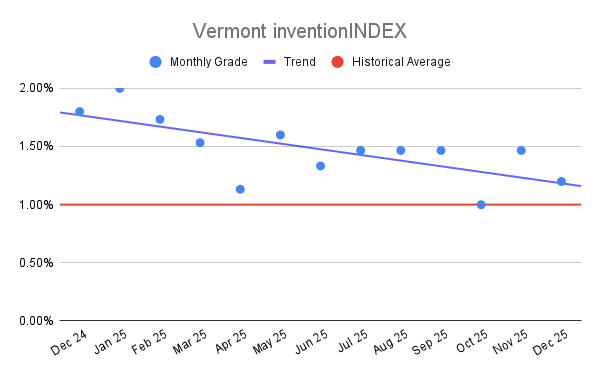 Vermont inventionINDEX December 2025:
  Vermont inventionINDEX November
