

The phrase “tax imposed under this chapter” refers to the specific income tax liabilities—personal, corporate, and entity-level—established under Title 32, Chapter 151 of the Vermont Statutes. In the context of the Research and Development tax credit, this definition restricts the credit’s application to these specific income-based taxes, preventing it from offsetting liabilities in other chapters such as sales, use, or property taxes.
Jurisdictional and Statutory Scope of Chapter 151
To understand the legal weight of the phrase “tax imposed under this chapter,” one must analyze the architecture of Title 32 of the Vermont Statutes, which governs taxation and finance. Chapter 151 is the primary statutory home for “Income Taxes,” and its boundaries are clearly defined to include all levies related to the earnings of individuals, estates, trusts, and various business entities. The legislature uses the term “chapter” as a jurisdictional marker to delineate exactly which revenue streams may be diminished by specific incentives, such as the Research and Development (R&D) tax credit authorized under § 5930ii.
The Vermont income tax system is subdivided into various subchapters, each of which establishes a distinct “tax imposed.” For instance, Subchapter 2 governs the taxation of individuals, trusts, and estates, with § 5821 explicitly naming the liability as the “Vermont personal income tax”. Subchapter 3 addresses corporate income taxes, while Subchapters 10A and 10B manage the taxation of S-corporations, partnerships, and limited liability companies. Consequently, the phrase “tax imposed under this chapter” serves as an umbrella term that gathers all these sub-components into a single eligible tax base for the R&D credit.
This statutory construction is critical because it excludes other significant taxes that a business might encounter. For example, the Education Property Tax is imposed under Chapter 135, and the Sales and Use Tax is imposed under Chapter 233. Because the R&D credit is specifically limited to the “tax imposed under this chapter” (Chapter 151), a taxpayer cannot use the credit to reduce their property tax bill or their sales tax remittance, even if those expenses were incurred as part of a research project. This separation maintains fiscal discipline by ensuring that income-based incentives only reduce income-based revenues.
The Mechanism of Federal Conformity and Section 5824
A foundational element of the “tax imposed under this chapter” is its relationship with federal law. Under 32 V.S.A. § 5824, Vermont formally adopts the statutes of the United States relating to federal income tax for the purpose of “computing the tax liability under this chapter”. This link is updated annually by the General Assembly to ensure that Vermont’s tax base remains synchronized with the Internal Revenue Code (IRC).
This conformity has profound implications for the R&D credit. Because the state credit is calculated as a percentage of the federal credit “allowed,” any federal changes to the calculation of QREs—such as the recent requirement to amortize research expenses over five years rather than deducting them immediately—directly impact the timing and amount of the “tax imposed” in Vermont. The state does not operate a parallel set of research definitions; rather, it uses the federal definition of “taxable income” as its starting point and applies the state credit as a final reduction of the resulting state liability.
Administrative Guidance from the Department of Taxes
The Vermont Department of Taxes provides extensive guidance on how the R&D credit should be calculated and applied to the “tax imposed.” This guidance is primarily disseminated through form instructions, technical bulletins, and the annual Tax Expenditure Report. The administrative “gold standard” for the R&D credit is the “hypothetical federal credit” method, which must be used by any taxpayer conducting research in multiple states.
The Hypothetical Federal Credit Calculation
When a business operates in Vermont and other jurisdictions, the federal R&D credit it claims on IRS Form 6765 includes expenses from all locations. However, Vermont law strictly limits the state credit to research “made within this State”. To satisfy this “in-state” requirement, the Department of Taxes requires taxpayers to perform a re-calculation:
- Isolate the QREs (wages, supplies, and contract research) that were physically conducted or utilized in Vermont.
- Calculate a “hypothetical” federal credit as if those Vermont-only QREs were the company’s only research expenses.
- Apply the Vermont 27 percent multiplier to this hypothetical figure.
This administrative proration ensures that the state is not subsidizing research conducted in competitor states, even if that research contributes to the overall federal credit of a Vermont-based company.
Documentation and Audit Guidelines
Revenue office guidance emphasizes that the burden of proof for the “in-state” nature of research lies entirely with the taxpayer. The Department recommends retaining documentation for at least as long as the federal rules require (typically three to seven years), but advises extending this period to cover the 10-year carryforward window for the R&D credit.
| Required Documentation Type | Purpose for R&D Credit Verification |
|---|---|
| Vermont Wage Records | To prove that R&D personnel were physically located in Vermont. |
| Supply Invoices | To verify that research supplies were used at a Vermont facility. |
| Federal Form 6765 | To establish the baseline federal credit from which the Vermont credit is derived. |
| Time Tracking Logs | To allocate the percentage of an employee’s time spent on “qualified” vs. “non-qualified” activities. |
If the Department determines during an audit that research was conducted outside the state or that the activities did not meet the IRS “Four-Part Test” (Permitted Purpose, Technological in Nature, Elimination of Uncertainty, and Process of Experimentation), it will adjust the “tax imposed” by disallowing the credit and potentially assessing interest and penalties.
The Corporate Minimum Tax and the Credit Floor
A critical nuance in the meaning of “tax imposed under this chapter” involves the corporate minimum tax. Under § 5832, Vermont imposes a corporate income tax that is the greater of a marginal rate (6.0% to 8.5%) or a minimum tax based on Vermont Gross Receipts. The minimum tax structure, updated in 2013, serves as a revenue floor that ensures every corporation pays for the privilege of doing business in the state.
Revenue office guidance, reflected in the instructions for Form CO-411 and Schedule BA-404, clarifies that the R&D credit—being a nonrefundable credit—cannot be used to reduce a corporation’s tax liability below the applicable minimum tax. This means that the “tax imposed” effectively has two layers: the “variable layer” based on income, which the credit can offset, and the “fixed layer” based on the minimum tax, which remains constant.
| Vermont Gross Receipts | Minimum Tax (The “Floor”) |
|---|---|
| Less than $500,000 | $100 |
| $500,000 to $1,000,000 | $500 |
| $1,000,000 to $5,000,000 | $2,000 |
| $5,000,000 to $300,000,000 | $6,000 |
| Over $300,000,000 | $100,000 |
For pass-through entities filing Form BI-471 or BI-476, the minimum entity tax is generally $250. The R&D credit generated by these entities cannot offset this $250 fee; instead, the credit is allocated to the owners to offset their individual “tax imposed” on their personal returns.
Credit Carryforward and Expiration
Unlike some state credits that are “use-it-or-lose-it,” the Vermont R&D credit includes a 10-year carryforward provision under § 5930ii(b). This is a vital feature for research-intensive firms that may incur significant expenses and generate large credits before they reach profitability. During these “pre-revenue” years, the “tax imposed under this chapter” might be limited to the minimum tax floor.
The ability to carry the credit forward for a decade allows these firms to “bank” their incentives and apply them against the much higher “tax imposed” that will arise once their research leads to commercial success and taxable net income. The Department of Taxes tracks these carryforwards through Schedule BA-404, where taxpayers must record the year the credit was earned, the amount used in the current year, and the amount remaining for future years.
Interaction with Other Chapter 151 Credits
The “tax imposed under this chapter” is often the target of multiple competing credits. Vermont law establishes an implicit or explicit ordering for these credits to determine how they reduce the liability. Generally, credits that are nonrefundable and have no carryforward are applied first, as they provide no benefit if not used in the current year. The R&D credit, having a generous 10-year carryforward, is typically applied later in the sequence.
Comparative Credit Architecture
Vermont offers several other credits within Chapter 151 that interact with the “tax imposed”:
- Investment Tax Credit: 24% of the federal investment credit for Vermont property, with no carryforward.
- Affordable Housing Tax Credit: A complex credit allocated by the Vermont Housing Finance Agency, which can be applied against income tax as well as bank franchise and insurance premium taxes—one of the few credits that extends beyond Chapter 151.
- Earned Income Tax Credit (EITC): A refundable credit for low-income individuals that is applied after all other credits have reduced the “tax imposed” to zero, potentially resulting in a refund check to the taxpayer.
The Department of Taxes uses Form IN-111 (for individuals) and CO-411 (for corporations) to manage this sequence. If a taxpayer has both the Investment tax credit and the R&D tax credit, the Investment credit will be used first to reduce the “tax imposed” because it cannot be carried forward, thereby “saving” the R&D credit for future years.
Transparency and Public Reporting Requirements
One of the most distinctive features of the R&D credit’s application to the “tax imposed” is the transparency mandate in § 5930ii(c). Every year, by January 15, the Department of Taxes must publish a list of all taxpayers who claimed the R&D credit in the previous year.
This requirement reflects a policy shift toward greater accountability for “tax expenditures”—the term used by economists and revenue officials to describe tax credits that act as indirect government spending. By reducing the “tax imposed under this chapter” for specific corporations, the state is essentially choosing to invest those potential revenues into private sector research. The public list allows the legislature and the citizenry to see which companies are the primary beneficiaries of this investment, though the specific dollar amounts of their tax liability and credit remain confidential under general tax secrecy laws.
Example: Multi-State Research Application and the Minimum Tax Floor
To illustrate the integration of the law and revenue office guidance, consider the case of Green Mountain Genomics, Inc., a C-corporation with research facilities in Vermont and New York.
Step 1: Identifying Qualified Research Expenditures (QREs)
For the 2024 tax year, Green Mountain Genomics spends $2,000,000 on qualified research.
- $1,200,000 is spent on researcher salaries and supplies at their laboratory in South Burlington, Vermont.
- $800,000 is spent on similar activities in New York.
- On their federal return (Form 6765), they claim a total federal R&D credit of $200,000 based on the full $2,000,000 in expenditures.
Step 2: Calculating the Vermont Credit Amount
According to the Department of Taxes guidance, the company must perform a “hypothetical federal credit” calculation using only the Vermont QREs.
- They determine that if their only QREs were the $1,200,000 spent in Vermont, their federal credit would have been $120,000.
- The Vermont R&D credit is then 27% of this hypothetical amount:
Vermont Credit = $120,000 x 0.27 = $32,400.
Step 3: Determining the “Tax Imposed” and the Minimum Floor
The company’s Vermont-apportioned net income is $400,000. Their Vermont Gross Receipts are $6,000,000.
- Calculate Marginal Tax:
- First $10,000 @ 6.0% = $600.
- Next $15,000 @ 7.0% = $1,050.
- Next $375,000 @ 8.5% = $31,875.
- Total marginal tax = $33,525.
- Identify Minimum Tax:
- With $6,000,000 in gross receipts, their minimum tax floor is $6,000.
- Apply the Credit:
- The “tax imposed” is $33,525.
- The credit is $32,400.
- Potential tax = $33,525 – $32,400 = $1,125.
- Enforce the Floor:
- Since $1,125 is less than the $6,000 minimum tax floor, the company must pay $6,000.
- The company uses only $27,525 of its credit ($33,525 – $6,000).
- The remaining $4,875 ($32,400 – $27,525) is carried forward to the 2025 tax year on Schedule BA-404.
Implications for Pass-Through Entities and Nonresidents
For S-corporations and partnerships, the “tax imposed under this chapter” often involves complex nonresident withholding rules. Under 32 V.S.A. § 5841 and § 5914, these entities must make estimated tax payments on behalf of their nonresident owners at the “next-to-lowest marginal tax rate”.
The R&D credit flows through to these nonresident owners and can be used to reduce the “tax imposed” on their individual Vermont returns. If the credit exceeds their liability, they cannot receive a refund, but they can carry it forward. Revenue office guidance in Form BI-471 and BI-477 helps these entities calculate the correct amount of withholding after accounting for the expected R&D credits of their members, thereby preventing the “over-collection” of tax.
Future Outlook and Legislative Trends
The definition of “tax imposed under this chapter” remains a point of periodic legislative debate. Recent technical changes, such as those in Act 72 (H.471), continue to refine the administrative processes for collecting and refunding taxes within Chapter 151. As Vermont looks to maintain its competitive edge in the green energy and biotechnology sectors, there are frequent calls to expand the R&D credit or to allow it to be applied against other chapters, such as the Bank Franchise tax or even the Insurance Premium tax, similar to the Affordable Housing credit.
However, for now, the “chapter” limitation serves as a robust fiscal guardrail. It ensures that the Vermont R&D tax credit remains a surgical instrument—one that reduces the cost of doing business specifically for those entities that contribute to the state’s knowledge economy through measurable research and development activity conducted on Vermont soil.
Final Thoughts on Statutory Analysis
The phrase “tax imposed under this chapter” is the legal anchor for the Vermont R&D tax credit. It provides the necessary boundaries for applying a federal-derivative credit to a state-specific tax base. By integrating the rigorous standards of IRC § 41 with the localized requirements of Vermont-only expenditures and the corporate minimum tax floor, the state has created a system that is both pro-growth and fiscally responsible. For the professional tax practitioner, mastery of this chapter-based architecture is essential for ensuring that research-active clients can fully realize the benefits of Vermont’s primary economic development incentive while remaining in full compliance with the evolving guidance of the Department of Taxes.





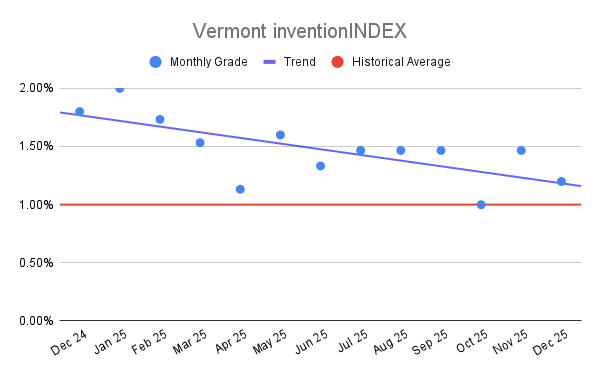 Vermont inventionINDEX December 2025:
  Vermont inventionINDEX November
