

Quick Summary: Vermont R&D Tax Credit Transparency
The Vermont Research and Development Tax Credit, codified under 32 V.S.A. § 5930ii, uniquely mandates the annual public disclosure of all taxpayers claiming the credit. Unlike standard confidential tax filings, this transparency provision overrides 32 V.S.A. § 3102 to ensure public accountability for state tax expenditures. The Vermont Department of Taxes publishes this list annually (Report RP-1298), detailing the names of claimants and the credit amounts. This report outlines the statutory architecture, the calculation methodology (27% of the federal credit attributable to Vermont), and the compliance requirements necessary for businesses to navigate this public disclosure while benefiting from the incentive.
The annual publication of the list refers to the mandatory public disclosure by the Vermont Department of Taxes of all taxpayers who claimed the Research and Development tax credit. This statutory requirement serves as a transparency mechanism to ensure public accountability for the utilization of high-value corporate fiscal incentives within the state.
The Research and Development (R&D) tax credit in Vermont, codified under 32 V.S.A. § 5930ii, represents a significant policy instrument designed to stimulate innovation and high-tech investment within the state’s borders. While most tax records are guarded by strict confidentiality protocols under 32 V.S.A. § 3102, the R&D credit is subject to a specific transparency carve-out that requires the names of claimants to be publicized annually. This detailed analysis explores the statutory origins of this requirement, the interplay between state and federal tax codes, the specific guidance issued by the Vermont Department of Taxes, and the administrative processes that govern the transition of a confidential tax filing into a public record. By examining the legislative intent behind 32 V.S.A. § 5930ii(c), the report clarifies how the state balances the protection of proprietary business information with the public’s right to oversee tax expenditures. Furthermore, this examination details the technical requirements for qualified research, the methodology for prorating federal credits to the Vermont context, and the rigorous documentation standards expected of any entity appearing on the annual publication list.
Statutory Architecture and the Transparency Mandate
The legal foundation for the Vermont Research and Development Tax Credit is 32 V.S.A. § 5930ii. The statute establishes a credit against Vermont income tax liabilities for taxpayers who engage in qualified research activities within the state. While the first two subsections of the law define the eligibility and the carryforward provisions, the third subsection, § 5930ii(c), introduces the transparency requirement that is central to this analysis.
The Language of 32 V.S.A. § 5930ii(c)
The statute provides that each year, on or before January 15, the Department of Taxes shall publish a list containing the names of the taxpayers who have claimed a credit under this section during the most recent completed calendar year. This directive is significant for several reasons. First, it uses the mandatory term shall, which removes any administrative discretion from the Commissioner of Taxes regarding whether to release the information. Second, it establishes a hard deadline of January 15, ensuring that the information is available to the General Assembly and the public at the beginning of each legislative session. Third, it specifies that the list must contain the names of those who claimed the credit, which implies that the disclosure occurs at the point of filing, rather than after a multi-year audit process has finalized the credit amount.
Exceptions to Taxpayer Confidentiality under Section 3102
To appreciate the gravity of the annual publication requirement, it must be viewed against the backdrop of Vermont’s general tax secrecy laws. Under 32 V.S.A. § 3102, any present or former officer or agent of the Department of Taxes is prohibited from disclosing any return or return information to unauthorized persons. The definition of return information is expansive, covering names, addresses, identification numbers, and any information regarding whether a return was filed or the nature of a person’s income.
The Vermont Legislature has established specific, limited exceptions to this rule. While most exceptions involve sharing data with other government agencies (such as the Joint Fiscal Office or law enforcement), the R&D credit list is one of the few instances where the general public is granted access to identifiable taxpayer names.
| Disclosure Category | Publicly Disclosed Information | Statutory Authority |
|---|---|---|
| R&D Tax Credit Claimants | Names of all entities claiming the credit in the prior year. | 32 V.S.A. § 5930ii(c) |
| Top Delinquent Taxpayers | Names and addresses of top 100 individual/business debtors. | 32 V.S.A. § 3102(m) |
| License Revocation | Name and address of entities with revoked tax licenses. | 32 V.S.A. § 3102(i) |
| Statistical Statistics | Aggregate data that does not identify specific persons. | 32 V.S.A. § 3102(g) |
| Tax Expenditure Reports | Fiscal impact estimates for specific tax provisions. | 32 V.S.A. § 312 |
The policy rationale for this specific disclosure is transparency in economic development. Because the R&D credit is a tax expenditure—meaning it represents revenue the state chooses not to collect to achieve a specific policy goal—the legislature determined that the public should know which specific private entities are the beneficiaries of this public investment.
Revenue Office Guidance and Administrative Reporting
The Vermont Department of Taxes translates the statutory mandate of § 5930ii(c) into action through its annual publication series, most notably the report designated as RP-1298. This report is the official Annual Publication of List referred to in the guidance.
The RP-1298 Publication Series
The Department publishes the R&D credit report annually, organized by the calendar year in which the claims were made. For instance, the report published in January 2024 (RP-1298-2023) lists the companies that filed a claim during the 2023 calendar year. This timeline ensures that the public receives the data shortly after the standard tax filing deadlines and any applicable extensions.
The guidance provided by the Department on its official website and within various taxpayer fact sheets clarifies the scope of this disclosure. The Department explicitly warns taxpayers that if you take the federal Research and Development (R&D) Credit you may qualify for a state R&D credit… Each year we publish a list of companies that claimed this credit. This notice serves as a constructive waiver; by electing to claim the benefit, the taxpayer acknowledges that their status as a claimant will become a matter of public record.
Interaction with Compliance and Audits
While the published list includes the names of all claimants, the Department’s guidance emphasizes that inclusion on the list does not signify that the credit has been approved in an audit sense. The Department’s Compliance Division may still select any claimant for a detailed audit to verify the accuracy of the expenditures reported.
The guidance suggests that state audits focus heavily on proration accuracy—ensuring that only research conducted physically within Vermont is included in the state-level calculation. Documentation must be retained for at least the duration of the 10-year carryforward period to defend the claim if it is challenged in subsequent years.
Technical Application of the Vermont R&D Law
The Vermont Research and Development Tax Credit is inextricably linked to federal law, specifically the Internal Revenue Code (IRC) Section 41. To understand how the law applies and who eventually appears on the annual list, it is necessary to examine the technical definitions and calculation methods required by the state.
Adoption of Federal Standards
Vermont law adopts the federal definition of qualified research expenditures (QREs). This includes wages paid to employees performing research, supplies used in research, and a percentage of costs paid for contract research. To qualify for the state credit, and thus for inclusion on the public list, the research activity must pass the federal Four-Part Test.
Permitted Purpose: The activity must relate to a new or improved function, performance, reliability, or quality of a business component.
Elimination of Uncertainty: The taxpayer must intend to discover information that eliminates uncertainty concerning the capability or method for developing or improving a product or process.
Process of Experimentation: Substantially all of the activities must constitute a process of experimentation involving the evaluation of alternatives through modeling, simulation, or systematic trial and error.
Technological in Nature: The process of experimentation must fundamentally rely on the principles of physical or biological science, engineering, or computer science.
The Proration Methodology
The most critical distinction between the federal and Vermont R&D credits is the geographical limitation. Vermont’s credit is calculated as 27% of the federal credit attributable to Vermont expenditures. This requires a specific hypothetical calculation.
Taxpayers do not simply take 27% of their final federal credit. Instead, they must:
Identify nationwide QREs used for the federal return.
Isolate the Vermont-only QREs.
Calculate what the federal credit would have been if only those Vermont QREs were used in the federal formula (using either the Regular Research Credit method or the Alternative Simplified Credit method).
Apply the 27% Vermont rate to that hypothetical federal credit amount.
The mathematical formula for the Vermont credit (VTC) is typically represented as:
VTC = 0.27 times (Federal Credit calculated using only VT-based QREs)
This specific proration ensures that the state is not subsidizing research activities occurring in other jurisdictions, even if those activities are performed by a Vermont-based company.
Comparative Analysis of Credit Features and Reporting
The Vermont R&D credit is notable for its high prorated rate and its extended carryforward period, both of which influence the frequency and duration of a company’s appearance in the annual publication.
| Feature | Vermont R&D Credit Detail | Impact on Annual Publication |
|---|---|---|
| Credit Rate | 27% of the Vermont portion of the federal credit. | High rate drives participation, increasing the list’s length. |
| Carryforward | Unused credits carry forward for up to 10 years. | Companies may appear on the list in the year they claim a carryforward. |
| Refundability | Nonrefundable; applies only to income tax liability. | Only companies with Vermont liability typically appear as claiming the credit. |
| Entity Eligibility | C-Corps, S-Corps, LLCs, Partnerships, and Individuals. | Public list identifies the primary business entity regardless of tax structure. |
| Minimum Spend | No state-specific minimum; follows federal thresholds. | Startups and smaller innovators can qualify and appear on the list. |
The 10-year carryforward is particularly significant. Because the credit is nonrefundable, a company in a high-investment/low-revenue phase (common in R&D-heavy sectors) may generate more credits than it can use in a single year. When that company eventually applies the carried-forward credit to a future tax year’s liability, that act of claiming the credit triggers their inclusion on the annual publication list for that specific year.
Comprehensive Industry Example: Aerospace Innovations, Inc.
To illustrate how these local revenue office guidelines apply in practice, consider the case of a hypothetical company, Aerospace Innovations, Inc. (AII), a firm developing composite materials for aviation.
The Research and Filing Process
In 2024, AII conducts significant research at its facility in South Burlington. They also have a small satellite office in Massachusetts.
Total Nationwide QREs: $5,000,000.
Vermont-Specific QREs: $4,000,000.
Federal Credit: Using the Alternative Simplified Credit (ASC) method, AII calculates a federal credit of $300,000 on its nationwide spend.
To comply with Vermont revenue office guidance, AII must perform a separate calculation for its Vermont return. They re-run the ASC formula using only the $4,000,000 spent in South Burlington. This results in a hypothetical federal credit of $240,000.
The Vermont R&D tax credit for AII is:
240,000 times 0.27 = $64,800
AII files its Vermont Corporate Income Tax Return (Form CO-411) in 2025, attaching Form BA-404 to detail the R&D calculation.
The Disclosure Outcome
Because AII filed its claim during the 2025 calendar year, the Department of Taxes includes Aerospace Innovations, Inc. on the annual list of R&D claimants published in January 2026 (Report RP-1298-2025).
If an investigative journalist or a competitor reviews the 2026 report, they will see AII’s name. However, the report will not disclose that AII claimed $64,800 or any details about their $4,000,000 in expenditures. This satisfies the statutory requirement for transparency regarding the identity of the beneficiary while preserving the confidentiality of the financial details under § 3102.
Economic Impact and Policy Implications of the Annual List
The Annual Publication of List is more than a bureaucratic requirement; it is a tool for economic analysis. The Legislative Joint Fiscal Office (JFO) uses the aggregate data from these claims to produce the Biennial Tax Expenditure Report. This report assesses whether the R&D credit is achieving its goal of increasing qualifying research activities that occurred in Vermont.
Transparency and Corporate Accountability
Vermont’s commitment to publishing these names reflects a broader trend toward accountability in state-level economic development. According to benchmarks like those from Good Jobs First, Vermont ranks highly among states for its disclosure of economic development subsidies. The R&D list is a key component of this ranking because it allows the public to verify that the 27% credit—one of the highest in the nation—is actually being utilized by companies that maintain a physical presence in Vermont.
A secondary effect of the annual publication is the implicit pressure it places on companies to ensure their claims are robust. Because a company’s participation is public knowledge, there is a reputational risk if a claim is later disallowed in a high-profile audit. The Department’s guidance on good faith documentation for other tax areas, such as sales tax exemptions, mirrors the rigor expected for R&D claims. Taxpayers are encouraged to conduct look-back studies to verify their eligibility before claiming the credit and appearing on the public list.
Final Thoughts
The Annual Publication of List is the administrative manifestation of Vermont’s policy that public tax incentives should be accompanied by public transparency. While 32 V.S.A. § 3102 provides a general shield of privacy for taxpayers, 32 V.S.A. § 5930ii(c) ensures that the names of those benefiting from the Research and Development tax credit are revealed to the public every January. This requirement, integrated with federal IRC § 41 standards and enforced through Department of Taxes reporting (RP-1298), creates a balanced system where innovation is rewarded, but the fiscal cost is made visible to the citizenry. For businesses operating in Vermont, appearing on this annual list is a sign of their commitment to the state’s burgeoning high-tech economy, provided they maintain the rigorous documentation and proration accuracy demanded by the Department’s compliance guidance.
Who We Are:
Swanson Reed is one of the largest Specialist R&D Tax Credit advisory firm in the United States. With offices nationwide, we are one of the only firms globally to exclusively provide R&D Tax Credit consulting services to our clients. We have been exclusively providing R&D Tax Credit claim preparation and audit compliance solutions for over 30 years. Swanson Reed hosts daily free webinars and provides free IRS CE and CPE credits for CPAs.
Are you eligible?

Why choose us?

Pass an Audit?

What is the R&D Tax Credit?
The Research & Experimentation Tax Credit (or R&D Tax Credit), is a general business tax credit under Internal Revenue Code section 41 for companies that incur research and development (R&D) costs in the United States. The credits are a tax incentive for performing qualified research in the United States, resulting in a credit to a tax return. For the first three years of R&D claims, 6% of the total qualified research expenses (QRE) form the gross credit. In the 4th year of claims and beyond, a base amount is calculated, and an adjusted expense line is multiplied times 14%. Click here to learn more.
Never miss a deadline again

Stay up to date on IRS processes

Discover R&D in your industry

R&D Tax Credit Preparation Services
Swanson Reed is one of the only companies in the United States to exclusively focus on R&D tax credit preparation. Swanson Reed provides state and federal R&D tax credit preparation and audit services to all 50 states.
If you have any questions or need further assistance, please call or email our CEO, Damian Smyth on (800) 986-4725.
Feel free to book a quick teleconference with one of our national R&D tax credit specialists at a time that is convenient for you.
R&D Tax Credit Audit Advisory Services
creditARMOR is a sophisticated R&D tax credit insurance and AI-driven risk management platform. It mitigates audit exposure by covering defense expenses, including CPA, tax attorney, and specialist consultant fees—delivering robust, compliant support for R&D credit claims. Click here for more information about R&D tax credit management and implementation.
Our Fees
Swanson Reed offers R&D tax credit preparation and audit services at our hourly rates of between $195 – $395 per hour. We are also able offer fixed fees and success fees in special circumstances. Learn more at https://www.swansonreed.com/about-us/research-tax-credit-consulting/our-fees/



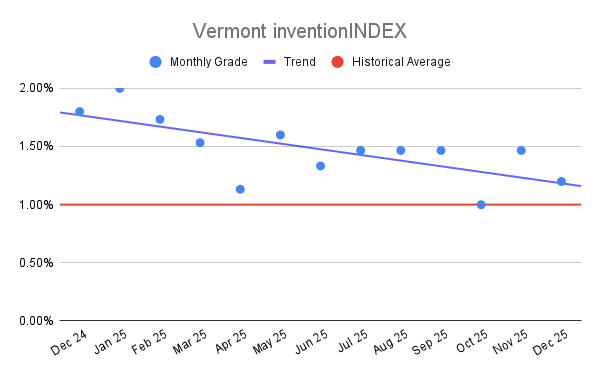 Vermont inventionINDEX December 2025:
  Vermont inventionINDEX November
