

Quick Answer: Vermont R&D Tax Credit Overview
The Vermont Research and Development Tax Credit is a nonrefundable fiscal incentive codified under 32 V.S.A. § 5930ii. It allows eligible taxpayers to claim a credit equal to 27% of the federal tax credit allowed for qualified research expenditures incurred within Vermont. While the credit cannot result in a cash refund if it exceeds tax liability, it includes a 10-year carryforward provision, allowing businesses to utilize the credit against future tax obligations. This structure is designed to encourage long-term investment in local innovation and intellectual property development.
A nonrefundable tax credit is a statutory mechanism that permits a taxpayer to reduce their established income tax liability on a dollar-for-dollar basis until the liability reaches zero. Any credit value remaining after the liability is fully offset is not issued as a cash refund, though it may be carried forward to future tax years if authorized by law.
Theoretical Framework of Nonrefundable Credits in State Taxation
The nonrefundable tax credit serves as a primary instrument of fiscal policy, designed to incentivize specific economic activities while ensuring that the state does not incur direct out-of-pocket expenses beyond the collection of taxes from the participating entity. In the broader landscape of United States tax law, credits are categorized by their refundability status, which determines the ultimate economic benefit to the taxpayer in scenarios where the credit amount exceeds the total tax owed. For a nonrefundable credit, the maximum benefit is strictly capped at the taxpayer's total tax liability for the period. This limitation distinguishes nonrefundable incentives from transfer payments, which are characteristic of refundable credits such as the Earned Income Tax Credit (EITC) or the Child Tax Credit (CTC) in certain jurisdictions.
From the perspective of a state revenue office, nonrefundable credits are essentially revenue foregone rather than a budgetary outlay. This distinction is critical for state treasury management, as it prevents the depletion of cash reserves for entities that are not currently contributing to the state's tax base through net profitable operations. For businesses, however, this creates a liquidity gap. A company engaged in intensive research and development (R&D) that has not yet reached profitability cannot use a nonrefundable credit to fund its current operations, unlike a refundable credit which would provide an immediate cash infusion. To mitigate this disadvantage, Vermont law incorporates a carryforward provision, allowing the credit to act as a deferred tax asset that can be used once the company transitions into a tax-paying position.
| Credit Characteristic | Nonrefundable (e.g., Vermont R&D) | Refundable (e.g., Vermont Child Tax Credit) |
|---|---|---|
| Offset Limit | Cannot exceed total tax liability | Can exceed total tax liability |
| Cash Disbursement | No cash refund provided | Excess paid as a refund |
| Fiscal Treatment | Revenue reduction (Tax Expenditure) | Direct outlay (Social Spending) |
| Beneficiary Profile | Profitable or tax-paying entities | Often lower-income or startup entities |
| Carryforward | Common (up to 10 years in VT) | Rarely necessary |
The structural logic of the Vermont R&D Tax Credit is rooted in the benefit-received principle of taxation, where the state provides a discount on the price of doing business in Vermont in exchange for the positive externalities generated by innovation, such as high-paying jobs and the creation of intellectual property. This is particularly evident in the enterprise zone provisions, which offer targeted R&D incentives in areas characterized by high unemployment or slow population growth, thereby linking the nonrefundable credit to broader regional development goals.
Legal Authority and Statutory Purpose of the Vermont R&D Credit
The Vermont Research and Development Tax Credit is codified under 32 V.S.A. § 5930ii. This section provides that a taxpayer of the state shall be eligible for a credit against the tax imposed under Chapter 151 (Income Taxes) in an amount equal to 27% of the federal tax credit allowed in the taxable year for eligible research and development expenditures under 26 U.S.C. § 41(a) that are made within the State of Vermont. The statute's simplicity—pegging the state credit directly to a percentage of the federal credit—masks a complex administrative and legal interdependency.
The legislative intent, as specified in 32 V.S.A. § 5813(p), is to encourage business investment in research and development within Vermont and to attract and retain intellectual-property-based companies. This statutory purpose is a vital component of the law, as it provides the Vermont Department of Taxes and the judicial system with a framework for interpreting ambiguous expenditures. For instance, if a taxpayer’s activities are borderline in terms of their research status, the department may look to whether the activity aligns with the goal of expanding Vermont's intellectual property base.
Under subsection (b) of 32 V.S.A. § 5930ii, the law explicitly addresses the nonrefundable nature of the credit by establishing a 10-year carryforward window. This ensures that the incentive is not entirely lost for high-growth, pre-revenue companies, provided they can reach profitability within a decade. Furthermore, subsection (c) introduces a transparency requirement that is relatively unique among state tax incentives: the Department of Taxes must publish an annual list of all taxpayers who have claimed the credit. This public disclosure serves as a check on the use of state funds (in the form of foregone revenue) and informs the legislature's periodic evaluation of the credit's effectiveness.
Federal Conformity and the Piggyback Mechanism
The Vermont R&D credit is what tax professionals refer to as a piggyback credit. It does not exist independently of the federal Research and Experimentation Tax Credit established under Internal Revenue Code (IRC) § 41. Consequently, the eligibility for the Vermont credit is entirely contingent upon the taxpayer’s eligibility for the federal credit. If a taxpayer's claim is denied at the federal level during an Internal Revenue Service (IRS) audit, the Vermont credit is automatically disqualified.
The Four-Part Test for Qualified Research ActivitiesTo qualify for the federal credit, and by extension the Vermont credit, research activities must satisfy the IRS Four-Part Test:
Section 174 Test (Permitted Purpose): The activity must relate to a new or improved function, performance, reliability, or quality of a business component. This includes products, processes, software, techniques, or formulas.
Elimination of Uncertainty Test: The taxpayer must intend to discover information that would eliminate uncertainty concerning the development or improvement of a business component. Uncertainty exists if the information available to the taxpayer does not establish the capability or method for developing the component or the appropriate design of that component.
Process of Experimentation Test: The taxpayer must undergo a systematic process designed to evaluate one or more alternatives to achieve a result where the capability, method, or design is uncertain at the beginning. This process often involves modeling, simulation, or systematic trial and error.
Technological in Nature Test: The process of experimentation must fundamentally rely on the principles of physical or biological sciences, engineering, or computer science. The researcher cannot simply be utilizing existing social science or management principles.
Vermont-Specific Qualified Research Expenses (QREs)While the definition of Qualified Research Activity (QRA) is identical at both the federal and state levels, the pool of Qualified Research Expenses (QREs) used to calculate the Vermont credit is much narrower. Only QREs incurred for research conducted within the state of Vermont are eligible for the 27% credit.
The calculation of the state credit requires the taxpayer to isolate Vermont-based expenses from their total federal QREs. These expenses include:
In-State Wages: Compensation paid to employees for performing, supervising, or directly supporting qualified research within Vermont. This includes first-level managers who supervise researchers but excludes general administrative staff.
Supplies Used in Vermont: The cost of tangible property, other than land or improvements to real property, that is consumed during the research process in Vermont. This frequently includes materials for prototypes and laboratory chemicals.
In-State Contract Research: 65% of the amount paid to third parties for qualified research conducted on the taxpayer's behalf within Vermont. If the research is performed at a qualifying university or nonprofit scientific research organization, this percentage can increase to 75% in certain federal contexts that Vermont follows.
Computer Rentals: Costs for leasing computers or cloud servers used more than 80% in the performance of qualified research activities, provided the hardware is located in or the services are attributed to Vermont operations.
Administrative Guidance and Filing Procedures
The Vermont Department of Taxes manages the R&D credit through several specific forms and schedules. The primary compliance document is Schedule BA-404, Tax Credits Earned, Applied, and Carried Forward.
Reporting the Credit on Schedule BA-404For a nonrefundable credit, tracking the carryforward balance is arguably more important than the initial calculation of the credit earned. Schedule BA-404 acts as a multi-year ledger where the taxpayer must report:
Column A: Amount of credit carried forward from prior years.
Column B: Amount of credit earned in the current tax year.
Column C: Amount of credit applied to the current year's tax liability (this cannot exceed the tax owed).
Column D: The remaining carryforward balance, calculated as (A + B) - C, adjusted for any credits that have reached their 10-year expiration limit.
The Department of Taxes specifies that Schedule BA-404 must be attached to every return where a credit is either earned or utilized. For C-corporations, the total credit applied is carried to Form CO-411, Line 12. For individuals, the credit is reported on Schedule IN-119, which is then attached to Form IN-111.
Supporting Documentation RequirementsRevenue office guidance emphasizes that the burden of proof lies with the taxpayer. To withstand a state audit, a taxpayer must be prepared to provide:
Federal Form 6765: The foundational document used to claim the federal credit.
Detailed Proration Schedule: A spreadsheet or narrative showing exactly how the taxpayer identified Vermont-specific wages, supplies, and contract costs. This is particularly critical for unitary groups where research might be shared across multiple states.
Project Documentation: Project charters, lab notebooks, and time-tracking data that link specific employee hours to the activities satisfying the Four-Part Test.
Payroll Records: Evidence that the wages claimed were subject to Vermont income tax withholding, reinforcing their status as in-state expenses.
Flow-Through Treatment for Pass-Through Entities
Vermont’s business landscape is heavily populated by S-Corporations, Partnerships, and Limited Liability Companies (LLCs). For these entities, the R&D tax credit does not reduce the entity's tax (as these entities generally pay only a minimum tax), but instead flows through to the individual partners or shareholders.
The entity reports the credit on Vermont Schedule K-1VT, which informs each owner of their pro-rata share of the credit based on their ownership percentage. The individual owner then applies this credit on their own Form IN-111 against their personal income tax liability. Crucially, the nonrefundable nature of the credit remains intact at the individual level. If an individual owner has a $5,000 share of the R&D credit but only owes $2,000 in Vermont personal income tax, they can only reduce their tax to zero and must carry forward the remaining $3,000 on their personal return.
| Entity Type | Reporting Form | Credit Application |
|---|---|---|
| C-Corporation | CO-411 | Applied at the entity level to corporate income tax |
| S-Corporation | BI-471 / K-1VT | Passed through to shareholders' personal returns |
| Partnership | BI-471 / K-1VT | Passed through to partners' personal returns |
| Unitary Group | CO-411-U | Restricted to the affiliate that earned the credit |
A unique challenge arises for unitary groups filing a combined return (Form CO-411-U). Vermont revenue guidance specifies that credits may only offset the tax attributable to the specific member of the group that was authorized to earn the credit. This tracing requirement prevents a highly profitable Vermont affiliate from using credits generated by a different, non-profitable affiliate within the same unitary group, unless they were part of the same qualifying project.
Interaction with Federal Tax Reform and the OBBBA of 2025
The valuation of the Vermont R&D credit is inextricably linked to federal tax rules regarding the timing of expense deductions. Historically, IRC § 174 allowed businesses to immediately expense R&D costs. However, the Tax Cuts and Jobs Act (TCJA) of 2017 mandated that starting in 2022, these expenses must be capitalized and amortized over five years (domestic) or 15 years (foreign).
This change significantly impacted Vermont taxpayers. By forcing the amortization of R&D expenses, the federal government (and Vermont, which conforms to federal adjusted gross income) effectively increased a business's taxable income in the early years of a project. While this resulted in a higher tax liability against which the nonrefundable R&D credit could be applied, it also created a severe cash-flow strain for many innovators.
The 2025 Legislative ShiftOn July 4, 2025, the One Big Beautiful Bill Act (OBBBA) was signed into law, restoring the immediate expensing of domestic R&D costs for tax years beginning after December 31, 2024. This federal reform has several implications for Vermont:
Cash Flow Restoration: Businesses can once again deduct 100% of their domestic research costs in the year they are incurred, reducing their current tax liability.
Retroactive Claims: Eligible small businesses (those with gross receipts under 31 million) may retroactively apply the expensing rules to the 2022-2024 tax years by amending their returns. This can result in significant federal and state refunds due to the reduction in prior-year taxable income.
Credit Calculation Adjustment: Because the federal credit calculation (Form 6765) often requires an adjustment to the deduction for research expenses (to prevent a double benefit), the return to immediate expensing will require Vermont taxpayers to meticulously re-calculate their hypothetical federal credit based on these new deduction rules.
Operational Case Study: The Lifecycle of a Vermont R&D Credit
To clarify the practical application of these rules, consider a hypothetical software firm, Green Mountain Algorithms (GMA), based in Montpelier, Vermont. GMA is a C-corporation that develops sophisticated machine-learning prototypes for the aerospace industry.
Phase 1: Identifying Qualified Activities and Expenses (2025)GMA undertakes a project to develop a new flight-stabilization algorithm. They incur the following expenses:
Vermont Salaries: $500,000 for software engineers based in Montpelier.
Remote Salaries: $200,000 for engineers based in New Hampshire.
In-State Supplies: $50,000 for specialized server hardware used for simulation in Vermont.
Contract Research: $100,000 paid to the University of Vermont (UVM) for specialized testing.
For Vermont tax purposes, GMA must exclude the $200,000 in New Hampshire salaries. Their Vermont QREs are:
Wages: $500,000
Supplies: $50,000
Contract Research (at 65% rate): $65,000
Total VT QREs: $615,000
Phase 2: Calculating the CreditAssuming GMA uses the federal ASC method and their average Vermont QREs for the three prior years were $400,000. The base amount for the ASC method is 50% of the average, or $200,000.
Excess QREs: $615,000 - $200,000 = $415,000
Hypothetical Federal ASC Credit: $415,000 x 14% = $58,100
Vermont R&D Credit: $58,100 x 27% = $15,687
Phase 3: Application of the Nonrefundable CreditGMA files its 2025 Vermont Corporate Income Tax Return. Due to other deductions and the newly restored R&D expensing rules under the OBBBA, their Vermont tax liability is only $10,000.
Total Credit Available: $15,687
Current Tax Liability: $10,000
Credit Applied: $10,000 (Reducing tax to $0)
Remaining Carryforward: $5,687
GMA must pay the minimum corporate tax (usually based on gross receipts), but their income-based liability is eliminated. They will record the $5,687 carryforward on Schedule BA-404 to be used in 2026 or later.
Phase 4: Long-Term Management and ExpirationIn 2035, any portion of this specific $5,687 credit that has not been used will expire. GMA’s tax department must track each year’s credit bucket separately to ensure that the oldest credits are applied first—a First-In, First-Out (FIFO) approach mandated by standard tax accounting practices to prevent the unnecessary expiration of credits.
Comparative Analysis with Regional Innovation Incentives
Vermont’s decision to maintain a nonrefundable R&D credit with a high percentage rate (27%) contrasts with the strategies of neighboring states. This policy choice reflects a focus on attracting established, profitable tech firms while offering a robust long-term asset to startups.
| State | R&D Credit Basis | Rate | Refundability |
|---|---|---|---|
| Vermont | % of Federal Credit | 27% | No (10-year carryforward) |
| Minnesota | Tiered % of QREs | 10% / 4% | Partially (19.2% - 25% starting 2025) |
| New York | % of QREs | 5% (Exempt Cos) | Yes (for Qualified Small Businesses) |
| Massachusetts | % of QREs | 10% / 15% | No (15-year carryforward) |
Minnesota’s recent move toward partial refundability—targeting approximately 25 million dollars in annual refunds statewide—represents a different fiscal philosophy. By allowing startups to receive a cash payment of 19.2% of their unused credits, Minnesota provides immediate liquidity for innovation. Vermont, by sticking with the nonrefundable model, prioritizes the reduction of the overall tax burden for the existing business community and limits the state's direct budgetary exposure to the tech sector's volatility.
Compliance and Audit Strategy for Vermont Taxpayers
Given the high value of the R&D credit and the transparency requirement, Vermont R&D claims are frequently scrutinized by the Department of Taxes. A robust compliance strategy must account for both the federal and state nuances.
Addressing the Fixed-Base CalculationFor taxpayers using the Regular Method, calculating the fixed-base percentage is a common area of dispute. The fixed-base percentage is generally the ratio of total QREs to total gross receipts for a specific period (usually 1984-1988 for older firms or a rolling period for newer ones). Vermont requires that this ratio be recalculated using only Vermont-sourced QREs and Vermont-sourced gross receipts.
VT Fixed Base % = Sum Historical VT QREs / Sum Historical VT Gross Receipts
Revenue guidance stipulates that the minimum base amount can never be less than 50% of the current-year QREs, ensuring that the credit is always focused on incremental increases in research spending rather than subsidizing a static level of activity.
Managing the Internal-Use Software (IUS) RestrictionA significant portion of Vermont’s R&D activity occurs in the software sector. IRS regulations, which Vermont adopts, place a higher hurdle on Internal-Use Software—software developed for a company's own administrative use (e.g., HR or accounting systems) rather than for sale or for use in a production process. IUS must meet a Three-Part High Threshold of Innovation test in addition to the standard Four-Part Test:
Innovative: The software must result in a reduction in cost or improvement in speed that is substantial and economically significant.
Significant Economic Risk: The taxpayer must commit substantial resources to the development and have a high degree of uncertainty that those resources will be recovered.
Not Commercially Available: The software cannot be purchased off-the-shelf or modified with minimal effort.
Audit Guidelines for Pass-Through EntitiesFor S-Corps and Partnerships, the Department of Taxes often audits the entity to verify the QREs but assesses the individual partners. Taxpayers should ensure that the Schedule K-1VT clearly breaks down the credit and that the partners have documentation of their Vermont tax liability in the years the credit is applied. If an entity is participating in an Enterprise Zone program, it must also provide the certification certificate received from the local zone administrator to the Department of Taxes to validate the higher credit rates or expanded eligibility.
Synthesis of Findings and Strategic Recommendations
The Vermont Research and Development Tax Credit is a powerful but strictly governed incentive. Its nonrefundable nature is balanced by a 10-year carryforward and a high percentage rate, creating a unique economic profile that favors established firms while providing a back-ended benefit for startups.
Strategic considerations for professional tax planning in Vermont include:
Prioritization of Nonrefundable Credits: Taxpayers should always apply their nonrefundable R&D credits before any refundable credits (like the Earned Income Credit or specific property tax credits) or credits with shorter carryforward windows (like the Solar Investment Credit). This maximizes the shelf life of the taxpayer's total credit portfolio.
Rigorous In-State Allocation: Businesses with multi-state operations must implement accounting systems that can geo-tag research expenses to Vermont. Failing to exclude out-of-state wages or supplies is the most frequent cause of credit disallowance during Department of Taxes audits.
Exploitation of Federal Expensing Rules: The restoration of Section 174 expensing in 2025 provides an immediate opportunity for businesses to reduce their taxable income. Small businesses should immediately evaluate whether amending 2022-2024 returns is beneficial, as the reduction in state tax liability for those years may allow for the utilization of R&D credits that would otherwise have been carried forward.
Documentation Longevity: Because the credit can be carried forward for a decade, the documentation supporting the original 2025 claim must be preserved until at least 2038 (10 years carryforward + 3 years statute of limitations). Digital preservation of lab notebooks and time-tracking data is essential.
By understanding the interplay between 32 V.S.A. § 5930ii, IRC § 41, and the administrative guidance provided by the Vermont Department of Taxes, businesses can effectively leverage this incentive to offset the costs of innovation and contribute to the state's goal of fostering a robust, knowledge-based economy. The nonrefundable nature of the credit, rather than being a deterrent, acts as a stabilizer for state revenue while rewarding those entities that achieve the ultimate goal of tax policy: sustainable, profitable growth within the borders of Vermont.
Who We Are:
Swanson Reed is one of the largest Specialist R&D Tax Credit advisory firm in the United States. With offices nationwide, we are one of the only firms globally to exclusively provide R&D Tax Credit consulting services to our clients. We have been exclusively providing R&D Tax Credit claim preparation and audit compliance solutions for over 30 years. Swanson Reed hosts daily free webinars and provides free IRS CE and CPE credits for CPAs.
Are you eligible?

Why choose us?

Pass an Audit?

What is the R&D Tax Credit?
The Research & Experimentation Tax Credit (or R&D Tax Credit), is a general business tax credit under Internal Revenue Code section 41 for companies that incur research and development (R&D) costs in the United States. The credits are a tax incentive for performing qualified research in the United States, resulting in a credit to a tax return. For the first three years of R&D claims, 6% of the total qualified research expenses (QRE) form the gross credit. In the 4th year of claims and beyond, a base amount is calculated, and an adjusted expense line is multiplied times 14%. Click here to learn more.
Never miss a deadline again

Stay up to date on IRS processes

Discover R&D in your industry

R&D Tax Credit Preparation Services
Swanson Reed is one of the only companies in the United States to exclusively focus on R&D tax credit preparation. Swanson Reed provides state and federal R&D tax credit preparation and audit services to all 50 states.
If you have any questions or need further assistance, please call or email our CEO, Damian Smyth on (800) 986-4725.
Feel free to book a quick teleconference with one of our national R&D tax credit specialists at a time that is convenient for you.
R&D Tax Credit Audit Advisory Services
creditARMOR is a sophisticated R&D tax credit insurance and AI-driven risk management platform. It mitigates audit exposure by covering defense expenses, including CPA, tax attorney, and specialist consultant fees—delivering robust, compliant support for R&D credit claims. Click here for more information about R&D tax credit management and implementation.
Our Fees
Swanson Reed offers R&D tax credit preparation and audit services at our hourly rates of between $195 – $395 per hour. We are also able offer fixed fees and success fees in special circumstances. Learn more at https://www.swansonreed.com/about-us/research-tax-credit-consulting/our-fees/



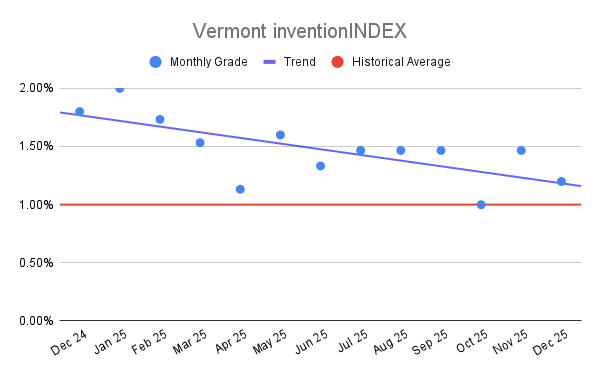 Vermont inventionINDEX December 2025:
  Vermont inventionINDEX November
