

Quick Answer: What are Qualified Supplies in Vermont?
Supplies used in the conduct of qualified research are defined as non-depreciable tangible property consumed or utilized directly during the process of experimentation. To qualify for the Vermont R&D Tax Credit (27%), these expenditures must meet the federal four-part test under IRC Section 41 and be specifically attributable to activities performed within Vermont. Items subject to depreciation (like machinery) and land are strictly excluded.
Supplies used in the conduct of qualified research are non-depreciable tangible property consumed or utilized directly during the process of experimentation performed within the State of Vermont. To qualify for the 27% state tax credit, these expenditures must meet the rigorous four-part test defined by Internal Revenue Code Section 41 and be specifically attributable to Vermont-based activities.
Comprehensive Analysis of the Statutory and Regulatory Environment
The Vermont Research and Development (R&D) Tax Credit is an essential instrument of state fiscal policy, designed to foster a climate of innovation by subsidizing the high costs associated with scientific and technological advancement. Authorized under 32 V.S.A. § 5930ii, the credit is administered by the Vermont Department of Taxes and provides a significant nonrefundable incentive to businesses engaging in qualifying activities within the state. The state’s legislative approach is one of strict conformity to federal standards, specifically "piggybacking" on the definitions and calculations provided in Section 41 of the Internal Revenue Code (IRC).
This alignment with federal law means that the term "supplies" in the Vermont context is inextricably linked to the federal definition found in IRC § 41(b)(2)(C). However, the application of this definition requires a nuanced understanding of both federal tax theory and Vermont-specific administrative requirements. The credit serves as a dollar-for-dollar reduction of Vermont personal income, business, or corporate income tax liabilities, offering a 27% rate that ranks among the highest in the United States. This high rate reflects a deliberate policy choice to offset the inherent risks companies face when investing in research where the outcomes are uncertain.
The Economic Philosophy of R&D Incentives in VermontThe justification for the Vermont R&D credit, and specifically the inclusion of supply costs, is rooted in the economic concept of positive externalities. When a private company invests in research, the knowledge, technological innovation, and process improvements that result often provide benefits to society that far exceed the profit captured by the firm itself. Because firms typically only invest up to the point where their private profit is maximized, they tend to under-invest in R&D from a socially optimal perspective. By providing a 27% credit on qualified expenditures—including the tangible materials consumed in the lab—the State of Vermont effectively lowers the private cost of research, encouraging firms to move closer to that socially optimal level of innovation.
| Legislative Provision | State Reference | Federal Reference | Key Function |
|---|---|---|---|
| Credit Authorization | 32 V.S.A. § 5930ii | IRC § 41(a) | Establishes the right to claim the credit. |
| Qualified Expenses | 32 V.S.A. § 5930ii(a) | IRC § 41(b) | Defines wages, supplies, and contract research. |
| Supplies Definition | Implied via § 5930ii | IRC § 41(b)(2)(C) | Restricts supplies to non-depreciable tangible property. |
| Qualified Research | Implied via § 5930ii | IRC § 41(d) | Establishes the four-part test for eligibility. |
| Carryforward | 32 V.S.A. § 5930ii(b) | Varies by state | Allows 10-year window for unused credits. |
| Transparency | 32 V.S.A. § 5930ii(c) | N/A | Requires annual publication of claimant names. |
The Statutory Definition of Qualified Research Supplies
Under the federal framework adopted by Vermont, qualified research expenses (QREs) are categorized as either in-house research expenses or contract research expenses. Supplies are a subset of in-house research expenses, alongside wages paid to employees and amounts paid for the right to use computers (such as cloud computing for R&D).
The Tangible Property RequirementThe term "supplies" is defined in IRC § 41(b)(2)(C) as any tangible property other than land or improvements to land and property of a character subject to the allowance for depreciation. This definition creates a clear boundary: the item must have physical substance. Intangible expenditures, such as patent attorney fees, software licenses, or general insurance premiums, are excluded because they do not constitute tangible property. Even if these costs are essential to the research project, they fail the statutory definition of a supply.
The exclusion of "land or improvements to land" ensures that the credit is focused on the active process of experimentation rather than the acquisition of real estate. This distinction is critical in Vermont, where land-use regulations and facility improvements might otherwise tempt a business to characterize infrastructure costs as research supplies.
The Non-Depreciable MandatePerhaps the most significant constraint on supply eligibility is the exclusion of property subject to an allowance for depreciation. In tax terms, depreciable property is generally that which has a useful life of more than one year and is used in a trade or business. Therefore, capital assets like laboratory equipment, specialized machinery, test rigs, and computers are disqualified from being claimed as supplies.
Supplies are intended to be "consumed" or "used up" during the experimental process. This includes raw materials, chemicals, biological reagents, and electronic components used to construct one-time prototypes. The R&D credit is designed to incentivize the "burn rate" of materials needed for trial and error, while other sections of the tax code, such as Section 179 or bonus depreciation, address the tax treatment of long-term capital investments.
The Indirect Cost ExclusionTreasury Regulation § 1.41-2(b)(1) clarifies that expenditures for supplies that are "indirect research expenditures or general and administrative expenses" do not qualify as in-house research expenses. This means that even if a supply is tangible and non-depreciable, it must have a direct nexus to the qualified research activity.
Common examples of excluded indirect supplies include:
- General office supplies (pens, paper, staples) used by the research department.
- Maintenance and cleaning supplies for the general laboratory environment.
- Travel-related expenses, such as meals or lodging, which are often mistakenly categorized as R&D costs but are explicitly excluded from the supply definition.
The Nexus to Qualified Services: "Used in the Conduct"
A supply only becomes a qualified expense if it is "used in the conduct of qualified research." The regulations further define this as use in the performance of "qualified services" by an employee of the taxpayer.
Defining Qualified ServicesUnder IRC § 41(b)(2)(B), qualified services are divided into three tiers:
- Engaging in Qualified Research: This involves the actual, hands-on performance of experimentation—the scientist at the bench or the engineer at the CAD station.
- Direct Supervision: This includes the first-line managers who immediately oversee the researchers. Higher-level executives who are only involved in financial or personnel matters are excluded.
- Direct Support: This covers activities that directly enable the research, such as a lab assistant cleaning specific experimental equipment or a clerk compiling data points from a specific trial.
For a supply cost to be eligible, it must be directly linked to these services. For instance, chemicals used by a scientist are qualified supplies. However, the cost of the paper used by an accountant to track the budget for that scientist's project is an indirect cost and does not qualify. The Vermont Department of Taxes, in its audit capacity, often scrutinizes the "nexus" between the supply expense and the specific qualified service performed.
The Extraordinary Utilities ExceptionWhile general utility charges like electricity and water are typically considered non-qualifying overhead, Treasury Regulation § 1.41-2(b)(2)(ii) provides an exception for "extraordinary expenditures." If a taxpayer can demonstrate that the unique nature of their research required additional, extraordinary utility usage, those costs may be treated as supplies.
A relevant example in Vermont’s tech sector would be a semiconductor manufacturer or a high-energy physics lab using massive amounts of electricity to power experimental lasers or cleanrooms. While the electricity for general office lighting is a non-qualified G&A expense, the incremental power surge required to run a specific experimental apparatus could be documented and claimed as a research supply.
The Four-Part Test for Qualified Research in Vermont
The eligibility of a supply is contingent upon the activity in which it is used meeting the federal "Four-Part Test" for qualified research. Vermont strictly adheres to these standards to ensure the credit is only applied to genuine technological innovation.
The Permitted Purpose TestThe research must be intended to develop a new or improved "business component," which is defined as any product, process, software, formula, or technique held for sale, lease, or license, or used in the taxpayer’s trade or business. The goal must be to improve functionality, performance, reliability, or quality. Supplies used to merely aesthetic ends or for routine seasonal changes do not meet this test.
The Elimination of Uncertainty TestTaxpayers must demonstrate that they faced technical uncertainty at the outset of the project regarding the capability or method of achieving the desired result, or the appropriate design of the business component. If the solution was readily available through standard practice or public knowledge, the materials consumed do not qualify for the credit.
The Process of Experimentation TestThis is arguably the most critical test for supply costs. The taxpayer must undergo a systematic process of evaluating one or more alternatives to achieve the desired result. This includes testing, modeling, simulation, and systematic trial-and-error. Supplies consumed in a failed experiment are just as qualifying as those in a successful one, provided the process was rigorous.
The Technological in Nature TestThe research must fundamentally rely on the principles of the "hard sciences," such as physics, chemistry, biology, engineering, or computer science. Research in the social sciences, arts, or humanities is explicitly excluded. This ensures that the supplies claimed—such as laboratory chemicals or electronic substrates—are being used in a scientific context.
Local State Revenue Office Guidance and Administrative Application
The Vermont Department of Taxes provides guidance primarily through Technical Bulletins and the instructions for Schedule BA-404. Because Vermont’s credit is based on the federal credit "allowed," the Department's guidance focuses on the proper apportionment of federal QREs to the State of Vermont.
Recomputing the Federal Credit for VermontWhen a company operates in multiple states, it must recompute its federal credit using only the expenses that occurred in Vermont. This requires the taxpayer to:
- Identify the total QREs nationwide.
- Isolate the Vermont-sourced QREs (wages for Vermont employees, supplies used in Vermont labs).
- Establish a Vermont-specific "base amount" using Vermont gross receipts.
- Calculate the "hypothetical federal credit" on those Vermont-only figures.
- Multiply that result by 27% to arrive at the Vermont R&D Tax Credit.
This recomputation ensures that the Vermont credit only subsidizes activities happening within state lines, preventing "credit leakage" to other jurisdictions.
Documentation and Audit StandardsThe Vermont Department of Taxes emphasizes the necessity of accurate recordkeeping. Taxpayers are advised to retain their R&D documentation for as long as federal rules require, typically 3 to 7 years. However, because Vermont allows a 10-year carryforward of unused credits, it is a best practice to maintain records for the entire 10-year window plus the period covered by the statute of limitations for the year in which the credit is actually applied.
Auditors look for a clear "nexus" or bridge between the costs and the activities. For supplies, this means being able to show that a specific invoice for tangible materials relates to a project that passed the four-part test. If supply costs represent an unusually high percentage of total QREs, it often triggers a "red flag" for auditors, as supplies typically form a smaller portion of the R&D budget compared to wages.
| Document Type | Purpose in Vermont R&D Claim |
|---|---|
| Form BA-404 | Primary form for claiming and reporting the credit. |
| Schedule RD | Supplemental form to calculate the 27% multiplier. |
| Federal Form 6765 | Basis for the entire credit; must be attached to VT return. |
| Technical Bulletin 45 | Provides background on investment credit logic. |
| Transparency List | Public report of all companies claiming the credit. |
Excluded Activities and Non-Qualifying Supplies
Certain activities are explicitly excluded from the definition of "qualified research" under IRC § 41(d)(4), and consequently, any supplies used in these activities are ineligible for the Vermont credit.
Research After Commercial ProductionOnce a product or process is ready for commercial release or use, any further research is considered "post-production." Materials used to refine a product already on the market are generally excluded unless they lead to a significant new business component that independently meets the four-part test. This is a frequent point of contention in audits, as companies often try to claim "product maintenance" or "quality control" as R&D.
Adaptation and DuplicationResearch related to adapting an existing business component to a specific customer's requirement is excluded. For example, if a Vermont software firm uses materials to customize an existing platform for a single client, those materials are not qualified research supplies. Similarly, "reverse engineering" or the duplication of an existing component is not qualified research.
Funded ResearchIf the research is funded by a grant, contract, or another person (including government entities), it is excluded to the extent of that funding. In Vermont, if a business receives a state or federal grant for a project, the expenditure basis for the R&D credit must be adjusted downward to account for that assistance. This prevents "double-dipping" where the government pays for the supplies directly and then provides a tax credit for the same costs.
Prototypes, Pilot Models, and Experimental Materials
The creation of prototypes is a hallmark of research and development in many of Vermont's core industries, such as aerospace and advanced manufacturing. The tax treatment of the materials used in these models is highly favorable but requires strict adherence to the definition of a supply.
Prototype Materials as SuppliesA prototype or "pilot model" is defined as a representation of a product that is produced to test a hypothesis or eliminate technical uncertainty. The raw materials used to construct these models—metals, polymers, electronic components—are considered qualified research supplies.
A key distinction is that while the materials are supplies, the equipment used to build the prototype (like a 3D printer) is a depreciable asset and its cost is excluded. Furthermore, if the prototype is eventually sold to a customer, it may still qualify as an R&D expense, provided its primary purpose was experimental. However, once the design is finalized and "commercial production" begins, the materials used for subsequent units become inventory/cost of goods sold, not R&D supplies.
The "Shrink-Back" RuleIn complex projects where only part of the work is truly experimental, the "shrink-back" rule (Treasury Regulation § 1.41-4(b)(2)) allows taxpayers to apply the four-part test to a discrete subset of the business component. For supply costs, this means that if a company is building a large machine where only the novel sensor system is experimental, they can claim the materials for the sensor even if the materials for the machine's frame do not qualify.
Strategic Impacts of Federal Legislation: TCJA and OBBBA
Recent changes in federal law have significantly altered the landscape for R&D expenditures, creating both challenges and opportunities for Vermont taxpayers.
IRC Section 174 AmortizationStarting in 2022, the Tax Cuts and Jobs Act (TCJA) required that all research and experimental (R&E) expenditures be capitalized and amortized over 5 years (for domestic research) or 15 years (for foreign research), rather than being deducted immediately. This includes the very same "supplies" that a company might be claiming for the R&D credit.
This change created a significant cash-flow burden for R&D-intensive companies in Vermont. While the Section 41 credit provides an immediate tax reduction, the underlying deduction is now spread out over several years. Because Vermont corporate income tax starts with federal taxable income, this amortization requirement effectively increased Vermont taxable income for many firms starting in 2022.
The One Big Beautiful Bill Act (OBBBA)The OBBBA, introduced to provide relief from the TCJA’s amortization rules, has major implications for the 2024 and 2025 tax years.
- Restoration of Expensing: Section 174A of the OBBBA restores the option for full expensing of domestic R&D expenditures for tax years beginning after December 31, 2024.
- Retroactive Relief for Small Businesses: Small businesses (those with average annual gross receipts under $31 million) can elect to apply the new expensing rules retroactively to 2022 and 2023.
- Impact on the Credit: While the expensing rules affect deductions, they do not directly change the calculation of the Section 41 credit. However, they significantly improve the overall tax benefit of engaging in R&D by allowing the credit and the deduction to be realized simultaneously.
Vermont taxpayers should closely monitor whether the state "couples" with these new federal provisions, as state-level decoupling could lead to a situation where research supplies are expensed federally but still amortized for Vermont state purposes.
Detailed Vermont R&D Credit Example
To illustrate the interplay of these complex rules, consider the case of "Green Mountain Bio-Solutions," a mid-sized biotechnology firm located in an Enterprise Zone in South Burlington, Vermont.
The ProjectThe firm is developing a new biodegradable polymer for use in medical sutures. The project requires:
- Synthesizing multiple chemical formulations to find the optimal tensile strength.
- Using a high-speed centrifuge to separate compounds.
- Conducting stress-tests on prototype sutures.
| Expense Item | Amount | Eligibility Analysis |
|---|---|---|
| Lab Reagents/Chemicals | $80,000 | Qualified Supply: Tangible, consumed in research. |
| New Centrifuge | $120,000 | Not a Supply: Depreciable capital equipment. |
| Researcher Salaries (VT) | $400,000 | Qualified Wages: Directly involved in experimentation. |
| Office Supplies/Toner | $5,000 | Ineligible: Indirect G&A overhead. |
| Lab Utilities (Standard) | $12,000 | Ineligible: Standard overhead. |
| Extraordinary Electricity | $8,000 | Qualified Supply: Power used specifically for the centrifuge trials. |
| Cloud Computing (R&D) | $15,000 | In-House Research: Qualifying under IRC § 41(b)(2)(A)(iii). |
The total Vermont Qualified Research Expenditures for the year are:
QRE_VT = Wages + Supplies + Computer Use
QRE_VT = $400,000 + ($80,000 + $8,000) + $15,000 = $503,000
Step 2: Establish the Base AmountThe firm uses the Alternative Simplified Credit (ASC) method. Their average Vermont QREs for the three preceding tax years was $300,000.
Base Amount = 50% × Average Prior QREs = 0.5 × $300,000 = $150,000
Step 3: Compute the Hypothetical Federal CreditIncremental QREs = $503,000 - $150,000 = $353,000
Hypothetical Federal Credit = 14% × $353,000 = $49,420
Step 4: Calculate the Vermont R&D Tax CreditVermont Credit = 27% × $49,420 = $13,343.40
In this scenario, the "Supplies" (reagents and extraordinary utilities) accounted for $88,000 of the expenditure base. If the firm had failed to properly document the extraordinary nature of the electricity or had included the centrifuge as a supply, the credit would be significantly different and potentially subject to disallowance upon audit.
Transparency and Public Accountability in Vermont
Vermont’s R&D tax credit is unique in its "Transparency List" requirement. Under 32 V.S.A. § 5930ii(c), the Department of Taxes must publish an annual report of all taxpayers who claimed the credit. This list, available on the Department’s website as reports like RP-1298, provides a level of public oversight that is rare for corporate tax incentives.
For the professional tax practitioner, this means that every claim for research supplies is a matter of public record. This fosters a culture of compliance, as companies are aware that their status as R&D claimants is visible to competitors, the press, and the legislature. It also serves as a benchmark for the scale of R&D activity in the state, with the Department reporting several million dollars in credits claimed annually across various sectors.
Final Thoughts and Strategic Recommendations
The "Supplies Used in the Conduct of Qualified Research" represents a vital component of the Vermont R&D Tax Credit, allowing innovative firms to recoup a significant portion of their tangible "burn rate" during the experimentation process. By adopting a high 27% credit rate and strictly following federal IRC Section 41 standards, Vermont has created a powerful, predictable, and transparent incentive for technological advancement.
To maximize the benefit of this credit while ensuring audit readiness, Vermont taxpayers should adopt the following professional practices:
- Meticulous Identification: Clearly distinguish between depreciable laboratory assets and non-depreciable research supplies. Small items like hand tools or test rigs that might be expensed for accounting purposes must still be evaluated for their "depreciable character" under tax law.
- Utility Sub-metering: If research involves high-energy equipment, utilize sub-metering or rigorous engineering estimates to substantiate "extraordinary" utility costs as qualified supplies.
- Inventory Integration: For manufacturing firms, implement a "withdrawal for R&D" system that tracks raw materials removed from general production inventory for use in prototypes, providing a clean audit trail.
- Component-Level Tracking: Utilize the "shrink-back" rule to capture supply costs for specific experimental sub-systems when the overall project might contain non-qualifying elements.
- Alignment with Federal Amortization: Ensure that the supply costs claimed for the Vermont credit are properly synchronized with federal capitalization requirements under Section 174 or the new Section 174A.
Through the disciplined application of these standards, Vermont businesses can effectively leverage their investments in physical materials to drive both private success and broader economic growth in the Green Mountain State.





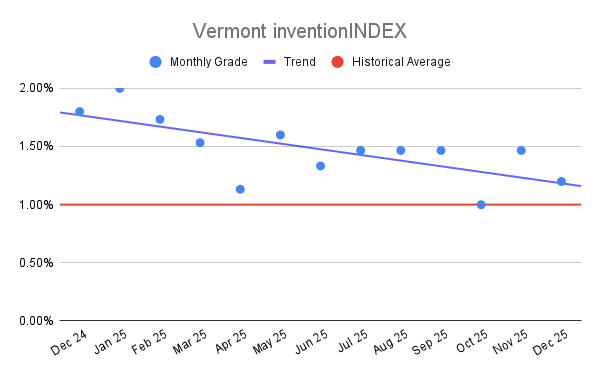 Vermont inventionINDEX December 2025:
  Vermont inventionINDEX November
