

The “technological in nature” requirement dictates that a research activity must fundamentally rely on the principles of the physical or biological sciences, engineering, or computer science to qualify for tax relief. This criterion serves as the essential boundary between rigorous scientific inquiry and activities focused on aesthetic, commercial, or social science pursuits.
The interpretation of this standard within the jurisdiction of Vermont is inextricably linked to the federal Internal Revenue Code (IRC) Section 41, as Vermont statutes are designed to mirror federal definitions to ensure administrative simplicity and taxpayer consistency. Under 32 V.S.A. § 5930ii, a taxpayer is eligible for a credit equal to 27 percent of the federal tax credit allowed for research expenditures made specifically within the state. While the user’s initial query references 32 V.S.A. § 5930z, it is critical to observe that § 5930z was historically associated with affordable housing tax credits and was repealed effective January 1, 2019. The current and relevant statutory authority for the research and development incentive is § 5930ii, which was established in 2009 and later amended in 2013 to refine the credit rate and reporting requirements. The “technological in nature” prong is the second of a mandatory four-part test that every business component must satisfy to be deemed “qualified research.” If an activity fails this technological threshold, even if it succeeds in improving a product or eliminating uncertainty, the associated expenses—such as wages, supplies, and contract research costs—are ineligible for both the federal and Vermont state credits.
The Statutory Evolution and Federal Conformity of the Vermont Credit
The architecture of Vermont’s tax code relies heavily on federal “piggybacking,” where the state adopts federal definitions of taxable income and qualified expenditures to minimize the compliance burden on businesses. The transition from older economic incentive models to the current Research and Development Tax Credit under 32 V.S.A. § 5930ii reflects a policy shift toward supporting high-growth, innovation-based sectors like aerospace, biotechnology, and software development.
Comparison of Statutory Authority and Previous Provisions
The legislative history indicates that Vermont has prioritized a high prorated rate of 27 percent to remain competitive with other states. This rate is applied to the federal credit amount attributable to Vermont-sourced Qualified Research Expenditures (QREs).
| Feature | Description under 32 V.S.A. § 5930ii | Federal Reference (IRC § 41) |
|---|---|---|
| Primary Requirement | Expenditure must be for “qualified research” | Must meet the Four-Part Test |
| Credit Rate | 27% of the federal allowance | 20% (RRC) or 14% (ASC) |
| Carryforward | 10 years | 20 years (Federal standard) |
| Source Rule | Strictly limited to in-state activities | Domestic (U.S. based) research |
| Transparency | Claimant names published annually | Confidential tax data |
This conformity means that the Vermont Department of Taxes does not maintain a separate, independent definition of “technological in nature.” Instead, it adopts the interpretations found in Treasury Regulation § 1.41-4, which clarifies that information is technological in nature if the process of experimentation relies on the “hard sciences”. The state’s role is primarily administrative and focused on ensuring the accuracy of the proration—confirming that the wages and supplies claimed were indeed utilized for research conducted within Vermont borders.
Deconstructing the “Technological in Nature” Requirement
To satisfy the “technological in nature” prong, the taxpayer must demonstrate that the research was undertaken to discover information that would eliminate technical uncertainty, and that the process of discovery fundamentally relied on physical or biological sciences, engineering, or computer science.
The Reliance on Hard Sciences
The distinction between “hard” and “soft” sciences is a critical boundary in R&D tax law. The IRS and the Vermont Department of Taxes exclude activities based on economics, management science, or social sciences.
- Physical Sciences: This encompasses physics and chemistry. For a Vermont-based materials manufacturer, researching the molecular bonding of a new adhesive to ensure it remains stable in sub-zero temperatures relies on chemical principles.
- Biological Sciences: This includes biology and microbiology. A Vermont biotechnology firm developing a new enzyme-based treatment for agricultural applications satisfies this prong through its reliance on biological principles.
- Engineering: This is the application of mathematical and physical principles to design and build systems or structures. A Vermont aerospace company designing a more aerodynamic wing for a small aircraft is performing engineering-based research.
- Computer Science: This involves the development of algorithms, data structures, and software architecture. Simply using a computer to perform a task is not computer science; rather, the “technological in nature” requirement is met when the research addresses challenges in the underlying software logic or system efficiency.
The taxpayer is not required to seek information that exceeds the “common knowledge of skilled professionals” in the field; they only need to seek information that is new to them to solve a specific technical uncertainty. Furthermore, the issuance of a patent (other than a design patent) is considered conclusive evidence that the taxpayer has discovered information that is technological in nature.
The Relationship to the Four-Part Test
The “technological in nature” requirement cannot be analyzed in isolation. It must be viewed as part of the holistic “Four-Part Test” used to define qualified research.
| Test Component | Purpose | Relation to Technology |
|---|---|---|
| Permitted Purpose | To create a new or improved business component | The technology must be used for function, not form |
| Technological in Nature | Fundamental reliance on hard sciences | Establishes the scientific basis of the work |
| Elimination of Uncertainty | Addressing doubts in capability, method, or design | Technology is the tool used to solve the doubt |
| Process of Experimentation | Evaluation of alternatives via trial and error | Scientific method must be applied |
Local Vermont Revenue Office Guidance and Administrative Procedures
The Vermont Department of Taxes provides guidance through its tax forms, instructions, and annual reports. The primary administrative document is Form BA-404, “Tax Credits Earned, Applied, Expired, and Carried Forward,” which must be attached to the taxpayer’s return.
Filing Requirements and Form BA-404
Taxpayers must include a copy of their federal Form 6765, “Credit for Increasing Research Activities,” when claiming the Vermont credit. If the federal credit was earned based on expenditures in multiple states, the taxpayer must provide a breakdown of these expenditures and a “recomputed credit calculation” based only on the activities that occurred in Vermont.
The Department of Taxes emphasizes that “your expenditures must be eligible for and receive the federal tax credit to claim the Vermont tax credit”. This instruction effectively incorporates all IRS rulings and Treasury Regulations into Vermont’s local guidance. If an IRS auditor determines that a project was not “technological in nature”—perhaps because it was focused on marketing or aesthetics—the Vermont credit associated with that project would also be disallowed.
The Proration Mechanism
The Vermont credit calculation requires a “hypothetical federal credit” determined solely by Vermont QREs. This ensures the state only incentivizes research conducted within its borders.
- Identify Vermont QREs: Wages for employees in Vermont, supplies consumed in Vermont labs, and 65% of payments to Vermont-based contractors.
- Calculate the Hypothetical Federal Amount: Use federal rules (Regular or ASC method) as if the Vermont QREs were the only QREs the company had.
- Apply the 27% Vermont Rate: Multiply the hypothetical federal credit by 0.27 to find the state credit.
Transparency and Public Reporting
Vermont law requires the Department of Taxes to publish an annual report (RP-1298) containing the names of all taxpayers who claimed the credit during the previous calendar year. This transparency is a unique local requirement intended to promote accountability. It also suggests that businesses claiming the credit should be prepared for public association with “research and development,” which underscores the need for activities to be legitimately technological.
Exclusions and the Boundaries of Technology
A significant portion of guidance, both at the federal level and as adopted by Vermont, is dedicated to defining what does not qualify as technological research. This clarity prevents the credit from being diluted by non-innovative activities.
Non-Qualifying Activities and Exclusions
The following activities are specifically excluded from being considered “technological in nature” or “qualified research”:
- Aesthetics and Style: Research relating to style, taste, cosmetic, or seasonal design factors is excluded. For example, changing the color or texture of a product for better “shelf appeal” is not a technological improvement.
- Post-Production Activities: Once commercial production begins, the “research” phase is generally considered complete. Activities such as “tooling up” for production, trial production runs, and troubleshooting existing equipment are not qualified.
- Adaptation: Modifying an existing product to meet a specific customer’s request is not technological research unless it involves solving a new technical uncertainty using the scientific method.
- Surveys and Studies: Efficiency surveys, management studies, market research, and routine data collection are based on social or business sciences and thus fail the “technological in nature” prong.
- Internal Use Software (IUS): Software developed for a company’s internal administrative functions (HR, accounting) must meet a “high threshold of innovation” test. It must be innovative, involve significant economic risk, and not be commercially available.
| Exclusion Category | Reason for Disqualification | Example |
|---|---|---|
| Aesthetics | Not functional/scientific | Redesigning a label for better branding |
| Post-Production | Uncertainty already resolved | Debugging a minor flaw in a finished product |
| Social Science | Not a “hard science” | A consumer survey on product preference |
| Duplication | No discovery of information | Reverse-engineering a competitor’s component |
Comprehensive Example: Vermont Software and Hardware Integration
To illustrate the application of the “technological in nature” standard, consider “Green Mountain Precision Systems,” a Vermont-based firm developing a new automated sorting system for regional dairy producers.
The Project: “Ultra-Sort 5000”
The company aims to develop a system that uses high-speed infrared sensors and machine learning to detect and remove contaminants from raw milk lines in real-time.
Verification of the Technological in Nature Requirement
The project relies on:
- Physics: Developing infrared sensor arrays that can penetrate liquid without losing signal clarity.
- Computer Science: Designing a real-time algorithm that can process sensor data and trigger a mechanical reject arm within milliseconds.
- Mechanical Engineering: Constructing a high-speed valve system that can withstand the high-pressure cleaning cycles required in food production.
- Result: The project is fundamentally based on “hard sciences” and thus satisfies the “technological in nature” prong.
Application of the Remainder of the Four-Part Test
- Permitted Purpose: The goal is to improve the quality and reliability of the milk production process.
- Elimination of Uncertainty: At the start, the company did not know if the sensors could operate at the required flow rate or if the reject arm would damage the surrounding piping (Method and Design uncertainty).
- Process of Experimentation: The team developed three distinct sensor prototypes and ran 100 trials, recording error rates and adjusting the software code after each run (Systematic trial and error).
Expense Calculation and Credit Proration
Green Mountain Precision Systems has the following expenditures:
- Total Project Cost: $1,000,000.
- Vermont-Based QREs: $800,000 (Wages for Vermont engineers and locally sourced testing supplies).
- Out-of-State QREs: $200,000 (Software contractors in California).
Step 1: Hypothetical Federal Credit (ASC Method)
Assume the company’s average Vermont QREs over the past three years was $400,000.
The federal base is 50% of this average = $200,000.
Step 2: Vermont Credit Calculation
The Vermont credit is 27% of the hypothetical federal amount.
The company files Form BA-404, listing $22,680 as the credit earned in the current year. They may apply this against their Vermont corporate income tax liability and carry forward any excess for up to 10 years.
Audit Standards and Documentation Best Practices
Because Vermont relies on federal conformity, its audit standards mirror those of the IRS. The Department of Taxes focuses on ensuring that the “nexus” between the expense and the research activity is well-documented.
Contemporaneous Record-Keeping
To defend a claim that research was “technological in nature,” a taxpayer must maintain:
- Technical Documents: Design specifications, CAD drawings, flowcharts, and architecture diagrams for software projects.
- Testing Logs: Records of failed prototypes, trial results, and data analysis that show a “process of experimentation” was occurring.
- Time Tracking: Proof that the employees whose wages are being claimed spent their time on “qualified services,” which include performing, supervising, or directly supporting the research.
- Project Lists: A comprehensive list of all projects claimed, with a brief technical description of the uncertainty faced and the science relied upon.
Vermont-specific audits will pay particular attention to the “In-State Only” rule. Taxpayers must be able to prove through payroll records and vendor invoices that the activities and materials were indeed Vermont-sourced.
Economic Impact and Future Outlook
The Research and Development Tax Credit is a vital component of Vermont’s economic strategy. By offering a high 27% rate, the state encourages established manufacturers and emerging tech firms to maintain their high-value research operations within the state.
Recent changes in federal law, specifically the requirement under IRC § 174 to capitalize and amortize research expenses over five years rather than expensing them immediately, have significant implications for Vermont businesses. Because Vermont’s tax system is so closely tied to federal definitions, these changes affect the timing of when research-related tax benefits are realized at the state level.
Despite these federal shifts, Vermont’s commitment to the credit remains robust. The 10-year carryforward period provides a long-term benefit that supports businesses through multiple cycles of product development. For a Vermont taxpayer, the “technological in nature” standard is not merely a legal hurdle, but a definition of the innovation that drives the state’s most productive economic sectors.
Final Thoughts
The requirement that research be “technological in nature” ensures that the Vermont R&D tax credit fulfills its purpose of incentivizing scientific and engineering advancements. By adhering to federal standards under IRC § 41, Vermont provides a consistent framework for businesses while maintaining a competitive 27 percent credit rate. Success in claiming this credit depends on a rigorous application of the Four-Part Test and the maintenance of contemporaneous documentation that substantiates the scientific basis of the work performed within the state. As Vermont continues to publish claimant data and refine its administrative oversight, the “technological in nature” threshold remains the definitive line between routine business operation and the qualified research that fuels future economic growth.





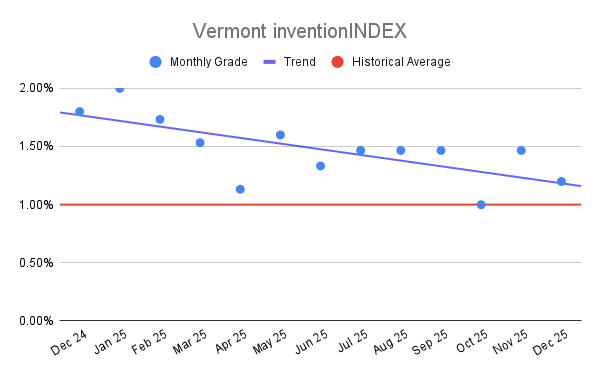 Vermont inventionINDEX December 2025:
  Vermont inventionINDEX November
