

Quick Answer: What is the Social Science Exclusion in the Vermont R&D Tax Credit?
The Social Sciences, Arts, and Humanities Exclusion is a statutory limitation within the Vermont Research and Development Tax Credit (and federal IRC § 41) that strictly disqualifies research activities relying on “soft sciences.” To be eligible for the 27% state credit, research must be “technological in nature,” meaning it must fundamentally rely on the principles of physical or biological sciences, engineering, or computer science. Activities such as economic modeling, consumer psychology studies, aesthetic industrial design, or historical research are ineligible, regardless of their complexity or value.
The social sciences, arts, and humanities exclusion in Vermont’s R&D tax credit removes non-technical research—such as economics, behavioral studies, or aesthetic design—from eligibility for the 27 percent state incentive. To qualify, research must instead fundamentally rely on principles of physical or biological sciences, engineering, or computer science to resolve technical uncertainties.
The Vermont Research and Development (R&D) tax credit, codified under 32 V.S.A. § 5930ii, represents a significant fiscal instrument designed to foster a climate of innovation within the Green Mountain State. By offering a credit equal to 27 percent of the federal research credit attributable to Vermont-based expenditures, the state provides one of the most competitive prorated rates in the United States. However, the eligibility for this credit is not universal across all forms of inquiry or creative endeavor. Instead, it is governed by a rigorous “technological mandate” derived from the federal Internal Revenue Code (IRC) Section 41, which Vermont adopts by reference. This mandate explicitly excludes research in the social sciences, arts, or humanities, creating a critical jurisdictional boundary between “hard science” innovation and “soft science” or aesthetic development. Understanding this exclusion is paramount for Vermont businesses, as the misclassification of research activities can lead to significant audit risks, the disallowance of credits, and potential penalties under the state’s transparency and recapture provisions.
Legislative Foundations and the Vermont-Federal Interplay
The Vermont R&D tax credit does not exist in a statutory vacuum; rather, it is part of a complex “piggyback” system where state tax policy is inextricably linked to federal definitions. The primary mechanism for this linkage is 32 V.S.A. § 5930ii(a), which states that a taxpayer is eligible for a credit in an amount equal to 27 percent of the federal tax credit allowed for eligible research and development expenditures under 26 U.S.C. § 41(a) that are made within the state. This statutory language effectively incorporates the entirety of the federal regulatory framework into Vermont law, including the definition of “qualified research” and the specific list of excluded activities found in IRC § 41(d)(4).
The Evolution of the Federal Standard
The federal research credit was first introduced in the Economic Recovery Tax Act of 1981 to counteract a decades-long decline in domestic research spending relative to the size of the economy. The original intent was to incentivize activities that generate “spillovers” or positive externalities—innovations that benefit society at large beyond the private profit realized by the inventing firm. Because research in the social sciences, arts, or humanities was viewed as having a more direct, internal application for a company’s business model or as being less likely to lead to the kind of “technological” breakthroughs that drive broad economic growth, these disciplines were specifically excluded from the credit’s inception.
Vermont’s Adoption and State-Specific Enhancements
While Vermont adopts the federal definitions, it applies its own unique rate and administrative safeguards. The state’s 27 percent rate is significantly higher than many other states that offer only a flat percentage of expenses or a lower percentage of the federal amount. This high rate is balanced by a robust transparency requirement: under 32 V.S.A. § 5930ii(c), the Vermont Department of Taxes must publish an annual report containing the names of all taxpayers who have claimed the credit during the most recently completed calendar year. This transparency aims to promote public oversight and ensure that the substantial tax expenditures authorized by the credit are supporting true technological innovation rather than excluded activities.
| Vermont R&D Credit Attribute | Statutory Provision | Detail/Mechanism |
|---|---|---|
| Governing State Law | 32 V.S.A. § 5930ii | Established in 2009 |
| Federal Linkage | IRC § 41 | Adopts federal definitions for “Qualified Research” |
| Credit Amount | 27% of Federal Credit | Calculated on a prorated, Vermont-only basis |
| Carryforward Period | 10 Years | Unused credits apply to future income tax liabilities |
| Refundability | Nonrefundable | Applied only against actual tax liability |
| Documentation | Federal Standards | Requires adherence to IRS record-keeping rules |
The Meaning of the Exclusion: Social Sciences, Arts, and Humanities
The exclusion of social sciences, arts, and humanities is codified in IRC § 41(d)(4)(G) and is further clarified through Treasury Regulations and decades of IRS guidance. At its core, this exclusion serves as a filter to ensure that the R&D credit is applied only to research that is “technological in nature”. Research that fundamentally relies on the “soft sciences” or on aesthetic principles is categorically ineligible, regardless of how rigorous the study may be.
Defining Research in the Social Sciences and Humanities
Under Treas. Reg. § 1.41-4A(c), the term “research in the social sciences or humanities” encompasses all areas of research other than research in a field of laboratory science (such as physics or biochemistry), engineering, or technology. This is a remarkably broad definition that excludes entire industries and academic disciplines from the credit. In a tax context, social science research often involves the study of human behavior, social systems, economic models, or organizational management.
The Treasury Regulations provide specific examples of activities that fall under this exclusion:
- Economic Modeling: The development of a new economic model or theory is a social science activity. While such models may be mathematically complex, they do not rely on physical or biological sciences.
- Contractual Products: The development of a new life insurance contract or other financial instruments is excluded.
- Business Procedures: The creation of new accounting procedures or management techniques is viewed as social science or public administration.
- Culinary Arts: The development of a new cookbook or recipe is specifically listed as an example of research that does not qualify, as it is rooted in culinary arts rather than technological experimentation.
The Exclusion of Arts and Aesthetic Inquiry
The “Arts” portion of the exclusion targets research that is related to style, taste, cosmetic appeal, or seasonal design factors. Under Treas. Reg. § 1.41-4(a)(5)(ii), research is not considered to be conducted for a “qualified purpose” if it relates to these non-functional attributes. This creates a high hurdle for Vermont’s design-heavy industries. While the engineering required to make a product smaller, faster, or more durable is qualified, the creative work required to make it more visually appealing or to match a current fashion trend is excluded.
This exclusion is particularly relevant in the context of “industrial design.” If a Vermont furniture manufacturer experiments with a new joinery technique to increase the load-bearing capacity of a chair, that activity may qualify. However, if the manufacturer experiments with different wood stains or upholstery patterns purely for aesthetic reasons, those activities are excluded as “arts”.
Literary, Historical, and Similar Projects
Further clarifying the “Humanities” aspect, Treas. Reg. § 1.174-2(a)(6)(vii) excludes research in connection with literary, historical, or similar projects involving the production of property. This includes the production of films, sound recordings, video tapes, and books. Even if a documentary film requires significant historical research or a novel requires deep social inquiry, the expenses associated with these activities do not constitute “qualified research” for the purposes of the credit.
The “Technological in Nature” Requirement: The Hard Science Counterpart
To understand the exclusion of social sciences and arts, one must understand the requirement they fail to meet: the “Technological in Nature” test. For research to be technological in nature, the process of experimentation used to discover the information must fundamentally rely on principles of the physical or biological sciences, engineering, or computer science.
The Dominance of “Hard” Sciences
The federal and Vermont R&D credits are intended to support what are traditionally called the “hard” sciences. The distinction between a hard science and a social science often hinges on the predictability and replicability of the laws governing the field. Physics, chemistry, and biology operate on universal laws that can be tested through controlled experimentation. In contrast, social sciences like sociology or economics involve human variables that are significantly more difficult to isolate and test in a laboratory sense.
| Qualified “Hard” Science | Excluded “Social” Science / Art |
|---|---|
| Physics and Fluid Dynamics | Economics and Market Theory |
| Biochemistry and Pharmacology | Psychology and Consumer Behavior |
| Electrical and Mechanical Engineering | Business Management and Administration |
| Computer Science (Algorithms) | Aesthetic/Cosmetic Industrial Design |
| Material Science (Metallurgy) | Literature and Historical Research |
The Role of Computer Science in Vermont
Vermont’s growing technology sector must navigate the fine line between computer science and business logic. While computer science is a qualified field, the “Social Science” exclusion can still apply if the software is being developed to implement a social science concept. For example, a Vermont fintech company developing a new algorithm to predict market crashes is performing computer science. However, if the development effort is primarily focused on the economic theory behind the prediction—rather than the technical challenges of the code, data processing, or system architecture—it may fall under the social science exclusion.
Local State Revenue Office Guidance: Administrative Application
The Vermont Department of Taxes provides guidance primarily through form instructions, technical bulletins, and the annual transparency reports. Unlike the IRS, which issues voluminous Private Letter Rulings (PLRs) and Technical Advice Memoranda (TAMs), Vermont’s guidance is more focused on the mechanical application of the federal rules to a state-specific tax return.
Schedule BA-404: The Primary Compliance Document
Taxpayers claiming the R&D credit must complete Schedule BA-404, “Tax Credits Earned, Applied, Expired, and Carried Forward”. This schedule requires the taxpayer to attach a copy of federal Form 6765, “Credit for Increasing Research Activities”. The Department of Taxes guidance for Schedule BA-404 explicitly states that a taxpayer’s expenditures must be eligible for and receive the federal tax credit to claim the Vermont tax credit. This reinforces the idea that the social sciences and arts exclusion is an absolute barrier at the state level.
Proration and the Vermont-Only Recomputation
For Vermont-based entities with operations in other states, the Department of Taxes requires a “recomputed credit calculation based only on the expenditures that occurred in Vermont”. This involves:
- Identifying Vermont QREs: Isolating wages paid to Vermont employees, supplies used in Vermont, and contract research performed in Vermont.
- Federal Formula Application: Applying the federal base rules and calculation methods—such as the Regular Credit or ASC—using only Vermont-sourced data.
- The 27% Multiplier: Applying the Vermont statutory rate of 27 percent to the resulting “hypothetical federal credit”.
If an auditor determines that a taxpayer included non-technical social science research (like a market study conducted at a Burlington office) in their Vermont QREs, the entire portion of the credit derived from those expenses would be disallowed.
Audit Guidelines and Documentation Standards
Vermont Department of Taxes audit guidelines emphasize that taxpayers must retain R&D documentation for at least as long as federal rules require, which is typically 3 to 7 years, but for R&D purposes, this should extend to the 10-year carryforward window. State audits focus heavily on “proration accuracy” and the “nature of activities”. Taxpayers must be prepared to provide documentation that proves their activities pass the “Four-Part Test” and are not excluded social sciences.
| Vermont Tax Form | Description / Purpose | Statutory Link |
|---|---|---|
| Form IN-111 | Vermont Individual Income Tax Return | 32 V.S.A. § 5821 |
| Schedule IN-119 | Vermont Tax Adjustments and Nonrefundable Credits | Used to report the R&D credit |
| Schedule BA-404 | Tax Credits Earned, Applied, Expired, and Carried Forward | Mechanical calculation of credit |
| Schedule BA-406 | Credit Allocation Schedule | Allocates R&D credits to owners |
| Form BI-471 | Business Income Tax Return | For partnerships and S-Corps |
Detailed Analysis: The Boundary Between Technical and Non-Technical
The complexity of the social sciences and arts exclusion often manifests in modern, interdisciplinary industries where technical and non-technical fields overlap. This is especially true in Vermont’s specialized sectors, such as precision manufacturing, craft beverage production, and software-as-a-service (SaaS).
Software Development: UI/UX vs. Backend Engineering
In the software industry, the “Arts” exclusion is a frequent point of contention. User Experience (UX) and User Interface (UI) design often involve elements of both psychology (social science) and aesthetic design (arts). If a Vermont software developer is testing two different button colors to see which one has a higher click-through rate, that activity is excluded. It is a market survey (social science) related to style and taste (arts). However, if the developer is re-engineering the application’s backend architecture to reduce latency and allow for thousands of concurrent users, that is computer science (qualified research).
Biotechnology: Clinical Trials vs. Economic Feasibility
In the pharmaceutical and biotech sectors—major claimants of the credit in Vermont—the distinction between technical research and social science research is stark. Clinical testing of a pharmaceutical product to determine its biological efficacy is a qualified activity. However, a study to determine the “cost-effectiveness” of the drug or the “economic impact” of its introduction to the healthcare system is a social science study (economics) and is excluded.
Manufacturing: Engineering vs. Market Research
Vermont’s manufacturing sector, ranging from aerospace to food processing equipment, must separate the process of technical experimentation from business-related surveys. If a manufacturer of composite materials conducts a systematic study to develop a new resin that is more heat-resistant, the activity is “Technological in Nature”. If that same manufacturer conducts a focus group with aerospace engineers to see if they like the texture or branding of the new material, that is market research and is excluded.
Case Law and Precedent: Suder v. Commissioner and Others
The interpretation of the R&D credit exclusions is often refined through the federal court system, which provides the legal framework that Vermont’s Department of Taxes follows. One of the most significant cases in recent years is Suder v. Commissioner (T.C. Memo. 2014-201), which highlights the analytical complexity of the IRC § 41 tax credit rules.
Insights from Suder v. Commissioner
In Suder, the Tax Court addressed whether a telecommunications company’s product development activities constituted qualified research. While the case focused largely on the “Four-Part Test” and the “consistency requirement” for calculating the base amount, it reinforced the principle that every claimed activity must be substantiated with evidence that it is technological in nature and not a mere duplication or adaptation. For Vermont taxpayers, Suder serves as a warning that oral testimony—while sometimes accepted—is far less effective than contemporaneous documentation in proving that research was not a social science or art project.
The “Shrinking-Back” Principle
Another critical legal concept is the “shrinking-back” rule under Treas. Reg. § 1.41-4(b)(2). This rule is applied if a taxpayer fails the qualified research test with respect to an overall business component (like a complete machine) because too much of the work was excluded (like style or market research). In such cases, the taxpayer can “shrink back” the claim to the specific technical components—the sub-assemblies or sub-processes—that do pass the test. This allows Vermont businesses to still claim credits for the technical portions of a project even if the project as a whole has social science or art elements.
Example of Application in a Vermont Context
To clarify the practical implications of these exclusions, consider a hypothetical case of a Vermont-based aerospace startup, “Green Mountain Avionics,” which is developing a new heads-up display (HUD) for small aircraft.
Project Activity A: Optical Engineering
The company’s engineers must develop a new way to project images onto a curved canopy without distortion. They conduct a series of experiments using laser-refraction principles (physics) and computer algorithms to calibrate the display in real-time. This involves significant trial and error and the development of several prototypes.
- Tax Analysis: This activity is Qualified Research. It is technological in nature (physics/computer science) and seeks to eliminate a technical uncertainty through a process of experimentation. It is not a social science or art.
Project Activity B: Ergonomic User-Study
The company hires a psychologist to observe pilots in a simulator to determine if the HUD causes “cognitive tunnel vision” or behavioral fatigue. The psychologist uses behavioral data and surveys to suggest changes to how information is presented.
- Tax Analysis: This activity is Excluded. It is a social science study (psychology/behavioral science) and does not rely on the principles of engineering or physical science.
Project Activity C: Cosmetic Dashboard Integration
The company’s designers create a new carbon-fiber frame for the HUD to match the aesthetic of modern aircraft cockpits. They test various finishes and colors to ensure the product looks “premium” to potential buyers.
- Tax Analysis: This activity is Excluded. It relates to style and cosmetic design factors (Arts) rather than improving the function or reliability of the business component.
Financial and Reporting Outcome
Green Mountain Avionics calculates its total QREs by including the wages of the optical engineers (Project A) and the supplies for the prototypes, but it must exclude the salary of the psychologist (Project B) and the costs for the cosmetic design (Project C). On its Vermont Schedule BA-404, it reports only the Project A expenditures. If its total Vermont-qualified federal credit is $100,000, it would claim a $27,000 Vermont R&D tax credit.
Economic Policy and the Future of the Vermont Credit
The exclusion of social sciences and arts reflects a deliberate policy choice to direct state subsidies toward industries with high technical barriers to entry and high potential for innovation-led growth. In Vermont, where the economy relies on a mix of traditional agriculture and high-tech manufacturing, the R&D credit serves as a bridge to the “innovation economy”.
The Role of “Positive Externalities”
The core justification for the 27 percent credit—and for the exclusion of social sciences—is the concept of positive externalities. Governments subsidize R&D because private firms under-invest in research that creates general knowledge. A breakthrough in battery chemistry at a Vermont lab benefits many other companies and the public at large. In contrast, a “new accounting procedure” or a “new cookbook” provides a more concentrated benefit to the specific firm that develops it, without the same level of societal spillover. By focusing on the hard sciences, the Vermont legislature ensures that taxpayer dollars are supporting the activities most likely to create lasting economic value.
State Competition and the 27% Rate
Vermont’s 27 percent rate is a powerful tool for economic development. Many states use tax incentives to compete for business location decisions, and R&D credits are a major factor in where tech and manufacturing firms decide to expand. However, because Vermont’s credit is nonrefundable and limited to income tax liability, it is most beneficial for profitable, established firms or for startups that can utilize the 10-year carryforward window. The transparency list serves as a safeguard against the “race to the bottom” by ensuring that the public can see exactly which companies are benefiting from the state’s generosity.
Summary of Compliance and Risk Management
To maintain eligibility for the Vermont R&D credit while navigating the social sciences, arts, and humanities exclusion, taxpayers should adhere to a rigorous internal compliance framework.
- Activity-Level Identification: Taxpayers must evaluate research at the activity level rather than the project level. A single project may contain both qualified technical work and excluded social science work.
- Four-Part Test Verification: Every claimed activity should be measured against the Four-Part Test: Permitted Purpose, Elimination of Uncertainty, Process of Experimentation, and Technological in Nature.
- Strict Adherence to § 41(d)(4) Exclusions: Special attention must be paid to ensure no expenses are included for market research, cosmetic design, or behavioral studies.
- Documentation Integration: The most effective defense against a Vermont Department of Taxes audit is contemporaneous documentation that explicitly links the research to a “hard science” or engineering principle.
- Vermont-Specific Recomputation: Taxpayers must meticulously recompute their federal credit on a Vermont-only basis, ensuring that only in-state QREs are included in the 27 percent calculation.
By understanding the nuanced boundaries created by the social sciences, arts, and humanities exclusion, Vermont businesses can effectively utilize the R&D tax credit to drive innovation while minimizing the risks of tax disallowance and public transparency issues. The credit remains a cornerstone of Vermont’s economic policy, rewarding those firms that push the boundaries of technology and hard science in the pursuit of growth.
Who We Are:
Swanson Reed is one of the largest Specialist R&D Tax Credit advisory firm in the United States. With offices nationwide, we are one of the only firms globally to exclusively provide R&D Tax Credit consulting services to our clients. We have been exclusively providing R&D Tax Credit claim preparation and audit compliance solutions for over 30 years. Swanson Reed hosts daily free webinars and provides free IRS CE and CPE credits for CPAs.
Are you eligible?

Why choose us?

Pass an Audit?

What is the R&D Tax Credit?
The Research & Experimentation Tax Credit (or R&D Tax Credit), is a general business tax credit under Internal Revenue Code section 41 for companies that incur research and development (R&D) costs in the United States. The credits are a tax incentive for performing qualified research in the United States, resulting in a credit to a tax return. For the first three years of R&D claims, 6% of the total qualified research expenses (QRE) form the gross credit. In the 4th year of claims and beyond, a base amount is calculated, and an adjusted expense line is multiplied times 14%. Click here to learn more.
Never miss a deadline again

Stay up to date on IRS processes

Discover R&D in your industry

R&D Tax Credit Preparation Services
Swanson Reed is one of the only companies in the United States to exclusively focus on R&D tax credit preparation. Swanson Reed provides state and federal R&D tax credit preparation and audit services to all 50 states.
If you have any questions or need further assistance, please call or email our CEO, Damian Smyth on (800) 986-4725.
Feel free to book a quick teleconference with one of our national R&D tax credit specialists at a time that is convenient for you.
R&D Tax Credit Audit Advisory Services
creditARMOR is a sophisticated R&D tax credit insurance and AI-driven risk management platform. It mitigates audit exposure by covering defense expenses, including CPA, tax attorney, and specialist consultant fees—delivering robust, compliant support for R&D credit claims. Click here for more information about R&D tax credit management and implementation.
Our Fees
Swanson Reed offers R&D tax credit preparation and audit services at our hourly rates of between $195 – $395 per hour. We are also able offer fixed fees and success fees in special circumstances. Learn more at https://www.swansonreed.com/about-us/research-tax-credit-consulting/our-fees/



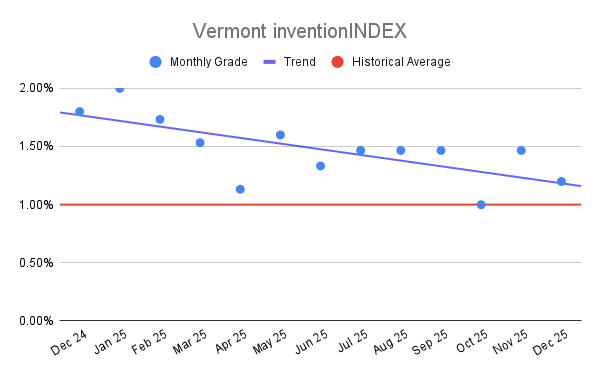 Vermont inventionINDEX December 2025:
  Vermont inventionINDEX November
