

Quick Summary: Vermont R&D Business Component
Definition: A “Business Component” is any product, process, computer software, technique, formula, or invention held for sale, lease, license, or used in a trade or business. It is the fundamental unit of analysis for the Vermont R&D tax credit (32 V.S.A. § 5930ii).
Key Requirement: To qualify for the 27% state credit, the federal “Four-Part Test” must be satisfied at the individual component level, not the project level. If a project fails, the “shrink-back” rule allows taxpayers to claim credit for the next largest qualifying subset of elements.
A business component is defined as any product, process, computer software, technique, formula, or invention intended to be held for sale, lease, or license, or used by a taxpayer in their trade or business. Within the context of the Vermont Research and Development tax credit, this term serves as the fundamental unit of analysis to which the federal four-part test must be applied to determine eligibility for the twenty-seven percent state-level incentive.
The Statutory Architecture of the Vermont Research and Development Tax Credit
The Vermont Research and Development (R&D) tax credit is established under the authority of 32 V.S.A. § 5930ii, which serves as the primary legislative vehicle for incentivizing technological innovation within the state’s borders. The statutory purpose of this credit, as explicitly defined in 32 V.S.A. § 5813(p), is to encourage business investment in research and development within Vermont and to attract and retain intellectual-property-based companies. The credit is structured as a nonrefundable incentive that allows taxpayers to offset their Vermont personal income tax or business and corporate income tax liabilities.
The legal mechanism of the credit is inherently derivative of the federal research credit provided under Internal Revenue Code (IRC) Section 41. According to the state statute, an eligible taxpayer is entitled to a credit in an amount equal to twenty-seven percent of the federal tax credit allowed in the taxable year for eligible research and development expenditures made within the state of Vermont. This creates a bifurcated compliance environment where a taxpayer must satisfy the rigorous standards of the IRS while simultaneously demonstrating to the Vermont Department of Taxes that the underlying activities and expenditures occurred geographically within the state.
One of the most distinctive features of the Vermont credit, relative to other state-level incentives, is its high prorated rate and its robust carryforward provision. While many states offer credits ranging from five to fifteen percent of the federal amount, Vermont’s twenty-seven percent rate positions it as a highly competitive jurisdiction for technology and manufacturing sectors. Furthermore, any unused credit amounts may be carried forward for up to ten years, providing long-term value for startups and established firms that may not have immediate tax liability.
| Statutory Feature | Vermont Provision (32 V.S.A. § 5930ii) | Federal Parallel (IRC § 41) |
|---|---|---|
| Credit Rate | 27% of the federal credit amount attributable to VT | 20% of QREs over a base amount (Regular Method) |
| Qualified Expenditures | Limited to Vermont-sourced QREs | Includes all U.S.-based QREs |
| Refundability | Nonrefundable | Generally nonrefundable; payroll offset for small businesses |
| Carryforward Period | 10 years | 20 years |
| Transparency | Mandatory annual list of all claimants | Taxpayer confidentiality remains paramount |
Defining the Business Component: The Legal Anchor of Qualified Research
The business component is the central conceptual unit of the R&D tax credit. Pursuant to IRC § 41(d)(2)(B), a business component is any product, process, computer software, technique, formula, or invention which is to be held for sale, lease, or license, or used by the taxpayer in a trade or business. The identification of a specific business component is not merely a formality; it is a prerequisite for the application of the four-part test. For research activities to be eligible for the Vermont credit, they must be conducted for the purpose of discovering information that is intended to improve the functionality, performance, reliability, or quality of a new or improved business component.
The law requires that the four-part test be applied separately to each business component. This granularity is critical because a taxpayer’s entire research project might not meet the statutory requirements, but specific subsets of that project—discrete business components—might. This principle is formalized in the shrink-back rule, which dictates that if the requirements for the credit are not met at the level of the entire product or process, the requirements are applied to the next most significant subset of elements. This process continues until either a subset of activities satisfies the test or the most basic element of the component is reached.
Functional vs. Non-Functional Attributes
The business component doctrine distinguishes between functional improvements and aesthetic or non-functional modifications. For a business component to qualify for the credit, the research must relate to a permitted purpose, specifically improving function, performance, reliability, or quality. Activities related to style, taste, cosmetic, or seasonal design factors are explicitly excluded. In the context of Vermont’s manufacturing and software sectors, this means that a company redesigning a product’s user interface solely for visual appeal would not be conducting qualified research, whereas redesigning the same interface to improve user processing speed or system reliability would likely satisfy the permitted purpose requirement.
Categorization of Business Components
Under Vermont and federal law, the broad definition of a business component is segmented into distinct categories, each carrying its own documentation and analysis requirements.
- Products: Tangible items developed for sale. Vermont’s aerospace, machine tool, and food science industries frequently claim the credit for developing new products such as precision parts, industrial tools, or specialized food formulations.
- Processes: Internal methods or techniques used in the production of products or the delivery of services. A critical distinction is made in IRC § 41(d)(2)(C), which requires that any plant process, machinery, or technique used for the commercial production of a business component be treated as a separate business component from the product being produced.
- Computer Software: This includes software intended for external sale or lease, as well as internal-use software (IUS) used for general and administrative functions. IUS is subject to a higher threshold test at the federal level, requiring the software to be innovative, involve significant economic risk, and not be commercially available.
- Techniques and Formulas: Intangible intellectual property, such as proprietary chemical compositions or industrial methods. Vermont’s biotechnology and pharmaceutical firms rely on this category when developing new drug delivery systems or diagnostic protocols.
- Inventions: Novel devices or methods that are typically eligible for patent protection. The research credit is often used by Vermont innovators to bridge the gap between initial conceptualization and the point where an invention is ready for commercial release.
The Four-Part Test: Qualitative Requirements for Business Components
To qualify for the Vermont R&D credit, every activity related to a business component must satisfy a rigorous four-part test. This test is applied at the level of the individual business component, and taxpayers must be prepared to substantiate each element through contemporaneous documentation.
Part One: The Section 174 Test (Elimination of Uncertainty)
The research must be undertaken for the purpose of discovering information that would eliminate uncertainty concerning the development or improvement of a business component. Uncertainty exists if the information available to the taxpayer does not establish the capability or method for developing or improving the business component, or the appropriate design of the business component. In Vermont, this requires the taxpayer to demonstrate that the technical challenges faced could not be resolved through the application of existing knowledge or routine engineering practices.
Part Two: The Technological in Nature Test
The activities must fundamentally rely on the principles of physical or biological science, engineering, or computer science. This requirement excludes research in the social sciences, arts, or humanities. For a Vermont firm, this means the experimentation process must be grounded in hard sciences. For instance, a food company in Vermont developing a new yogurt flavor through consumer taste tests would fail this test, as it relies on market research rather than biological or physical science. However, if the same company conducted research to stabilize the yogurt’s probiotics at room temperature using chemical engineering, the activity would be considered technological in nature.
Part Three: The Permitted Purpose Test
The purpose of the activity must be to create a new or improved function, performance, reliability, or quality of the business component. This test is inextricably linked to the definition of the business component itself. The taxpayer must intend to apply the discovered information to develop or improve a specific component that is intended to be held for sale, lease, or license, or used in the taxpayer’s trade or business.
Part Four: The Process of Experimentation Test
Substantially all of the research activities (defined as 80 percent or more) must constitute elements of a process of experimentation. This involves the systematic evaluation of one or more alternatives to achieve a desired result, typically through modeling, simulation, or trial-and-error testing. The taxpayer must identify the technological uncertainty and utilize a process to evaluate the alternatives to eliminate that uncertainty.
| Test Element | Legal Requirement | Documentation Evidence |
|---|---|---|
| Uncertainty | Technical gap in capability, method, or design. | Project charters, initial technical risk assessments, meeting minutes. |
| Technological | Based on engineering or hard sciences. | Technical specifications, engineering degrees of staff, lab protocols. |
| Purpose | Relates to functional improvement. | Product performance goals, quality control standards, design blueprints. |
| Experimentation | Systematic evaluation of alternatives. | Test logs, prototype iterations, simulation data, failed test results. |
Vermont Department of Taxes Guidance and Local Revenue Office Standards
The Vermont Department of Taxes, while following federal definitions, provides specific administrative guidance regarding the state-level application of the R&D credit. Because the Vermont credit is calculated as twenty-seven percent of the federal credit allowed for expenditures within the state, the Department’s oversight focuses heavily on the accuracy of the proration and the geographic nexus of the research.
The Prorated Calculation Method
Unlike some states that have their own independent credit calculation involving a state-specific base amount, Vermont utilizes a prorated share method. This simplifies the process for businesses that are already compliant with federal IRC § 41 standards. The calculation requires the taxpayer to:
- Identify total Qualified Research Expenditures (QREs) for the tax year under federal rules.
- Apportion those QREs to Vermont based on the ratio of in-state activities (e.g., wages paid to Vermont-based employees, supplies consumed in a Vermont lab).
- Compute a hypothetical federal credit using only the Vermont-apportioned QREs. This requires applying federal base amount rules, fixed-base percentages, or the Alternative Simplified Credit (ASC) method to the state-specific expenditures.
- Apply the twenty-seven percent state rate to this hypothetical federal credit amount.
This method ensures that the Vermont credit is directly proportional to the federal benefit, while strictly limiting the incentive to research conducted on Vermont soil.
Administrative Forms and Filing Instructions
Taxpayers claiming the Vermont R&D credit are required to file specific forms with the Department of Taxes. The primary document is Form BA-404, Vermont Research and Development Tax Credit, which is filed alongside the business’s corporate or personal income tax return. Furthermore, Vermont Schedule RD is often used as a supplemental worksheet to aid in the calculation of the credit by applying the twenty-seven percent multiplier to the state-apportioned federal credit amount.
For personal income tax filers, such as owners of S-corporations or partnerships, the credit is claimed using Form IN-111, Vermont Income Tax Return, and supported by Schedule IN-112, Vermont Tax Credits and Adjustments. Because Vermont is a lockstep state in terms of its tax philosophy, the filing status used on the federal return must typically be mirrored on the Vermont return.
Formal Rulings and Redacted Guidance
The Vermont Department of Taxes provides a mechanism for taxpayers to seek clarity on complex tax issues, including the definition of a business component in a novel industrial context. A Formal Ruling is the Department’s written response to a taxpayer’s request for an explanation of how state law applies to a specific proposed transaction. These rulings are binding on the Department for the requesting taxpayer and the presented facts. To ensure public transparency while maintaining taxpayer confidentiality, the Department publishes redacted versions of these rulings, which provide general guidance to others in similar tax situations.
| Document Type | Purpose in Vermont R&D Compliance | Availability/Source |
|---|---|---|
| 32 V.S.A. § 5930ii | Primary statute governing the credit. | Vermont Statutes Online |
| Form BA-404 | Form used to calculate and claim the R&D credit. | VT Dept. of Taxes |
| Schedule RD | Supplemental worksheet for federal/state proration. | VT Dept. of Taxes |
| Formal Rulings | Binding interpretations of law for specific taxpayers. | VT Dept. of Taxes Website |
| Technical Bulletins | General administrative guidance on tax law. | VT Dept. of Taxes Website |
Qualified Research Expenditures: The Quantitative Elements
The Vermont R&D credit is calculated based on Qualified Research Expenditures (QREs) that are incurred in the state of Vermont. These expenditures fall into four primary categories, all defined under federal IRC § 41(b) and adopted by the state.
1. In-House Research Wages
Wages paid to employees for qualified services are the most common component of a Vermont R&D claim. Qualified services include directly engaging in research, as well as the direct supervision or direct support of research activities. In Vermont, direct supervision refers to first-line management and not higher-level executive oversight. Similarly, direct support includes activities like a lab technician cleaning equipment used in a qualified experiment or a secretary typing the reports related to that specific experiment.
If substantially all of an individual’s services (defined as 80 percent or more) during a taxable year consist of qualified services, then 100 percent of the wages paid to that individual are considered QREs. This is a crucial planning tool for Vermont businesses, as it allows for the inclusion of the full salary of dedicated R&D personnel.
2. Supplies Used in Qualified Research
Supplies include any tangible personal property, other than land or improvements to land and depreciable property, that is used in the conduct of qualified research. Examples include chemicals consumed in a laboratory, materials used to build a prototype, and electricity or water used specifically in the research process. It is important to note that general administrative supplies or items used in routine manufacturing do not qualify.
3. Contract Research Expenses
Taxpayers may claim sixty-five percent of the amount paid or incurred to a third party for qualified research conducted on the taxpayer’s behalf. To qualify, the research must be performed within Vermont to be included in the state’s twenty-seven percent credit calculation. Furthermore, the taxpayer must bear the economic risk of the research (i.e., payment is not contingent on success) and must retain substantial rights to the results of the research.
4. Computer Leasing and Cloud Computing Costs
Historically, this category applied to the rental of mainframe computers. In the modern era, it has evolved to include cloud computing costs—such as server space or computing power—used for the development of software or the simulation of physical experiments. These expenses must be directly related to the performance of qualified research and are particularly relevant to Vermont’s expanding software-as-a-service (SaaS) sector.
| QRE Category | Inclusion Rate | Key Documentation |
|---|---|---|
| Wages | 100% of qualified portion | Payroll registers, W-2s, time tracking records. |
| Supplies | 100% of consumed items | General ledger, invoices, purchase orders. |
| Contract Research | 65% of contract amount | Master Service Agreements, Statements of Work, invoices. |
| Computer Costs | 100% of qualified usage | Cloud service bills, usage logs for server instances. |
Judicial Precedents and the Evolving Jurisprudence of Business Components
Recent federal court decisions have significantly impacted the interpretation of what constitutes a business component and a process of experimentation. Because the Vermont R&D credit is explicitly tied to federal standards, these cases serve as essential guidance for state-level compliance.
The Grigsby Decision: The Imperative of Specificity
In Leonard L. Grigsby et al. v. The United States, the U.S. Court of Appeals for the Fifth Circuit emphasized the need for taxpayers to clearly define their business components from the outset of a claim. The taxpayer, a construction firm, originally defined its business components as products (specifically, oil refineries and flood control systems built under contract). When the IRS challenged the product designation—arguing that the taxpayer did not hold these for sale but was simply providing a construction service—the taxpayer attempted to re-characterize the components as construction processes.
The court rejected this re-characterization, ruling that a change from a product to a process argument constituted an entirely new basis for the credit claim. Furthermore, the court noted that the taxpayer failed to identify even one specific new or improved process that met the four-part test. For Vermont contractors and engineers, the Grigsby case reinforces that a business component must be more than just a project name; it must be a discrete unit of technical advancement.
The Little Sandy Coal Case: The Substantially All Trap
In Little Sandy Coal Company, Inc. v. Commissioner, the court addressed the substantially all requirement of the process of experimentation test. The taxpayer claimed credits for developing new ships. The court found that because a significant portion of the work involved routine assembly and non-experimental construction, the project as a whole did not meet the requirement that eighty percent or more of the activities constitute a process of experimentation.
Crucially, the court observed that had the taxpayer shrunk back and identified smaller business components—such as a specific hull design or a new propulsion system—they might have successfully met the eighty percent threshold for those specific components. This case serves as a vital lesson for Vermont’s large-scale manufacturers: broad business components are harder to defend than specific, module-based components.
The Impact of Loper Bright on Administrative Deference
The 2024 Supreme Court ruling in Loper Bright Enterprises v. Raimondo has fundamentally altered the landscape of tax litigation by overturning the Chevron doctrine. Previously, courts were required to defer to an agency’s (like the IRS or the Vermont Department of Taxes) reasonable interpretation of an ambiguous statute. Under the new standard, courts must apply their own independent judgment when interpreting laws.
For Vermont taxpayers, this shift provides a fairer opportunity to challenge overly narrow or restrictive administrative interpretations of what qualifies as a business component or a process of experimentation. The IRS’s views are now merely persuasive rather than binding, allowing for a more nuanced application of the law to modern technological innovations.
New Reporting Requirements: Form 6765 and Section G
The IRS has introduced significant modifications to Form 6765, Credit for Increasing Research Activities, which Vermont taxpayers must complete to substantiate their state claims. These changes, phasing in over the 2024 and 2025 tax years, represent a monumental shift toward transparency and granular data collection.
Mandatory Business Component Detail (Section G)
The most notable addition is the new Section G, which requires taxpayers to provide both quantitative and qualitative information for each business component included in the credit claim. For each component, the taxpayer must provide:
- The name or unique identifier of the business component.
- The business component type (e.g., product, process, software).
- A description of the technical unknowns or information sought to be discovered.
- A breakdown of wages for conducting, supervising, and supporting research specific to that component.
- Allocated costs for supplies, computer leasing, and contract research for that specific component.
For tax years after 2024, Section G is mandatory for most filers. However, a 80/50 rule was introduced to mitigate the administrative burden: taxpayers must report at least 80 percent of their total QREs in descending order by component, but are not required to report more than 50 business components.
Strategic Implications for Vermont Claimants
This new reporting regime means that Vermont businesses can no longer rely on high-level estimates. They must implement project-based accounting and time-tracking systems that can map every dollar of QRE to a specific business component. For the Vermont Department of Taxes, this granular federal data will provide a more rigorous framework for auditing state-level claims and ensuring that the twenty-seven percent credit is supported by valid research activities.
| Reporting Era | Requirement | Level of Detail |
|---|---|---|
| Pre-2024 | Aggregate QREs by category (wages, supplies, etc.) | High-level corporate data. |
| 2024 (Section E) | Identification of the total number of business components. | Qualitative indicators. |
| 2025+ (Section G) | Mandatory component-level detail for 80% of QREs. | Granular project data. |
Detailed Example: Application of the Business Component Doctrine in Vermont
To illustrate the integration of these legal and administrative requirements, consider a hypothetical Vermont-based technology company, Green Mountain Dynamics (GMD), located in Essex Junction, Vermont.
Case Scenario: The Smart Grid Integration Project
GMD is contracted to develop a Smart Grid Optimizer (SGO) for a local utility. The project involves two primary objectives:
- Developing a new software algorithm that can predict energy demand peaks with 95 percent accuracy.
- Developing a new manufacturing process for a specialized Load-Sensing Relay used in the grid hardware.
Step 1: Identification of Business Components
GMD identifies two distinct business components:
- Business Component A (The Algorithm): A Computer Software component intended for license to utilities.
- Business Component B (The Welding Process): A Process component used to manufacture the hardware relay.
Step 2: Applying the Four-Part Test
For the Algorithm (BC A), GMD faces a technical uncertainty regarding the scalability of their predictive model. They conduct a process of experimentation using several alternative mathematical models (modeling and simulation). This work relies on computer science and mathematical engineering (Technological in Nature) and aims to improve the performance of the software (Permitted Purpose).
For the Welding Process (BC B), GMD is uncertain if laser welding can be used on a new conductive alloy without degrading its conductivity. They perform a series of trial-and-error tests with varying laser intensities and shielding gases (Process of Experimentation). This relies on physical science and metallurgical engineering (Technological in Nature) and aims to improve the quality of the relay (Permitted Purpose).
Step 3: Calculation of the Vermont Credit
GMD identifies $1,000,000 in federal QREs for the year, all of which were incurred at their Essex Junction facility.
Using the federal Regular Research Credit method:
- Total Federal QREs: $1,000,000.
- Federal Base Amount: $500,000 (minimum 50% of QREs).
- Incremental QREs: $500,000.
- Federal Credit (20% of $500k): $100,000.
Vermont Credit Calculation:
- Vermont-apportioned QREs: $1,000,000 (100% since all work was in VT).
- Hypothetical Federal Credit on VT QREs: $100,000.
- Vermont R&D Credit (27% of $100k): $27,000.
Step 4: Documentation and Filing
GMD files Vermont Form BA-404 and Schedule RD, claiming a $27,000 credit. They also ensure that their federal Form 6765 for 2025 includes Section G details for both the Smart Grid Algorithm and the Precision Welding Process, identifying the specific technical uncertainties and the wages allocated to each.
Audit Risks and Best Practices for Vermont Taxpayers
The Vermont Department of Taxes, empowered by the high transparency of the claimant list, periodically conducts audits focusing on R&D credit claims. Taxpayers must be prepared to defend their business component definitions and their proration of expenses.
Common Audit Pitfalls
- Failure to Support Proration: Auditors frequently scrutinize whether employees claimed as QREs were actually working in Vermont. If a company has a Vermont office but its engineering team works remotely from another state, those wages do not qualify for the Vermont credit.
- Inadequate Business Component Definitions: As seen in the Grigsby case, defining the component at too high a level (e.g., “The 2025 Project”) often leads to disallowance if the auditor finds that substantially all of the project was not experimental.
- Lack of Contemporaneous Documentation: Federal and state rules require records to be in sufficiently usable forms to substantiate expenditures. Reliance on oral testimony or post-hoc narratives created during an audit is generally insufficient.
- Miscalculating the Base Amount: When re-computing the hypothetical federal credit for Vermont, taxpayers often fail to use state-specific gross receipts and prior-year state QREs, leading to an incorrect base amount.
Recommended Documentation Standards
To mitigate risk, Vermont businesses should maintain a Tax Credit Defense File for each business component, containing:
- The Technical Case: A clear statement of the technical objective, the uncertainty identified, and the specific principles of science or engineering relied upon.
- The Experimental Record: Prototype drawings, test protocols, lab notes, and emails detailing technical setbacks and iterative solutions.
- The Quantitative Nexus: Payroll registers mapped to project codes, supply invoices labeled by business component, and contractor agreements that explicitly state the taxpayer bears the economic risk.
The Transparency Requirement: The Vermont Claimants List
A unique administrative feature of the Vermont R&D credit is the public disclosure mandate. Under 32 V.S.A. § 5930ii(c), the Department of Taxes must publish an annual list of all taxpayers who claimed the credit during the most recently completed calendar year. This list, often published as a Vermont Research and Development Tax Credit Report (e.g., RP-1298), includes the names of companies that filed a claim.
While the dollar amount of individual credits remains confidential, the public nature of the claimant list means that Vermont businesses are effectively declaring their participation in this tax expenditure program to the public and the legislature. This transparency is intended to promote oversight and ensure that the credit is fulfilling its statutory purpose of attracting intellectual-property-based companies to the state.
Comparative Perspective: Vermont vs. Regional Peer States
Understanding how Vermont’s Business Component and credit structure compares to other states can provide valuable context for businesses making location decisions.
| State | Credit Mechanism | Business Component standard | Rate/Benefit |
|---|---|---|---|
| Vermont | 27% of Federal Share. | Strict IRC § 41 adoption. | High rate; 10-year carryforward. |
| Maine | Increasing Research Credit. | Strict IRC § 41 adoption. | Multi-part calculation. |
| Minnesota | Tiered Incremental Credit. | IRC § 41 alignment. | 10% on first $2M; 4% above. |
| Arizona | Credit for Increased Activity. | Federal alignment; university bonus. | 24% up to $2.5M. |
Vermont’s approach is characterized by its simplicity—directly tying the benefit to a percentage of the federal credit—and its high rate, which incentivizes companies to concentrate their high-value engineering and scientific talent within the state.
Strategic Outlook and Final Thoughts
The business component is the essential nexus between technological activity and tax benefit in Vermont. As state and federal revenue offices move toward a more data-intensive, project-based audit model, the ability to clearly define, document, and defend specific business components has become the most critical skill for tax compliance professionals.
The twenty-seven percent Vermont Research and Development tax credit remains one of the state’s most powerful economic tools for fostering a high-wage, innovation-driven economy. However, the complexity of the federal four-part test, the rigors of the shrink-back rule, and the new granular reporting requirements of Form 6765 mean that the Business Component is no longer a static definition but an active management requirement. Vermont businesses that successfully integrate technical documentation with project-level financial tracking will be best positioned to maximize this incentive while navigating the increased transparency and scrutiny inherent in the state’s regulatory framework. The ten-year carryforward period ensures that this credit provides lasting value, making the Business Component doctrine a cornerstone of long-term corporate strategy for any firm innovating in the Green Mountain State.
Who We Are:
Swanson Reed is one of the largest Specialist R&D Tax Credit advisory firm in the United States. With offices nationwide, we are one of the only firms globally to exclusively provide R&D Tax Credit consulting services to our clients. We have been exclusively providing R&D Tax Credit claim preparation and audit compliance solutions for over 30 years. Swanson Reed hosts daily free webinars and provides free IRS CE and CPE credits for CPAs.
Are you eligible?

Why choose us?

Pass an Audit?

What is the R&D Tax Credit?
The Research & Experimentation Tax Credit (or R&D Tax Credit), is a general business tax credit under Internal Revenue Code section 41 for companies that incur research and development (R&D) costs in the United States. The credits are a tax incentive for performing qualified research in the United States, resulting in a credit to a tax return. For the first three years of R&D claims, 6% of the total qualified research expenses (QRE) form the gross credit. In the 4th year of claims and beyond, a base amount is calculated, and an adjusted expense line is multiplied times 14%. Click here to learn more.
Never miss a deadline again

Stay up to date on IRS processes

Discover R&D in your industry

R&D Tax Credit Preparation Services
Swanson Reed is one of the only companies in the United States to exclusively focus on R&D tax credit preparation. Swanson Reed provides state and federal R&D tax credit preparation and audit services to all 50 states.
If you have any questions or need further assistance, please call or email our CEO, Damian Smyth on (800) 986-4725.
Feel free to book a quick teleconference with one of our national R&D tax credit specialists at a time that is convenient for you.
R&D Tax Credit Audit Advisory Services
creditARMOR is a sophisticated R&D tax credit insurance and AI-driven risk management platform. It mitigates audit exposure by covering defense expenses, including CPA, tax attorney, and specialist consultant fees—delivering robust, compliant support for R&D credit claims. Click here for more information about R&D tax credit management and implementation.
Our Fees
Swanson Reed offers R&D tax credit preparation and audit services at our hourly rates of between $195 – $395 per hour. We are also able offer fixed fees and success fees in special circumstances. Learn more at https://www.swansonreed.com/about-us/research-tax-credit-consulting/our-fees/



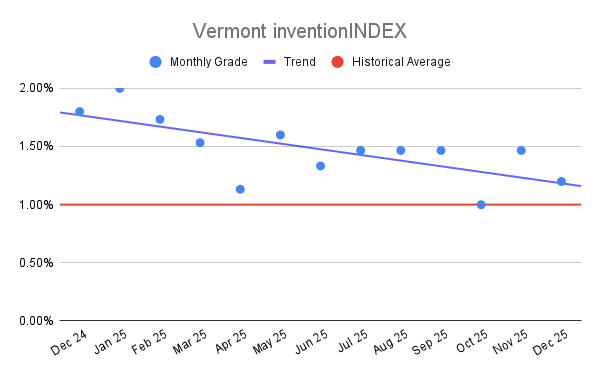 Vermont inventionINDEX December 2025:
  Vermont inventionINDEX November
