

Vermont Form BA-404 is the mandatory tax schedule used to track the lifecycle of state tax credits, including the Research and Development (R&D) incentive. It reconciles credits earned (27% of the federal credit), applied, expired, and carried forward (up to 10 years). The form ensures compliance with 32 V.S.A. § 5930ii, requiring taxpayers to recompute federal credits based solely on Vermont-sourced expenditures and strictly limiting application to the entity that earned the credit.
Vermont Form BA-404 is the specialized tax schedule designed to document the continuous status of state tax credits by tracking those newly earned, those applied to current liability, those that have expired, and those carried forward to subsequent tax years. Within the specific regulatory environment of the Vermont Research and Development (R&D) tax credit, the form functions as the vital nexus between federal innovation definitions and state-level fiscal incentives, formalizing the calculation of the 27% credit derived from qualified in-state expenditures.
The administrative complexity of Form BA-404 reflects the state's broader fiscal strategy to balance corporate incentivization with rigorous revenue oversight. By requiring a line-item reconciliation of credit vintages, the Vermont Department of Taxes ensures that nonrefundable incentives are utilized within their statutory life cycles—specifically ten years for R&D credits—while preventing the over-application of credits against tax liabilities not attributable to the entity authorized for the incentive. This schedule is mandatory for any taxpayer, whether a stand-alone C-Corporation, a member of a unitary group, or a pass-through entity, that seeks to benefit from the state’s research-based tax provisions.
Statutory Foundations of the Vermont Research and Development Credit
The legal authority for the Vermont Research and Development tax credit resides in 32 V.S.A. § 5930ii. This statute was enacted to attract and retain high-growth, intellectual-property-based companies by lowering the effective cost of innovation within the state's borders. The Vermont legislature recognized that while federal incentives provide a baseline for R&D investment, a state-specific piggyback credit could serve as a competitive differentiator in the New England economic landscape.
The law stipulates that a taxpayer is eligible for a credit against Vermont income tax in an amount equal to 27% of the federal tax credit allowed under 26 U.S.C. § 41(a) for the same taxable year. This 27% rate has been in effect since January 1, 2014, having been reduced from a prior rate of 30%. The state’s reliance on the federal Internal Revenue Code (IRC) is profound; however, the eligibility is strictly confined to expenditures made within this State. This creates a bifurcation in accounting where the taxpayer must maintain a Vermont-only ledger for research activities that may otherwise be aggregated at the federal level.
Integration with Federal StandardsThe Vermont R&D credit is not a standalone calculation but a derivative of the federal credit for increasing research activities. Under 32 V.S.A. § 5930ii, the federal tax credit allowed refers to the amount computed on IRS Form 6765. If a business conducts research across multiple states, the Vermont Department of Taxes requires a recomputation—a hypothetical federal credit—based solely on the Vermont-sourced Qualified Research Expenses (QREs).
| Statutory Element | Vermont Provision (32 V.S.A. § 5930ii) | Federal Parallel (IRC § 41) |
|---|---|---|
| Credit Rate | 27% of the federal credit amount | 20% (Regular) or 14% (ASC) |
| Geography | Limited to Vermont-based QREs | All U.S.-based QREs |
| Carryforward | 10 years | 20 years |
| Refundability | Nonrefundable | Generally nonrefundable |
| Public Disclosure | Names of earners are published annually | Confidential taxpayer data |
The recomputation logic ensures that Vermont only subsidizes activities that directly contribute to the local economy through jobs and facility investments. The Department of Taxes provides guidance that this recomputed amount is what must be entered into Form BA-404, Column B, for the year the credit is earned.
The Mechanics of Form BA-404: Columnar Logic and Reconciliation
Form BA-404 is structured to provide a comprehensive audit trail of a taxpayer's credit history. For the R&D credit, this data is typically reported on Line 1 of the schedule. The form's four primary columns facilitate a rigorous mathematical reconciliation that the state uses to verify that credits are not being over-claimed or used beyond their expiration dates.
Column A: Amount Carried Forward from Prior YearsThis column represents the beginning balance of credits available to the taxpayer at the start of the current tax year. It is the cumulative total of unused credits from previous years that have not yet reached their ten-year expiration limit. In a professional tax environment, this requires meticulous record-keeping of credit vintages. For example, if an R&D credit was earned in 2018, it must be tracked separately from a credit earned in 2022 to ensure it is used before it expires in 2028.
Column B: Amount Earned Current YearColumn B records the new credit generated during the current tax period. For the R&D tax credit, this is the 27% of the federal credit attributable to Vermont QREs. The Department of Taxes guidance specifies that if the federal credit was earned based on expenditures both in and out of Vermont, the taxpayer must provide a breakdown and a recomputed calculation. This hypothetical credit becomes the earned amount for the purposes of this column.
Column C: Amount Applied Current YearThis column captures the portion of the credit used to reduce the current year's Vermont tax liability. The application of credits is governed by several limitations. Generally, tax credits are limited to a percentage of the tax attributable to the income generated by the entity authorized for the credit. This authorized entity rule is particularly relevant in consolidated or unitary filings where one subsidiary may have significant research expenses but no tax liability, while another has high liability but no research. In most instances, the credit cannot exceed the taxpayer's total liability for the year, as it is nonrefundable.
Column D: Amount Carried Forward to Future YearsThe final column provides the ending balance of the credit, which will become the Column A value for the following year. The mathematical relationship is expressed as follows:
Column D = Column A + Column B - Column C - Expired Credits
The Department of Taxes instructions emphasize that any credits that expire without being used must be subtracted from the total reported in Column D. For the R&D credit, this occurs on the eleventh year after the credit was initially earned.
State Revenue Office Guidance on R&D Eligibility and Calculation
The Vermont Department of Taxes issues periodic instructions and technical bulletins to clarify the application of 32 V.S.A. § 5930ii. This guidance focuses heavily on the In-State Only requirement and the documentation necessary to survive a state audit.
Defining Vermont Qualified Research Expenses (QREs)To satisfy state guidance, a taxpayer must isolate costs that meet the federal definition of qualified research but occurred within Vermont. This includes:
- Wages: Payments to employees for time spent performing qualified services within Vermont. Guidance suggests using W-2 data and time-tracking records to apportion wages for employees who work in multiple jurisdictions.
- Supplies: Costs for tangible property (other than land or improvements to property) used in the conduct of qualified research in Vermont labs or facilities.
- Contract Research: 65% of the amount paid to a third party for qualified research conducted on the taxpayer's behalf within Vermont.
One of the most critical pieces of revenue office guidance involves the downward adjustment of the credit basis. If a taxpayer has received grants or assistance for financing research expenditures from any other public or private source, the basis expenditure amount for the credit calculation must be reduced by the amount of that assistance. This rule prevents the state from providing a tax credit on research that was already funded by state or federal grants, ensuring that the 27% incentive only applies to the taxpayer's own capital investment.
Recomputation Methods: Regular vs. ASCVermont conforms to the federal choice of calculation method. If a taxpayer uses the federal Regular Research Credit (RRC) method, they must use the same for Vermont, but recompute the fixed-base percentage and average annual gross receipts using only Vermont data.
If the taxpayer uses the Alternative Simplified Credit (ASC) method—which is increasingly common for firms without consistent historical data—they must recompute the ASC for Vermont. This involves taking 14% of the amount by which current-year Vermont QREs exceed 50% of the average Vermont QREs for the three preceding years. The resulting hypothetical federal ASC is then multiplied by 27% to reach the Vermont credit amount for Form BA-404.
Application to Unitary and Consolidated Businesses
The Vermont tax code treats unitary businesses with unique complexity, particularly regarding the sharing of credits. Guidance for Form CO-411-U (Combined Report for Unitary Businesses) and Schedule BA-404 specifies that while a unitary group files a combined return, the R&D credit is generally siloed to the member that earned it.
The Authorized Entity LimitationUnder Vermont's interpretation of the law, credits may only be applied to offset the tax of the entity that was authorized to earn them. For a unitary group, this means that even if the group as a whole has a tax liability, a research credit earned by Subsidiary A cannot be used to offset the tax liability attributable to Subsidiary B unless Subsidiary B was also part of the research activity.
When multiple entities within a unitary group report credits, the group must:
- Complete a single, consolidated Schedule BA-404 for the entire return package.
- Combine all credit amounts from all members on this single form.
- Attach a separate statement that breaks down the totals in Columns A through D by each specific entity.
- Report the credits applied by the Principal Vermont Corporation on Form CO-411 and credits applied by affiliates on their respective Schedule CO-421.
| Entity Type | Form for Application | Reporting Instrument |
|---|---|---|
| Stand-Alone C-Corp | Form CO-411, Line 14 | Schedule BA-404 |
| Unitary Group Principal | Form CO-411, Line 15 | Combined Schedule BA-404 |
| Unitary Affiliate | Schedule CO-421, Line 10 | Attached Statement to BA-404 |
| S-Corp / Partnership | Owner's Individual Return | Schedule BA-406 & K-1VT |
This siloing creates a strategic hurdle for large businesses, as credits may expire in one subsidiary even while another subsidiary is paying significant Vermont taxes. Professional tax planning often involves the careful allocation of research personnel and equipment among unitary members to maximize credit utilization before the 10-year expiration occurs.
Pass-Through Entities and the Role of Schedule BA-406
For S-Corporations, Partnerships, and LLCs treated as pass-through entities, the R&D credit is not applied at the business level. Instead, the credits are passed through to the individual owners, shareholders, or partners.
Distribution and TransferabilityTax credits earned by a pass-through entity are distributed to the owners in the same proportion that income or loss is distributed. Revenue office guidance emphasizes that these credits are generally not transferable; they cannot be sold to other taxpayers or reallocated in a manner inconsistent with the entity's operating agreement.
To facilitate this transfer, the entity must:
- Complete Schedule BA-404 to track the entity-level earning and carryforward.
- Complete Schedule BA-406 (Credit Allocation Schedule) for each owner, specifying their share of the newly earned credit.
- Provide each owner with a Schedule K-1VT, which the individual will use to claim the credit on their Vermont Individual Income Tax Return (Form IN-111), typically on Schedule IN-112 or IN-119.
If the pass-through entity files a composite return on behalf of its nonresident owners, the credits are applied directly on the composite schedule (Schedule BI-473, Line 10) to reduce the tax paid by the entity on the owners' behalf.
Documentation, Audit Defense, and Public Disclosure
Because the Vermont R&D tax credit involves a high prorated rate of 27%—ranking it among the top state incentives in the U.S.—it is a frequent subject of Department of Taxes scrutiny. Taxpayers must maintain documentation that not only proves the technical nature of the research but also confirms the physical location of the expenditures.
The Substantiation BurdenRevenue office guidance requires that for any credit claimed on Form BA-404, the taxpayer must include a copy of the federal authorization document (IRS Form 6765), a detailed description of the activity that generated the credit, and a calculation schedule. In an audit scenario, the Department typically looks for:
- Contemporaneous Records: Lab notebooks, project plans, and meeting minutes that satisfy the federal Four-Part Test (Technological in nature, Elimination of uncertainty, Process of experimentation, and Permitted purpose).
- Nexus Verification: Documentation proving the research was made within Vermont. This includes payroll records showing the work location of employees and invoices for supplies delivered to Vermont addresses.
- Historical Consistency: Auditors will verify that the 10-year carryforward reported in Column A of the current year matches Column D of the prior year's filing.
A unique feature of Vermont’s R&D law is 32 V.S.A. § 5930ii(c), which mandates that the Department of Taxes publish a list of all taxpayers who have claimed the credit during the most recent calendar year. This list, published annually by January 15, serves as a public record of corporate incentives. While the specific dollar amount of the credit remains confidential, the public disclosure of the company name is a statutory trade-off for the 27% tax benefit.
Comparative Analysis: The Alternative 3% Enterprise Zone Credit
While most research activities are reported via the 27% federal-derivative method on BA-404, Vermont historically maintained a secondary R&D incentive through its Enterprise Zone (EZ) program. This secondary pathway is often confused with the general R&D credit, yet its mechanics are fundamentally different.
The EZ R&D Credit MechanismUnder the Enterprise Zone program, eligible businesses—located in one of 16 designated zones with high unemployment or slow population growth—can earn a 3% state income tax credit for the increase in their annual R&D expenses compared to the previous two years.
| Feature | General R&D Credit (Line 1) | Enterprise Zone R&D Credit |
|---|---|---|
| Rate | 27% of Federal Credit | 3% of QRE Increase |
| Basis | Total Vermont QREs | Incremental QREs over 2-year average |
| Payout | Available in year earned | Claimed 25% each year for 4 years |
| Geography | Anywhere in Vermont | 16 Specific Enterprise Zones |
| Carryforward | 10 Years | Varies by certificate terms |
The 3% EZ credit requires a pre-certification application to a local enterprise zone administrator and the subsequent issuance of a tax credit certificate. This certificate replaces certain other forms and must be submitted with the Vermont income tax return along with Form DR1366. Because of its incremental nature and four-year payout requirement, the 3% EZ credit is significantly more administratively burdensome than the general 27% credit, which remains the primary driver of R&D reporting on Schedule BA-404.
Comprehensive Multi-Year Example: Precision Aerospace LLC
To synthesize the application of Form BA-404, the law, and revenue guidance, consider the multi-year tax journey of Precision Aerospace LLC, a Vermont-based aerospace engineering firm.
Year 1: Credit Generation and Initial ApplicationIn 2023, Precision Aerospace LLC (Precision) spent $1,000,000 on qualified research in its Middlebury, Vermont facility. The firm is a stand-alone C-Corporation.
- Federal Calculation: Precision calculates a hypothetical federal R&D credit of $100,000 using the ASC method.
- Vermont Calculation: Under 32 V.S.A. § 5930ii, the Vermont credit is 27% of $100,000, which equals $27,000.
- Liability: Precision has a 2023 Vermont tax liability of $15,000.
- Form BA-404 Entry:
- Column A (Prior): $0
- Column B (Earned): $27,000
- Column C (Applied): $15,000 (limited to tax liability)
- Column D (Carryforward): $12,000
In 2024, the aerospace market contracts, and Precision spends only $200,000 on R&D.
- Vermont Calculation: The new credit earned is $4,000.
- Liability: Precision has a 2024 tax liability of $10,000.
- Form BA-404 Reconciliation:
- Column A (Prior): $12,000 (from 2023 Column D)
- Column B (Earned): $4,000
- Total Available: $16,000
- Column C (Applied): $10,000
- Column D (Carryforward): $6,000
In 2025, Precision merges with a larger group and becomes a subsidiary in a unitary filing. The parent group, Global Tech Corp, earns no R&D credits of its own but has significant liability.
- The authorized entity rule: Precision earns an additional $5,000 in credits in 2025.
- Application: Under revenue guidance, the $5,000 earned by Precision, plus its $6,000 carryforward, can only offset the portion of the Global Tech combined tax liability that is attributable to Precision's own income.
- Reporting: Global Tech files a single Schedule BA-404. It shows the combined group's credits but attaches a statement breaking down the $11,000 balance specifically to Precision Aerospace.
Strategic Insights and Third-Order Implications
The structural design of Form BA-404 and the R&D credit suggests deeper economic intentions and potential risks for taxpayers.
The Sunk Cost of Non-RefundabilityBecause the credit is nonrefundable and subject to the 10-year expiration, companies in a prolonged pre-revenue or loss phase face the risk of credits becoming worthless. In the life sciences or biotech sectors, where R&D cycles often exceed ten years before profitability is reached, the Expired portion of BA-404 can become a significant drag on the company's valuation. This creates a use-it-or-lose-it pressure that may influence corporate restructuring or the timing of intellectual property licensing to generate taxable income within the 10-year window.
Audit SynchronizationThere is an emerging trend of audit synchronization between the IRS and the Vermont Department of Taxes. Guidance suggests that the state relies heavily on federal audit results. If a taxpayer settles a federal R&D audit and agrees to a 20% reduction in QREs, they are administratively required to amend their Vermont returns and adjust Form BA-404 for the affected years. Failure to do so proactively can result in the Department of Taxes assessing penalties for inconsistent reporting.
Interaction with the Business Solar CreditForm BA-404 also captures the Business Solar Energy Investment Tax Credit on Line 9. Guidance indicates that this credit has a much shorter carryforward period—only five years. A common error for taxpayers is the cross-contamination of carryforward rules, where a taxpayer incorrectly applies the R&D 10-year rule to their solar credits. The Department's automated systems are designed to flag BA-404 filings where the Column D value for Line 9 does not zero out after five years, leading to immediate reconciliation inquiries.
Administrative Procedures for Reporting and Filing
The physical filing of Form BA-404 requires alignment with several other state forms. For the 2024 tax year, the Department has streamlined the electronic filing requirements to ensure that credit data is captured at the point of submission.
Flow of Data across Vermont SchedulesThe R&D credit information entered into BA-404 is the primary source of truth for all other related schedules.
- For Individuals: The Applied amount (Column C) from BA-404 flows to Schedule IN-119, Line 7 (or similar), where it reduces the personal income tax liability of the business owner.
- For Corporations: The Applied amount flows to Form CO-411, Line 14, to reduce the corporate income tax.
- For Unitary Members: The specific allocation flows to Schedule CO-421, which acts as the member-level proof of credit usage within the combined return.
Analysis of revenue office guidance reveals several recurring errors that lead to credit disallowance:
- Failure to Recompute: Entering 27% of the total federal credit from Form 6765, rather than 27% of the Vermont-only recomputed amount.
- Grant Inclusion: Neglecting to subtract federal or state R&D grants from the expenditure basis before calculating the credit.
- Unitary Sharing: Attempting to use a credit earned by an out-of-state unitary member to offset Vermont tax, which violates the authorized entity and in-state only provisions.
- Missing BA-406: Pass-through entities failing to file the Credit Allocation Schedule (BA-406) for each partner, which prevents the individuals from claiming their share of the credit on their personal returns.
Final Thoughts: The Lifecycle of the Vermont Innovation Incentive
The Vermont Research and Development tax credit represents a significant commitment by the state to support the high-tech sector, provided that the investment remains within Vermont's borders. Form BA-404 serves as the critical regulatory guardrail for this incentive, ensuring that every dollar of credit is tracked from its inception to its final application or expiration. By adhering to the 27% rate established in 32 V.S.A. § 5930ii and following the Department of Taxes' rigorous recomputation and documentation guidelines, taxpayers can effectively utilize these credits to drive growth.
Ultimately, the successful management of R&D credits requires a dual-track strategy: maintaining a technical defense of the research activities under federal IRC § 41 standards, while simultaneously navigating the state-specific administrative requirements of Form BA-404. As Vermont continues to position itself as a hub for intellectual property and technological advancement, this tax framework will remain a cornerstone of the state's economic policy, rewarding those firms that can bridge the gap between scientific discovery and fiscal compliance.
Who We Are:
Swanson Reed is one of the largest Specialist R&D Tax Credit advisory firm in the United States. With offices nationwide, we are one of the only firms globally to exclusively provide R&D Tax Credit consulting services to our clients. We have been exclusively providing R&D Tax Credit claim preparation and audit compliance solutions for over 30 years. Swanson Reed hosts daily free webinars and provides free IRS CE and CPE credits for CPAs.
Are you eligible?

Why choose us?

Pass an Audit?

What is the R&D Tax Credit?
The Research & Experimentation Tax Credit (or R&D Tax Credit), is a general business tax credit under Internal Revenue Code section 41 for companies that incur research and development (R&D) costs in the United States. The credits are a tax incentive for performing qualified research in the United States, resulting in a credit to a tax return. For the first three years of R&D claims, 6% of the total qualified research expenses (QRE) form the gross credit. In the 4th year of claims and beyond, a base amount is calculated, and an adjusted expense line is multiplied times 14%. Click here to learn more.
Never miss a deadline again

Stay up to date on IRS processes

Discover R&D in your industry

R&D Tax Credit Preparation Services
Swanson Reed is one of the only companies in the United States to exclusively focus on R&D tax credit preparation. Swanson Reed provides state and federal R&D tax credit preparation and audit services to all 50 states.
If you have any questions or need further assistance, please call or email our CEO, Damian Smyth on (800) 986-4725.
Feel free to book a quick teleconference with one of our national R&D tax credit specialists at a time that is convenient for you.
R&D Tax Credit Audit Advisory Services
creditARMOR is a sophisticated R&D tax credit insurance and AI-driven risk management platform. It mitigates audit exposure by covering defense expenses, including CPA, tax attorney, and specialist consultant fees—delivering robust, compliant support for R&D credit claims. Click here for more information about R&D tax credit management and implementation.
Our Fees
Swanson Reed offers R&D tax credit preparation and audit services at our hourly rates of between $195 – $395 per hour. We are also able offer fixed fees and success fees in special circumstances. Learn more at https://www.swansonreed.com/about-us/research-tax-credit-consulting/our-fees/



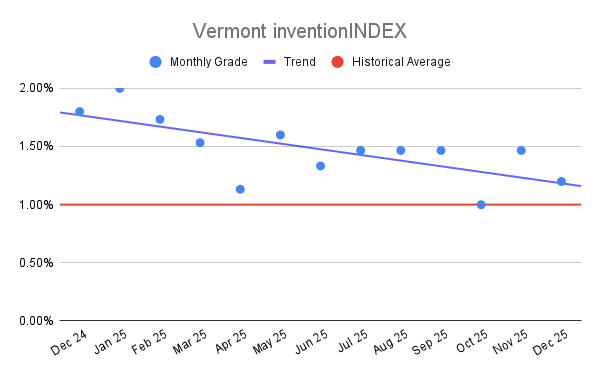 Vermont inventionINDEX December 2025:
  Vermont inventionINDEX November
