

Quick Answer: What is the Funded Research Exclusion in Vermont?
Funded research under the Vermont Research and Development (R&D) tax credit is defined as any research activity for which a taxpayer is reimbursed by a third party or does not retain substantial rights to the results. Consequently, expenditures associated with such research are excluded from the state’s tax credit calculation to ensure that incentives only subsidize innovation for which the taxpayer bears the genuine economic risk and possesses intellectual control.
The Vermont Research and Development Tax Credit, authorized under 32 V.S.A. § 5930ii, represents a critical pillar of the state’s economic development strategy, specifically designed to attract and retain intellectual-property-based companies while encouraging local investment in scientific advancement. By offering a nonrefundable credit equal to 27 percent of the federal R&D credit attributable to Vermont-based activities, the state provides a robust incentive that ranks among the most generous in the nation. However, the efficacy of this incentive is governed by its strict alignment with federal standards under Internal Revenue Code (IRC) § 41, particularly the “funded research” exclusion found in IRC § 41(d)(4)(H). This exclusion serves as an essential guardrail, preventing the state from providing tax relief for activities that are already being subsidized by other entities, such as federal grants, private contracts, or state assistance.
Statutory Infrastructure and Legislative Intent
The legal basis for the Vermont R&D tax credit is established in Title 32 of the Vermont Statutes Annotated. Section 5930ii defines the eligibility and calculation of the credit, which is inherently linked to the federal tax credit allowed for the same taxable year. This “piggyback” relationship is a deliberate policy choice intended to simplify tax compliance for Vermont businesses by utilizing existing federal definitions of “qualified research” and “qualified research expenditures” (QREs).
The legislative intent behind the credit is codified in 32 V.S.A. § 5813(p), which identifies the statutory purpose as the encouragement of business investment in research and development within the state. This alignment between state and federal law means that any activity excluded from the federal credit is automatically excluded from the Vermont credit. The funded research exclusion is perhaps the most significant of these exclusions for companies engaged in government contracting, academic partnerships, or collaborative industrial development.
| Statutory Element | Vermont Specification under 32 V.S.A. § 5930ii |
|---|---|
| Credit Calculation Base | 27% of the federal R&D credit amount |
| Geographic Constraint | Expenditures must be “made within this State” |
| Carryforward Period | 10 years for unused credits |
| Claimant Disclosure | Public publication of names annually by January 15 |
| Federal Conformity | Mirroring IRC § 41 definitions and exclusions |
| Tax Type Applicability | Corporate, Business, and Personal Income Tax |
Theoretical and Administrative Foundations of the Funded Exclusion
The funded research exclusion is rooted in the principle that the R&D tax credit is an incentive for risk-taking. If a taxpayer is being paid to perform research—effectively acting as a service provider—the taxpayer is not taking the risk associated with the innovation; rather, the party providing the funding is the one taking the risk. Under Treasury Regulation § 1.41-4A(d), research is considered funded to the extent that it is subsidized by any grant, contract, or otherwise by another person or governmental entity.
In the administrative context of Vermont’s tax system, the Department of Taxes requires taxpayers to recompute a “hypothetical” federal credit based solely on Vermont-sourced QREs. This recomputation is the primary point at which the funded research exclusion is applied. If a taxpayer receives a grant or contract to perform research in Vermont, they must determine if those specific expenditures meet the federal “risk” and “rights” standards. If they do not, those expenditures must be removed from the state-level calculation.
The Mechanism of the “Risk” Standard
The financial risk standard is the first hurdle in determining if research is funded. For research to be non-funded (and thus eligible for the credit), the taxpayer must bear the financial risk of failure. This means that the taxpayer’s right to payment must be contingent upon the success of the research. If a taxpayer is entitled to payment regardless of whether the research yields a successful result, the research is considered funded by the payer.
This standard is often evaluated by looking at the specific terms of the contract under which the research is performed. In the aerospace and defense sectors, which are prominent in Vermont, contract types are highly influential in this determination. Fixed-price contracts are typically viewed as non-funded because the contractor assumes the risk that the costs of research will exceed the contract price. If the research project fails or requires more resources than anticipated, the contractor suffers the financial loss.
Conversely, cost-plus or time-and-materials contracts are generally considered funded research. In these arrangements, the customer guarantees that the researcher will be reimbursed for all allowable costs, plus a fee. Because the researcher is made whole regardless of the project’s technical outcome, they bear no financial risk, and the credit belongs to the funding party if that party is a taxable entity.
The Mechanism of the “Substantial Rights” Standard
The second hurdle is the substantial rights standard. Even if a taxpayer bears the financial risk of a project, the research is deemed funded—and thus ineligible—if the taxpayer retains no substantial rights to the research results. This standard ensures that the taxpayer has the right to exploit the intellectual property they have developed without paying the other party for the privilege.
It is important to note that “substantial rights” do not require “exclusive rights”. A taxpayer may share the rights with a customer or a government agency and still qualify for the credit, provided they can use the research in their own business. For example, if a Vermont software firm develops a new algorithm under a government contract and the contract allows the firm to use that algorithm for other commercial clients without paying royalties, the firm has retained substantial rights. However, if the contract states that all rights, titles, and interests in the research are transferred exclusively to the client, the performer has no substantial rights, and the research is considered funded.
Local Vermont Revenue Office Guidance and Procedural Compliance
The Vermont Department of Taxes provides several forms and instructional documents that guide the application of the funded research exclusion. These documents emphasize that the state credit is a direct percentage of the federal allowance and that any state-specific adjustments must be clearly documented.
Schedule BA-404 and the Mandatory Adjustment
Schedule BA-404, “Tax Credits Earned, Applied, Expired, and Carried Forward,” is the primary form for claiming the R&D credit for corporations and business income tax filers. The instructions for this schedule provide the most direct local guidance on the funded research exclusion.
Under the “Research & Development Credit” section of the BA-404 instructions, the Department explicitly states: “If you have received grants or assistance for financing the expenditures from any other public or private source, the basis expenditure amount for the credit calculation must be adjusted downward to account for the assistance”. This directive applies to both the 27 percent general credit and other investment-related credits, such as the solar energy investment credit.
This “downward adjustment” language is critical. It implies that the taxpayer must subtract the amount of any grants or contract payments received from their total pool of Vermont research expenditures before calculating the credit. This prevents the credit from being applied to the portion of the R&D budget that was not internally financed.
Form IN-111 and Schedule IN-119 for Individuals
For individuals, such as sole proprietors or partners in pass-through entities, the R&D credit is claimed through the Vermont Individual Income Tax Return (Form IN-111) and its associated credit schedules, specifically Schedule IN-119. While these forms are simpler than the corporate filings, the same rules apply. The individual must receive their prorated share of the credit from the entity, and that credit must have already been adjusted for any funded research at the entity level.
The Recomputation Requirement
A key procedural requirement for Vermont taxpayers is the recomputation of the federal R&D credit. Because the federal credit is calculated on a nationwide basis, a taxpayer with operations in multiple states cannot simply take 27 percent of their total federal credit. Instead, they must:
- Identify all QREs incurred within Vermont (Wages, Supplies, and 65% of contract costs).
- Identify and exclude any Vermont-based expenditures that were “funded” by third parties.
- Recompute a hypothetical Federal Form 6765 using only the non-funded Vermont QREs.
- Multiply the resulting hypothetical federal credit by 27 percent to determine the Vermont credit.
| Contract Type | Risk Allocation | Vermont R&D Credit Eligibility for Performer |
|---|---|---|
| Firm-Fixed-Price (FFP) | Performer (Contractor) | Generally favorable; Performer assumes cost overruns |
| Cost-Plus-Fixed-Fee (CPFF) | Funder (Client) | Generally excluded; Funder reimburses all allowable costs |
| Time & Materials (T&M) | Funder (Client) | Generally excluded; Performer is paid for every hour/material |
| Milestone-Based | Shared/Performer | May qualify if payment is contingent on milestone success |
| Government Grants | Funder (Government) | Excluded; Expenditures are subsidized by public funds |
Advanced Analysis of Case Law and Jurisprudence
Because Vermont law adopts the federal standards of IRC § 41, the nuances of the funded research exclusion are defined by a body of federal jurisprudence that taxpayers must analyze when structuring their contracts and claims. Several landmark cases have established the legal tests for determining whether research is funded, particularly in the context of government and commercial contracting.
The Landmark Fairchild Case: Contingency of Payment
In Fairchild Industries, Inc. v. United States, the court focused on the critical relationship between payment and performance. Fairchild, an aerospace contractor, had entered into a fixed-price incentive contract with the U.S. Air Force. The government argued that the research was funded because Fairchild was expected to succeed and receive payment. However, the court held that the likelihood of success is irrelevant to the risk analysis. The “sole inquiry” is who bears the costs of the research upon failure. Because Fairchild was only entitled to payment if it produced results that met contract specifications—and the government had the right to reject the work—Fairchild bore the financial risk. This decision is a primary authority for Vermont contractors claiming the credit under fixed-price or performance-contingent agreements.
The Lockheed Martin Decision: Use Rights as Substantial Rights
The issue of intellectual property rights was clarified in Lockheed Martin Corp. v. United States. The government contended that Lockheed Martin did not have substantial rights because the contracts included security classifications and gave the government a non-exclusive license to use the developed technology. The court ruled in favor of the taxpayer, establishing that the “right to use the research results, even without the exclusive right, is a substantial right”. This case is vital for Vermont tech companies that often collaborate with the government; as long as the company can use the “know-how” or technology in its own future business without paying for it, the substantial rights requirement is met.
Modern Scrutiny: The Perficient and Grigsby Cases
More recent decisions from 2022, such as Perficient Inc. and Grigsby, demonstrate that the IRS and state tax authorities are increasing their scrutiny of “funded research” claims. In Perficient, a technology services company claimed that its master service agreements (MSAs) were non-funded because they included client rejection clauses. However, the court found that many of the projects were billed based on time-based milestones rather than technical success. The court emphasized that for a contract to be non-funded, the link between payment and technical success must be explicit and enforceable.
In Grigsby, a construction firm’s credit claim was denied because the contracts explicitly stated that all intellectual property would be transferred to the client. The court held that the firm had failed the substantial rights standard because it could not use the developed methods on other projects without the client’s permission. These cases serve as a warning to Vermont companies: generic “boilerplate” contract language can inadvertently disqualify millions of dollars in R&D tax credits.
The Shrink-Back Rule in Vermont Compliance
A significant but often overlooked aspect of the funded research exclusion is the “shrink-back” rule, found in Treasury Regulation § 1.41-4(b)(2). This rule allows a taxpayer to apply the four-part test for qualified research at the level of a business component, but if the overall component fails, the test can “shrink back” to the next discrete sub-component.
In the context of funded research, the shrink-back rule can be used defensively. If a large project is deemed to be “funded” by a client, the taxpayer may be able to isolate a specific sub-component of that project that was self-funded. For example, a Vermont manufacturer might be under a funded contract to build a new type of machinery for a client. While the machinery design itself is funded, if the manufacturer spends its own internal funds to develop a new, proprietary welding technique to build that machine, the costs of developing that technique may be non-funded and eligible for the Vermont credit.
Inter-Company Funding and Unitary Combined Returns
Vermont’s corporate tax structure underwent a significant change with the adoption of mandatory unitary combined filing for tax years beginning on or after January 1, 2023. This change has direct implications for how the funded research exclusion is applied to affiliated groups.
In a unitary group return, the affiliated group is treated as a single taxpayer. Consequently, if one member of the group performs research that is funded by another member of the same combined group, the funding arrangement is generally ignored for the purpose of the research credit. The expenditures are treated as if they were made by the group as a whole, avoiding the funded exclusion that would apply if the entities were filing separately. This treatment is particularly beneficial for large organizations that centralize their research and development functions in one Vermont subsidiary while providing funding from a parent or another affiliate.
The Enterprise Zone R&D Credit: A Parallel Incentive
While the primary R&D tax credit is authorized under 32 V.S.A. § 5930ii, Vermont also maintains a separate incentive under its Enterprise Zone (EZ) Program. This program is targeted at 16 designated zones with high unemployment or slow economic growth.
Differentiation in Calculation and Exclusion
The EZ R&D credit differs from the general 27 percent credit in several ways:
- Rate: The EZ credit is equal to 3 percent of the increase in annual research and development expenses over a base amount (typically the average of the prior two years).
- Duration: The credit is nonrefundable and must be claimed over a four-year period (25 percent each year).
- Funded Research: Like the general credit, the EZ credit explicitly excludes “government-funded research” and any research where the taxpayer does not retain rights.
However, the EZ credit is often more restrictive in its definition of eligible activities, excluding equipment acquisition, land, and customer-specific costs that do not involve technical experimentation. Businesses in Vermont must evaluate which program provides the greater benefit, although the general 27 percent credit is more widely utilized due to its direct link to the federal calculation.
Documentation and Audit Readiness
The Vermont Department of Taxes emphasizes that the burden of proof for the R&D credit rests solely with the taxpayer. In an audit, the Department will look for a robust nexus between the claimed expenditures and the qualified research activities.
Retaining the “Nexus” Documentation
Taxpayers must maintain documentation that links specific employees’ wages to specific research projects. For the purposes of the funded exclusion, this documentation must also include:
- Signed Contracts: Full copies of all MSAs, Statements of Work (SOWs), and purchase orders related to the research.
- Technical Reports: Evidence of experimentation, such as testing logs, prototypes, or design models that prove the taxpayer was engaged in a process of experimentation.
- Project Accounting: Records that show how research expenditures were tracked separately from commercial production costs.
- Legal Analysis of Rights: A written assessment explaining why the taxpayer believes it retains substantial rights to the results of contracted work.
The Role of Transparency Reports (RP-1298)
Vermont’s unique transparency requirement provides a public list of all claimants, which serves as a prompt for accurate filing. These reports, such as RP-1298, list the companies that filed a claim in a given calendar year. The existence of this public record means that any high-profile company claiming large credits must be prepared to defend the “non-funded” status of its Vermont research in the event of public or regulatory inquiry.
Comprehensive Case Study: Vermont Bio-Engineering Solutions
To synthesize these rules into a practical example, consider “Vermont Bio-Engineering Solutions” (VBES), a hypothetical firm based in Burlington, Vermont. In the current tax year, VBES engages in three distinct research projects.
Project 1: Internal Vaccine Platform Development
VBES invests $2,000,000 of its own venture capital funding into developing a new mRNA delivery platform.
- Funded Status: Non-funded. VBES owns all IP and takes all the financial risk.
- Vermont Context: The project uses 10 scientists in Burlington (Wages: $1,200,000) and consumes $300,000 in supplies.
- Eligibility: 100% of these Vermont QREs are eligible for the 27% credit calculation.
Project 2: Fixed-Price Diagnostic Contract
VBES enters into a $1,000,000 fixed-price contract with a private hospital chain to develop a rapid diagnostic kit. The contract states VBES is only paid if the kit achieves 99% accuracy. VBES retains the right to use the underlying chemical process for other products.
- Funded Status: Non-funded. Payment is contingent on successful technical results (the 99% accuracy threshold), placing the financial risk on VBES. VBES also retains substantial rights to use the core chemical process.
- Vermont Context: VBES incurs $600,000 in wages in Vermont for this project.
- Eligibility: These QREs are eligible and must be included in the recomputed Federal Form 6765.
Project 3: NIH Research Grant
VBES receives a $500,000 grant from the National Institutes of Health (NIH) to perform basic research on cell behavior. The grant is paid out in monthly installments based on hours worked. The NIH requires that all resulting data be placed in the public domain and that VBES may not patent the results.
- Funded Status: Funded. VBES is paid for its time regardless of the results, so it bears no risk. Furthermore, by requiring the data to be in the public domain and prohibiting patents, the NIH has effectively stripped VBES of “substantial rights” (the right to use the results without others having equal access).
- Vermont Context: VBES incurs $400,000 in Vermont wages on this project.
- Eligibility: Ineligible. Under the instructions for BA-404, VBES must adjust its basis downward by the $500,000 received, effectively removing this project from the credit calculation.
Calculation of the Credit
VBES calculates its Vermont credit as follows:
- Total Vermont QREs: $1,200,000 (Proj 1) + $300,000 (Proj 1 supplies) + $600,000 (Proj 2) = $2,100,000.
- Federal Recomputation: VBES completes a hypothetical Federal Form 6765 using the $2,100,000. Assuming a base amount of $1,000,000 and the 20% federal rate on the excess, the hypothetical federal credit is $220,000 (20% of $1,100,000).
- Vermont Credit: VBES takes 27% of the $220,000, resulting in a state credit of $59,400.
- Reporting: VBES enters $59,400 on Schedule BA-404, Line 4, and attaches the hypothetical Form 6765 and the project-by-project recomputation worksheet.
Interaction with Section 174 Capitalization
A significant development for Vermont R&D taxpayers in the 2024 and 2025 tax years is the continued requirement to capitalize and amortize R&D expenses under IRC Section 174. Since 2022, businesses can no longer immediately deduct R&D costs; instead, they must amortize domestic costs over five years and foreign costs over fifteen years.
Impact on the 27% Credit
While Section 174 governs the deduction of R&D expenses, the Vermont R&D credit is calculated based on the expenditure amount. However, there is a complex interaction: under IRC § 280C, a taxpayer generally cannot take both a credit and a full deduction for the same expense. Vermont law follows this federal treatment.
For the funded research exclusion, this means that if a project is funded, the taxpayer may still be required to capitalize the expenses under Section 174 even if they cannot claim the R&D credit. This creates a high stakes environment where a company might suffer the cash-flow disadvantage of capitalization without the offset of the 27 percent Vermont credit.
Future Outlook and Legislative Trends
The landscape of the Vermont R&D tax credit continues to be shaped by both state budgetary pressures and federal legislative changes. As of mid-2025, there are several trends for Vermont taxpayers to monitor:
- Potential Rate Adjustments: There has been historical oscillation between a 30 percent and 27 percent rate. If state revenue targets allow, there may be pressure to return to 30 percent to enhance competitiveness with neighboring states.
- Federal R&E Expensing Legislation: There is ongoing federal debate regarding the repeal of Section 174 capitalization. If the federal government reverts to immediate expensing, Vermont will likely follow suit, significantly improving the liquidity of innovation-focused firms in the state.
- Increased Audit Activity: With the adoption of unitary combined filing, the Vermont Department of Taxes has enhanced capabilities to audit large corporate groups. Taxpayers should expect more rigorous reviews of inter-company research agreements to ensure they are not being used to circumvent the funded research exclusion.
Synthesis of Key Findings
The meaning of funded research in the context of the Vermont R&D tax credit is a function of both financial risk and intellectual property ownership. By strictly adhering to federal IRC § 41 standards, Vermont ensures that its nonrefundable 27 percent credit is targeted toward taxpayers who are the primary drivers and risk-bearers of innovation within the state. Local guidance, such as the BA-404 instructions, provides the procedural framework for excluding grants and assistance, requiring a diligent downward adjustment of the credit basis.
For the professional tax practitioner or corporate executive in Vermont, success in claiming the R&D credit depends on more than just identifying scientific activities; it requires a deep, forensic analysis of the contractual relationships that govern those activities. Through proactive contract drafting, careful use of the shrink-back rule, and robust documentation of substantial rights, Vermont companies can maximize their innovation incentives while ensuring full compliance with state and federal law.
Who We Are:
Swanson Reed is one of the largest Specialist R&D Tax Credit advisory firm in the United States. With offices nationwide, we are one of the only firms globally to exclusively provide R&D Tax Credit consulting services to our clients. We have been exclusively providing R&D Tax Credit claim preparation and audit compliance solutions for over 30 years. Swanson Reed hosts daily free webinars and provides free IRS CE and CPE credits for CPAs.
Are you eligible?

Why choose us?

Pass an Audit?

What is the R&D Tax Credit?
The Research & Experimentation Tax Credit (or R&D Tax Credit), is a general business tax credit under Internal Revenue Code section 41 for companies that incur research and development (R&D) costs in the United States. The credits are a tax incentive for performing qualified research in the United States, resulting in a credit to a tax return. For the first three years of R&D claims, 6% of the total qualified research expenses (QRE) form the gross credit. In the 4th year of claims and beyond, a base amount is calculated, and an adjusted expense line is multiplied times 14%. Click here to learn more.
Never miss a deadline again

Stay up to date on IRS processes

Discover R&D in your industry

R&D Tax Credit Preparation Services
Swanson Reed is one of the only companies in the United States to exclusively focus on R&D tax credit preparation. Swanson Reed provides state and federal R&D tax credit preparation and audit services to all 50 states.
If you have any questions or need further assistance, please call or email our CEO, Damian Smyth on (800) 986-4725.
Feel free to book a quick teleconference with one of our national R&D tax credit specialists at a time that is convenient for you.
R&D Tax Credit Audit Advisory Services
creditARMOR is a sophisticated R&D tax credit insurance and AI-driven risk management platform. It mitigates audit exposure by covering defense expenses, including CPA, tax attorney, and specialist consultant fees—delivering robust, compliant support for R&D credit claims. Click here for more information about R&D tax credit management and implementation.
Our Fees
Swanson Reed offers R&D tax credit preparation and audit services at our hourly rates of between $195 – $395 per hour. We are also able offer fixed fees and success fees in special circumstances. Learn more at https://www.swansonreed.com/about-us/research-tax-credit-consulting/our-fees/



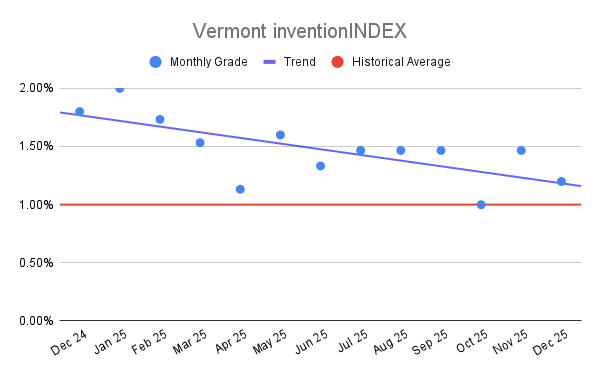 Vermont inventionINDEX December 2025:
  Vermont inventionINDEX November
