

The Permitted Purpose requirement mandates that research activities be directed toward the creation of a new or improved business component specifically intended to enhance its function, performance, reliability, or quality. In the context of the Vermont Research and Development tax credit, this standard serves as the primary gateway for determining whether technological activities qualify for the state’s twenty-seven percent incentive based on federal Internal Revenue Code standards.
Statutory Foundations and Vermont’s Adoption of Federal Standards
The Vermont Research and Development (R&D) tax credit is established under 32 V.S.A. § 5930ii, which defines the eligibility and magnitude of the incentive for taxpayers within the state. The core of the Vermont statute is its direct linkage to federal law, specifically the credit for increasing research activities as defined under 26 U.S.C. § 41. By tethering the state credit to the federal allowance, Vermont effectively adopts the rigorous "four-part test" used by the Internal Revenue Service (IRS) to vet qualifying research activities (QRAs). The Permitted Purpose test, often referred to as the Business Component Test, is the first and perhaps most critical hurdle in this four-part evaluation. Under 32 V.S.A. § 5930ii(a), a taxpayer is eligible for a credit equal to twenty-seven percent of the federal tax credit allowed in the taxable year for eligible research and development expenditures made within Vermont. This necessitates a comprehensive understanding of what constitutes a "permitted purpose" under federal law, as any activity failing this test at the federal level is automatically disqualified from the Vermont state credit.
The legislative intent behind this specific adoption, as outlined in 32 V.S.A. § 5813(p), is to encourage business investment in research and development within Vermont and to attract and retain intellectual-property-based companies. By utilizing the federal definition of Permitted Purpose, Vermont ensures that its tax base supports genuine technological advancement rather than routine business activities, while providing a streamlined compliance path for businesses already familiar with federal filing requirements. Vermont’s conformity to the Internal Revenue Code (IRC) is dynamic, with the state legislature typically updating its reference point to the IRC annually. For example, Vermont’s income tax code was updated in 2025 to reflect federal laws in effect as of December 31, 2024. This means that federal definitions of "qualified research" and "business component" under Section 41 are integrated into Vermont’s tax landscape with minimal local modification, except for the critical geographic limitation that expenditures must be "made within this State".
The mechanics of this conformity require a dual-layer analysis. First, the activity must satisfy the federal definition of qualified research. Second, the expenditures associated with that research must be localized to Vermont-specific operations. The Permitted Purpose test specifically anchors the research to a "business component," which the code defines as any product, process, computer software, technique, formula, or invention to be held for sale, lease, or license, or used by the taxpayer in a trade or business. For a Vermont taxpayer, the identification of the business component is the foundational step of the R&D credit claim, as every dollar of qualified research expenditure (QRE) must be linked back to the development or improvement of a specific component.
| Feature | Vermont R&D Tax Credit Specification | Federal R&D Credit Reference (IRC § 41) |
|---|---|---|
| Credit Rate | 27% of the Vermont-apportioned federal credit | Variable (Regular 20% or ASC 14%) |
| Primary Legal Basis | 32 V.S.A. § 5930ii | 26 U.S.C. § 41 |
| Qualifying Test | Federal Four-Part Test | Federal Four-Part Test |
| Geographic Scope | Limited to in-state (Vermont) expenditures | Nationwide (U.S.) |
| Carryforward | 10 years | 20 years |
| Refundability | Non-refundable | Generally non-refundable (except for QSBs) |
The Permitted Purpose Doctrine and the Business Component Test
The Permitted Purpose test, integrated into the broader definition of "qualified research" under IRC § 41(d), mandates that an activity is only eligible if it is undertaken for the purpose of discovering information which is technological in nature and the application of which is intended to be useful in the development of a new or improved business component. This requirement distinguishes between pure scientific inquiry and applied industrial research. While pure science seeks knowledge for its own sake, the R&D credit requires that the knowledge be harnessed to improve the tangible or intangible assets a business uses to generate revenue.
Architectural Elements of a Business ComponentThe term "business component" serves as the unit of analysis for the credit. Taxpayers must be able to "shrink back" their activities to the lowest identifiable level that meets the test. This means if an entire aircraft fails the four-part test, a specific novel fuel-injection system within that aircraft may still qualify. In Vermont's manufacturing and tech sectors, business components typically fall into several distinct categories. Products are the most common, representing tangible items developed for the marketplace, such as a new medical device manufactured in Burlington or a specialized aerospace component designed in Essex. Processes, another major category, involve internal methodologies or manufacturing techniques designed to improve efficiency, such as a new assembly line sequence that reduces waste. Computer software represents a significant portion of Vermont's R&D claims, covering programs developed for sale to customers or for internal use, provided they meet additional "internal use software" (IUS) hurdles. Finally, techniques, formulas, and inventions encompass specialized knowledge or proprietary methods, such as a new chemical formula for a Vermont-based pharmaceutical firm or a patented mechanical invention.
The Technical Objectives of the ImprovementFor an activity to satisfy the Permitted Purpose test, it must be intended to improve one of four specific technical attributes: functionality, performance, reliability, or quality. Functionality refers to the specific tasks or operations a business component is designed to perform. Research aimed at expanding the capabilities of a product, such as a sensor that can now detect moisture in addition to temperature, qualifies under this pillar. Performance relates to the efficiency, speed, or output of a component. Activities designed to make a process faster or reduce energy consumption fall into this category, which is particularly relevant for Vermont's growing green energy and machinery sectors. Reliability involves the consistency and durability of a component over time, such as testing new alloys to ensure they withstand extreme thermal stress. Quality focuses on the adherence to specifications and the reduction of defects, such as a brewery experimenting with new filtration techniques to achieve a more stable product.
Crucially, the Permitted Purpose test explicitly excludes activities that do not relate to these four pillars. Improvements that are purely visual or relate to style, taste, or seasonal design are disqualified. In an audit, the Vermont Department of Taxes or the IRS will scrutinize whether a redesign was driven by technical necessity or market-driven styling. For instance, a software company that updates its user interface solely for better visual appeal would fail the test, whereas a rewrite of the core algorithm to increase data processing speed by thirty percent would clearly satisfy the "performance" objective.
Local State Revenue Office Guidance and Administrative Procedures
The Vermont Department of Taxes provides the administrative infrastructure for claiming the credit through various forms and technical bulletins. While the state adheres to federal definitions, its local guidance focuses on the proration of expenditures and the transparency of the tax benefit.
Filing Requirements and Schedule BA-404The primary mechanism for claiming the R&D credit in Vermont is Schedule BA-404, "Tax Credits Earned, Applied, Expired, and Carried Forward". This form must be attached to the taxpayer's corporate or business income tax return, such as Form CO-411 or BI-471. The instructions for Schedule BA-404 emphasize that a copy of federal Form 6765 must be included to substantiate the underlying credit calculation. Furthermore, if the federal credit includes expenditures from multiple states, the taxpayer must provide a detailed breakdown and recompute the credit using only those expenditures that occurred in Vermont. This recomputed federal credit then serves as the base for Vermont’s twenty-seven percent rate.
| Filing Document | Purpose |
|---|---|
| Schedule BA-404 | Main schedule for tracking R&D credits earned and carried forward |
| Federal Form 6765 | Substantiation of the federal R&D credit calculation |
| Form CO-411 | Corporate income tax return for C-corporations |
| Form BI-471 | Business income tax return for S-corporations and partnerships |
| Schedule BA-406 | Credit allocation schedule for pass-through entities |
Vermont’s R&D credit is strictly limited to research and development expenditures made within the state. Guidance from the Department of Taxes requires that wages, supplies, and contractor costs be apportioned based on where the work was physically performed or where the materials were consumed. For example, if a Vermont-based company employs a team of engineers, with fifty percent of their time spent at a facility in Burlington and fifty percent at a site in New York, only the Burlington-related wages qualify for the Vermont credit. Similarly, payments to third-party contractors are only eligible if the services were performed within Vermont’s borders. This geographic nexus is a frequent focus of state audits, as the high twenty-seven percent rate creates a significant incentive for businesses to maximize their in-state claims.
Transparency and Public ReportingUnder 32 V.S.A. § 5930ii(c), Vermont is required to publish an annual list of taxpayers who have claimed the R&D credit. This list, typically released by the Department of Taxes on or before January 15th, includes the names of the claimants for the most recently completed calendar year. While the specific dollar amounts of the credits are not disclosed, the public nature of the claim adds a layer of accountability and necessitates that businesses maintain robust documentation to support their status as "intellectual-property-based companies".
Mathematical Application and Credit Computation
The Vermont R&D credit is non-refundable but offers a generous ten-year carryforward period. The calculation follows a multi-step process that begins with the federal credit methodology.
The Computation FormulaThe state credit is derived directly from the federal amount, but only the portion attributable to Vermont activities. The general formula can be expressed as:
Vermont Credit = 0.27 x (Recomputed Federal Credit based on VT QREs)
Where the recomputed federal credit follows either the Regular Credit method or the Alternative Simplified Credit (ASC) method, as used on the federal return. Under the ASC method, for instance, the recomputed federal credit would be fourteen percent of the current-year Vermont QREs that exceed fifty percent of the average Vermont QREs for the three preceding years.
Example Case Study: Green Mountain Precision EngineeringConsider a Vermont-based firm, Green Mountain Precision Engineering (GMPE), which is developing a more reliable hydraulic valve for use in industrial tractors. The project is undertaken to improve the "reliability" of the valve, thereby satisfying the Permitted Purpose test.
GMPE’s financial data for the current year includes:
- Total Vermont-based wages for research: $200,000
- Vermont supplies for prototyping: $20,000
- Payments to a Vermont research consortium: $50,000
The qualified research expenses (QREs) for Vermont are calculated as follows:
VT QREs = Wages + Supplies + (0.75 x Consortium Payments)
VT QREs = $200,000 + $20,000 + ($50,000 x 0.75) = $257,500
Assuming GMPE’s average VT QREs for the three prior years was $150,000, the ASC-based recomputed federal credit would be:
Recomputed Fed Credit = 0.14 x [$257,500 - (0.50 x $150,000)]
Recomputed Fed Credit = 0.14 x [$257,500 - $75,000] = 0.14 x $182,500 = $25,550
The Vermont R&D tax credit for the current year would then be:
VT Credit = 0.27 x $25,550 = $6,898.50
GMPE would enter this amount on Line 3 of Schedule BA-404 and carry it forward if its current-year Vermont tax liability is less than the credit amount.
Advanced Regulatory Concepts: IUS and Section 174
Two areas of significant complexity in the R&D landscape involve Internal Use Software (IUS) and the recent shifts in federal law regarding the capitalization of research expenses.
The Heightened Three-Part Test for IUSWhen a Vermont company develops software for its own internal administrative or management functions, it must satisfy a "heightened" test in addition to the standard four-part test. Guidance from both federal and state sources indicates that software is "internal use" if it is not to be sold, leased, or licensed to third parties. To meet the Permitted Purpose requirement for IUS, the development must be innovative, involve significant economic risk, and be commercially unavailable. Innovation in this context means the software must result in a substantial and economically significant reduction in cost or improvement in speed. For a Vermont insurance firm developing a proprietary risk-assessment tool, the research would only qualify if the firm could prove that no comparable software existed on the market and that the new tool provided a transformative leap in efficiency.
Federal Conformity and the Impact of OBBBARecent legislative changes at the federal level, such as the One Big Beautiful Bill Act (OBBBA), have significantly impacted the R&D credit landscape by restoring immediate expensing for domestic research and experimentation costs under Section 174. Vermont's conformity to these federal provisions is crucial because the R&D credit (IRC § 41) is intrinsically linked to these underlying expenses. The ability of small businesses to retroactively expense costs from 2022-2024 through amended returns has created a wave of new credit claims in the state. For a Vermont taxpayer, satisfying the Permitted Purpose test for the Section 41 credit also generally satisfies the requirement for Section 174 treatment, but the documentation must reflect the "experimental or laboratory sense" of the work as required by federal regulations.
Audit Protection and Documentation Best Practices
The high prorated rate of Vermont’s credit makes it a point of emphasis for state revenue office audits. Successful navigation of an audit depends on the quality of contemporaneous documentation that supports the Permitted Purpose of each research project.
Demonstrating a Process of ExperimentationThe Permitted Purpose test is inextricably linked to the "process of experimentation" test. Auditors look for evidence that the taxpayer evaluated one or more alternatives to achieve a result where the capability or method of achieving that result was uncertain at the outset. Documentation must include project records such as plans, design documents, and project reports that outline technical objectives and uncertainties. Furthermore, iteration logs and test results show that the research followed a systematic progression of work based on the principles of established science—proceeding from hypothesis to observation and evaluation.
Records Required for Vermont SubstantiationThe Department of Taxes expects taxpayers to maintain a clear link between their financial data and their technical activities. This includes payroll records, such as W-2s and time-tracking data, that tie specific employee hours to qualified research projects. Supply costs must be substantiated with receipts and invoices that demonstrate the materials were consumed in the research process rather than becoming part of a depreciable asset. For contractor expenses, Vermont taxpayers must retain contracts and Form 1099s to prove the geographic location of the work.
Strategic Outlook: The Role of the Credit in Vermont’s Economy
The Permitted Purpose doctrine ensures that Vermont's R&D credit is not a broad subsidy for all business activities but a targeted incentive for technical innovation. By providing a twenty-seven percent credit, Vermont positions itself as a competitive alternative to larger tech hubs, specifically targeting small to mid-sized manufacturing and software firms.
| State | Credit Rate (Prorated Federal) | Notable Policy Feature |
|---|---|---|
| Vermont | 27% | Public claimant transparency list required |
| Arizona | 24% | Capped at $2.5 million per taxpayer |
| Alaska | 18% | Definition same as IRC § 41 |
| Minnesota | 10% | Does not conform to ASC method |
| Florida | 10% | $9 million aggregate state cap |
The strategic significance of the credit is reflected in its indefinite expiration date and the state's consistent legislative updates to maintain federal conformity. As businesses increasingly rely on advanced technologies—from robotics in manufacturing to artificial intelligence in software—the Permitted Purpose requirement will continue to evolve, requiring taxpayers to be more precise in how they define their "business components" and the technical uncertainties they seek to resolve. For a professional peer in the tax or engineering domain, understanding this nexus between federal definitions and Vermont administrative guidance is essential for maximizing the value of the credit while minimizing compliance risk in an era of heightened transparency and audit activity.





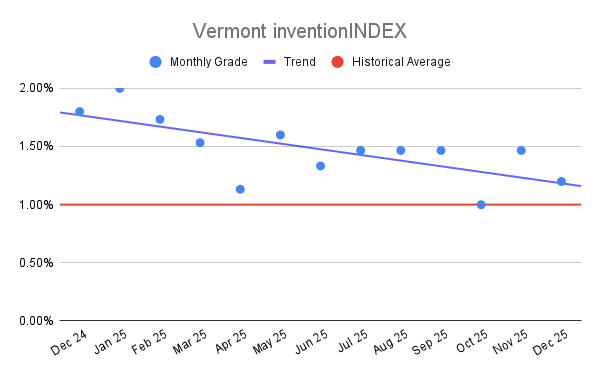 Vermont inventionINDEX December 2025:
  Vermont inventionINDEX November
