

Quick Answer: Vermont R&D Tax Credit Overview
The Vermont Research and Development (R&D) Tax Credit allows taxpayers to offset up to 27% of the federal research credit attributable to qualified expenditures incurred within Vermont. This nonrefundable credit is applied against the Individual Income Tax (Form IN-111) or corporate liability and features a 10-year carryforward period. To claim the credit, taxpayers must recompute federal figures using only Vermont-based wages, supplies, and contract research, and file Form BA-404.
Individual income tax, defined as the "applicable tax" within the Vermont Research and Development tax credit framework, represents the nonrefundable personal tax liability calculated under 32 V.S.A. Chapter 151. This credit offsets up to 27 percent of the federal research credit attributable to qualified expenditures incurred within the state, directly reducing the tax burden on residents, part-year residents, and non-residents earning Vermont-sourced income.
The Vermont Research and Development (R&D) tax credit is a sophisticated economic instrument designed to incentivize innovation through a "piggyback" relationship with federal standards. Codified under 32 V.S.A. § 5930ii, the credit bridges the gap between federal tax policy and state-specific economic development goals. For an individual taxpayer, the "applicable tax" refers specifically to the net income tax obligation reported on Form IN-111, the Vermont Individual Income Tax Return. This tax is derived from the Federal Adjusted Gross Income (AGI), which undergoes several state-specific modifications to arrive at Vermont taxable income. The R&D credit serves as a critical final-stage reduction, lowering the effective tax rate for entrepreneurs, partners, and shareholders who receive distributive shares of the credit from pass-through entities. The statutory framework ensures that the credit is strictly limited to research conducted within the geographic boundaries of Vermont, necessitating a rigorous recomputation of federal figures using only Vermont-based qualified research expenditures (QREs).
Statutory Interpretation and the Definition of Applicable Tax
The term "applicable tax" in the context of the Vermont R&D credit finds its legal root in the interaction between 32 V.S.A. § 5930ii and the broader definitions of income tax within Title 32. Under § 5930ii(a), a taxpayer is eligible for a credit "against the tax imposed under this chapter." This chapter—Chapter 151—encompasses the entirety of Vermont’s income tax law, covering individuals, estates, trusts, and corporations. For individual filers, the tax imposed is the personal income tax, which is structured as a progressive tax based on brackets.
The administrative guidance provided by the Vermont Department of Taxes clarifies that while the credit is earned through business activities, it is frequently applied to the "applicable tax" of individuals. This occurs when the R&D activities are conducted by pass-through entities such as S-corporations, limited liability companies (LLCs), or partnerships. In these instances, the credit is not taxed at the entity level but instead flows through to the individual owners' Vermont tax returns. The "applicable tax" for these individuals is their personal income tax liability, which includes tax on wages, dividends, and the distributive share of business income.
The state’s tax system is designed to provide transparency and stability. Under 32 V.S.A. § 5813(p), the statutory purpose of this specific credit is to "encourage business investment in research and development within Vermont and to attract and retain intellectual-property-based companies." By allowing the credit to offset individual income tax, Vermont specifically targets the owners and key personnel of high-growth tech firms, ensuring that the financial benefit of innovation remains closely tied to the taxpayers who provide the capital and strategic direction for the research activities.
The Federal Conformity Model: IRC § 41 Standards
Vermont’s R&D credit is intentionally aligned with Internal Revenue Code (IRC) § 41. This conformity simplifies compliance for taxpayers already filing federal Form 6765, Credit for Increasing Research Activities. To qualify for the Vermont credit, an individual or business must first meet the federal criteria for what constitutes "qualified research."
The Four-Part Test for InnovationThe Department of Taxes leverages the federal "four-part test" to validate the eligibility of research activities. Every activity claimed must satisfy the following:
- Technological in Nature: The research must fundamentally rely on principles of physical science, biological science, engineering, or computer science.
- Permitted Purpose: The goal of the research must be to develop a new or improved "business component," which includes products, processes, software, techniques, or formulas. The focus must be on improving functionality, performance, reliability, or quality.
- Elimination of Uncertainty: The taxpayer must demonstrate that at the outset of the research, there was uncertainty regarding the capability, method, or optimal design of the business component.
- Process of Experimentation: The research must involve a systematic process designed to evaluate one or more alternatives through modeling, simulation, or systematic trial and error.
The credit applies to a specific subset of business costs. For Vermont purposes, these costs must be isolated to expenditures made within the state.
| Expenditure Category | Federal Definition (IRC § 41) | Vermont Limitation and Guidance |
|---|---|---|
| Wages | Salaries and benefits for employees directly performing, supervising, or supporting research. | Limited to wages paid to employees for services performed within Vermont. |
| Supplies | Tangible property consumed in the research process, excluding land and depreciable assets. | Only supplies used in the conduct of research within Vermont are eligible. |
| Contract Research | Payments to third parties for research performed on behalf of the taxpayer. | Typically 65% of the amount paid for research conducted in Vermont. |
| Computer Leases | Costs for the right to use computers (including cloud computing) in the conduct of research. | Recomputed to reflect the Vermont-based portion of computer usage. |
The distinction between "total QREs" and "Vermont QREs" is the most critical aspect of the state’s guidance. Individuals receiving credits through multi-state businesses must ensure that the apportionment of these expenses is accurate, as this is a primary focus of Department of Taxes audits.
Mechanics of the Vermont Proration and Recomputation
The calculation of the Vermont R&D credit does not simply apply 27% to the federal credit amount found on Form 6765. Instead, Vermont uses a "prorated method" that requires a recomputation of the federal credit using only Vermont-source data. This ensures that the state only provides incentives for activity occurring within its borders.
The Recomputation ProcedureTo arrive at the credit amount, a taxpayer must perform a hypothetical federal calculation. This involves isolating Vermont QREs and the Vermont "base amount." Under federal rules, the base amount is designed to prevent credits for routine research spending that does not represent an increase over historical averages.
The standard formula provided by the Department of Taxes is:
- Establish Vermont QREs: Sum of Vermont wages, supplies, and 65% of Vermont contract research.
- Determine Vermont Base Amount: This is the product of the "fixed-base percentage" and the average annual Vermont gross receipts for the four preceding years.
- Calculate Vermont Excess: The Vermont QREs minus the Vermont Base Amount (which cannot be less than 50% of the current QREs).
- Hypothetical Federal Credit: Apply the federal credit rate (typically 20% for the regular method) to the Vermont Excess.
- Vermont Credit: Multiply the Hypothetical Federal Credit by 27%.
For startups or entities without a significant Vermont history, the Department of Taxes allows the use of federal startup rules to determine the fixed-base percentage. These rules generally assign a 3% fixed-base percentage for the first five years, gradually phasing into a historical average by the tenth year of research.
Vermont Department of Taxes Administrative Guidance and Filing Requirements
The Department of Taxes provides several layers of guidance through its official forms and instructions. These documents clarify how the credit interacts with individual income tax returns and the documentation required to withstand an audit.
Form BA-404: The Foundation of Credit TrackingFor all entities earning the R&D credit, Form BA-404, Tax Credits Earned, Applied, Expired, and Carried Forward, is the primary compliance document. Even if the tax liability is eventually paid by an individual, the entity conducting the research must complete this form to establish the credit’s validity.
The instructions for BA-404 specify that for the R&D credit:
- Taxpayers must include a copy of federal Form 6765.
- A detailed breakdown of Vermont-only expenditures must be provided.
- If the entity has received other public or private assistance for the research (such as grants), the basis for the credit must be adjusted downward by the amount of that assistance.
When a pass-through entity (S-corp, Partnership, LLC) earns the credit, it must allocate the credit to its owners using Schedule BA-406, Credit Allocation Schedule. This schedule ensures that the Department can track the movement of the credit from the business entity to the individual’s "applicable tax" liability.
Individuals receive their allocated share on Schedule K-1VT. This document is essential for the individual to claim the credit on their personal return. The Department's guidance highlights that the credit must be distributed to owners in the same proportion that the entity's income or loss is distributed.
Individual Filing on Form IN-111 and Schedule IN-119For the individual taxpayer, the final step in the process occurs on the personal income tax return. The credit is reported on Schedule IN-119, Vermont Tax Adjustments and Nonrefundable Credits.
The reporting hierarchy for an individual is as follows:
- Form IN-111, Line 8: Calculate the base Vermont income tax.
- Schedule IN-119, Part II, Line 4: Enter the R&D credit (Current year allocation + Carryforward from prior years).
- Form IN-111, Line 18: Total nonrefundable credits are pulled from Schedule IN-119.
- Form IN-111, Line 20: The credits are subtracted from the initial tax liability to determine the "Tax After Credits."
The "Applicable Tax" and the Nonrefundability Constraint
A defining characteristic of the R&D credit as it applies to individual income tax is its nonrefundable nature. This means the credit can only reduce the taxpayer's liability to zero; it cannot generate a tax refund.
The 10-Year Carryforward MechanismTo mitigate the impact of nonrefundability, particularly for early-stage companies or individuals with fluctuating income, the law provides a 10-year carryforward period. This allows a taxpayer to store "unused" credits for future years when their "applicable tax" liability may be higher.
The Department of Taxes emphasizes the importance of tracking these carryforwards meticulously. Each year, Column A of Form BA-404 must reflect the amount carried forward from the prior year, while Column D shows the amount remaining for future years. If an individual fails to claim the carryforward on Schedule IN-119 in a subsequent year, the Department may challenge the credit's availability in future periods.
Interaction with Other Nonrefundable CreditsVermont offers a variety of nonrefundable credits that compete with the R&D credit for an individual’s limited tax liability. These include:
- Investment Tax Credit: 24% of the federal credit for Vermont property.
- Charitable Housing Credit: Encourages investment in housing charities.
- Affordable Housing Credit: 25% of the qualified basis of housing projects.
- Historic Rehabilitation Credit: 10% of qualified expenditures.
Under Vermont’s ordering rules, nonrefundable credits are typically applied in the order that maximizes the taxpayer's benefit, though the Department guidance suggests that credits with shorter carryforward windows (like the Solar Energy credit with 5 years) should be prioritized over the R&D credit's 10-year window.
Public Transparency and the RP-1298 Report
One of the most unique aspects of the local revenue office guidance is the transparency requirement codified in 32 V.S.A. § 5930ii(c). Every year, by January 15, the Department of Taxes must publish a list of the names of all taxpayers who claimed the R&D credit.
This list, referred to as Report RP-1298, is publicly available on the Department’s website. For individual taxpayers who receive the credit via a pass-through entity, it is typically the name of the entity that appears on the list, rather than the individual owners. However, if the taxpayer is a sole proprietor claiming the credit directly on their individual return, their name will be included. This reporting requirement serves as a deterrent against fraudulent or aggressive credit claims and provides the legislature with data on the program's utilization across different economic sectors.
Comparative Policy Analysis: Vermont vs. Regional Peers
The effectiveness of Vermont's R&D credit is often measured against the incentives offered by other states. At 27% of the federal credit, Vermont’s rate is significantly higher than many of its neighbors, a fact the Department and economic advisors highlight to attract businesses.
| State | R&D Credit Rate | Refundability | Carryforward |
|---|---|---|---|
| Vermont | 27% of Vermont Federal Credit. | Nonrefundable. | 10 Years. |
| Minnesota | 10% on first $2M excess; 4% above. | Partially Refundable (2025+). | 15 Years. |
| Rhode Island | Credits against Corporate and Individual. | Nonrefundable (mostly). | Varies by year. |
| Iowa | Incremental method matching federal. | Often Refundable. | N/A (due to refund). |
Vermont’s 27% rate is one of the highest in the nation for a "prorated federal" style credit. However, the lack of refundability compared to states like Minnesota or Iowa means that the credit is primarily beneficial to established, profitable businesses and their owners who have a consistent "applicable tax" liability to offset.
Practical Application: A Detailed Case Study and Example
To illustrate the interplay between the law, the administrative forms, and the individual "applicable tax," we consider the case of "Vermont Aerospace Innovations" (VAI), an S-corp.
Scenario BackgroundVAI is a precision engineering firm with operations in Vermont and Massachusetts. In 2024, the company engaged in a project to develop a new type of lightweight composite material for aircraft engines.
- Total Federal QREs: $1,000,000.
- Vermont-Specific QREs: $600,000 (comprising $500,000 in Vermont wages and $100,000 in Vermont supplies).
- Federal Credit Claimed (Form 6765): $80,000.
- Vermont Gross Receipts (Prior 4-year average): $4,000,000.
- Fixed-Base Percentage: 5%.
The Vermont base amount is calculated as $4,000,000 x 5% = $200,000.
Because $200,000 is less than 50% of the current Vermont QREs ($300,000), the minimum base of $300,000 must be used under IRC § 41 rules as adopted by Vermont.
Step 2: Calculating the Hypothetical Federal CreditThe Vermont excess QRE is $600,000 - $300,000 = $300,000.
The hypothetical federal credit at a 20% rate is $300,000 x 20% = $60,000.
Step 3: Determining the Vermont State CreditThe Vermont R&D Credit is $60,000 x 27% = $16,200.
Step 4: Flow-Through to the IndividualVAI is owned by a single shareholder, Mark, who is a full-year Vermont resident.
VAI files Form BI-471 (Business Income Tax Return) and attaches Form BA-404 showing the $16,200 credit.
VAI issues a Schedule K-1VT to Mark, allocating the $16,200 R&D credit.
Mark’s Personal Tax Filing (Form IN-111):
- Adjusted Gross Income: $250,000.
- Vermont Taxable Income: $220,000.
- Vermont Income Tax (Applicable Tax): $14,500.
- Nonrefundable Credit Application: Mark applies $14,500 of his $16,200 credit on Schedule IN-119.
- Net Tax Owed: $0.
- Carryforward: Mark carries forward the remaining $1,700 ($16,200 - $14,500) for use in 2025.
This example demonstrates how the credit "eliminates" the applicable tax for the individual, provided the research occurs within state lines and the recomputation is documented correctly on Form BA-404.
Audit Preparedness and Substantiation Standards
The Department of Taxes audit guidelines suggest that taxpayers retain documentation for at least as long as federal rules require—typically 3 to 7 years—but the state recommends keeping R&D records for the full 10-year carryforward window.
Critical Documentation for IndividualsIndividuals and their pass-through entities must be prepared to provide:
- Payroll Records: W-2s and time-tracking data that link specific employee hours to Vermont-based research projects.
- Invoices for Supplies: Documentation proving that supplies were used in a Vermont facility.
- Project Summaries: A narrative description of each project that explicitly addresses the four-part test (e.g., how uncertainty was eliminated through experimentation).
- Federal Approval: While not always required, having a record of a successful federal R&D audit provides strong evidence for the state’s "piggyback" credit.
The Department specifically looks for "proration accuracy." If a company operates in multiple states, the auditor will scrutinize the "Vermont-only" recomputation. Any attempt to include out-of-state wages or supplies will result in a disqualification of that portion of the credit and potential penalties for underpayment of the individual's "applicable tax."
The Economic Context: Innovation and the Future of Vermont Tax Policy
The R&D credit is part of a broader suite of incentives intended to stabilize the Vermont economy. In addition to R&D, the Department of Taxes oversees the Vermont Employment Growth Incentive (VEGI) and various downtown tax credits.
The R&D credit's role is unique because it specifically targets intellectual property development. Unlike the Machinery and Equipment credit, which rewards physical plant investment in REAP zones, the R&D credit is available statewide, making it particularly valuable for the software and biotech sectors in Burlington and Montpelier.
As federal tax laws evolve—such as the 2025-2026 changes to retirement income exclusions and the permanent expensing of research costs—Vermont’s conformity to IRC § 41 ensures that the state’s incentive remains relevant. The 10-year carryforward provides a long-term "insurance policy" for innovative individuals, ensuring that their current-year research expenditures will eventually provide a dollar-for-dollar reduction in their Vermont individual income tax.
Final Thoughts
The meaning of "applicable tax" in the context of the Vermont R&D credit is the functional endpoint of a complex legal and administrative journey. It begins with the federal definition of qualified research under IRC § 41, proceeds through a Vermont-specific recomputation under 32 V.S.A. § 5930ii, and concludes with a line-item reduction on the individual’s Form IN-111.
Taxpayers must view the credit not as an automatic 27% rebate, but as a earned reduction in tax liability that requires:
- Verification of a Vermont Nexus: Only in-state work counts.
- Meticulous Recomputation: Re-calculating federal credits using Vermont-only base and expenditure data.
- Rigorous Filing: Using Forms BA-404 and BA-406 at the entity level and Schedule IN-119 at the individual level.
- Compliance with Transparency: Acknowledging that the taxpayer’s name (or entity) will be publicly listed as a recipient of state support for innovation.
Through this framework, Vermont maintains a competitive tax environment for individuals who invest their time and capital in the state's burgeoning high-tech economy.
Who We Are:
Swanson Reed is one of the largest Specialist R&D Tax Credit advisory firm in the United States. With offices nationwide, we are one of the only firms globally to exclusively provide R&D Tax Credit consulting services to our clients. We have been exclusively providing R&D Tax Credit claim preparation and audit compliance solutions for over 30 years. Swanson Reed hosts daily free webinars and provides free IRS CE and CPE credits for CPAs.
Are you eligible?

Why choose us?

Pass an Audit?

What is the R&D Tax Credit?
The Research & Experimentation Tax Credit (or R&D Tax Credit), is a general business tax credit under Internal Revenue Code section 41 for companies that incur research and development (R&D) costs in the United States. The credits are a tax incentive for performing qualified research in the United States, resulting in a credit to a tax return. For the first three years of R&D claims, 6% of the total qualified research expenses (QRE) form the gross credit. In the 4th year of claims and beyond, a base amount is calculated, and an adjusted expense line is multiplied times 14%. Click here to learn more.
Never miss a deadline again

Stay up to date on IRS processes

Discover R&D in your industry

R&D Tax Credit Preparation Services
Swanson Reed is one of the only companies in the United States to exclusively focus on R&D tax credit preparation. Swanson Reed provides state and federal R&D tax credit preparation and audit services to all 50 states.
If you have any questions or need further assistance, please call or email our CEO, Damian Smyth on (800) 986-4725.
Feel free to book a quick teleconference with one of our national R&D tax credit specialists at a time that is convenient for you.
R&D Tax Credit Audit Advisory Services
creditARMOR is a sophisticated R&D tax credit insurance and AI-driven risk management platform. It mitigates audit exposure by covering defense expenses, including CPA, tax attorney, and specialist consultant fees—delivering robust, compliant support for R&D credit claims. Click here for more information about R&D tax credit management and implementation.
Our Fees
Swanson Reed offers R&D tax credit preparation and audit services at our hourly rates of between $195 – $395 per hour. We are also able offer fixed fees and success fees in special circumstances. Learn more at https://www.swansonreed.com/about-us/research-tax-credit-consulting/our-fees/



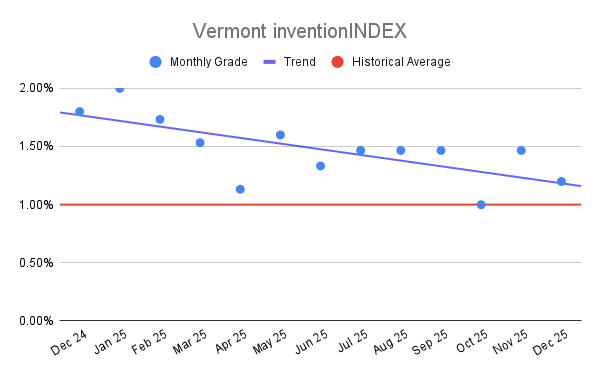 Vermont inventionINDEX December 2025:
  Vermont inventionINDEX November
