

A credit carryforward in the context of the Vermont Research and Development tax credit allows businesses to preserve unused tax credits from a current year and apply them against future tax liabilities for a period of up to ten years. This mechanism ensures that innovative entities can derive full fiscal value from their qualifying expenditures even when their immediate tax liability is insufficient to exhaust the earned credit amount.
The Statutory Origin and Legislative Context of 32 V.S.A. § 5930ii
The Vermont Research and Development (R&D) tax credit is established under the authority of 32 V.S.A. § 5930ii, a provision of the Vermont Statutes Annotated that serves as the state’s primary fiscal incentive for technological advancement. This statute was designed to create a direct link between Vermont’s tax code and the federal standards for qualified research, specifically those codified in the Internal Revenue Code (IRC) under Section 41. The evolution of this credit is marked by significant legislative shifts, most notably the transition from earlier economic advancement programs, such as those governed by the now-repealed 32 V.S.A. § 5930z.
Historically, the state of Vermont offered various R&D-related incentives through its Enterprise Zone program, but these were often localized or limited to specific geographic regions. The repeal of § 5930z in 2019 represented a consolidation of these efforts into a more uniform, statewide credit structure under § 5930ii. Effective for tax years beginning on or after January 1, 2014, the legislature adjusted the credit rate from 30 percent to the current 27 percent of the allowed federal credit amount. This adjustment reflected broader budgetary considerations while maintaining Vermont’s position as a competitive state for high-growth sectors such as biotechnology, aerospace, and software engineering.
The current statutory language of § 5930ii is structured into three primary sub-sections that define the life cycle of the credit. Subsection (a) identifies the eligibility criteria and the 27 percent rate. Subsection (b) establishes the ten-year carryforward period, providing the legal basis for the “deferred tax asset” nature of the credit. Finally, subsection (c) introduces a transparency mandate, requiring the Vermont Department of Taxes to publish an annual list of all claimants. This legislative design ensures that while the state subsidizes private innovation, it also maintains a level of public accountability and fiscal predictability.
The Federal Nexus: Conformity with IRC § 41
The integrity of the Vermont R&D tax credit is fundamentally dependent on federal tax law. Because § 5930ii explicitly “piggybacks” on the federal credit allowed under 26 U.S.C. § 41(a), Vermont does not maintain an independent set of technical standards for what constitutes “research”. Instead, the state relies on the Department of the Treasury and the Internal Revenue Service (IRS) to establish the qualitative benchmarks for innovation.
The Four-Part Test as Applied to Vermont Law
To qualify for the state credit—and by extension, the carryforward—a taxpayer’s activities must satisfy the rigorous “Four-Part Test” outlined in the federal regulations. Guidance from the Vermont Department of Taxes emphasizes that if an activity fails this federal test, it is automatically ineligible for the 27 percent state credit.
- Technological in Nature: The research must fundamentally rely on principles of the physical or biological sciences, engineering, or computer science. This excludes purely social science, artistic, or management-based studies.
- Permitted Purpose: The objective of the research must be the development of a new or improved “business component,” which can be a product, process, software, formula, or technique. The goal must be to improve functionality, performance, reliability, or quality.
- Elimination of Uncertainty: Taxpayers must demonstrate that they intended to discover information that would eliminate technical uncertainty concerning the development or improvement of a business component. This means that at the project’s outset, the taxpayer did not know the specific method or design required to achieve the goal.
- Process of Experimentation: The research must involve a systematic process of experimentation, such as testing, modeling, simulation, or trial and error. The taxpayer must be evaluating alternatives to solve the technical uncertainty identified in step three.
This federal nexus simplifies compliance for businesses that are already claiming the federal credit on IRS Form 6765. However, the state revenue office guidance clarifies that a taxpayer must be allowed the federal credit for the same tax year; if the federal credit is denied upon audit, the Vermont credit and any associated carryforwards are typically adjusted or disallowed as well.
The Proration Mechanism: Recomputing the Credit for Vermont
While the qualitative standards are federal, the quantitative application of the Vermont R&D credit is strictly localized. One of the most common misconceptions regarding the state credit is the assumption that it is a simple 27 percent multiplier of the final federal credit amount appearing on Form 6765. In reality, the state requires a re-computation of the credit based only on in-state activities.
Apportionment of Qualified Research Expenditures (QREs)
Vermont guidance requires taxpayers to isolate the portion of their federal QREs that were incurred within the physical borders of Vermont. This includes:
- Wages: Only wages paid to employees for services performed in Vermont qualify. If an employee performs research in both Vermont and another state, their wages must be prorated.
- Supplies: Only supplies consumed in Vermont for research activities are eligible.
- Contract Research: Taxpayers may include 65 percent of the costs paid to third parties for research performed in Vermont. If the contractor is a qualified research consortium, this amount may increase to 75 percent.
The Hypothetical Federal Credit Calculation
Once the Vermont-specific QREs are identified, the taxpayer must perform a “hypothetical” federal credit calculation. This involves using federal calculation methods—either the Regular Research Credit method or the Alternative Simplified Credit (ASC) method—but applying them only to the Vermont numbers.
| Calculation Component | State Revenue Office Guidance |
|---|---|
| Step 1 | Identify Vermont QREs (In-state wages, supplies, and contract research). |
| Step 2 | Determine the applicable federal base amount or prior-year average using only Vermont-sourced data. |
| Step 3 | Calculate the “excess” of current year Vermont QREs over the Vermont base. |
| Step 4 | Apply the federal statutory rate (e.g., 20% for Regular or 14% for ASC) to the excess. |
| Step 5 | Multiply the resulting “Hypothetical Federal Credit” by 27% to find the Vermont Credit. |
This re-computation ensures that the state does not subsidize innovation occurring in other jurisdictions. Furthermore, it protects the state’s fiscal stability by preventing a massive influx of credits from multinational corporations that may have minimal Vermont presence but large global R&D budgets.
Meaning and Mechanics of the Credit Carryforward
The concept of a “carryforward” is essential to the R&D credit because research expenditures often generate significant credits in the early stages of a product’s development, long before the company realizes taxable income. Without a carryforward provision, many startups and expanding manufacturers would lose the value of the credit simply because they were in a loss position during the year the innovation occurred.
Nonrefundability and the 10-Year Limitation
Under 32 V.S.A. § 5930ii(b), the Vermont R&D credit is classified as nonrefundable. In the hierarchy of tax incentives, a nonrefundable credit can reduce a taxpayer’s tax liability to zero, but it cannot result in a refund check from the Department of Taxes. Any credit amount that remains after the tax liability is neutralized is considered the “unused” portion.
The law permits this unused portion to be carried forward to the next tax year. Vermont’s ten-year window is notably generous compared to other business credits in the state. For example, the investment tax credit for solar energy is limited to a five-year carryforward, and the credit for the sale of a mobile home park is limited to three years. The extended ten-year period for R&D reflects the state’s acknowledgment of the “valley of death” in innovation, where technical success precedes financial stability by several years.
Sequence of Credit Utilization
State guidance follows the “First-In-First-Out” (FIFO) principle for credit utilization. When a taxpayer has credits available from multiple years, they are required to apply the oldest credits first. This prevents the oldest carryforwards from expiring while newer credits are consumed. If a credit is not utilized within its ten-year life cycle, it is deemed “expired” and can no longer be used to offset Vermont tax.
| Carryforward Life Cycle | Status and Action |
|---|---|
| Year of Origin (Year 0) | Credit is earned (Column B of Schedule BA-404). Offset current tax. |
| Years 1 through 9 | Credit remains available for carryforward (Column A). Applied to future tax. |
| End of Year 10 | Any remaining balance from the Year 0 credit expires and is removed from the ledger. |
Administrative Guidance: The Role of Schedule BA-404
For professional practitioners and corporate tax departments, the management of the credit carryforward is primarily a function of Schedule BA-404, “Tax Credits Earned, Applied, Expired, and Carried Forward”. This form is mandatory for any taxpayer claiming or carrying forward an R&D credit.
Completing the Carryforward Ledger
The Department of Taxes instructions for Schedule BA-404 provide a structured methodology for tracking these balances across tax years. The form uses a columnar approach to ensure mathematical accuracy:
- Column A (Amount Carried Forward from Prior Years): This represents the total balance of R&D credits from the preceding ten years that remained unused as of the last day of the prior tax period.
- Column B (Amount Earned Current Year): This is the result of the 27 percent calculation based on current-year Vermont QREs.
- Column C (Amount Applied Current Year): This is the actual amount of credit used to reduce the current year’s Vermont tax liability. This amount cannot exceed the taxpayer’s tax liability for the year.
- Column D (Amount Carried Forward to Future Years): This is the closing balance of the credit ledger. The mathematical formula for Column D is: Column A + Column B – Column C = Column D. If any credits from ten years ago were not used and have reached their expiration, they must be subtracted from this final Column D total.
The revenue office guidance also clarifies that if a company participates in multiple tax credit programs—such as the Downtown and Village Center program or the Affordable Housing program—it must complete a separate row or column for each credit type on Schedule BA-404. This ensures that credits with different expiration periods (e.g., 9 years for Downtown vs. 10 years for R&D) are not commingled.
Application to Different Entity Types
The meaning and application of the carryforward vary significantly depending on the legal structure of the business. Vermont law accommodates C-corporations, S-corporations, partnerships, and LLCs, but the path of the credit from the laboratory to the tax return follows different routes.
C-Corporations and Unitary Groups
For C-corporations, the credit is earned and used at the entity level. If the corporation is part of a “unitary relationship” with other entities, Vermont requires combined reporting. Under the combined reporting rules, the group determines its total Vermont tax liability as a single unit.
Guidance for unitary businesses (Form CO-411) states that while the group files a single Schedule BA-404, they must include an attached statement that breaks down the credits by the specific entity that generated them. This is a critical compliance detail; if a subsidiary is sold or leaves the group, its specific portion of the credit carryforward typically remains with the entity that earned it, rather than staying with the parent group, unless a specific tax-sharing agreement or state law dictates otherwise.
Pass-Through Entities (S-Corps, Partnerships, LLCs)
For pass-through entities, the R&D credit operates differently. The entity itself calculates the total credit earned based on its Vermont QREs. However, because the entity does not pay income tax at the corporate level, the credit is allocated to the individual owners (shareholders, partners, or members).
- Allocation: The credit is distributed to the owners in the same proportion that the entity’s income or loss is distributed.
- Reporting: The entity reports this allocation on Schedule BA-406 and provides each owner with a Schedule K-1VT.
- Utilization: The individual owners then claim their share of the credit on their own Vermont individual income tax return (Form IN-111).
- Individual Carryforward: If an individual’s share of the credit exceeds their personal Vermont tax liability, that individual manages the carryforward on their own personal tax return using Schedule BA-404.
This mechanism is highly beneficial for startups because it allows the R&D credits to offset the owners’ other sources of Vermont income, such as salaries from other jobs or investment income, provided the individual has Vermont income tax liability.
Revenue Office Guidance on Compliance and Transparency
The Vermont Department of Taxes provides specific guidance on the procedural requirements for maintaining eligibility for the carryforward. Because the R&D credit represents a direct reduction of state revenue, it is frequently a target for audit and verification.
Audit Guidelines and Documentation Retention
The primary focus of state audits is the “Vermont sourcing” of the credit. While the federal government might audit the technical nature of the research, Vermont audits focus on whether the wages were truly paid to Vermont employees and whether the supplies were truly used in the state.
State guidance recommends that taxpayers retain all R&D documentation for at least the entire ten-year carryforward window. If a taxpayer utilizes a carryforward in year 9 from a credit earned in year 1, the Department may theoretically request documentation from year 1 to prove the credit’s validity.
- Employee Logs: Taxpayers should keep contemporary records showing the hours spent by each employee on specific R&D projects.
- Project Descriptions: Detailed technical narratives that support the Four-Part Test must be readily available.
- Federal Forms: A copy of the federal Form 6765 must be attached to the state return to verify the federal “allowed” status.
The Annual Transparency List
A unique feature of Vermont’s R&D tax credit guidance is the mandatory public disclosure. Under 32 V.S.A. § 5930ii(c), the Department of Taxes is required to publish annually a list of all taxpayers who claimed the credit during the most recent calendar year.
This list serves several administrative and public policy purposes:
- Public Oversight: It allows citizens and policymakers to see which companies are benefiting from the state’s tax incentives.
- Verification: It provides a public record that can be checked against other state development grants or contracts to ensure no duplication or violation of other state regulations.
- Benchmarking: It allows businesses to understand the landscape of innovation in the state, although the specific R&D project details remain confidential.
Example Calculation: Multi-Year Generation and Carryforward
To provide a concrete understanding of how the law and guidance apply, we examine a hypothetical scenario for “Green Mountain Aerospace,” a C-corporation headquartered in South Burlington, VT.
Scenario Background
Green Mountain Aerospace conducts all its research in Vermont. In 2024, it engaged in a major design project for carbon-fiber wing structures.
- 2024 Vermont QREs: $2,000,000.
- Federal Credit Method: ASC (Alternative Simplified Credit).
- Federal Prior 3-Year QRE Average: $1,500,000.
- Calculated Federal Credit (Vermont Only):
- Base = 50% of $1.5M = $750,000.
- Incremental QRE = $2,000,000 – $750,000 = $1,250,000.
- Hypothetical Federal Credit = $1,250,000 × 14% = $175,000.
Determining the Vermont Credit Earned
Following the guidance of § 5930ii(a), the Vermont credit is 27 percent of the hypothetical federal credit.
Vermont Credit = $175,000 × 0.27 = $47,250
Applying the Credit to Tax Liability
For the 2024 tax year, Green Mountain Aerospace has a Vermont corporate income tax liability of $10,000.
- Total Credit Available: $47,250.
- Amount Applied (Column C, Schedule BA-404): $10,000.
- Remaining Credit (Column D, Schedule BA-404): $37,250.
Managing the Carryforward over Time
The company anticipates reaching full production in 2026. The carryforward is tracked as follows:
| Tax Year | Opening Carryforward | Current Credit Earned | Tax Liability | Credit Applied | Closing Carryforward |
|---|---|---|---|---|---|
| 2024 | $0 | $47,250 | $10,000 | $10,000 | $37,250 |
| 2025 | $37,250 | $0 | $5,000 | $5,000 | $32,250 |
| 2026 | $32,250 | $0 | $40,000 | $32,250 | $0 |
In 2026, the company was able to wipe out $32,250 of its $40,000 tax liability using the carryforward from 2024. This resulted in a net tax payment of only $7,750, demonstrating the significant cash-flow benefit of the carryforward.
Comparative Analysis of Credit Carryforwards in Vermont
The Vermont R&D tax credit exists within a broader ecosystem of tax incentives, each with its own carryforward rules and limitations. Understanding the relative strength of the R&D carryforward is essential for corporate tax planning.
| Credit Name | Statutory Reference | Carryforward Period | Refundability |
|---|---|---|---|
| Research & Development | 32 V.S.A. § 5930ii | 10 Years | Nonrefundable |
| Affordable Housing | 32 V.S.A. § 5930u | 14 Years | Nonrefundable |
| Downtown & Village Center | 32 V.S.A. § 5930cc | 9 Years | Nonrefundable |
| Machinery & Equipment | 32 V.S.A. § 5930ll | Repealed/Varies | Nonrefundable |
| Mobile Home Park Sale | 32 V.S.A. § 5930cc(d) | 3 Years | Nonrefundable |
| Investment Tax Credit | 32 V.S.A. § 5930ii | 5 Years (Solar) | Nonrefundable |
The ten-year carryforward for R&D is the second longest in the state, surpassed only by the Affordable Housing credit. This long window is a strategic decision by the Vermont legislature to support industries with long gestation periods, such as life sciences and advanced manufacturing.
Strategic Implications for Taxpayers
The interaction between the R&D credit and the carryforward mechanism creates several strategic opportunities and risks for Vermont taxpayers. Because the credit is derived from the federal calculation, any strategy used to maximize the federal R&D credit will have a direct, 27 percent impact on the Vermont credit and the subsequent carryforward.
Look-Back Studies and Prior Year Credits
Guidance from the Department of Taxes allows for “look-back” studies to identify unclaimed credits for prior tax years. Generally, a taxpayer can amend their returns for the last three or four open tax years to claim R&D credits that were previously overlooked.
For example, if a company identifies $100,000 in missed Vermont credits from 2021, 2022, and 2023, they can amend their returns to generate these credits. Even if the company had no tax liability in those years, the credits will immediately enter the carryforward “bank” on Schedule BA-404, providing a ten-year window from the original year of the expenditure to offset future taxes.
Impact of Mergers and Acquisitions
The treatment of carryforwards during business restructuring is a complex area of Vermont tax law. Generally, when a corporation is acquired in a tax-free reorganization, its tax attributes—including the R&D credit carryforward—may transfer to the acquiring entity, subject to federal limitations such as those found in IRC Section 382. However, the state revenue office guidance emphasizes that the credit must still be used against the tax liability of the entity that is essentially a continuation of the business that earned the credit.
Final Thoughts: The Long-Term Value of the Carryforward
The Vermont Research and Development tax credit, governed by 32 V.S.A. § 5930ii, represents a powerful tool for businesses committed to local innovation. By aligning state incentives with federal IRC § 41 standards and providing a robust ten-year carryforward, Vermont offers a predictable and supportive fiscal environment for high-growth sectors.
The essence of the carryforward is fiscal preservation. It ensures that the technical labor of today becomes the tax savings of tomorrow, provided that the taxpayer adheres to the rigorous documentation and reporting standards set forth by the Vermont Department of Taxes. For professional practitioners, the key to maximizing this value lies in precise re-computation of Vermont-only QREs, diligent maintenance of the BA-404 ledger, and a strategic understanding of how these credits flow through unitary and pass-through structures. As Vermont continues to position itself as a hub for technology and manufacturing in the Northeast, the R&D carryforward remains the cornerstone of its corporate tax incentive portfolio.





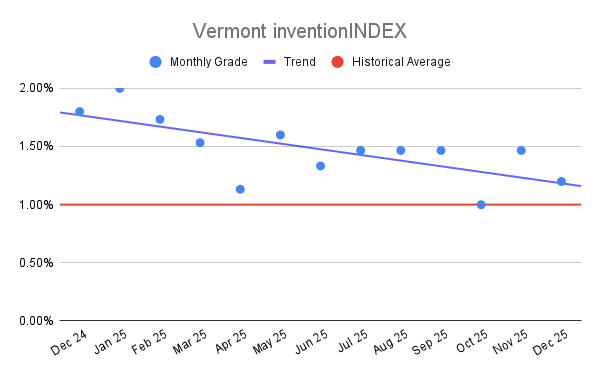 Vermont inventionINDEX December 2025:
  Vermont inventionINDEX November
