

Pass-through entity credit allocation in Vermont is the statutory process by which the Vermont Research and Development (R&D) Tax Credit is distributed to individual shareholders, partners, or members. Entities such as S-corporations and partnerships do not claim the credit directly; instead, they calculate a credit equal to 27% of federal qualified research expenditures made within Vermont and pass it through to owners via Schedule BA-406. Owners then apply this nonrefundable credit against their personal Vermont income tax liability using Form IN-111.
Pass-through entity credit allocation signifies the statutory process by which tax incentives generated at the business level are distributed to individual or corporate owners based on their proportional interest. In the context of the Vermont Research and Development tax credit, this mechanism allows businesses like S-corporations and partnerships to pass a credit equal to 27% of their federal research expenditures made within the state directly to their shareholders, partners, or members.
Theoretical and Statutory Foundations of the Credit Pass-Through Mechanism
The concept of the pass-through entity serves as a fundamental pillar of American and Vermont tax jurisprudence, operating on the principle that certain business structures should not be treated as separate taxable entities from their owners. Instead, these organizations—comprising Subchapter S corporations, general and limited partnerships, and limited liability companies—function as conduits for the transmission of income, losses, and, most critically for this analysis, tax credits. The Vermont Department of Taxes recognizes this transparency to ensure that the economic incentives intended to drive specific activities, such as technological innovation, reach the ultimate stakeholders who bear the financial risk of the enterprise.
The legal authorization for the Vermont Research and Development (R&D) Tax Credit is found in 32 V.S.A. § 5930ii. This statute explicitly defines the eligibility and magnitude of the credit, stating that a taxpayer of the state shall be entitled to a credit against the tax imposed in an amount equal to 27% of the federal tax credit allowed under 26 U.S.C. § 41(a) for eligible research and development expenditures made specifically within Vermont. For pass-through entities, the “taxpayer” mentioned in the statute is effectively the group of individual owners, as the entity itself generally pays only a minimum tax of $250 while the substantive tax liability resides with the shareholders or partners.
The allocation of this credit is governed by the broader rules of pass-through taxation, which dictate that tax attributes must follow the distributive share of the entity’s income or loss. If an entity is engaged in qualified research activities in Vermont, it does not “consume” the credit itself but rather documents the amount earned and notifies its owners of their respective portions. This ensures that the incentive remains functional regardless of the business structure chosen by the taxpayer, fostering a neutral environment for investment in the state’s burgeoning tech and manufacturing sectors.
Comprehensive Analysis of Qualified Research Activities and Vermont Sourcing
For a pass-through entity to successfully allocate an R&D credit, the underlying activities must first satisfy the rigorous definitions of “qualified research” established at the federal level and adapted for Vermont’s jurisdiction. Vermont law mirrors the federal Internal Revenue Code (IRC) Section 41, which utilizes a mandatory “four-part test” to distinguish between routine business activities and genuine innovation.
The first criterion is that the research must be intended to discover information that would eliminate technical uncertainty concerning the development or improvement of a business component. The second requirement mandates that the research includes a process of experimentation, involving testing, modeling, simulating, and systematic trial and error to evaluate one or more alternatives. Thirdly, the activity must be technological in nature, fundamentally relying on the principles of physical science, biological science, engineering, or computer science. Finally, the research must have a permitted purpose, aimed at improving the functionality, performance, reliability, or quality of a new or existing product, process, formula, or software.
While the qualitative definition of research is federal, the quantitative basis for the Vermont credit is strictly geographical. Only qualified research expenditures (QREs) conducted within the borders of Vermont are eligible for the 27% state multiplier. This requirement imposes a significant administrative burden on pass-through entities, particularly those with multi-state operations. Entities must identify and isolate specific Vermont-sourced data, which includes wages paid to employees for research performed in Vermont, supplies consumed in the state during research, and a percentage of contract research costs for services rendered within Vermont boundaries.
| Expense Category | Federal Treatment (IRC § 41) | Vermont Allocation (32 V.S.A. § 5930ii) |
|---|---|---|
| In-House Wages | 100% of qualified employee time | Only for services performed within Vermont |
| Research Supplies | 100% of non-depreciable supplies | Only for items used in Vermont R&D |
| Contract Research | 65% of payments to third parties | Only for research performed in Vermont |
| Research Consortia | 75% of payments | Only for Vermont-based activities |
| Computer Leasing | 100% of lease costs for R&D | Only for equipment physically in Vermont |
The distinction between total federal QREs and Vermont-specific QREs is the catalyst for a “hypothetical” federal credit calculation. Vermont revenue office guidance dictates that a taxpayer must recompute what their federal credit would have been if only their Vermont expenses were considered. This recomputation is necessary because the federal credit is based on incremental increases above a base amount, and applying a flat 27% to the total federal credit would unfairly include research conducted in other states.
The Role of Revenue Office Guidance and Technical Bulletins
The Vermont Department of Taxes provides extensive guidance on the practical application of credit allocation through administrative rules and technical bulletins. Technical Bulletin 06 is particularly relevant, as it outlines the obligations of S-corporations, partnerships, and LLCs to make estimated payments on behalf of nonresident owners. This bulletin establishes the nexus between the entity’s income and the owner’s final tax liability, creating a procedural bridge for the application of credits.
Revenue office guidance emphasizes that businesses must utilize Form BI-471, the Business Income Tax Return, as the primary vehicle for reporting their activity. For entities involved in R&D, this filing must be accompanied by Schedule BA-404, which tracks the credits earned, applied, and carried forward. The department requires a detailed breakdown of expenditures on Schedule RD, a supplemental form designed specifically for the R&D credit to isolate the Vermont-only portion of the federal basis.
A critical shift in guidance occurred in recent years concerning apportionment. Starting in 2023, Vermont moved to a “single sales factor” calculation for pass-through entities, a departure from the traditional three-factor formula of property, payroll, and sales. This change, reflected in the instructions for Schedule BI-477 (which replaced BA-402), simplifies the process for many businesses but complicates it for others, especially when determining how research-related income is sourced to the state for the purpose of defining the “taxable income” that the R&D credit is ultimately meant to offset.
Furthermore, the Department of Taxes has highlighted the importance of basis adjustments in its “Compliance Corner.” A notable example involves the disallowance of federal “bonus depreciation” under IRC Section 168(k). Because Vermont does not conform to federal bonus depreciation for personal income tax, pass-through entities must provide specific adjustment amounts to their owners so they can manually correct their Vermont income returns. While not directly an R&D credit rule, these adjustments are crucial for owners to accurately calculate the net tax liability against which the R&D credit will be applied.
Procedural Mechanics of Allocation: BA-404 and BA-406
The actual transfer of the tax credit from the entity to the owner is a multi-step filing process. It begins with the entity documenting its total credit on Schedule BA-404. This schedule serves as a ledger for the entity’s tax credits, requiring the user to report credits carried forward from prior years, credits earned in the current year, and any credits that may have expired. Because the R&D credit has a 10-year carryforward period, the BA-404 is vital for maintaining the continuity of the incentive over a decade of business cycles.
Once the total earned credit is calculated on BA-404, the entity must allocate this total among its owners using Schedule BA-406, the Credit Allocation Schedule. The department requires the filing of a separate BA-406 for every individual shareholder, partner, or member who is receiving a portion of the credit. This form acts as the legal notice to the state that a specific portion of the entity’s earned incentive has been transferred to a specific individual’s tax ID.
| Form Number | Title | Function in R&D Credit Allocation |
|---|---|---|
| BA-404 | Tax Credits Earned, Applied, Expired | Calculates and tracks the entity’s total R&D credit |
| BA-406 | Credit Allocation Schedule | Assigns specific dollar amounts to each owner |
| Schedule RD | R&D Supplemental Schedule | Recomputes federal credit using Vermont-only QREs |
| K-1VT | Shareholder/Partner Info | Provides the owner with the final credit amount for their return |
| BI-471 | Business Income Tax Return | The master return that anchors all other schedules |
The allocation must be done pro-rata. For example, if a partnership has two equal partners, each must receive 50% of the credit. Vermont does not typically allow for “special allocations” of tax credits that deviate from the distribution of income and loss, a restriction designed to prevent the selling or trading of credits between individuals with differing tax appetites. The Department of Taxes verifies these allocations by reconciling the totals on the individual owners’ returns with the master BA-404 filed by the entity.
Application to Individual and Corporate Tax Liability
For the individual owner of a pass-through entity, the R&D credit is applied on their personal income tax return, Form IN-111, using Schedule IN-112 or Schedule IN-119. The credit is nonrefundable, meaning it cannot reduce the taxpayer’s liability below zero or result in a cash refund from the state. Instead, any amount of the allocated credit that exceeds the individual’s Vermont tax liability in the current year is carried forward for up to 10 years to offset future income.
Nonresident owners face additional compliance layers. Because they are receiving income from a Vermont source, they are generally required to file a Vermont nonresident return. The credit allocated to them via the pass-through entity serves to offset the tax they owe on that specific Vermont income. If the entity files a composite return (Form BI-473), the credit is applied at the entity level against the aggregate tax owed for all nonresident members. However, even in a composite filing, the credit cannot reduce the tax below the $250 minimum.
The interaction between the credit and the owner’s tax liability can be summarized by the following equation:
$$T_{final} = \max(T_{base} – C_{applied}, 0)$$
Where:
- $T_{final}$ is the final tax due.
- $T_{base}$ is the pre-credit Vermont tax liability attributable to the income.
- $C_{applied}$ is the amount of the allocated R&D credit used in the current year, which is limited by the $T_{base}$ and the 10-year expiration window.
Detailed Case Study: Precision Bio-Analytics LLC
To ground these theoretical concepts in practice, consider the case of Precision Bio-Analytics LLC, a multi-state laboratory headquartered in Burlington, Vermont. The entity is structured as a partnership with four partners, each holding a 25% interest.
Step 1: Expense Identification and Sourcing
During the 2024 tax year, Precision Bio-Analytics LLC spends $2,000,000 on qualified research activities. Their internal tracking, necessitated by Vermont revenue guidance, reveals that 75% of these activities ($1,500,000) occurred in their Burlington lab, while the remaining 25% took place in a satellite facility in New Hampshire. The $1,500,000 in Vermont QREs consists of:
- $1,100,000 in wages for scientists residing and working in Vermont.
- $300,000 in specialized reagents and lab supplies purchased and used in Vermont.
- $100,000 in contract research for clinical testing performed by a Vermont university.
Step 2: Calculating the Hypothetical Federal Credit
The firm first calculates its federal R&D credit on its total $2,000,000 in expenses. Using the federal Alternative Simplified Credit (ASC) method, they determine their total federal credit is $120,000. However, for the Vermont filing, they must re-run the ASC formula using only the $1,500,000 in Vermont-specific QREs. This recomputation results in a hypothetical federal credit of $90,000.
Step 3: Determining the Vermont Credit Amount
Precision Bio-Analytics LLC applies the Vermont statutory rate of 27% to this hypothetical federal base:
$$C_{VT} = \$90,000 \times 0.27 = \$24,300$$
Step 4: Credit Allocation to Partners
The entity files its Form BI-471 and attaches Schedule BA-404 showing $24,300 in credits earned. It then prepares four separate BA-406 forms, one for each partner. Since each partner holds a 25% interest, the allocation is:
$$\$24,300 \times 0.25 = \$6,075 \text{ per partner}$$
Step 5: Final Tax Impact
Partner A is a Vermont resident. When filing her Form IN-111, her total Vermont tax liability is $10,000. She applies her $6,075 credit, reducing her final tax to $3,925.
Partner B is a nonresident. The entity has already withheld estimated taxes on his behalf using Form WH-435 at the 6.6% rate. When Partner B files his nonresident return, he uses the $6,075 credit to offset his liability and applies the WH-435 payments as a credit against the remaining balance, likely resulting in a refund of the over-withheld amount.
Audit Risks and Documentation Compliance
Because of the high value of the Vermont R&D credit—which ranks among the top prorated rates in the United States—the Department of Taxes maintains a rigorous audit environment. Pass-through entities are particularly vulnerable during audits because they must not only prove the quality of the research but also the accuracy of the geographic proration.
Auditors typically request payroll records that clearly distinguish between research and non-research tasks, as well as contemporaneous documentation proving the physical location where the research was performed. For a pass-through entity, this means that if an employee works remotely from another state, their wages may be disqualified from the Vermont base even if the company is headquartered in Vermont.
Documentation must be retained for at least as long as the 10-year carryforward period plus the statute of limitations, which often totals 13 to 15 years. Revenue office guidelines suggest that taxpayers who fail to maintain project-level records that align with the federal “four-part test” risk a full disallowance of the state credit, which would then flow through to each owner’s individual tax return, triggering multiple audits and potential interest and penalties for the individual partners or shareholders.
Legislative Trends and Future Outlook
The landscape of pass-through entity taxation in Vermont is currently in a state of flux due to federal limitations on the state and local tax (SALT) deduction. Since 2018, individual taxpayers have been limited to a $10,000 deduction for state taxes on their federal returns. In response, 36 states have enacted “SALT cap workarounds” by allowing pass-through entities to pay tax at the entity level, which is then deductible for federal purposes.
In Vermont, this was the primary focus of Senate Bill 45 (S.45) in the 2023-2024 session. The bill proposed an elective entity-level tax that would have allowed for such a workaround, potentially shifting the application of credits like the R&D credit from the individual level back to the entity level. Although S.45 passed the Senate, it was not enacted before the session adjourned on May 12, 2024.
However, omnibus tax legislation signed by Governor Phil Scott in May 2025 updated Vermont’s conformity to the IRC as of December 31, 2024, signaling continued alignment with federal standards while the state continues to evaluate the fiscal impact of a potential pass-through entity tax. For practitioners, this means that the current “flow-through” model of credit allocation remains the law of the land for the 2025 and 2026 tax years, requiring continued focus on individual-level reporting and pro-rata distribution.
Final Thoughts
The allocation of the Vermont Research and Development tax credit for pass-through entities is a sophisticated process that demands a deep understanding of both federal innovation standards and state-specific sourcing requirements. By allowing the 27% state credit to flow directly to owners, Vermont creates a potent incentive for capital-intensive technical ventures. However, this power is balanced by strict compliance mandates, including the necessity of a hypothetical federal recomputation, pro-rata allocation via BA-406, and rigorous geographic documentation. As Vermont continues to modernize its tax code through single-sales factor apportionment and potential future entity-level tax options, the role of the pass-through entity as a conduit for innovation remains a central feature of the state’s economic strategy. Taxpayers and their advisors must remain vigilant in their documentation and filing procedures to ensure that these valuable incentives are successfully captured and defended in an increasingly complex regulatory environment.
Who We Are:
Swanson Reed is one of the largest Specialist R&D Tax Credit advisory firm in the United States. With offices nationwide, we are one of the only firms globally to exclusively provide R&D Tax Credit consulting services to our clients. We have been exclusively providing R&D Tax Credit claim preparation and audit compliance solutions for over 30 years. Swanson Reed hosts daily free webinars and provides free IRS CE and CPE credits for CPAs.
Are you eligible?

Why choose us?

Pass an Audit?

What is the R&D Tax Credit?
The Research & Experimentation Tax Credit (or R&D Tax Credit), is a general business tax credit under Internal Revenue Code section 41 for companies that incur research and development (R&D) costs in the United States. The credits are a tax incentive for performing qualified research in the United States, resulting in a credit to a tax return. For the first three years of R&D claims, 6% of the total qualified research expenses (QRE) form the gross credit. In the 4th year of claims and beyond, a base amount is calculated, and an adjusted expense line is multiplied times 14%. Click here to learn more.
Never miss a deadline again

Stay up to date on IRS processes

Discover R&D in your industry

R&D Tax Credit Preparation Services
Swanson Reed is one of the only companies in the United States to exclusively focus on R&D tax credit preparation. Swanson Reed provides state and federal R&D tax credit preparation and audit services to all 50 states.
If you have any questions or need further assistance, please call or email our CEO, Damian Smyth on (800) 986-4725.
Feel free to book a quick teleconference with one of our national R&D tax credit specialists at a time that is convenient for you.
R&D Tax Credit Audit Advisory Services
creditARMOR is a sophisticated R&D tax credit insurance and AI-driven risk management platform. It mitigates audit exposure by covering defense expenses, including CPA, tax attorney, and specialist consultant fees—delivering robust, compliant support for R&D credit claims. Click here for more information about R&D tax credit management and implementation.
Our Fees
Swanson Reed offers R&D tax credit preparation and audit services at our hourly rates of between $195 – $395 per hour. We are also able offer fixed fees and success fees in special circumstances. Learn more at https://www.swansonreed.com/about-us/research-tax-credit-consulting/our-fees/



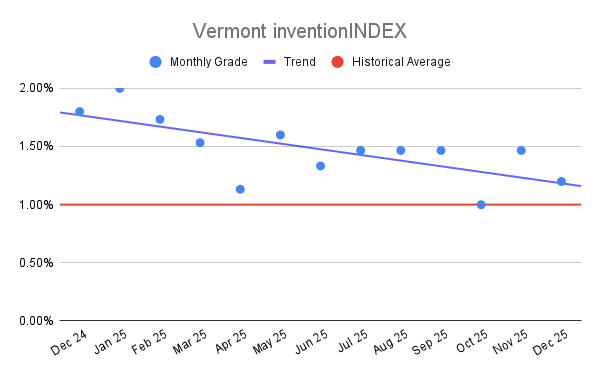 Vermont inventionINDEX December 2025:
  Vermont inventionINDEX November
