

The ten-year carryforward period for the Vermont Research and Development tax credit allows taxpayers to apply unused credits from previous years against their state income tax liability for up to a decade after the credit was initially earned. This mechanism ensures that businesses making significant qualifying investments in innovation can eventually realize the full fiscal value of those expenditures, even if they lack sufficient tax liability in the immediate years following the research activity.
The provision is fundamentally designed to bridge the temporal gap between the heavy capital outflows required for early-stage research and the eventual revenue generation that yields a taxable net income. In the landscape of state-level fiscal incentives, the ten-year window serves as a vital financial asset, particularly for sectors such as biotechnology, aerospace, and advanced manufacturing, where the research and development (R&D) cycle often spans several years before a product reaches commercial viability. By permitting this extension, the Vermont legislature effectively lowers the long-term cost of capital for firms that anchor their intellectual property development within the state.
Statutory Foundations and Legislative Intent of 32 V.S.A. § 5930ii
The primary legal authority for the Vermont Research and Development tax credit is codified in 32 V.S.A. § 5930ii. This statute was established to encourage business investment in research and development within Vermont and to attract and retain intellectual-property-based companies. The law explicitly states that a taxpayer of the state is eligible for a credit against their income tax in an amount equal to 27 percent of the federal tax credit allowed under 26 U.S.C. § 41(a) for expenditures made within Vermont.
The carryforward provision itself is found in subsection (b) of the statute, which mandates that any unused credit available may be carried forward for up to 10 years. This legislative language is concise but carries broad implications for tax planning and corporate financial reporting. Unlike certain other credits that may have shorter windows—such as the three-year carryforward for the Qualified Sale of a Mobile Home Park Credit—the R&D credit offers a substantial runway.
| Statutory Attribute | Legal Specification | Source Reference |
|---|---|---|
| Credit Rate | 27% of the federal credit amount attributable to Vermont QREs | 1 |
| Eligibility Criteria | Must be eligible for the federal credit under IRC § 41 | 1 |
| Carryforward Length | Up to 10 years following the tax year the credit was earned | 1 |
| Refundability | Nonrefundable; cannot exceed total tax liability | 1 |
| Transparency | Public disclosure of claimant names required annually | 1 |
The evolution of the statute reflects changes in the state’s fiscal priorities. Prior to January 1, 2014, the credit was set at a 30 percent rate. The reduction to 27 percent was a targeted adjustment intended to balance the state budget while remaining highly competitive with neighboring jurisdictions. Despite this reduction, the ten-year carryforward remained a constant feature, underscoring its role as the primary stabilization mechanism for the incentive.
The Meaning of the Carryforward in Financial and Accounting Terms
In the context of corporate finance, a tax credit carryforward is a deferred tax asset. For a Vermont-based firm, the R&D carryforward represents a future reduction in cash outflows for taxes. The ten-year period defines the expiration horizon of this asset. If the credit is not utilized within this timeframe, the asset must be written off, representing a permanent loss of the incentive’s value.
The nonrefundable nature of the credit is the reason the carryforward exists. Nonrefundable credits can only reduce a taxpayer’s liability to zero; they cannot result in a payment from the state to the taxpayer. Therefore, for a startup company with no revenue, an R&D credit earned in Year 1 is essentially locked in the carryforward account until the company generates a profit in later years.
First-In, First-Out (FIFO) Application
The Vermont Department of Taxes adheres to a First-In, First-Out (FIFO) principle for the application of carryforward credits. This means that when a taxpayer has credits available from multiple years, the oldest credits are applied first to the current year’s tax liability. This administrative convention is vital because it minimizes the risk of credits expiring.
| Credit Year | Amount Earned | Expiration Year | Application Priority |
|---|---|---|---|
| 2024 | $50,000 | 2034 | 1st |
| 2025 | $45,000 | 2035 | 2nd |
| 2026 | $60,000 | 2036 | 3rd |
If a taxpayer has a $70,000 liability in 2026, they would first use the entire $50,000 from the 2024 tranche and then $20,000 from the 2025 tranche. The remaining $25,000 from 2025 and the entire $60,000 from 2026 would carry forward.
Federal Conformity and the Hypothetical Credit Calculation
The Vermont R&D credit is unique because it is a derivative credit. It does not exist independently of the federal credit for increasing research activities governed by Internal Revenue Code (IRC) Section 41. To understand the carryforward, one must understand how the credit is initially computed.
The Recomputation Requirement
Vermont revenue office guidance, specifically found in the instructions for Schedule BA-404, requires taxpayers to perform a recomputation if their research activities occur both inside and outside of Vermont. A taxpayer cannot simply take 27 percent of the total federal credit reported on IRS Form 6765 unless 100 percent of their qualified research expenditures (QREs) were incurred in Vermont.
Instead, the taxpayer must isolate their Vermont-only QREs and then calculate a hypothetical federal credit as if those were the only expenditures made. This involves:
- Identifying Vermont-specific wages for employees performing research within the state.
- Identifying supplies consumed in research within Vermont.
- Calculating 65% of contract research for services performed in Vermont.
- Applying either the Regular Research Credit method or the Alternative Simplified Credit (ASC) method to these Vermont-only figures.
Once this hypothetical federal credit is determined, the 27 percent Vermont rate is applied to arrive at the state credit for the year. The unused portion of this specific annual amount is what enters the ten-year carryforward cycle.
Federal Method Consistency
Vermont guidance specifies that a taxpayer must use the same calculation method (Regular or ASC) for the state credit that they used for their federal return. This ensures consistency and simplifies the audit process for the Department of Taxes. If a company elects the ASC method federally—which typically provides a credit equal to 14 percent of the difference between current-year QREs and 50 percent of the average QREs for the three preceding years—they must use that same logic for their Vermont hypothetical calculation.
Administrative Guidance: Navigating Department of Taxes Forms
The operationalizing of the ten-year carryforward is managed through a suite of forms provided by the Vermont Department of Taxes. Professional compliance requires a nuanced understanding of these documents.
Schedule BA-404: The Credit Tracker
Schedule BA-404, titled Tax Credits Earned, Applied, Expired, and Carried Forward, is the definitive ledger for a company’s R&D tax assets. This form must be attached to the income tax return whenever a credit is earned, used, or carried over.
The form structure is designed to provide a transparent audit trail of the ten-year period:
- Column A (Amount Carried Forward from Prior Years): This column represents the sum of all unused R&D credits from the preceding ten years. For a 2024 filing, this would include tranches from 2014 through 2023.
- Column B (Amount Earned Current Year): This is the result of the 27 percent hypothetical calculation for the current tax year.
- Column C (Amount Applied Current Year): This is the portion used to offset the current year’s liability. It cannot exceed the total tax due.
- Column D (Amount Carried Forward to Future Years): This is the ending balance. Crucially, the instructions state that if a credit expires (passes its 10th year), it must be deducted from this total and reported as expired.
Apportionment and Schedule BA-402
For businesses with activity outside Vermont, Schedule BA-402 (Apportionment and Allocation Schedule) is required. While the R&D credit itself is based on specific in-state QREs, the overall tax liability against which the carryforward is applied is determined by the company’s apportioned Vermont income.
Guidance for unitary groups—multiple corporations filing as a single entity—indicates that while the credits are generated by specific members, they are generally applied against the group’s combined Vermont tax liability. This provides an advantage for large organizations, as a profit in one Vermont subsidiary can be offset by R&D credits generated by a different subsidiary that may be in a research-intensive, loss-making phase.
Detailed Analysis of Pass-Through Entity Treatment
A significant portion of Vermont businesses are organized as pass-through entities, such as S-corporations, Partnerships, or Limited Liability Companies (LLCs). For these entities, the R&D credit and its ten-year carryforward follow a distinct flow-through path.
Credit Allocation to Owners
The R&D credit is calculated at the entity level but is not used by the entity. Instead, it is allocated to the owners based on their distributive share of the business. The entity reports this allocation on Schedule K-1VT.
The individual owners then claim the credit on their personal income tax returns (Form IN-111). If an owner’s personal Vermont tax liability is less than their share of the credit, the ten-year carryforward period applies at the individual level.
| Entity Type | Reporting Level | Carryforward Tracker |
|---|---|---|
| C-Corporation | Entity (CO-411) | Entity-level BA-404 |
| S-Corporation | Individual (IN-111) | Individual-level BA-404 |
| Partnership | Individual (IN-111) | Individual-level BA-404 |
| Unitary Group | Combined (CO-411) | Group-level BA-404 |
Strategic Implications for Nonresident Owners
For nonresident owners of Vermont pass-through entities, the R&D credit is particularly valuable. Since Vermont taxes nonresidents on their Vermont-sourced income, the R&D credit can offset the tax liability generated by the very business performing the research. If the nonresident owner has no other Vermont income and the business is not yet profitable, the owner must still file a Vermont return to claim the credit and start the ten-year carryforward clock. Failing to file in the year the credit is earned may result in the loss of that year’s tranche.
Economic Rationale: Why Ten Years and Not Twenty?
The discrepancy between the Vermont ten-year carryforward and the federal twenty-year carryforward is a point of frequent debate in tax policy. Understanding this difference is essential for long-term financial planning.
The federal 20-year window, established by the Taxpayer Relief Act of 1997, was intended to provide a nearly permanent incentive for large-scale, long-cycle industrial innovation. Vermont’s choice of ten years represents a compromise between providing a meaningful incentive and protecting the state’s long-term revenue predictability. From a revenue office perspective, carryforwards are unfunded liabilities. If thousands of companies were allowed to carry forward credits for 20 years, the state would face significant uncertainty in its future tax collections.
For high-tech sectors, the ten-year limit creates a commercialization deadline. A company has roughly a decade to take its research from the lab to a point of profitability where it can utilize the tax assets. If a pharmaceutical drug takes 12 years to clear FDA hurdles and reach market, the credits earned in years one and two will expire before they can ever be used to offset the tax on the resulting profits.
Audit Risks and Extended Record Retention
The ten-year carryforward period fundamentally alters the statute of limitations for tax audits. While a standard audit might only look back three to four years, the existence of a carryforward allows the Department of Taxes to examine the records of the year in which the credit was earned, even if that was nine years ago.
Documentation Standards
Vermont revenue office guidance emphasizes that taxpayers must retain documentation for as long as the carryforward is active. If a company uses a credit in 2030 that was earned in 2021, the Department may request the 2021 payroll records to verify the QREs.
Essential documentation that must survive the ten-year window includes:
- Contemporaneous Project Records: Documents that show the research was intended to eliminate technical uncertainty and involved a process of experimentation.
- Time Tracking and Payroll: Evidence that specifically links employee wages to the qualified research activities performed in Vermont.
- General Ledger Detail: Line-item expenses for supplies and contract research, often requiring a look-back study if the credits were not claimed originally.
- Federal Form 6765: A copy of the federal filing for each year a credit was earned, as Vermont’s credit is legally tied to the federal allowance.
Comparative Analysis with Other Vermont Credits
The ten-year carryforward for R&D is one of the more generous timelines in the Vermont tax code. Comparing it to other credits highlights its significance as a targeted industry incentive.
| Credit Type | Carryforward Duration | Key Limitation |
|---|---|---|
| R&D Tax Credit | 10 Years | Must be VT-based QREs |
| Affordable Housing | 14 Years | Limited to $400k/year statewide |
| Seed Capital Fund | 4 Years | Capped at 50% of tax liability |
| Investment Tax Credit | 0 Years (except Solar) | Only available in year earned |
| Solar Energy Credit | 5 Years | Must be federal eligible |
The Affordable Housing credit offers a longer window (14 years), but it is a highly regulated, application-based credit with an aggregate state cap. In contrast, the R&D credit is an entitlement credit; if a taxpayer meets the criteria and performs the research, they are entitled to the credit without a separate state application or cap. This makes the ten-year carryforward the primary mechanism for managing the fiscal impact on the state treasury.
Transparency and Public Reporting Requirements
One unique aspect of Vermont’s R&D tax credit guidance is the transparency requirement mandated by 32 V.S.A. § 5930ii(c). Every year, by January 15, the Department of Taxes must publish a list of all taxpayers who claimed the credit in the previous year.
This transparency serves several functions:
- Public Oversight: It allows citizens and legislators to see which companies are benefiting from the state’s tax expenditures.
- Compliance Incentive: The knowledge that the company’s name will be on a public list of claimants can deter overly aggressive or fraudulent claims.
- Economic Benchmarking: It provides data on which industries (e.g., software, manufacturing, biotech) are most active in Vermont’s R&D sector.
For a company managing a carryforward, this means their name may appear on the public list for the year they earn the credit and again for every year they apply a portion of that carryforward to their tax liability.
The Hypothetical Federal Credit Formula
To accurately calculate the amount entering the carryforward, one must master the math of the hypothetical credit. The formula for the Vermont R&D credit can be expressed as a function of the federal credit calculated using only Vermont expenditures.
Case Study Example: Green Mountain Aerospace
Consider a mid-sized aerospace component manufacturer located in Rutland, Vermont. In 2024, the company engages in a major project to develop a new fuel-efficient turbine.
Scenario Data:
- Total Federal QREs: $5,000,000 (including facilities in Vermont and Texas)
- Vermont-Specific QREs: $2,000,000
- Federal Calculation Method: Alternative Simplified Credit (ASC)
- 2024 Vermont Tax Liability: $10,000
Step 1: Calculate the Hypothetical Federal Credit for Vermont
Assuming the company’s three-year average of Vermont QREs was $1,000,000. Under the ASC method, the federal credit is 14% of the amount by which current QREs exceed 50% of the average.
Step 2: Calculate the Vermont State Credit
Apply the 27% state rate to the hypothetical federal amount. For example, if the hypothetical federal credit is $210,000, the Vermont credit would be $56,700.
Step 3: Apply the Credit and Establish the Carryforward
The company applies the credit to its $10,000 liability.
- Current Tax Paid: $0 (Credit offsets the full $10,000)
- Unused Credit: $56,700 – $10,000 = $46,700
- Carryforward Amount: $46,700 enters the 10-year carryforward pool.
Step 4: Year-over-Year Tracking
In 2025, the company earns another $30,000 in credits. Its tax liability is $20,000.
Following FIFO rules, it uses $20,000 of the 2024 carryforward.
- Remaining 2024 Carryforward: $46,700 – $20,000 = $26,700 (Expires in 2034)
- New 2025 Carryforward: $30,000 (Expires in 2035)
- Total Tax Asset: $56,700
| Year | Credit Earned | Applied | Remaining 2024 Tranche | Remaining 2025 Tranche | Total Carryforward |
|---|---|---|---|---|---|
| 2024 | $56,700 | $10,000 | $46,700 | $0 | $46,700 |
| 2025 | $30,000 | $20,000 | $26,700 | $30,000 | $56,700 |
| 2026 | $0 | $15,000 | $11,700 | $30,000 | $41,700 |
Strategic Planning and the Time Value of Money
A sophisticated financial analysis of the ten-year carryforward must account for the Time Value of Money. Because the credit is nonrefundable and must be carried forward, its value in 2024 dollars is actually less than its face value. A $100,000 credit that is not used until Year 10 is worth significantly less than a $100,000 credit used today, due to inflation and the opportunity cost of capital.
NPV of a Tax Carryforward
The Net Present Value (NPV) of a carryforward depends on the company’s cost of capital and the year the credit is eventually applied. For Vermont companies, the ten-year limit provides a boundary condition. If a company does not expect to have a liability within ten years, the NPV of the credit is effectively zero.
This reality often influences R&D location decisions. A firm might choose to perform research in a state with a refundable R&D credit (like some versions of the federal credit for small businesses) over Vermont’s nonrefundable credit, even if Vermont’s rate is higher. However, Vermont’s high 27 percent rate is intended to compensate for its nonrefundability by providing a larger total pot of credits for those companies that do achieve profitability.
The Impact of Corporate Mergers and Acquisitions (M&A)
In the event of a merger or acquisition, the Vermont R&D carryforward becomes a critical asset on the balance sheet. However, the use of these credits by an acquiring company is often restricted by both federal and state law.
Change in Ownership Rules
Under federal IRC Section 382, when a company undergoes an ownership change (defined as a more than 50 percentage point change in ownership over a three-year period), its ability to use pre-change tax credits and net operating losses is limited to an annual amount based on the value of the company at the time of the change.
Vermont generally follows these federal principles. If a startup with $1,000,000 in R&D carryforwards is acquired by a large multinational, the multinational cannot immediately use all $1,000,000 to wipe out its Vermont tax bill. Instead, the credits will be meted out over the remaining years of their ten-year lifespan, subject to the Section 382 limitation. This ensures that companies do not traffic in tax credits by simply buying failing research firms to harvest their tax assets.
The Role of Look-Back Studies
Vermont revenue office guidance allows companies to perform look-back studies to claim R&D credits for the last three or four open tax years. This is a vital tool for companies that performed qualifying research in the past but were unaware they were eligible for the credit.
When a look-back study identifies unclaimed credits from 2021, 2022, and 2023, the taxpayer can amend their returns for those years.
- The credit is first used to offset the liability in those past years (resulting in a refund of taxes already paid).
- Any remaining amount then enters the carryforward pool, with the ten-year clock starting from the original year the expenditure occurred.
For example, a study conducted in 2024 for the 2021 tax year would yield a credit that expires in 2031, not 2034. The clock is not reset by the filing of the amendment; it is anchored to the year of the activity.
Interactions with the Pass-Through Entity Elective Tax
A recent and complex development in Vermont tax law is the creation of an elective, entity-level income tax on pass-through businesses (often called a SALT Workaround or PTE Tax). This bill allows S-corporations and partnerships to pay tax at the entity level, which then provides a credit to the individual members.
Guidance suggests that the R&D tax credit is available to members after the application of other credits related to this elective tax. This ordering rule is important for the ten-year carryforward. If the PTE tax credit already reduces an individual’s Vermont tax to zero, the R&D credit will be forced into the carryforward pool, even if the individual had a high income. Taxpayers must carefully model the interaction of these different credit layers to ensure they do not inadvertently push R&D credits toward their ten-year expiration date.
Summary of Key Takeaways for Tax Professionals
Navigating the ten-year carryforward of the Vermont R&D tax credit requires a synthesis of statutory law, administrative forms, and accounting principles.
- Statutory Rigor: The credit is governed by 32 V.S.A. § 5930ii and requires federal eligibility under IRC § 41.
- Proration and Recomputation: Credits must be recomputed based solely on Vermont-sourced QREs (wages, supplies, and 65% of contract research).
- The 10-Year Clock: Unused credits expire after ten years. Tracking this requires diligent use of Schedule BA-404 and adherence to FIFO application rules.
- Entity Flow-Through: For pass-throughs, the credit and carryforward reside with the individual owners, tracked on their personal returns.
- Audit Exposure: The carryforward window extends the record-retention requirement. Documents must be kept for the duration of the carryforward plus the standard audit period.
- Transparency: Claimant names are public. This is a factor for companies valuing their strategic privacy.
The Vermont Research and Development tax credit remains one of the most powerful tools in the state’s economic arsenal. By providing a 27 percent rate—significantly higher than the national state average—and a decade-long window for utilization, the state creates a robust incentive for companies to innovate. However, the nonrefundability and the ten-year expiration horizon demand that companies treat their tax credits not as mere paperwork, but as strategic financial assets that require active management and long-term planning.
Extended Narrative: The Lifecycle of a Research Credit in Vermont
To fully appreciate the implications of the ten-year carryforward, one must examine the lifecycle of the credit from the laboratory to the final tax return. This journey involves multiple layers of compliance and strategic decision-making.
Phase 1: The Research Activity and Qualification
The lifecycle begins when a Vermont company identifies a technical uncertainty. Under the Four-Part Test incorporated from federal law, the company must seek to resolve this uncertainty through a process of experimentation. In Vermont, the geographic boundary is absolute: only the work performed within state lines counts toward the 27 percent calculation.
For a software firm in Burlington, this means they must track the hours of developers specifically working on innovative modules rather than routine maintenance. If a developer works from a home office in New Hampshire two days a week, those hours must be excluded from the Vermont QRE base, as the expenditure was not made within this State.
Phase 2: Year-End Computation and Filing
At the close of the fiscal year, the company’s tax department or external CPA firm gathers the QRE data. They perform the hypothetical federal credit calculation. This is often the most labor-intensive part of the process, as it requires recreating the federal Form 6765 logic using a subset of the company’s total data.
The resulting credit is then entered onto Schedule BA-404. If the company has a tax liability, a portion of the credit is consumed. If not, the entire amount is shelved in the carryforward account. At this point, the company’s name is submitted to the Department of Taxes for the annual transparency list.
Phase 3: The Intermediate Years (Management of the Asset)
During years three through seven of the carryforward, the company must balance its tax planning. If the company is considering a move or a change in structure, the value of the carryforward is a factor in those discussions. For example, if the company moves its research facility to New York, it can no longer earn new Vermont credits, but it can still use its existing Vermont carryforwards against any remaining Vermont tax liability (such as that generated by a sales office left behind in the state).
Phase 4: The Expiration Horizon and Final Application
As the company approaches the ten-year mark, the use it or lose it pressure peaks. If the company has a large carryforward from ten years ago that is about to expire, it might look for ways to accelerate Vermont-sourced income to create a tax liability that can soak up the credit. Alternatively, if the company is sold, the acquirer will conduct due diligence on these credits, looking at the 10-year-old lab notes to ensure the asset they are buying is valid and will not be disallowed in an audit.
The final application of the credit occurs when the company enters the remaining amount into Column C of its final BA-404 for that tranche. The tax liability is reduced, cash is preserved, and the lifecycle of that specific year’s incentive is complete.
Final Thoughts: The Strategic Value of Vermont’s Approach
Vermont’s R&D tax credit, through its 27 percent rate and 10-year carryforward, creates a unique environment for innovation. It is an all-or-nothing incentive: it does not provide immediate cash like a grant or a refundable credit, but it provides a massive reward for companies that successfully commercialize their research and achieve profitability within a decade.
The ten-year carryforward period is the anchor of this system. It provides the stability necessary for long-term planning while maintaining the state’s fiscal guardrails. For the professional peer or domain expert, the message is clear: the R&D credit is not just a tax return line item; it is a decade-long commitment to documentation, compliance, and strategic financial management. Companies that master these mechanics will find Vermont to be one of the most hospitable climates for intellectual property development in the United States.





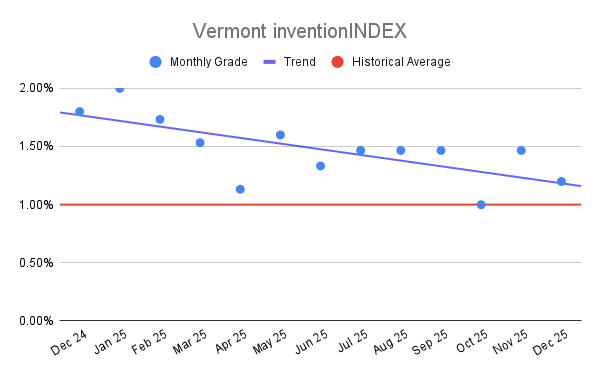 Vermont inventionINDEX December 2025:
  Vermont inventionINDEX November
