

Quick Answer: Vermont Contract Research Expenses
What is the rule for contract research in Vermont?
Vermont allows businesses to claim the Research and Development (R&D) Tax Credit for contract research expenses, typically at a rate of 65% of the payment made to third parties. To qualify, the taxpayer must retain substantial rights to the research results and bear the economic risk of the project. The credit is calculated at 27% of the federal credit amount attributable to Vermont-sourced activities.
Contract research expenses represent sixty-five percent of the total payments made to third-party entities for performing qualified research activities where the taxpayer retains substantial rights and bears the economic risk. Within the Vermont regulatory landscape, these expenses are a vital component of the qualified research expenditure pool used to determine the state’s twenty-seven percent nonrefundable tax credit.
The Vermont Research and Development (R&D) tax credit serves as a sophisticated fiscal mechanism designed to stimulate high-tech investment and intellectual property creation within the state’s borders. By allowing a credit equal to 27% of the federal credit amount attributable to Vermont-based activities, the state effectively subsidizes a significant portion of the technical risk inherent in innovation. The inclusion of contract research expenses within this framework is particularly significant for small to mid-sized enterprises (SMEs) that may lack the internal laboratory infrastructure or specialized personnel required for complex experimentation, thereby necessitating the engagement of external engineering firms, laboratories, or research consortia.
Statutory Authority and Legislative Architecture
The Vermont Research and Development Tax Credit is codified under 32 V.S.A. § 5930ii, a provision that replaced the now-repealed 32 V.S.A. § 5930z. The transition from § 5930z to § 5930ii represented a broader legislative effort to align Vermont’s tax incentives with federal standards while maintaining a high degree of transparency and accountability. Under the current statute, any taxpayer who is eligible for the federal research credit under Internal Revenue Code (IRC) Section 41 and has made eligible research and development expenditures within Vermont is entitled to the credit.
The Evolution of Vermont’s Credit Rate
The credit has undergone various adjustments over the last decade, reflecting Vermont’s evolving fiscal policy and competitive positioning against other states. Historically, the credit was set at 30% of the federal credit amount but was reduced to 27% in 2014. This 27% rate remains one of the highest “piggyback” rates in the United States, particularly when compared to states like Alaska (18% of federal) or Kansas (6.5% of federal).
| Statutory Attribute | Current Provision (32 V.S.A. § 5930ii) |
|---|---|
| Credit Percentage | 27% of the federal credit amount |
| Eligible Entity Types | C-Corps, S-Corps, Partnerships, LLCs, Sole Proprietors |
| Applicable Taxes | Personal Income Tax, Business/Corporate Income Tax |
| Carryforward Period | 10 years for unused credits |
| Refundability Status | Nonrefundable |
| Public Disclosure | Department must publish a list of claimants annually |
The nonrefundable nature of the credit means that it can only be used to offset a taxpayer’s actual Vermont income tax liability. However, the 10-year carryforward provides a critical safety net for pre-revenue startups and cyclical businesses that may incur heavy R&D costs years before achieving a taxable profit.
Conceptualizing Contract Research Expenses (CRE)
Contract research expenses occupy a unique space in the Qualified Research Expenditure (QRE) hierarchy. While in-house expenses—such as wages paid to employees and costs of supplies consumed in research—are typically included at 100% of their actual cost, contract research is subject to a statutory “haircut”.
The 65% Rule and the Consortia Exception
The primary logic behind the 65% limitation on contract research is the assumption that a third-party contractor includes a profit margin and administrative overhead in their billing. The Internal Revenue Service, and by extension the Vermont Department of Taxes, intends for the credit to subsidize the actual research costs rather than the contractor’s profit.
- Standard Contractor Payments (65%): For payments made to any person other than an employee of the taxpayer for the performance of qualified research, only 65% of the amount is included in the QRE pool. This applies to private-sector laboratories, independent consultants, and engineering firms.
- Qualified Research Consortia (75%): A more generous 75% rate applies if the research is performed by a qualified research consortium. A consortium is generally a tax-exempt organization (under Section 501(c)(3) or 501(c)(6)) that is organized and operated primarily to conduct scientific research and is not a private foundation.
- Basic Research Payments (100% in some contexts): While the 65% rule is standard for the “Credit for Increasing Research Activities” under Section 41(a)(1), certain “basic research payments” made to universities under Section 41(a)(2) may follow different computational rules, though these are less common in state-level business credit claims.
Distinguishing Contracts for Research from Contracts for Products
A frequent point of contention in Vermont audits is whether an agreement constitutes a contract for research or a contract for the purchase of a finished product. For an expense to qualify as a CRE, the contract must be for the performance of research on the taxpayer’s behalf. If a taxpayer hires a firm to build a piece of equipment that is already known to work, even if that equipment is used in a research project, the payment is for a capital asset, not research services.
| Expense Category | Percentage Included in QREs | Federal/State Authority |
|---|---|---|
| Qualified Research Wages | 100% | IRC § 41(b)(2); 32 V.S.A. § 5930ii |
| Research Supplies | 100% | IRC § 41(b)(2); 32 V.S.A. § 5930ii |
| Contract Research (Standard) | 65% | IRC § 41(b)(3); 32 V.S.A. § 5930ii |
| Research Consortia | 75% | IRC § 41(b)(3); 32 V.S.A. § 5930ii |
| Computer/Cloud Leasing | 100% | IRC § 41(b)(2); 32 V.S.A. § 5930ii |
The Legal Pillars: Economic Risk and Substantial Rights
The eligibility of contract research expenses hinges upon two fundamental legal concepts found in Treasury Regulation § 1.41-2(e): the “Risk” test and the “Rights” test. These principles are strictly applied by Vermont auditors to ensure that the entity claiming the credit is the one that actually shouldered the burden of the innovation.
The Economic Risk Requirement
Economic risk is defined as the responsibility for the costs of research even if the research is not successful. If a contract stipulates that the taxpayer only pays if the contractor delivers a specific result (a “contingent on success” or “turnkey” agreement), the contractor is the one bearing the risk. In such cases, the contractor may be eligible for the credit, and the taxpayer is disqualified from claiming those expenses as CREs.
Evidence of risk is often found in the payment structure. Time-and-materials contracts generally favor the taxpayer’s claim to the credit, as they demonstrate that the taxpayer is paying for the effort of experimentation rather than the certainty of a result. Conversely, fixed-price contracts must be carefully scrutinized to ensure that the taxpayer remains liable for the costs regardless of whether the technical objectives are met.
The Substantial Rights Requirement
The “Rights” test mandates that the taxpayer must retain “substantial rights” to the research results. While this does not require exclusive rights, the taxpayer must at least have the right to use the research results in its own trade or business without paying a fee or royalty to another party.
If a contractor retains all patent rights and only grants the taxpayer a limited license to use the final product, the taxpayer has not incurred a qualified research expense; rather, they have purchased a product or a license. In Vermont, the “substantial rights” requirement is often analyzed in the context of inter-company agreements or university partnerships where intellectual property (IP) clauses can be complex.
Local State Revenue Guidance: Vermont Department of Taxes
The Vermont Department of Taxes (VDT) provides guidance that emphasizes simplicity through federal conformity but adds specific layers regarding the geographic sourcing of expenses and documentation.
The Prorated Method of Calculation
Vermont does not require a standalone state-level base amount calculation. Instead, it uses a prorated method that begins with the federal credit. The procedure involves three primary phases:
- Nationwide QRE Identification: The taxpayer first identifies all qualified research expenses across all states, following the rules of IRC Section 41.
- Vermont Sourcing: The taxpayer then isolates the portion of those QREs that were incurred “within this State”. For contract research, this means determining where the contractor’s employees actually performed the work.
- Hypothetical Federal Calculation: The taxpayer calculates what their federal credit would be if the only QREs they had were the Vermont-sourced ones. This calculation must use the same method (Regular or Alternative Simplified Credit) used on the actual federal return (Form 6765).
- State Application: The resulting hypothetical federal credit is multiplied by 27% to arrive at the Vermont Research and Development Tax Credit.
Official Sourcing Guidance for Contract Research
The VDT emphasizes that only research conducted physically in Vermont qualifies. If a Vermont business hires a consulting firm in New York to perform technical modeling, those expenses are “out-of-state” and must be excluded from the Vermont credit calculation, even though they are perfectly valid for the federal credit. Conversely, if a multi-state corporation with no physical headquarters in Vermont hires a Vermont-based lab to perform research, that corporation can claim the Vermont R&D credit to offset its Vermont tax liability (assuming it has nexus in the state).
Administrative Forms and Filing Procedures
To claim the credit, taxpayers must navigate specific state forms that bridge the gap between their federal filing and their Vermont return.
- Form BA-404: This is the “Vermont Research and Development Tax Credit” form where the primary calculation occurs. It requires the disclosure of federal QREs and Vermont QREs.
- Schedule RD: This supplemental schedule is used to determine the exact multiplier and the hypothetical federal credit amount.
- Form IN-119 or Schedule BI-471: Depending on whether the taxpayer is an individual or a corporation, the credit is ultimately reported on these summary credit schedules before being applied to the tax liability.
It should be noted that while some tax software packages may reference a “Form RD-111” in the context of research credits, local guidance confirms that RD-111 is often associated with other jurisdictions (such as Kansas City, MO) and the primary Vermont forms remain BA-404 and Schedule RD.
Technical Application: The Four-Part Test for Contractors
Every dollar of contract research expense must pass the rigorous “Four-Part Test” derived from Section 41(d). For contracted services, this test must be met from the perspective of the taxpayer’s business goals.
1. The Section 174 Test (Permitted Purpose)
The activities must be intended to develop or improve a business component’s functionality, performance, reliability, or quality. For a contractor, this means their statement of work (SOW) must clearly outline a goal of technical improvement rather than aesthetic or market-based changes.
2. Elimination of Uncertainty
The taxpayer must show that at the beginning of the project, the information available did not establish the capability or method for developing the business component or the appropriate design. When hiring a contractor, it is insufficient to claim uncertainty because the taxpayer’s own staff lacked the knowledge; the uncertainty must be objective and technical in nature.
3. Process of Experimentation
The contractor’s work must involve a systematic evaluation of alternatives through trial and error, modeling, or simulation. Invoices that simply state “Engineering Services” are often disallowed. Vermont guidance encourages taxpayers to maintain contractor progress reports that document failed iterations and the technical reasoning behind design changes.
4. Technological in Nature
The research must fundamentally rely on the principles of hard science, such as physical science, biological science, engineering, or computer science. Research based on economics, financial analysis, or social sciences is strictly excluded.
Comprehensive Example: Vermont R&D Credit with Contract Research
The following example demonstrates the interplay between federal QREs and Vermont-sourced contract research. Consider “Vermont Tech Dynamics” (VTD), a software firm that utilizes both in-house developers and external consultants to develop a new proprietary encryption algorithm.
Data Points for the Taxable Year
| Expenditure Category | Total Nationwide Amount | Vermont-Sourced Amount |
|---|---|---|
| Qualifying Research Wages | $1,000,000 | $800,000 |
| Research Supplies | $50,000 | $40,000 |
| Contract Research (Private Lab) | $200,000 | $100,000 |
| Research Consortia (University) | $100,000 | $100,000 |
Step 1: Calculate the Vermont QRE Pool
The taxpayer must first apply the statutory haircuts to the contract research before summing the Vermont-sourced expenses.
- Vermont Wages: $800,000 (included at 100%)
- Vermont Supplies: $40,000 (included at 100%)
- Vermont Private Lab CRE: $100,000 × 65% = $65,000
- Vermont Consortia CRE: $100,000 × 75% = $75,000
- Total Vermont QREs: $800,000 + $40,000 + $65,000 + $75,000 = $980,000
Step 2: Calculate the Hypothetical Federal Credit
VTD uses the Alternative Simplified Credit (ASC) method. The ASC is 14% of the QREs that exceed 50% of the average QREs for the three preceding years.
- Average Vermont QREs (Prior 3 Years): $600,000
- Base Amount (50% of Average): $300,000
- Incremental Amount: $980,000 – $300,000 = $680,000
- Hypothetical Federal Credit: $680,000 × 14% = $95,200
Step 3: Determine the Vermont Credit
The Vermont credit is 27% of the hypothetical federal credit.
- Vermont R&D Tax Credit: $95,200 × 27% = $25,704
Step 4: Comparison with Federal Benefit
| Credit Type | Calculation Base | Benefit Amount |
|---|---|---|
| Federal Credit (Nationwide) | $1,175,000 QREs (with haircuts) | ~$110,000 |
| Vermont Credit (In-State) | $980,000 QREs (with haircuts) | $25,704 |
In this scenario, VTD gains a combined tax reduction of approximately $135,704, with the Vermont portion representing a significant 19% addition to the federal benefit.
Recent Legislative Shifts and the Future of R&D in Vermont
The landscape for R&D tax policy shifted dramatically with the passage of the Tax Cuts and Jobs Act (TCJA) and the subsequent “One Big Beautiful Bill Act” (OBBBA) of 2025. These changes primarily affected Section 174, which governs the deductibility of R&D costs, rather than the Section 41 credit itself. However, because the credit and the deduction are intrinsically linked, these shifts have profound implications for Vermont taxpayers.
The Impact of Mandatory Amortization
Starting in 2022, the TCJA required businesses to amortize R&D expenses over five years for domestic research and fifteen years for foreign research, rather than taking an immediate deduction. This created a higher tax burden for Vermont startups that were previously able to use R&D losses to zero out their liability.
The OBBBA of 2025 has largely restored immediate expensing for domestic R&D, providing a “catch-up” mechanism for expenses incurred between 2022 and 2024. Vermont conforms to these federal changes, meaning that Vermont-based contract research can once again be fully expensed in the year it is incurred, enhancing the immediate cash flow benefit of the 27% credit.
The Inflation Reduction Act (IRA) and Payroll Tax Credits
The IRA introduced an expansion of the federal R&D credit that allows qualified small businesses to offset their payroll tax (specifically Social Security and Medicare taxes) instead of income tax. While the federal credit can be applied to payroll taxes, the Vermont R&D credit remains restricted to income tax only. This creates a bifurcation in strategy: a Vermont startup may use its federal credit to save on payroll costs while carrying forward its Vermont credit to a future year when it has income tax liability.
Documentation and Audit Preparedness: Department of Taxes Standards
Vermont’s Department of Taxes is known for its rigorous verification of “in-state” activity. Because the credit rate is high (27%), audits frequently focus on the precise location where research was performed.
Essential Documentation for Contract Research
To survive a Vermont audit of contract research expenses, the taxpayer should maintain a “Tax Controversy File” containing:
- The Master Service Agreement (MSA): This document should explicitly state that the taxpayer owns the intellectual property and that the payment is not contingent on the successful outcome of the research.
- Detailed Invoices: Invoices should separate technical research time from routine administrative or support tasks. Vermont auditors will often strike out portions of an invoice that relate to project management, marketing, or general consulting.
- Location Logs: For contractors who operate in multiple states, a signed statement from the contractor confirming the percentage of work performed physically in Vermont is highly recommended.
- Proof of Payment: Cancelled checks or bank statements must match the amounts claimed on Form BA-404.
- Substantiation of the 4-Part Test: Technical documentation, such as schematics, code commits, or laboratory notebooks from the contractor, must be available to prove a process of experimentation occurred.
The Transparency List and Public Oversight
Taxpayers should be aware that Vermont law requires the Department of Taxes to publish a list of all entities that claim the R&D credit each year. This list promotes public oversight and is often cited by legislative bodies to evaluate the effectiveness of the state’s tax expenditures. While specific dollar amounts of the credits are generally protected as confidential tax information, the identity of the claimants is public.
Strategic Considerations for Multi-State Operations
For companies with a presence in multiple states, the Vermont R&D credit presents both opportunities and complexities.
Nexus and Apportionment
A company does not need to be headquartered in Vermont to claim the credit. However, it must have a Vermont income tax liability against which to apply the credit. If a company has sales in Vermont and is required to file a corporate income tax return, any research it conducts within Vermont can be used to reduce its Vermont tax burden.
Interaction with Other Vermont Credits
The R&D credit is often claimed alongside other Vermont incentives, such as the Investment Tax Credit (24% of the federal amount for Vermont property) or the Downtown and Village Center tax credits. When integrating contract research into a broader tax strategy, taxpayers must ensure they are not “double-dipping” by claiming the same expense for multiple state incentives.
Final Thoughts and Practical Recommendations
The integration of contract research expenses into the Vermont Research and Development Tax Credit framework offers a substantial incentive for companies to innovate within the state. With a credit rate of 27%—applied against the hypothetical federal credit on Vermont QREs—the state positions itself as a leader in technical subsidization.
However, the high value of the credit comes with a requirement for precision. Taxpayers must meticulously apply the 65% statutory haircut to contractor payments, ensure they retain substantial rights and bear economic risk, and, most importantly, provide undeniable proof that the research activities were conducted within the physical boundaries of Vermont.
As federal law continues to evolve through acts like the OBBBA of 2025, Vermont’s reliance on federal IRC Section 41 standards ensures that its credit remains robust and modernized. For professional peers and corporate entities navigating this landscape, the strategy should focus on early documentation, clear IP-focused contracts, and a granular tracking of contractor locations to maximize the fiscal benefits of the Vermont Research and Development Tax Credit.
Who We Are:
Swanson Reed is one of the largest Specialist R&D Tax Credit advisory firm in the United States. With offices nationwide, we are one of the only firms globally to exclusively provide R&D Tax Credit consulting services to our clients. We have been exclusively providing R&D Tax Credit claim preparation and audit compliance solutions for over 30 years. Swanson Reed hosts daily free webinars and provides free IRS CE and CPE credits for CPAs.
Are you eligible?

Why choose us?

Pass an Audit?

What is the R&D Tax Credit?
The Research & Experimentation Tax Credit (or R&D Tax Credit), is a general business tax credit under Internal Revenue Code section 41 for companies that incur research and development (R&D) costs in the United States. The credits are a tax incentive for performing qualified research in the United States, resulting in a credit to a tax return. For the first three years of R&D claims, 6% of the total qualified research expenses (QRE) form the gross credit. In the 4th year of claims and beyond, a base amount is calculated, and an adjusted expense line is multiplied times 14%. Click here to learn more.
Never miss a deadline again

Stay up to date on IRS processes

Discover R&D in your industry

R&D Tax Credit Preparation Services
Swanson Reed is one of the only companies in the United States to exclusively focus on R&D tax credit preparation. Swanson Reed provides state and federal R&D tax credit preparation and audit services to all 50 states.
If you have any questions or need further assistance, please call or email our CEO, Damian Smyth on (800) 986-4725.
Feel free to book a quick teleconference with one of our national R&D tax credit specialists at a time that is convenient for you.
R&D Tax Credit Audit Advisory Services
creditARMOR is a sophisticated R&D tax credit insurance and AI-driven risk management platform. It mitigates audit exposure by covering defense expenses, including CPA, tax attorney, and specialist consultant fees—delivering robust, compliant support for R&D credit claims. Click here for more information about R&D tax credit management and implementation.
Our Fees
Swanson Reed offers R&D tax credit preparation and audit services at our hourly rates of between $195 – $395 per hour. We are also able offer fixed fees and success fees in special circumstances. Learn more at https://www.swansonreed.com/about-us/research-tax-credit-consulting/our-fees/



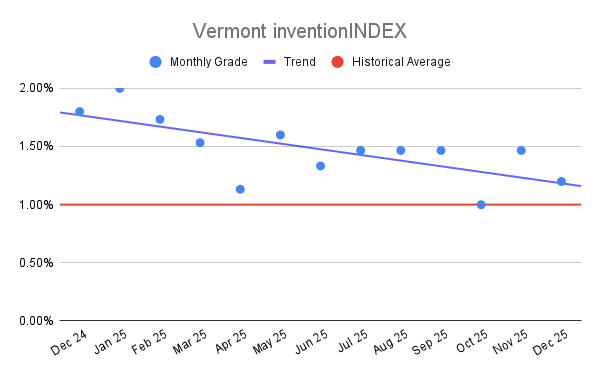 Vermont inventionINDEX December 2025:
  Vermont inventionINDEX November
