

Quick Answer: Are Depreciable Assets Qualified Supplies in Vermont?
No. Property subject to the allowance for depreciation is strictly excluded from the definition of “Qualified Research Expenses” (supplies) for the Vermont Research and Development tax credit. While consumable items like raw materials and chemicals are eligible, capital assets with a useful life exceeding one year—such as machinery, servers, and lab equipment—are disqualified. This rule mirrors IRC Section 41, ensuring that taxpayers cannot claim both an immediate R&D credit and long-term depreciation deductions for the same asset.
Property subject to the allowance for depreciation refers to capital assets with a determinable useful life exceeding one year that are strictly excluded from the definition of qualified research supplies. This statutory exclusion ensures that the Vermont Research and Development tax credit incentivizes the immediate consumption of raw materials and prototypes rather than the acquisition of long-term equipment already eligible for cost recovery through standard depreciation.
Overview of the Supply Classification Framework
The intersection of federal tax law and state-level incentives creates a complex regulatory environment for Vermont taxpayers engaged in innovative activities. The Vermont Research and Development (R&D) tax credit, authorized under 32 V.S.A. § 5930ii, is designed to mirror the federal credit for increasing research activities provided by Section 41 of the Internal Revenue Code (IRC). At its core, the credit is calculated as a percentage of the federal credit amount attributable to research expenditures made within the state of Vermont. To navigate this incentive effectively, a professional understanding of the definition of “Qualified Research Expenses” (QREs) is required, particularly the distinction between consumable supplies and depreciable property.
Under IRC Section 41(b)(2)(C), the term “supplies” is defined as any tangible property other than land or improvements to land and property of a character subject to the allowance for depreciation. This definition is adopted in full by the Vermont Department of Taxes, as the state credit is explicitly tied to the federal “allowed” credit for expenditures that meet the criteria of 26 U.S.C. § 41(a). The exclusion of depreciable property serves a critical policy function: it prevents the duplication of tax benefits where a single asset might otherwise be eligible for both an immediate R&D credit and long-term depreciation deductions under IRC Section 167 or Section 168.
The “character” of the property—whether it is subject to depreciation—is an objective test focused on the physical nature and utility of the item rather than the specific accounting elections made by the taxpayer. For a business operating in Vermont’s diverse technology and manufacturing sectors, this means that every screw, chemical reagent, and prototype frame must be evaluated against its intended use and durability.
Statutory and Regulatory Foundations of the Research Credit
The legal structure of the research credit is hierarchical, beginning with the federal code and flowing into Vermont state statutes. A comprehensive analysis must first establish the parameters of IRC Section 41 before examining the specific application of Vermont’s 27 percent “piggyback” rate.
Federal Statutory Definitions under IRC Section 41
The federal credit for increasing research activities consists of the sum of in-house research expenses and contract research expenses. In-house research expenses are further categorized into three distinct buckets: wages, supplies, and amounts paid for the use of computers.
| Expense Type | Statutory Reference | Eligibility Criteria |
|---|---|---|
| Wages | 26 U.S.C. § 41(b)(2)(D) | Paid for “qualified services” including direct research, supervision, or support. |
| Supplies | 26 U.S.C. § 41(b)(2)(C) | Tangible property used in research, excluding land and depreciable assets. |
| Computer Use | 26 U.S.C. § 41(b)(2)(A)(iii) | Amounts paid to another person for the right to use computers/servers for research. |
| Contract Research | 26 U.S.C. § 41(b)(3) | 65% of amounts paid to third parties for research (75% for research consortia). |
The term “supplies” is relatively broad but bounded by the specific exclusion of depreciable property. This exclusion is intended to restrict the supply category to items that are consumed during the research process or that lose their separate identity through incorporation into a prototype.
Vermont’s Adaptation: 32 V.S.A. § 5930ii
Vermont’s R&D tax credit is an “indirect piggyback” credit. Unlike some states that have developed unique state-specific credit formulas, Vermont defines its credit as 27 percent of the federal tax credit allowed in the taxable year for research expenditures made within the state.
This statutory tie-in has several implications for the taxpayer:
- Conformity: If an expense is disqualified at the federal level—for example, if a piece of equipment is deemed “of a character subject to depreciation”—it is automatically disqualified from the Vermont credit.
- Apportionment: For businesses with multi-state operations, the federal credit must be “recomputed” using only Vermont-sourced QREs. This recomputation must strictly follow the federal methodology (Regular or ASC) selected for the federal return.
- Audit Exposure: An audit of the federal credit by the Internal Revenue Service (IRS) often triggers a corresponding adjustment by the Vermont Department of Taxes, as the state credit is mathematically dependent on the federal “allowed” amount.
The “Depreciable Character” Test: Analysis and Application
The most critical analytical hurdle in classifying research supplies is determining whether an item is of a “character subject to the allowance for depreciation.” This test is objective and does not rely on whether the taxpayer actually depreciates the asset on their financial statements or tax returns.
Determining Useful Life and Wear and Tear
Property is subject to depreciation if it has a determinable useful life of more than one year and is subject to wear and tear, decay, or obsolescence. In the context of R&D, this often creates a conflict for items like specialized testing equipment, lab furniture, and reusable tools.
Even if a taxpayer chooses to expense a $2,000 piece of equipment under a de minimis safe harbor for general accounting purposes, that item remains “of a character subject to depreciation” if its physical properties would allow it to function for several years. Consequently, such an item cannot be included in the supply category for the R&D credit calculation.
Qualifying Consumables vs. Capital Equipment
To illustrate the boundary between qualifying supplies and depreciable property, consider the following data comparing typical research expenditures:
| Category | Qualifying Supply (Section 41) | Depreciable Property (Excluded) |
|---|---|---|
| Raw Materials | Aluminum, plastic, and alloys used to build a prototype that is destroyed in testing. | A CNC machine or laser cutter used to shape those raw materials. |
| Lab Materials | Chemicals, reagents, and disposable gloves consumed during experiments. | A centrifuge, microscope, or lab bench with a 5-year life. |
| Electronics | Breadboard components, resistors, and integrated circuits soldered into trial units. | An oscilloscope or logic analyzer used to test those circuits. |
| Prototypes | Materials used for “first article” runs that are eventually scrapped. | “Hard” tooling or molds used for long-term production of the final product. |
The distinction rests on the “consumption” principle. If the item is physically integrated into a test model or exhausted during the performance of qualified services, it is a supply. If it remains as a functional tool available for future use, it is a depreciable asset.
Vermont Revenue Office Guidance and Documentation Requirements
The Vermont Department of Taxes provides guidance through its official forms, instructions, and reports. Because the Vermont credit is calculated using a localized version of federal Form 6765, the documentation must be of the same caliber as that required for an IRS audit.
Form BA-404: The Master Credit Schedule
Taxpayers claiming the R&D credit must complete Form BA-404, “Tax Credits Earned, Applied, and Carried Forward”. This form requires the taxpayer to detail the amount of credit earned in the current year and reconcile it against any prior-year carryforwards.
The instructions for Form BA-404 specifically state that a recomputed credit calculation must be provided if the federal credit was earned based on expenditures both in and out of Vermont. This recomputed calculation is effectively a “Vermont-only Form 6765” where the taxpayer identifies Vermont wages, Vermont supplies, and Vermont contract research.
Schedule RD and Individual Filers
For individuals and pass-through entities, the credit flows through to the owners. Individual taxpayers report their share of the credit on Schedule IN-112 or IN-119, depending on the tax year and specific reporting requirements. Schedule RD is often used as a supplemental work paper to demonstrate the application of the 27 percent multiplier to the federal QREs.
Audit and Transparency: 32 V.S.A. § 5930ii(c)
A unique aspect of Vermont’s R&D tax credit is the mandatory public disclosure. Each year, by January 15, the Department of Taxes must publish a list of every taxpayer who claimed the credit in the preceding calendar year. This transparency report includes the names of the companies, highlighting the importance of accuracy in supply classification, as these claims are part of the public record and subject to scrutiny.
Regarding documentation, the Department expects taxpayers to retain:
- Invoices and purchase orders for supplies that explicitly describe the material and its non-depreciable nature.
- Project-based logs that tie the supply consumption to a specific technical uncertainty.
- Technical reports detailing the “process of experimentation” where the supplies were consumed.
Theoretical Conflicts: The Impact of Section 174 Amortization
A significant shift in tax policy occurred with the amendment of IRC Section 174, which now requires research and experimental (R&E) expenditures to be capitalized and amortized over five years (fifteen years for foreign research).
This change has led to questions regarding whether “amortizable” property under Section 174 is now considered “property of a character subject to the allowance for depreciation” for purposes of the Section 41 credit exclusion. Current professional consensus and limited memorandum guidance from other jurisdictions suggest that the two sections remain distinct. While Section 174 governs the deductibility of costs, Section 41 governs the creditability of costs.
Property that is inherently a consumable supply—such as raw metal for a prototype—remains a qualifying supply for the Section 41 credit even though the cost of that supply must now be amortized over five years under Section 174. Conversely, property that was always depreciable—like a microscope—remains excluded from the Section 41 supply category, regardless of how it is treated under Section 174.
Mathematical Integration: The Vermont Credit Formula
The calculation of the Vermont Research and Development tax credit requires a precise re-evaluation of the federal incremental base. For a Vermont taxpayer, the credit is not a simple 27 percent of their total federal credit; it is 27 percent of a “hypothetical” federal credit based only on Vermont QREs.
The credit amount (CVT) is determined by:
CVT = 0.27 × Hypothetical Federal Credit
Where:
- I is the incremental rate (20% for the Regular Research Credit or 14% for the Alternative Simplified Credit).
- QREVT represents the sum of Vermont-sourced wages, supplies (excluding depreciable property), and computer use costs.
- BVT is the localized base amount, calculated using Vermont-specific historical data.
Example: High-Tech Manufacturing in Burlington
Consider “Green Mountain Aerospace,” a manufacturer located in Burlington, Vermont. In the current tax year, the company develops a new propulsion system. Their expenses are detailed below:
| Expense Item | Total Amount | Vermont Portion | Qualified? | Reason for Qualification/Exclusion |
|---|---|---|---|---|
| Research Engineer Salaries | $500,000 | $500,000 | Yes | Vermont wages for qualified services. |
| Titanium Alloy for Prototypes | $120,000 | $120,000 | Yes | Consumable supply; not depreciable. |
| New Wind Tunnel Fan | $45,000 | $45,000 | No | Property of a character subject to depreciation. |
| Cloud Computing (AWS) | $15,000 | $15,000 | Yes | Cost for the right to use computers for research. |
| University Lab Contract | $100,000 | $100,000 | Yes | 65% of Vermont-sourced contract research. |
Calculations:
-
Vermont QREs (QREVT):
- Wages: $500,000
- Supplies: $120,000 (Excludes the $45,000 fan)
- Computer Use: $15,000
- Contract Research: $65,000 ($100,000 × 0.65)
- Total QREVT = $700,000
-
Base Amount (BVT):
Assume the company’s Vermont-localized base amount (calculated using Vermont historical receipts and expenses) is $500,000. -
Hypothetical Federal Credit (CFed-VT):
Using the Regular Method (20% rate):
CFed-VT = 0.20 × ($700,000 – $500,000) = $40,000 -
Vermont State Credit (CVT):
CVT = 0.27 × $40,000 = $10,800
In this example, the $45,000 fan was correctly excluded from the supply category because it is an asset with a multi-year useful life. Had the company incorrectly included it, the Vermont credit would have been inflated by $2,430 ($45,000 × 0.20 × 0.27), creating a significant audit liability and potential for penalties and interest.
Advanced Regulatory Analysis: Prototypes as Depreciable Assets
One of the most litigated areas of the R&D tax credit is the treatment of prototypes that are later sold or used in production. If a prototype is constructed using $100,000 in materials and $50,000 in labor, the taxpayer may initially claim the $100,000 in materials as “supplies”.
However, if that prototype is a “fully-functional representation” that is not destroyed during testing but is instead placed into service as a piece of production machinery, the IRS may argue that the prototype itself is “property of a character subject to depreciation”. In such cases, the materials that make up the prototype are no longer considered “supplies” because they have become part of a depreciable capital asset.
Taxpayers must therefore distinguish between:
- Experimental Prototypes: Built to resolve uncertainty and subsequently scrapped or destroyed. These qualify as supplies.
- Production Prototypes: Built to resolve uncertainty but intended to remain in service as a long-term asset. These may be disqualified from the supply category, though the labor (wages) to build them may still be eligible.
Compliance and Audit Strategy in the Vermont Jurisdiction
The Vermont Department of Taxes maintains a high standard for credit substantiation, largely because the R&D credit is one of the state’s most significant business tax expenditures. The Department’s audit techniques often focus on the proration accuracy of multi-state claims and the proper classification of supplies.
Contemporaneous Recordkeeping
The burden of proof rests entirely on the taxpayer. For Vermont-based research, this means maintaining a “Vermont Research File” that contains:
- A copy of the federal Form 6765.
- The Vermont-specific recomputation schedules.
- Vendor invoices for every dollar of supplies claimed, with notes explaining how each item was used in experimentation and why it is non-depreciable.
- Documentation of the 10-year carryforward, ensuring that credits generated in a loss year are properly tracked and not expired before they can be applied to a profitable year.
Vermont Pass-Through Treatment
For partnerships and S-corporations, the credit is reported on the entity’s Vermont tax return (e.g., Form BI-471) but the actual tax offset occurs on the owners’ individual returns. This decentralized application means that a single error in supply classification at the entity level can lead to dozens of individual audits for a company’s shareholders.
The Role of Technical Bulletins
The Vermont Department of Taxes periodically issues Technical Bulletins that provide deep dives into specific tax issues. While few bulletins focus exclusively on the R&D credit, the Department’s treatment of depreciation in TB-44 serves as a warning that federal bonus depreciation and other accelerated methods must be carefully reconciled for Vermont purposes. This underscores the state’s rigorous approach to any tax attribute tied to the character of depreciable property.
Final Thoughts
The exclusion of property subject to the allowance for depreciation from the qualified research supply category is a foundational rule of the Vermont R&D tax credit. By aligning the state credit with the federal definitions under IRC Section 41, Vermont ensures a standardized approach to innovation incentives while protecting the tax base from the duplication of capital investment benefits.
For practitioners and business leaders, the 27 percent credit represents a significant opportunity to offset the high costs of discovery and technical improvement within the state. However, the transition from a “supply” to a “capital asset” is a delicate one, requiring careful monitoring of prototype development, tool procurement, and lab expenditures. By maintaining rigorous, project-based documentation and adhering to the objective “character” test for every research-related purchase, Vermont taxpayers can secure the value of this credit and support the state’s burgeoning reputation as a hub for scientific and industrial advancement. The rigidity of the supply definition—and its explicit exclusion of depreciable property—is the mechanism that ensures the Vermont R&D tax credit remains a precise tool for subsidizing the intellectual process of experimentation rather than the physical infrastructure of production.
Who We Are:
Swanson Reed is one of the largest Specialist R&D Tax Credit advisory firm in the United States. With offices nationwide, we are one of the only firms globally to exclusively provide R&D Tax Credit consulting services to our clients. We have been exclusively providing R&D Tax Credit claim preparation and audit compliance solutions for over 30 years. Swanson Reed hosts daily free webinars and provides free IRS CE and CPE credits for CPAs.
Are you eligible?

Why choose us?

Pass an Audit?

What is the R&D Tax Credit?
The Research & Experimentation Tax Credit (or R&D Tax Credit), is a general business tax credit under Internal Revenue Code section 41 for companies that incur research and development (R&D) costs in the United States. The credits are a tax incentive for performing qualified research in the United States, resulting in a credit to a tax return. For the first three years of R&D claims, 6% of the total qualified research expenses (QRE) form the gross credit. In the 4th year of claims and beyond, a base amount is calculated, and an adjusted expense line is multiplied times 14%. Click here to learn more.
Never miss a deadline again

Stay up to date on IRS processes

Discover R&D in your industry

R&D Tax Credit Preparation Services
Swanson Reed is one of the only companies in the United States to exclusively focus on R&D tax credit preparation. Swanson Reed provides state and federal R&D tax credit preparation and audit services to all 50 states.
If you have any questions or need further assistance, please call or email our CEO, Damian Smyth on (800) 986-4725.
Feel free to book a quick teleconference with one of our national R&D tax credit specialists at a time that is convenient for you.
R&D Tax Credit Audit Advisory Services
creditARMOR is a sophisticated R&D tax credit insurance and AI-driven risk management platform. It mitigates audit exposure by covering defense expenses, including CPA, tax attorney, and specialist consultant fees—delivering robust, compliant support for R&D credit claims. Click here for more information about R&D tax credit management and implementation.
Our Fees
Swanson Reed offers R&D tax credit preparation and audit services at our hourly rates of between $195 – $395 per hour. We are also able offer fixed fees and success fees in special circumstances. Learn more at https://www.swansonreed.com/about-us/research-tax-credit-consulting/our-fees/



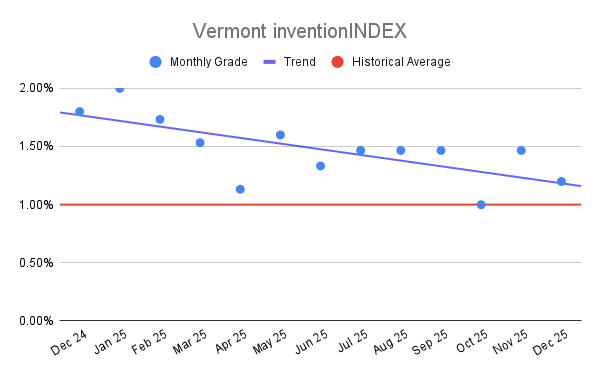 Vermont inventionINDEX December 2025:
  Vermont inventionINDEX November
