

Quick Answer: What is the Vermont Process of Experimentation?
The Process of Experimentation is a mandatory, systematic trial-and-error procedure required to qualify for the Vermont R&D Tax Credit (32 V.S.A. § 5930ii). It requires taxpayers to move beyond high-level conceptualization and demonstrate a structured methodology of testing, modeling, and refining a business component to resolve technical uncertainties. This process acts as a filter to distinguish routine engineering from qualified research, ensuring that only expenditures related to genuine innovation—conducted within Vermont borders—are eligible for the state's 27% tax credit.
The Process of Experimentation is a systematic trial-and-error procedure used to evaluate design alternatives and resolve technical uncertainties inherent in developing new products or processes. In Vermont, this standard serves as the critical qualitative filter for determining if research expenditures qualify for the state’s 27 percent tax credit under 32 V.S.A. § 5930ii.
This regulatory requirement demands that a taxpayer move beyond mere high-level conceptualization into a structured methodology of testing, modeling, and refining a business component until technical goals are met. Within the context of Vermont’s tax code, the "Process of Experimentation" (PoE) is not a suggestion but a mandatory evidentiary hurdle that bridges the gap between routine engineering and qualified research. This report examines the statutory origins of the PoE requirement, its integration with federal Internal Revenue Code (IRC) § 41, the specific guidance issued by the Vermont Department of Taxes, and the practical application of these rules through industrial examples and audit-ready documentation strategies.
Statutory Foundation and the Vermont-Federal Nexus
The Vermont Research and Development (R&D) Tax Credit, as established under 32 V.S.A. § 5930ii, is designed to encourage investment in the state's innovation economy by providing a dollar-for-dollar reduction in tax liability. The state credit is nonrefundable and applies to personal income tax, business income tax, or corporate income tax. The defining characteristic of this incentive is its direct reliance on the federal standard; Vermont's credit is calculated as 27 percent of the portion of the federal R&D tax credit that is attributable to qualified research expenditures (QREs) conducted within the borders of Vermont.
This "piggyback" structure means that Vermont essentially adopts the definitions found in 26 U.S.C. § 41, specifically the "Four-Part Test" used to identify qualified research. While the state legislature has the authority to decouple from certain federal provisions, Vermont has maintained a high degree of conformity to ensure administrative simplicity for taxpayers who are already complying with federal filing requirements. However, the state imposes a strict geographical filter: only expenditures made for research "within this State" qualify for the 27 percent calculation.
Historical Context and Evolution of the Credit RateThe Vermont R&D credit has undergone legislative refinements since its inception. Prior to January 1, 2014, the credit rate was 30 percent of the federal amount. The reduction to the current 27 percent rate was enacted to balance the state’s fiscal requirements with the need to remain a competitive destination for high-tech firms. Despite this reduction, Vermont remains one of the more generous states in terms of prorated credit value compared to the national average.
| Provision | Current Vermont Specification |
|---|---|
| Statute | 32 V.S.A. § 5930ii |
| Credit Rate | 27% of the federal R&D credit |
| Eligible Entities | C-Corps, S-Corps, LLCs, Partnerships, Sole Proprietors |
| Carryforward | 10 years |
| Refundability | Nonrefundable |
| Expenditure Type | Vermont-based QREs only |
The Four-Part Test: The Gateway to Qualification
To understand the "Process of Experimentation," one must view it as the final and most rigorous stage of the Four-Part Test mandated by IRC § 41(d). Each part of the test acts as a filter; if an activity fails any single part, it is disqualified from being a "Qualified Research Activity" (QRA), and its associated costs cannot be included in the credit calculation.
The Permitted Purpose TestThe research must be intended to develop a new or improved "business component". A business component is any product, process, software, technique, formula, or invention that is held for sale, lease, or license, or used in the taxpayer’s trade or business. The improvement must specifically target the component’s functionality, performance, reliability, or quality. Activities focused solely on style, taste, or cosmetic changes are strictly excluded.
The Technological in Nature TestThe process used to discover the information must fundamentally rely on the principles of the "hard sciences," such as engineering, physics, chemistry, biology, or computer science. This excludes research in the social sciences, arts, or humanities.
The Elimination of Uncertainty TestThe taxpayer must be able to demonstrate that, at the outset of the project, they faced technological uncertainty regarding the "capability" of achieving the result, the "method" of achieving it, or the "appropriate design" of the final product. If the solution was readily available or could be achieved through routine engineering, the activity does not meet the threshold for research.
The Process of Experimentation TestThe fourth test requires that substantially all of the activities must involve a "Process of Experimentation". This is where the taxpayer must demonstrate a systematic trial-and-error approach to evaluating alternatives to resolve the uncertainties identified in Step 3.
Anatomy of the Process of Experimentation
The Process of Experimentation (PoE) is the operational heart of the R&D credit. Under Treasury Regulation § 1.41-4(a)(5), a process of experimentation is a process designed to evaluate one or more alternatives to achieve a result where the capability or the method of achieving that result, or the appropriate design of that result, is uncertain as of the beginning of the taxpayer's research activities.
Systematic Evaluation and IterationA PoE is fundamentally different from a single "eureka" moment or a linear development path. It necessitates a structured loop of hypothesis, testing, analysis, and refinement. The Vermont Department of Taxes, following federal guidelines, looks for evidence that the taxpayer purposefully evaluated multiple design paths. This might involve:
- Modeling and Simulation: Using digital or mathematical representations to predict the behavior of a component under various conditions.
- Systematic Trial and Error: A methodical approach where variables are changed one at a time to isolate their effects on the outcome.
- Prototyping: Building physical or digital iterations of a product to test specific technical hypotheses.
The law requires that "substantially all"—which the IRS and state authorities interpret as 80 percent or more—of the research activities for a given business component must constitute a process of experimentation. If the experimental portion of the work falls below this 80 percent threshold, the taxpayer may apply the "shrink-back rule". This rule allows the taxpayer to apply the Four-Part Test to a smaller, more discrete part of the business component (e.g., a specific sub-assembly or a single module of a software program) that does meet the 80 percent threshold.
Elimination of the "Discovery Test"Historically, the tax code required research to meet a "Discovery Test," which mandated that the taxpayer discover information that was new to the entire industry—a standard that proved nearly impossible for small and medium-sized businesses. In 2004, the federal government (and by extension Vermont) abandoned this standard in favor of the current "Process of Experimentation" rule. Under the modern standard, the information discovered only needs to be "new to the taxpayer". This allows a Vermont company to qualify for the credit by developing a product that competitors may already have, provided the company had to undergo its own systematic experimentation to figure out how to design and build it.
Vermont Department of Taxes: Local Guidance and Reporting
Claiming the Vermont R&D tax credit involves a specific set of forms and administrative procedures that ensure the state is only subsidizing work physically conducted within its borders.
Essential Forms and Filing ProceduresThe primary mechanism for claiming the credit is the filing of Form BA-404, "Tax Credits Earned, Applied, Expired, and Carried Forward". This form serves as the central register for all state-level business credits. To substantiate the R&D portion, taxpayers are required to attach a copy of their federal Form 6765, "Credit for Increasing Research Activities".
For companies with operations in multiple states, Vermont guidance is very specific: the taxpayer must perform a "recomputed credit calculation" based only on the expenditures that occurred in Vermont. This is not simply a matter of taking 27 percent of the final federal credit amount; rather, the taxpayer must simulate a federal filing as if the company's only R&D activities were those performed in Vermont.
Recomputing the Credit for Vermont-Only ActivitiesThe recomputation process involves several technical steps:
- Isolate Vermont QREs: Identify wages paid to employees for research performed in Vermont, supplies consumed in Vermont-based research, and 65 percent of contract research performed by Vermont-based contractors.
- Determine Vermont Base Amount: If using the Regular Method, the taxpayer must calculate a base amount using Vermont-specific gross receipts and historical R&D spending.
- Calculate Hypothetical Federal Credit: Apply the federal credit formula (Regular or ASC) to these Vermont-specific figures.
- Apply 27% Multiplier: The final Vermont credit is 27 percent of this hypothetical federal amount.
| Component | Regular Method | ASC Method |
|---|---|---|
| Federal Rate | 20% of QREs over Base Amount | 14% of QREs over 50% of prior 3-yr avg |
| VT Rate (Prorated) | 27% of Federal Amount | 27% of Federal Amount |
| Data Required | VT QREs + VT Gross Receipts | VT QREs (Current + 3 Prior Yrs) |
| Suitability | High-growth firms with low base ratios | Firms with missing historical data or high base ratios |
Deep Dive into Qualified Research Expenditures (QREs)
The financial component of the R&D credit is built upon four specific categories of "qualified research expenditures" (QREs) as defined in IRC § 41(b). For the Vermont credit, each of these must be scrutinized to ensure the expense was incurred within the state.
Qualified WagesThis is typically the largest component of any R&D claim. It includes wages paid to employees who are directly performing, supervising, or supporting qualified research activities.
- Direct Performance: The actual "bench work," coding, or engineering.
- Direct Supervision: Managing the researchers and being responsible for the technical outcome.
- Direct Support: Activities such as cleaning laboratory equipment or building prototypes to be tested by the engineers.
In Vermont, only wages subject to Vermont income tax withholding are generally eligible for the state credit calculation.
Qualified SuppliesThis category covers tangible property used in the conduct of qualified research. This includes materials used to build prototypes or components consumed during the "Process of Experimentation". It explicitly excludes land, improvements to land, and depreciable property.
Contract Research ExpensesA taxpayer may include 65 percent of the amount paid to third parties for research performed on the taxpayer’s behalf. If the research is performed by a qualified research consortium (such as a university-led non-profit), this amount increases to 75 percent. To qualify for the Vermont credit, the research must be performed within Vermont.
Computer Leasing and Cloud ComputingTaxpayers may include amounts paid for the right to use computers in the conduct of qualified research. In the modern era, this has been interpreted to include cloud computing and server hosting costs (e.g., AWS or Azure) used for development and testing environments.
Applying the PoE: A Comprehensive Industrial Example
To illustrate the technical and procedural requirements for the Vermont R&D credit, consider the following case study of a Vermont-based aerospace startup.
The Innovation: "Green Mountain Avionics"Green Mountain Avionics (GMA) is a company located in South Burlington, Vermont. GMA is developing a new type of lightweight, high-altitude communication relay for drones.
Step 1: Identification of Technical UncertaintyAt the beginning of the project, GMA faces two primary uncertainties:
- Capability: It is unknown if the current lightweight carbon fiber composite can withstand the thermal expansion cycles at 70,000 feet.
- Design: The engineers are unsure of the optimal antenna configuration to minimize drag while maximizing signal strength at high speeds.
GMA enters a 12-month development cycle characterized by systematic experimentation:
- Iterative Design: The team designs four different antenna prototypes using CAD software.
- Simulation: Using thermal modeling software, they simulate the carbon fiber’s behavior in extreme cold.
- Testing: They build physical prototypes of the antennas and test them in a high-velocity wind tunnel located in Vermont.
- Analysis and Refinement: After the first round of testing shows signal degradation at high speeds, the engineers analyze the data, change the antenna’s sweep angle, and perform a second round of wind tunnel testing.
GMA identifies the following costs associated with the South Burlington relay project:
- Wages: $400,000 paid to Vermont-based aerospace engineers.
- Supplies: $50,000 for specialized carbon fiber and antenna components consumed in testing.
- Contract Research: $100,000 paid to a Vermont-based materials testing lab to perform thermal analysis ($65,000 eligible after 65% haircut).
- Total Vermont QREs: $515,000.
Assuming GMA is a new company and elects the ASC method for its federal return, the Vermont calculation would follow this logic:
- Current Year VT QREs: $515,000.
- Base Amount (assuming it's a new entity, the base is 50% of current QREs): $257,500.
- Hypothetical Federal Credit: $515,000 - $257,500 = $257,500. $257,500 \times 14\% = \$36,050$.
- Vermont State Credit: $\$36,050 \times 27\% = \$9,733.50$.
GMA would claim this $9,733.50 on Form BA-404 and carry forward any unused portion for up to 10 years.
Audit Defense and Documentation Standards
Given that the Vermont Department of Taxes publishes an annual list of R&D credit claimants, businesses must be prepared for a higher level of scrutiny. Successful audit defense rests on the quality of "contemporaneous documentation"—records created at the time the research was being performed.
Linking Activity to ExperimentationThe most common reason for credit denial is the failure to link financial expenditures to the specific Process of Experimentation. Auditors often find that while a company clearly did "engineering," they cannot prove they used a "systematic process of experimentation". To mitigate this risk, Vermont companies should maintain:
- Project Folders: Containing the project’s technical objectives and the specific uncertainties being addressed.
- Experiment Logs: Records of what was tested, why it was tested, the results of the test, and how those results informed the next step.
- Time-Tracking Worksheets: Detailed breakdowns of how much time engineers spent on research vs. routine production support.
- Meeting Minutes: Documentation of design reviews and technical brainstorming sessions where alternatives were evaluated.
In addition to the qualitative PoE test, the Vermont Department of Taxes frequently focuses on the "proration accuracy". Auditors will verify that the wages being claimed were indeed for work performed in Vermont and that the gross receipts used in the base calculation correctly reflect Vermont-specific activity.
| Audit Danger Zone | Required Corrective Documentation |
|---|---|
| Routine Quality Control | Proof that testing was to validate a design, not just to check a production unit for defects. |
| Customer Adaptation | Documentation showing that the adaptation required resolving a new technological uncertainty. |
| Oral Testimony Only | Replaced by contemporaneous logs, emails, and technical reports. |
| Vague Project Descriptions | Specific technical language defining the hard science principles applied. |
Software R&D and Internal Use Software (IUS)
In Vermont’s growing tech sector, software development is a major driver of R&D credit claims. However, software development is subject to unique rules, particularly when it is intended for "Internal Use".
The Three-Part Heightened Test for IUSIf software is developed solely for a company's own internal administrative functions (e.g., payroll, accounting, or project management), it must meet a "Heightened Three-Part Test" in addition to the standard Four-Part Test:
- Innovativeness: The software must result in a reduction in cost or improvement in speed that is "substantial and economically significant".
- Significant Economic Risk: The taxpayer must commit substantial resources to the development with reasonable uncertainty that the software will actually work.
- Commercial Unavailability: The software cannot be purchased "off-the-shelf" or modified through standard commercial configuration.
The IRS (and by extension Vermont) has issued specific audit guidelines for software R&D to help examiners focus their resources.
| Activity Risk Level | Examples |
|---|---|
| Low Risk (Rarely Fails) | Developing new operating systems, compilers, or complex algorithms. |
| Moderate Risk | Developing highly customized interfaces between legacy systems. |
| High Risk (Often Denied) | Routine bug fixing, website design using standard templates, or minor feature updates. |
Interaction with IRC Section 174 Amortization
A significant development for Vermont R&D claimants is the mandatory capitalization of research expenses under IRC § 174, effective for tax years beginning after December 31, 2021. Under the Tax Cuts and Jobs Act (TCJA), businesses can no longer deduct R&D expenses in the year they are incurred; instead, they must capitalize and amortize them over 5 years (15 years for foreign research).
This change has introduced a new layer of complexity. While Section 174 and Section 41 are related, the definition of an "experimental expenditure" under Section 174 is broader than a "qualified research expense" under Section 41. A cost might be required to be capitalized under Section 174 (e.g., patent legal fees) but not be eligible for the R&D credit under Section 41. Vermont taxpayers must carefully distinguish between these two classifications to ensure their state tax liability is correctly reported.
Implications for Unitary Business Groups
Vermont requires corporations that are part of an affiliated group engaged in a "unitary business" to file a combined return. This has specific implications for the R&D credit:
- Member Sharing: The credit is typically earned by the specific member of the group that performed the research. However, once the credit is generated, it may sometimes be used by other members of the unitary group to offset their own Vermont tax liabilities, depending on the specific apportionment rules in effect.
- Apportionment: For a unitary group, the recomputed federal credit must still be based strictly on the Vermont-only QREs of the member performing the work.
Future Outlook and State Economic Strategy
The Vermont R&D credit is more than just a tax break; it is a central pillar of the state’s economic development strategy. By offering a high 27 percent rate and a 10-year carryforward, Vermont provides a stable and predictable incentive that appeals to long-term research projects. The annual publication of claimants ensures transparency and allows the legislature to track the ROI of the program.
As the global economy shifts toward even more research-intensive sectors like artificial intelligence, renewable energy, and precision medicine, the "Process of Experimentation" standard will continue to be the primary filter through which Vermont separates routine business activity from the type of high-value innovation that justifies public support. Businesses that master the technical definitions of experimentation and maintain the rigorous documentation required by the Vermont Department of Taxes will find themselves well-positioned to maximize their returns and fuel their growth within the Green Mountain State.
Final Thoughts and Recommendations
The Vermont Research and Development tax credit remains a robust incentive for companies dedicated to genuine innovation. The Process of Experimentation is the definitive qualitative standard that taxpayers must meet to qualify.
- Prioritize Narrative Documentation: Vermont businesses should move away from simple time-tracking and toward "technical narratives" that clearly articulate the uncertainty faced and the systematic experiments performed to resolve it.
- Strict Adherence to Proration: Given the state’s focus on geography, taxpayers must ensure their systems can accurately isolate Vermont-based costs from those incurred in other states.
- Monitor Federal Changes: Because Vermont’s credit is tied to IRC § 41, any shifts in federal audit posture or judicial interpretations of the PoE will have immediate effects on Vermont filings.
- Leverage Professional Studies: Given the complexity of the 27 percent recomputed calculation and the scrutiny of the transparency list, many Vermont firms find that a formal R&D tax credit study is a necessary investment to ensure both compliance and maximum utilization.
Who We Are:
Swanson Reed is one of the largest Specialist R&D Tax Credit advisory firm in the United States. With offices nationwide, we are one of the only firms globally to exclusively provide R&D Tax Credit consulting services to our clients. We have been exclusively providing R&D Tax Credit claim preparation and audit compliance solutions for over 30 years. Swanson Reed hosts daily free webinars and provides free IRS CE and CPE credits for CPAs.
Are you eligible?

Why choose us?

Pass an Audit?

What is the R&D Tax Credit?
The Research & Experimentation Tax Credit (or R&D Tax Credit), is a general business tax credit under Internal Revenue Code section 41 for companies that incur research and development (R&D) costs in the United States. The credits are a tax incentive for performing qualified research in the United States, resulting in a credit to a tax return. For the first three years of R&D claims, 6% of the total qualified research expenses (QRE) form the gross credit. In the 4th year of claims and beyond, a base amount is calculated, and an adjusted expense line is multiplied times 14%. Click here to learn more.
Never miss a deadline again

Stay up to date on IRS processes

Discover R&D in your industry

R&D Tax Credit Preparation Services
Swanson Reed is one of the only companies in the United States to exclusively focus on R&D tax credit preparation. Swanson Reed provides state and federal R&D tax credit preparation and audit services to all 50 states.
If you have any questions or need further assistance, please call or email our CEO, Damian Smyth on (800) 986-4725.
Feel free to book a quick teleconference with one of our national R&D tax credit specialists at a time that is convenient for you.
R&D Tax Credit Audit Advisory Services
creditARMOR is a sophisticated R&D tax credit insurance and AI-driven risk management platform. It mitigates audit exposure by covering defense expenses, including CPA, tax attorney, and specialist consultant fees—delivering robust, compliant support for R&D credit claims. Click here for more information about R&D tax credit management and implementation.
Our Fees
Swanson Reed offers R&D tax credit preparation and audit services at our hourly rates of between $195 – $395 per hour. We are also able offer fixed fees and success fees in special circumstances. Learn more at https://www.swansonreed.com/about-us/research-tax-credit-consulting/our-fees/



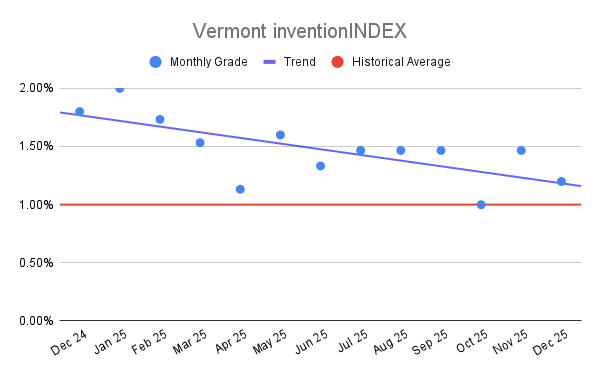 Vermont inventionINDEX December 2025:
  Vermont inventionINDEX November
