

The Vermont R&D Tax Credit is a non-refundable incentive codified under 32 V.S.A. § 5930ii. It provides a tax credit equal to 27% of the federal research credit for qualified expenditures (wages, supplies, and contract research) that are sourced specifically to Vermont. To qualify, activities must meet the federal “four-part test” and be conducted within the state. Unused credits can be carried forward for up to 10 years.
Eligible Research and Development Expenditures in Vermont comprise the specific costs of wages, supplies, and contract research incurred for activities conducted within the state that satisfy the federal four-part qualification test. These expenditures serve as the basis for a nonrefundable tax credit equal to 27 percent of the federal research credit attributable to a taxpayer’s Vermont-based innovation.
The legal and administrative architecture governing the Vermont Research and Development (R&D) Tax Credit is built upon a foundation of strict federal conformity, geographic specificity, and a unique prorated calculation method. As established under 32 V.S.A. § 5930ii, the credit is intended to foster a robust ecosystem for intellectual property development within the state by lowering the effective cost of scientific discovery and technological advancement. To navigate this incentive effectively, taxpayers and practitioners must understand the intersection of the Internal Revenue Code (IRC), Vermont state statutes, and the specific guidance issued by the Vermont Department of Taxes. This analysis explores the nuances of eligible expenditures, the rigorous qualitative thresholds of the four-part test, and the administrative mechanisms that govern the recomputation of federal credits for state-specific reporting.
Legislative Context and Statutory Purpose of 32 V.S.A. § 5930ii
The Vermont R&D Tax Credit was formally introduced to the state’s tax code in 2009, during a special legislative session, and became effective for tax years 2011 and thereafter. Its primary statutory purpose, as articulated in 32 V.S.A. § 5813(p), is to encourage business investment in research and development within Vermont and to attract and retain companies that are focused on the creation of intellectual property. By providing a state-level counterpart to the federal credit, Vermont signals its commitment to the high-technology sector, particularly in fields such as biotechnology, aerospace, and software development.
The credit underwent a significant legislative adjustment effective January 1, 2014, when the credit rate was reduced from 30 percent to 27 percent of the allowed federal credit amount. This reduction was accompanied by enhanced reporting requirements, reflecting a legislative desire to balance economic incentives with fiscal transparency. Under the current statute, the credit is nonrefundable, meaning it can only offset a taxpayer’s actual liability for personal income tax, corporate income tax, or business income tax. Recognizing that research-intensive companies often operate at a loss during their early years, the law provides a generous 10-year carryforward period for any unused credit portions.
The Meaning of Eligible Research and Development Expenditures
In the context of the Vermont tax credit, “Eligible Research and Development Expenditures” are defined by their direct relationship to the federal concept of “Qualified Research Expenses” (QREs) as set forth in 26 U.S.C. § 41. For an expenditure to be considered “eligible” in Vermont, it must meet two distinct criteria: it must qualify under federal law as a QRE, and it must be “made within this State”. This creates a geographical nexus requirement that distinguishes Vermont’s state credit from the federal credit’s broader national and territorial scope.
Classification of Expenditures
Eligible expenditures are broadly categorized into three types: in-house research wages, supplies used in research, and contract research expenses. Each category is subject to specific definitions and limitations drawn from federal regulations and reinforced by state guidance.
| Expenditure Category | Federal Definition (IRC § 41) | Vermont Eligibility Requirement |
|---|---|---|
| Wages | Remuneration for qualified services as defined in IRC § 3401(a). | Wages paid for services performed physically in Vermont. |
| Supplies | Tangible property (non-depreciable) used in qualified research. | Supplies consumed or utilized in Vermont-based research activities. |
| Contract Research | 65% of amounts paid to third parties for research (75% for consortia). | Payments for research activities performed within Vermont borders. |
Wages typically represent the most substantial portion of an R&D claim. Under Vermont guidance, these are defined by conformity to IRC § 3401(a) and must be paid to employees who are directly involved in the conduct, supervision, or support of research activities. For example, if a software engineer is developing a new algorithm while working from a remote office in Burlington, their wages are eligible; however, if the same engineer relocates to a branch in New Hampshire, their wages cease to be eligible for the Vermont credit from the date of the move, regardless of the fact that the work continues to benefit a Vermont-based corporation.
Supplies must be tangible property, excluding land and improvements to land, and cannot be of a character subject to the allowance for depreciation. This exclusion is critical, as it differentiates R&D expenditures from capital investments. While a specialized computer used to run simulations is a depreciable asset and thus excluded, the specific materials consumed during the testing of a physical prototype would qualify as eligible supplies.
Contract research expenses are eligible at 65 percent of the actual amount paid to third-party vendors, provided the vendor conducts the research in Vermont. This requirement places the burden of proof on the taxpayer to document where the subcontractor’s work was performed. If a Vermont company hires a consulting firm in New York to conduct laboratory testing, those expenses may qualify for the federal credit but are ineligible for the Vermont credit because the activity was not conducted “within this State”.
The Federal Four-Part Test: Qualitative Requirements
Eligibility for the Vermont R&D credit is not merely a matter of financial record-keeping; it requires that the underlying activities pass the rigorous “four-part test” established by the Internal Revenue Service (IRS) and adopted by the Vermont Department of Taxes.
The Permitted Purpose Test
The research must be undertaken for the purpose of discovering information that is intended to be useful in the development of a new or improved “business component” of the taxpayer. A business component is defined as any product, process, computer software, technique, formula, or invention that is held for sale, lease, or license, or used in the taxpayer’s trade or business. The focus must be on improving the functionality, performance, reliability, or quality of that component. Activities intended primarily for aesthetic improvements or style-based changes do not meet this threshold.
The Elimination of Uncertainty Test
The research must be intended to discover information that would eliminate “technical uncertainty” concerning the development or improvement of the business component. Uncertainty exists when the information available to the taxpayer at the outset of the project does not establish whether the taxpayer has the capability to develop the component, the method for doing so, or the appropriate final design of the component. This test distinguishes routine engineering or “plug-and-play” development from true research.
The Process of Experimentation Test
To qualify, the taxpayer must engage in a systematic process of experimentation. This process must involve the evaluation of one or more alternatives to achieve the desired result, typically through modeling, simulation, or a systematic trial-and-error methodology. Merely showing that a solution was found is insufficient; the taxpayer must demonstrate the technical steps taken to test hypotheses and refine the design.
The Technological in Nature Test
The process of experimentation must fundamentally rely on the principles of the “hard sciences,” such as the physical or biological sciences, engineering, or computer science. This requirement excludes research in the social sciences, arts, humanities, or business management techniques. For software development, this means the work must address a technical challenge in computer science (e.g., creating a more efficient data processing architecture) rather than simply automating a business process using existing, well-understood methods.
Vermont Revenue Office Guidance: The Administrative Framework
The Vermont Department of Taxes provides guidance primarily through official forms, instructions, and historical technical bulletins. The central document for claiming the R&D credit is Schedule BA-404, Tax Credits Earned, Applied, Expired, and Carried Forward. Taxpayers must complete this schedule and attach it to their state income tax return (IN-111 for individuals, BI-471 for pass-through entities, or CO-411 for corporate groups).
The Requirement for Federal Credit Approval
State guidance emphasizes that a taxpayer must first qualify for and claim the federal R&D tax credit to be eligible for the state credit. If the federal credit is disallowed upon audit, the Vermont credit will likewise be disallowed. This dependency ensures that the state does not have to maintain a separate, parallel technical review staff to evaluate the scientific merit of every claim, instead relying on the standards of the IRS.
Recomputing the Federal Credit for Vermont
A critical point of guidance is the “recomputation requirement” for taxpayers with multi-state operations. Vermont does not calculate its credit as a percentage of the actual federal credit if that federal credit was based on nationwide expenditures. Instead, the Department of Taxes requires taxpayers to perform a “hypothetical federal credit calculation” using only Vermont-sourced QREs.
The recomputation involves several distinct steps:
- Isolating Vermont QREs: Separating wages, supplies, and contract research performed in Vermont from total nationwide expenses.
- Developing a Vermont Base Amount: Calculating a state-specific “base amount” using Vermont gross receipts for the prior four years (for the Regular Method) or Vermont QREs for the prior three years (for the ASC method).
- Applying Federal Rates: Using the federal percentage (e.g., 20% for the Regular Method or 14% for the ASC) against the excess of Vermont QREs over the Vermont base.
- Applying the 27% Multiplier: Taking the result of the hypothetical federal calculation and multiplying it by 0.27 to arrive at the Vermont credit amount.
Form BA-404 and Supplemental Documentation
Departmental guidance for Schedule BA-404 specifies that taxpayers must include a copy of their Federal Form 6765, Credit for Increasing Research Activities. Furthermore, if the credit was earned through an S-Corporation, LLC, or Partnership, the entity must provide a breakdown of the credit allocation to each owner on Schedule K-1VT. For unitary affiliate groups, the guidance is even more specific: credits may only offset the tax of the specific entity that earned them, and a statement showing the separate company income and tax calculation must be attached to the consolidated return.
Comparison of Calculation Methods: Regular vs. ASC
Vermont allows taxpayers to utilize either the Regular Research Credit method or the Alternative Simplified Credit (ASC) method, consistent with the election made at the federal level. The choice of method can significantly impact the final credit value, especially for startups or companies with fluctuating research budgets.
The Regular Method Calculation
The Regular Method is generally calculated as 20 percent of the excess of current-year QREs over a base amount. The base amount is derived by multiplying the taxpayer’s “fixed-base percentage” by the average annual gross receipts for the four preceding tax years. For Vermont, the “fixed-base percentage” is the ratio of the aggregate Vermont QREs to the aggregate Vermont gross receipts for the 1984–1988 period (or a specialized formula for startups).
A critical protection for the state revenue office is the “50 percent floor”: the base amount cannot be less than 50 percent of the current-year QREs. This ensures that even high-growth companies must demonstrate a significant increase in research spending to capture the full 20 percent federal rate.
The Alternative Simplified Credit (ASC) Method
The ASC method, introduced as a simpler alternative to the Regular Method, calculates the credit as 14 percent of the current-year QREs that exceed 50 percent of the average QREs for the prior three tax years. If the taxpayer has no QREs in any of the three preceding years, the ASC rate is 6 percent of current-year QREs. Vermont conformity allows the use of the ASC, but the prior three years of data must be restricted to Vermont-only expenditures.
| Method | Hypothetical Federal Rate | Vermont Base Factor | Floor Requirement |
|---|---|---|---|
| Regular | 20% of excess. | Fixed-base % × Avg VT Gross Receipts (4 yrs). | Min 50% of current VT QREs. |
| ASC | 14% of excess. | 50% of Avg VT QREs (3 yrs). | N/A |
Comprehensive Case Study: Calculation and Application
To demonstrate the application of Vermont’s R&D tax credit guidance, consider “Green Mountain MedTech,” a fictional corporation based in Burlington with additional operations in New York. The company elected to use the ASC method on its 2024 federal return.
Phase 1: Identifying the Vermont Expenditure Base
Green Mountain MedTech spent a total of $5,000,000 on research and development activities across both locations. After an internal audit, the company isolated the following Vermont-sourced eligible expenditures:
- Wages: $1,200,000 paid to researchers located in the Burlington facility.
- Supplies: $300,000 for laboratory materials used in Vermont.
- Contract Research: $500,000 paid to a Vermont-based clinical trial organization (CTO). Under the 65% rule, only $325,000 is eligible.
- Total Vermont QREs ($QRE_VT): $1,200,000 + $300,000 + $325,000 = $1,825,000.
Phase 2: Determining the Vermont-Specific Base Amount
Using the ASC method, the company must average its Vermont QREs for the three preceding years (2021, 2022, and 2023):
- 2021 VT QREs: $1,400,000
- 2022 VT QREs: $1,500,000
- 2023 VT QREs: $1,600,000
- Three-Year Average ($Avg_VT): $1,500,000.
- Vermont Base Amount: $0.50 × 1,500,000 = 750,000.
Phase 3: Calculating the Hypothetical Federal Credit
The hypothetical federal credit ($C_hypo$) is calculated as 14 percent of the current Vermont QREs in excess of the state-specific base:
$$C_hypo = 0.14 × (QRE_VT – 750,000) \\ C_hypo = 0.14 × (1,825,000 – 750,000) \\ C_hypo = 0.14 × 1,075,000 = 150,500$$
Phase 4: Final Vermont R&D Credit Determination
The final Vermont credit ($C_VT$) is equal to 27 percent of this hypothetical federal amount:
$$C_VT = 0.27 × 150,500$$
$$C_VT = 40,635$$
This credit of $40,635 would be reported on Schedule BA-404, Line 4 (Research & Development). It would then be applied against the company’s Vermont corporate income tax liability on Form CO-411. If the company’s tax liability was only $30,000, it would use $30,000 of the credit to reduce its tax to zero and carry forward the remaining $10,635 for use in the next tax year, up to a maximum of 10 years.
Compliance, Transparency, and Public Disclosure
A unique aspect of the Vermont R&D credit is the statutory requirement for public disclosure. Under 32 V.S.A. § 5930ii(c), the Department of Taxes is mandated to publish a list every year, by January 15, containing the names of all taxpayers who claimed the credit during the most recently completed calendar year. This provision is intended to promote public oversight of tax expenditures, which are essentially the fiscal equivalent of government appropriations.
Documentation Standards for Audit Defense
Given the public nature of the credit and the high state-level rate (27%), Vermont R&D claims are subject to scrutiny. Local revenue office guidance emphasizes that taxpayers must maintain documentation that would satisfy an IRS audit under IRC § 41. This includes:
- Payroll Records: Documentation linking specific employee time to qualified projects in Vermont.
- Technical Reports: Project descriptions, white papers, or lab notebooks that demonstrate the “process of experimentation” and the “elimination of uncertainty”.
- Invoices and Contracts: Clear evidence that supplies were consumed in-state and that contract research was performed by Vermont-based entities.
The Department of Taxes focuses heavily on the “nexus” of expenditures during audits. For example, if a multi-state company allocates 50 percent of its CTO’s salary to Vermont based on the location of the headquarters, but the CTO actually works out of a laboratory in New Jersey, the department will likely disallow that portion of the claim.
Interplay with Unitary Reporting and Pass-Through Entities
Vermont requires “unitary” business groups—corporations that are part of an affiliated group with interdependent operations—to file a combined return. The application of the R&D credit in a unitary context is more restrictive than in some other states.
Unitary Affiliate Schedule (CO-421/CO-422)
Credits earned by one member of a unitary group cannot be freely shared with other members to offset their respective tax liabilities unless specifically authorized by statute. For the R&D credit, the guidance on Form BA-404 specifies that the credit “may only offset tax attributable to income earned by the entity authorized for the credit”. This means that if a research subsidiary has a loss and thus no tax liability, but the parent manufacturing entity is profitable, the parent cannot use the subsidiary’s R&D credit on a consolidated basis. The subsidiary must instead carry its credit forward for up to 10 years.
Pass-Through Treatment for S-Corps and LLCs
For pass-through entities, the R&D tax credit is not claimed at the entity level but is instead distributed to the owners (shareholders, partners, or members) in the same proportion that income or loss is distributed. These owners then claim the credit on their individual Vermont income tax returns (Form IN-111).
To facilitate this, the entity must:
- Calculate the total Vermont R&D credit using the hypothetical federal recomputation.
- Report the credit on Schedule K-1VT, identifying the specific amount earned by each owner.
- The individual owner then reports their share on Schedule IN-112 (Vermont Tax Credits and Adjustments) or Schedule IN-119 (Vermont Tax Adjustments and Nonrefundable Credits).
Historical Nuances: The Enterprise Zone R&D Credit
While the 27 percent credit under § 5930ii is the state-wide standard, historical guidance and some vendor-specific materials reference a different “R&D credit” associated with Vermont’s Enterprise Zone (EZ) program.
Distinguishing the EZ Credit from the § 5930ii Credit
The Enterprise Zone R&D credit is much more geographically restricted and follows a different calculation logic. It is typically available to businesses located in one of the 16 designated enterprise zones—areas characterized by high unemployment or low income per capita.
- EZ Credit Rate: Often cited as a 3 percent state income tax credit for the increase in annual research expenses compared to the previous two years.
- Clawback/Claim Period: The EZ credit must be claimed at 25 percent each year for four years, and the business must maintain a presence in the zone for at least three years.
For most modern technology firms, the § 5930ii state-wide credit is the preferred incentive because of its higher rate (27% of the federal credit) and its lack of strict zone-based residency requirements. However, businesses in specific rural or disadvantaged areas should evaluate whether the EZ incentives provide additional benefits that can be layered with state-wide credits.
Strategic Implications and Future Outlook
The Vermont Research and Development Tax Credit remains a cornerstone of the state’s strategy to attract intellectual-property-based companies. At 27 percent, Vermont’s prorated share of the federal credit is among the highest in the United States, positioning the state as a favorable alternative to regional competitors.
The Impact of Federal Law Changes
Because Vermont’s R&D credit is tied to IRC § 41, any changes at the federal level have a direct “ripple effect” on the state credit. For instance, the passage of the Protecting Americans from Tax Hikes (PATH) Act of 2015 made the federal R&D tax credit permanent, which in turn stabilized the long-term outlook for the Vermont credit. More recently, changes to the treatment of Section 174 expenses (requiring the amortization of research costs over five years rather than immediate expensing) have complicated the tax planning for R&D-intensive firms. While the credit remains based on Section 41 expenditures, the deduction rules under Section 174 can affect a company’s overall state taxable income and thus its capacity to utilize the nonrefundable credit.
Economic Development and Retention
State tax expenditure reports highlight that while a small number of taxpayers utilize the credit, its fiscal impact is significant in terms of supporting high-wage employment in tech and manufacturing sectors. By specifically targeting expenditures “made within this State,” the Vermont legislature has created a powerful incentive for companies not just to incorporate in Vermont, but to physically base their laboratories, testing facilities, and engineering teams within its borders.
Summary of Key Takeaways
The Vermont R&D Tax Credit offers a sophisticated mechanism for innovative companies to reduce their state tax liability. The core elements of the program include:
- Statutory Conformity: Eligibility is determined by federal IRC § 41 standards, including the rigorous four-part test for qualified research.
- Geographic Sourcing: Only expenditures (Wages, Supplies, Contract Research) sourced directly to Vermont are eligible.
- The 27% Multiplier: The state credit is equal to 27 percent of a hypothetical federal credit recomputed on Vermont-only data.
- Carryforward and Non-refundability: The credit is nonrefundable but can be carried forward for 10 years to offset future liability.
- Administrative Transparency: The names of all claimants are published annually by the Department of Taxes.
By adhering to the administrative guidance found in Form BA-404 and maintaining robust documentation of the Vermont-nexus of research activities, taxpayers can effectively leverage this incentive to support their ongoing technical and scientific initiatives within the state.
Who We Are:
Swanson Reed is one of the largest Specialist R&D Tax Credit advisory firm in the United States. With offices nationwide, we are one of the only firms globally to exclusively provide R&D Tax Credit consulting services to our clients. We have been exclusively providing R&D Tax Credit claim preparation and audit compliance solutions for over 30 years. Swanson Reed hosts daily free webinars and provides free IRS CE and CPE credits for CPAs.
Are you eligible?

Why choose us?

Pass an Audit?

What is the R&D Tax Credit?
The Research & Experimentation Tax Credit (or R&D Tax Credit), is a general business tax credit under Internal Revenue Code section 41 for companies that incur research and development (R&D) costs in the United States. The credits are a tax incentive for performing qualified research in the United States, resulting in a credit to a tax return. For the first three years of R&D claims, 6% of the total qualified research expenses (QRE) form the gross credit. In the 4th year of claims and beyond, a base amount is calculated, and an adjusted expense line is multiplied times 14%. Click here to learn more.
Never miss a deadline again

Stay up to date on IRS processes

Discover R&D in your industry

R&D Tax Credit Preparation Services
Swanson Reed is one of the only companies in the United States to exclusively focus on R&D tax credit preparation. Swanson Reed provides state and federal R&D tax credit preparation and audit services to all 50 states.
If you have any questions or need further assistance, please call or email our CEO, Damian Smyth on (800) 986-4725.
Feel free to book a quick teleconference with one of our national R&D tax credit specialists at a time that is convenient for you.
R&D Tax Credit Audit Advisory Services
creditARMOR is a sophisticated R&D tax credit insurance and AI-driven risk management platform. It mitigates audit exposure by covering defense expenses, including CPA, tax attorney, and specialist consultant fees—delivering robust, compliant support for R&D credit claims. Click here for more information about R&D tax credit management and implementation.
Our Fees
Swanson Reed offers R&D tax credit preparation and audit services at our hourly rates of between $195 – $395 per hour. We are also able offer fixed fees and success fees in special circumstances. Learn more at https://www.swansonreed.com/about-us/research-tax-credit-consulting/our-fees/



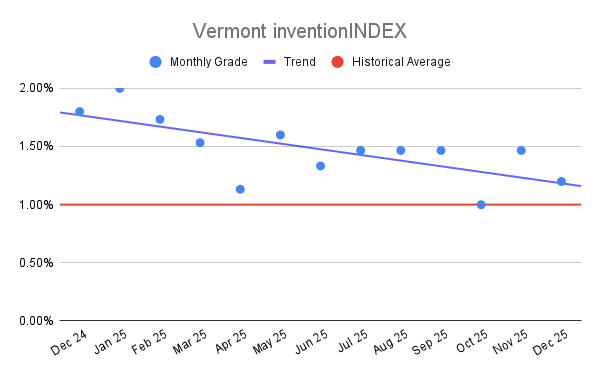 Vermont inventionINDEX December 2025:
  Vermont inventionINDEX November
