

The Vermont Research and Development tax credit is a nonrefundable incentive equal to 27 percent of the federal credit attributable to qualified research expenses physically performed within the state. It requires a recomputation of the federal credit using only Vermont-specific wages, supplies, and contract research costs to determine the final state-level benefit.
Statutory Authority and Legislative Framework
The legal architecture of the Vermont Research and Development (R&D) Tax Credit is primarily anchored in 32 V.S.A. § 5930ii, a statute designed to align state fiscal policy with federal innovation incentives while restricting the benefit to activities that contribute directly to the local economy. Under this provision, a taxpayer is eligible for a credit against Vermont income tax in an amount equal to 27 percent of the federal tax credit allowed under 26 U.S.C. § 41(a) for expenditures "made within this State". This specific phrasing creates a dual-compliance burden: the taxpayer must first satisfy the rigorous requirements for the federal credit and then isolate the portion of those activities that possess a physical nexus to Vermont.
The legislative intent behind this credit, as clarified in 32 V.S.A. § 5813(p), is to encourage business investment in research and development within Vermont and to attract and retain intellectual-property-based companies. This purpose differentiates the R&D credit from other state incentives, such as the Machinery and Equipment Tax Credit, which focuses on capital investment in Rural Economic Area Partnership (REAP) zones, or the Downtown and Village Center tax credits, which focus on historic rehabilitation. The R&D credit is a specialized tool for the "knowledge economy," rewarding the performance of scientific and technological inquiry rather than the mere purchase of assets.
Historically, the credit rate was higher, set at 30 percent for claims prior to January 1, 2014, before being adjusted to the current 27 percent rate. Despite this adjustment, Vermont’s rate remains one of the highest prorated shares of the federal credit in the United States, which serves as a competitive signal to tech and manufacturing sectors. The administrative oversight of the credit is handled by the Vermont Department of Taxes, which is mandated by law to publish a transparency list by January 15 of each year containing the names of all taxpayers who claimed the credit in the preceding calendar year.
The Meaning of Activities Conducted in the State
The phrase "activities conducted in the state" is the functional heart of the Vermont R&D tax credit. While the federal credit applies to qualified research conducted anywhere within the United States, Vermont limits its incentive to the geographic boundaries of the state. This restriction necessitates a precise definition of what it means for research to be "conducted" or "made within" Vermont.
Physical Presence and Human CapitalThe most significant component of "activities conducted in the state" relates to wages. In the eyes of the Vermont Department of Taxes, research is conducted where the employee is physically standing at the time the work is performed. This creates a strict geographic requirement for the labor component of Qualified Research Expenditures (QREs).
| Expenditure Type | Federal Definition (IRC § 41) | Vermont Geographic Requirement |
|---|---|---|
| Wages | Salaries for performing, supervising, or supporting research. | Must be paid for work physically performed within Vermont. |
| Supplies | Tangible property (other than land or improvements) used in research. | Must be consumed or used within a Vermont facility. |
| Contract Research | 65% (or 75%) of amounts paid to third parties for research. | The contractor's research activities must physically occur in Vermont. |
| Computer Leases | Costs for computers used in qualified research. | The computer or equipment must be located in Vermont. |
In an era of increasing labor mobility, this definition poses challenges for Vermont-based companies with remote workforces. If a Burlington-based software firm employs a lead developer living in New Hampshire, the developer’s wages, while eligible for the federal R&D credit, are excluded from the Vermont credit because the "activity" of coding and testing is not being conducted within the state’s jurisdiction. Conversely, a multi-national corporation with no headquarters in Vermont can claim the credit for its specialized lab in Montpelier, as the physical performance of the research occurs there.
The Four-Part Test in the Vermont ContextVermont adheres strictly to the federal "four-part test" to determine if an activity is qualified, but adds the geographic filter to each part. For an activity to be "conducted in the state," it must meet the following criteria while being performed in Vermont:
Permitted Purpose: The research must be intended to create a new or improved business component in terms of function, performance, reliability, or quality. If the design phase occurs in Vermont but the performance testing occurs in a wind tunnel in Ohio, only the design phase activities are "conducted in the state".
Elimination of Uncertainty: The activity must seek to discover information that would eliminate technical uncertainty concerning the development or improvement of the business component. The technical uncertainty must be resolved by personnel or resources located in Vermont.
Process of Experimentation: The taxpayer must engage in a systematic process of evaluating alternatives through testing, modeling, or trial and error. In Vermont, this often applies to the development of prototypes or the iteration of software code within the state's borders.
Technological in Nature: The research must fundamentally rely on principles of physical science, biological science, engineering, or computer science. Vermont's tech and manufacturing sectors are the primary users of the credit because their core activities align with these scientific disciplines.
State Revenue Office Guidance and Administrative Requirements
The Vermont Department of Taxes provides detailed guidance on the administrative steps required to claim the credit, primarily through instructions for Schedule BA-404 and supplemental forms. The overarching principle of this guidance is "recomputation."
The Recomputation of the Federal CreditUnlike some states that allow a simple percentage of the federal credit total, Vermont requires taxpayers to recompute a "hypothetical" federal credit. This process is essential because the federal credit is calculated based on incremental growth in research spending across the entire United States. To find the Vermont benefit, the taxpayer must strip away all non-Vermont data and run the federal formulas (either the Regular method or the Alternative Simplified Credit method) using only Vermont-specific inputs.
According to the instructions for Form BA-404, if a federal credit was earned based on expenditures both in and out of Vermont, the taxpayer must provide a breakdown of the expenditure amounts and a recomputed credit calculation. This recomputation includes:
- Identifying Vermont-only QREs for the current year.
- Identifying Vermont-only QREs and, if using the regular method, Vermont-only gross receipts for the base period (typically the prior four years).
- Applying the federal credit formula to these Vermont-specific figures to arrive at a "Vermont-allowed federal credit".
- Multiplying that amount by 27 percent.
Filing for the credit requires a high level of transparency. Taxpayers are required to include a copy of Federal Form 6765, "Credit for Increasing Research Activities," with their Vermont return. The department also emphasizes that if a taxpayer has received grants or assistance from any other public or private source (such as federal research grants), the expenditure amount for the credit calculation must be adjusted downward to account for that assistance.
The primary forms used for this process include:
- Form BA-404: This is the master schedule for all tax credits, where the R&D credit is listed on Line 1.
- Form BA-406: Used by pass-through entities to allocate the earned credit among various owners or partners.
- Schedule IN-119: Used by individual taxpayers to claim their share of the credit on their personal income tax return.
- Form BI-471: The business income tax return where the credit is ultimately applied.
Impact of Federal Tax Law Changes (2022-2026)
The Vermont R&D credit is inextricably linked to federal law, which means shifts in federal policy have profound implications for Vermont taxpayers. Two major federal developments—the Tax Cuts and Jobs Act (TCJA) of 2017 and the subsequent Reconciliation Act of 2025—have fundamentally altered the timing and calculation of research benefits.
Section 174 CapitalizationStarting in 2022, federal law changed to require the capitalization and amortization of research and experimental expenditures over five years (or fifteen years for foreign research), rather than allowing an immediate deduction in the year incurred. This federal change "flows through" to Vermont because the state uses federal taxable income as its starting point and has not decoupled from Section 174.
While capitalization affects the deduction of expenses, it does not directly change the credit calculation, though it creates a significant cash-flow burden for Vermont innovation companies. The IRS also modified Form 6765 for tax year 2024 to include Section E, where taxpayers must indicate the number of business components and if QREs were determined under the ASC 730 Directive. Vermont taxpayers must ensure their recomputed Vermont credit documentation mirrors these new federal reporting standards to avoid audit discrepancies.
The Reconciliation Act of 2025The Reconciliation Act of 2025 restored the pre-TCJA treatment for domestic research and experimental expenses, allowing them to be deducted immediately in the year incurred. Legislative analysis in Vermont suggests this change will cause a short-term reduction in state revenue as taxpayers deduct expenses right away. However, it is expected to stabilize the R&D environment. The memorandum from the Vermont Office of Legislative Counsel notes that while the federal deduction changes, the Vermont credit (the 27 percent incentive) may remain relatively unaffected because most taxpayers claim the full federal credit and use the basis adjustment for domestic expenditures.
Comparative Analysis of Credit Methods
The choice between the Regular Research Credit method and the Alternative Simplified Credit (ASC) method is a critical decision for Vermont taxpayers. Vermont generally requires that the method used for the state recomputation match the method elected on the federal return.
Methodological Differences in the Vermont ContextThe Regular Method requires a "fixed-base percentage," which for many companies involves looking back at the ratio of research expenses to gross receipts from 1984–1988 or using specialized startup rules. For a Vermont recomputation, this fixed-base percentage must be calculated using only Vermont-sourced QREs and Vermont-sourced gross receipts.
The ASC Method is often more attractive because it only requires data from the prior three tax years. For Vermont purposes, the "base" for the ASC is 50 percent of the average of the three prior years' Vermont QREs.
| Metric | Regular Credit Method | Alternative Simplified Credit (ASC) |
|---|---|---|
| History Required | Extensive (often back to the 1980s). | Prior 3 years. |
| Vermont Base | VT Fixed-base % × Avg. VT Gross Receipts. | 50% of 3-year avg. VT QREs. |
| Federal Rate | 20% of incremental QREs. | 14% of incremental QREs. |
| VT Rate (Effective) | 5.4% of recomputed incremental QREs (27% × 20%). | 3.78% of recomputed incremental QREs (27% × 14%). |
While the Regular Method has a higher nominal rate, the difficulty of establishing a Vermont-only historical base often makes the ASC the default choice for modern tech companies and startups.
Detailed Application: The Case of Green Mountain Aerospace
To visualize the interplay between state and federal rules, consider Green Mountain Aerospace (GMA), a hypothetical engineering firm located in Rutland, Vermont, that specializes in drone propulsion systems.
Project Composition and Geographic BreakdownIn the current tax year, GMA spent $2,000,000 on a project to develop a new hydrogen-based drone engine. The expenditures were categorized as follows:
- Vermont-Based Engineering Wages: $1,200,000 for a team working in Rutland.
- Remote Software Development (California): $300,000 for a consultant in San Jose.
- Laboratory Supplies (Rutland): $100,000 for specialized fuel and components.
- Third-Party Testing Contract (Middlebury College): $100,000 for aerodynamic testing.
- Third-Party Testing Contract (MIT, Massachusetts): $300,000 for combustion analysis.
GMA must first determine which of these federal QREs were "made within the state" of Vermont.
Wages: Only the Rutland team qualifies ($1,200,000). The California consultant is excluded from the Vermont base but remains in the federal base.
Supplies: The fuel and components used in Rutland qualify ($100,000).
Contract Research: The Middlebury contract is 65% includable ($65,000) because the work happened in Vermont. The MIT contract is excluded from the Vermont base because the activity was conducted in Massachusetts.
Total Vermont QREs: $1,365,000.
Step 2: Establish the Vermont Base (ASC Method)Assuming GMA's Vermont QREs for the three preceding years were $1,000,000, $1,100,000, and $1,200,000.
- 3-Year Average VT QRE: $1,100,000.
- Base (50% of Average): $550,000.
- Current VT QREs: $1,365,000.
- Amount over Base: $815,000.
- Hypothetical Federal Credit: $815,000 × 14% = $114,100.
- Final Vermont Credit: $114,100 × 27% = $30,807.
GMA has a Vermont tax liability of $20,000. They apply $20,000 of the credit to zero out their current year tax. The remaining $10,807 is carried forward and can be used to offset Vermont income tax for up to ten years.
Unitary Groups, Pass-Throughs, and Composite Filing
The Vermont R&D credit behaves differently depending on the legal structure of the taxpayer. The Department of Taxes has established specific guidance for unitary groups and pass-through entities to ensure the credit is applied correctly without being duplicated.
Unitary Business GroupsFor a unitary group—a group of related corporations that are sufficiently interdependent to be treated as a single taxpayer—Vermont requires combined reporting on Form CO-411. The group completes one Schedule BA-404 for the entire unitary group. However, they must attach a supporting statement that breaks down the credit earned by each individual entity within the group. This is critical because only the entities with physical activities in Vermont generate the credit, but the group can potentially use those credits to offset the combined group liability, subject to apportionment rules.
Pass-Through Entities (S-Corps, Partnerships, LLCs)The credit earned by a pass-through entity is not claimed on the entity's own return (BI-471). Instead, it is distributed to the owners or partners based on their ownership percentage. Each owner receives a Schedule BA-406, which documents their share of the credit. The owners then claim the credit on their personal income tax returns (IN-111), using Schedule IN-119.
If a pass-through entity has non-resident owners and elects to pay tax on their behalf at the "composite level," the credit is applied on Schedule BI-473, Line 23. This mechanism ensures that even non-resident owners of a Vermont-based research firm can benefit from the credit, provided the research activity itself occurred within the state.
Special Zones and Strategic Incentives
Vermont also integrates the R&D credit with geographic-specific programs like the Enterprise Zone (EZ) Program. These zones are designated areas characterized by high unemployment, low per capita income, or slow population growth.
Enterprise Zone R&D CreditsIn certain contexts, the EZ program provides enhanced or specific R&D incentives to encourage investment in these distressed areas. To qualify for R&D credits under the EZ program, businesses must typically maintain a presence in the zone for at least three years. The process involves:
- Submitting a pre-certification application to the local enterprise zone administrator.
- Completing an online certification application once activities are underway.
- Receiving a tax credit certificate that replaces standard forms like DR0074 or DR0076.
This targeted approach ensures that the R&D credit serves not just as a general incentive for innovation, but as a tool for regional economic revitalization.
Audit Risks and Documentation Best Practices
Because of its high value (27 percent) and the requirement of public disclosure, the Vermont R&D tax credit is a frequent subject of departmental review. The Department of Taxes focuses primarily on "proration accuracy"—ensuring that the taxpayer has correctly excluded non-Vermont expenses.
Common Audit PitfallsContract Research Nexus: Claiming 65% of a contract paid to a firm in Boston or Montreal. Audits will look for the location where the contractor performed the work.
Supply Diversion: Purchasing supplies in Vermont but using them at a secondary facility in another state.
Supervisory Wage Overstatement: Claiming the full wages of a manager who oversees both a Vermont lab and an out-of-state lab. Only the portion of time spent supervising Vermont-based research is eligible.
Grant Funding Failure: Neglecting to subtract federal or state grant amounts from the basis of the credit.
Record-Keeping StandardsTaxpayers should maintain a "Nexus Log" or a project-based time-tracking system that explicitly records the physical location of employees. For supplies, maintaining invoices with Vermont delivery addresses and project-consumption logs is recommended. For contract research, taxpayers should request a "Letter of Performance Location" from their contractors to substantiate that the services were conducted within Vermont.
The retention period for these records should be significantly longer than the standard federal requirement. Since unused credits can be carried forward for ten years, a credit earned in Year 1 and applied in Year 10 may be audited in Year 13. Therefore, documenting the Year 1 activities is a long-term compliance obligation.
Public Transparency and the Annual RP-1298 Report
One of the most distinctive features of 32 V.S.A. § 5930ii is the transparency mandate. Unlike federal tax returns, which are strictly confidential, the names of Vermont R&D credit claimants are public record. Each year, the Department of Taxes publishes the "Vermont Research and Development Tax Credit List" (Report RP-1298).
This report serves multiple purposes. For the legislature, it provides a means to evaluate the "return on investment" of the credit by seeing which companies are utilizing it and where they are located. For the public, it ensures that significant tax expenditures are being directed toward real businesses performing real research. For the business community, it creates a de facto registry of the state's most innovative firms, which can be useful for benchmarking and economic analysis.
The published list typically includes:
- The name of the individual or entity claiming the credit.
- The calendar year in which the credit was claimed.
Taxpayers who are concerned about privacy should be aware that claiming the credit is an implicit waiver of confidentiality regarding their identity as a claimant, though the specific dollar amount of the credit and the details of the research remain protected under standard tax secrecy laws.
Final Thoughts: Strategic Value of the Vermont R&D Credit
The Vermont Research and Development tax credit represents a sophisticated interplay between federal conformity and state-level geographic protectionism. By offering a 27 percent credit—one of the highest in the nation—Vermont provides a robust incentive for companies to anchor their high-value research activities within the state. However, the rigorous "conducted in the state" requirement means that this is not a "free" benefit; it requires precise accounting and a strategic commitment to Vermont-based labor and resources.
The recomputation requirement acts as a filter, ensuring that state revenue is only "spent" on activities that have a direct, localized economic impact. For modern enterprises navigating the complexities of remote work and global supply chains, the Vermont R&D credit demands a high degree of administrative discipline. However, for those who can successfully demonstrate that their innovation is truly "Made in Vermont," the credit provides a powerful mechanism to reduce tax liability and fund the next generation of technological advancement. As federal law continues to evolve through 2026 and beyond, the Vermont credit remains a stable and valuable pillar of the state's economic development strategy.





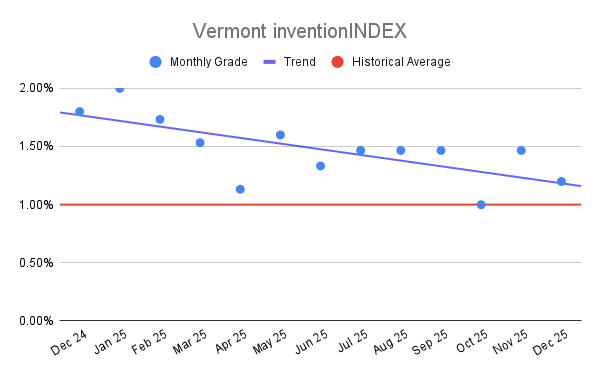 Vermont inventionINDEX December 2025:
  Vermont inventionINDEX November
