

Quick Answer: Vermont R&D Tax Credit
The Vermont Research and Development Tax Credit offers a nonrefundable incentive equal to 27% of the federal R&D tax credit recomputed for expenditures incurred specifically within Vermont. To qualify, taxpayers must apply the federal four-part test under IRC § 41 to their Vermont-based activities. Eligible expenses include wages for services performed in Vermont, supplies used in the state, and contract research. Unused credits can be carried forward for up to 10 years.
The Vermont Research and Development Tax Credit provides a nonrefundable incentive equal to 27 percent of a recomputed federal credit based on qualified expenditures made within the state. This credit requires taxpayers to apply the rigorous standards of Internal Revenue Code Section 41 specifically to activities and expenses incurred within Vermont’s borders.
The integration of state-level tax incentives with federal statutory frameworks creates a sophisticated environment for corporate tax planning and economic development. At the heart of this intersection in the State of Vermont is the relationship between Internal Revenue Code (IRC) § 41 and 32 V.S.A. § 5930ii. The federal credit, established to incentivize "increasing research activities," serves as the technical and definitional foundation upon which Vermont has built its own localized incentive. However, the Vermont credit is not a simple percentage of the federal amount reported on a taxpayer’s national return. Rather, it requires a surgical re-examination of the taxpayer’s research portfolio to isolate those activities with a specific Vermont nexus. This process involves a "hypothetical federal credit" re-computation, where the taxpayer must demonstrate that their Vermont-based expenditures meet the federal "four-part test" and satisfy all QRE (Qualified Research Expense) criteria as if the state were a standalone tax jurisdiction.
The Statutory Architecture of Internal Revenue Code Section 41
Internal Revenue Code Section 41 represents the primary federal mechanism for subsidizing private-sector innovation. Its complexity arises from the necessity of distinguishing between routine business activities and genuine scientific or technological advancement. For Vermont taxpayers, understanding § 41 is the mandatory first step, as the state credit is explicitly tethered to the "federal tax credit allowed in the taxable year" under 26 U.S.C. § 41(a).
Legislative Intent and EvolutionThe research credit was originally introduced as part of the Economic Recovery Tax Act of 1981. Its purpose was to reverse the decline in United States research and development spending by providing a direct tax offset for incremental investment in innovation. After decades of being a temporary provision subject to frequent expirations and retroactive renewals, the credit was made permanent by the Protecting Americans from Tax Hikes (PATH) Act of 2015. This permanence provided the stability necessary for states like Vermont to develop long-term incentive programs based on federal standards without the constant threat of the underlying statutory engine disappearing.
The General Rule for Credit DeterminationUnder IRC § 41(a), the research credit is calculated as the sum of several components. The most common component for a typical trade or business is 20 percent of the excess of the qualified research expenses for the taxable year over the "base amount". The "base amount" is a critical variable designed to ensure the credit only rewards increases in research spending rather than existing, baseline activities.
The Code provides two primary avenues for this calculation, each with its own methodology for determining the base amount. These methods are mirrored in Vermont’s reporting requirements, as the state allows taxpayers to use either the Regular Research Credit (RRC) method or the Alternative Simplified Credit (ASC) method, provided it aligns with their federal filing.
| Federal Calculation Method | Basis of Calculation | Statutory Reference |
|---|---|---|
| Regular Research Credit (RRC) | 20% of QREs over a base amount determined by historical fixed-base percentages and average gross receipts. | IRC § 41(a)(1) |
| Alternative Simplified Credit (ASC) | 14% of QREs that exceed 50% of the average QREs for the three preceding taxable years. | IRC § 41(c)(4) |
The choice between these methods can have profound implications for the resulting Vermont credit, especially for companies with significant historical research expenditures or those experiencing rapid growth in their Vermont-based operations.
The Technical Definitions of Qualified Research
To claim the Vermont credit, a taxpayer must first prove that their activities constitute "qualified research" under IRC § 41(d). This is determined by the application of a rigorous four-part test. Revenue office guidance from both the IRS and the Vermont Department of Taxes emphasizes that this test is applied at the level of the "business component," which includes products, processes, software, techniques, formulas, or inventions.
The Four-Part Test FrameworkFor any activity to qualify, it must satisfy all four of the following criteria. Failure to meet even a single part of the test disqualifies all associated costs from being included in the credit calculation.
- The Section 174 Test (Permitted Purpose): The expenditure must qualify as a research and development cost in the "experimental or laboratory sense." This means the activity must be intended to discover information that would eliminate uncertainty concerning the development or improvement of a business component. The goal must be to improve functionality, performance, reliability, or quality.
- Elimination of Uncertainty: Uncertainty exists if the information available to the taxpayer at the outset of the project does not establish the capability or method for developing or improving the product, or the appropriate design of the product. It is important to note that the taxpayer does not need to succeed in eliminating the uncertainty; the intent and the process are the qualifying factors.
- Process of Experimentation: The taxpayer must engage in a systematic process designed to evaluate one or more alternatives to achieve the desired result. This typically involves modeling, simulation, systematic trial and error, or other scientific methods. At least 80 percent of the activities must be part of this process of experimentation.
- Technological in Nature: The process of experimentation must fundamentally rely on the principles of the "hard sciences," such as engineering, physics, biological science, or computer science. Activities based on the social sciences, arts, humanities, or management techniques are explicitly excluded.
IRC § 41(d)(4) provides a specific list of activities that, despite potentially involving high costs, are prohibited from being treated as qualified research. These exclusions are strictly followed by Vermont auditors.
- Research after Commercial Production: Any activity conducted once the business component is ready for commercial sale or use.
- Adaptation of Existing Components: Tailoring a product to a specific customer's requirement without new technical innovation.
- Duplication: "Reverse engineering" an existing component from blueprints or physical examination.
- Surveys and Studies: Market research, efficiency surveys, management studies, or routine data collection.
- Foreign Research: Any research conducted outside the United States or its possessions. For Vermont purposes, this is further narrowed to exclude research conducted outside of Vermont.
- Funded Research: Any research to the extent it is funded by a grant, contract, or other person or governmental entity. Vermont specifically requires the basis of the credit calculation to be adjusted downward for any such assistance.
Categorization of Qualified Research Expenses (QREs)
Once an activity is determined to be a "qualified research activity" (QRA), the costs associated with that activity must be categorized as QREs under IRC § 41(b). Only four specific types of expenses are eligible for inclusion in the credit base.
Wage ExpensesWages are often the largest component of the R&D tax credit. Under IRC § 41(b)(2)(D), "wages" are defined by reference to Section 3401(a), encompassing all remuneration for services performed by an employee. For the credit, these must be "qualified services," which include:
- Direct Engagement: The actual performance of research (e.g., a scientist in a lab or a software engineer writing code).
- Direct Supervision: The immediate management of researchers (e.g., a project manager overseeing a technical team).
- Direct Support: Activities that directly aid the research (e.g., a lab technician cleaning equipment or a person compiling research data).
Vermont requires that these wages be paid to employees for services performed within the state. The "substantially all" rule applies here as well: if an employee spends 80 percent or more of their time on qualified services, 100 percent of their wages may be included in the QRE pool.
Supplies and Raw MaterialsSupplies used in the conduct of qualified research are eligible, provided they are not land or improvements to land and are not of a character subject to the allowance for depreciation. This typically includes chemicals, prototype materials, and items consumed during testing. For Vermont taxpayers, these supplies must be used at a Vermont-based research facility.
Contract Research ExpensesUnder IRC § 41(b)(3), contract research represents payments to third parties for qualified research. Only 65 percent of the amount paid is generally included in the QRE calculation to account for the contractor's overhead and profit, which do not directly constitute research labor. For payments to certain research consortia, this figure increases to 75 percent. In the Vermont context, the contractor must be performing the research on behalf of the taxpayer, and the taxpayer must retain the economic risk and the rights to the research results.
Computer Usage CostsThe fourth category includes amounts paid to another person for the right to use computers in the conduct of qualified research. In modern practice, this is increasingly applied to cloud computing costs, such as Amazon Web Services (AWS) or Microsoft Azure, provided the servers are utilized for qualified research activities like large-scale simulations or software development environments.
The Vermont Legislative Framework: 32 V.S.A. § 5930ii
While IRC § 41 provides the technical definitions, 32 V.S.A. § 5930ii provides the authority and specific parameters for the Vermont state credit. This statute was enacted to encourage business investment within Vermont and to attract and retain intellectual-property-based companies.
Statutory Terms and RatesThe statute stipulates that a Vermont taxpayer is eligible for a credit against the tax imposed under the state's income tax chapter in an amount equal to 27 percent of the "federal tax credit allowed in the taxable year for eligible research and development expenditures... that are made within this State".
Historically, this rate was 30 percent, but it was amended by Act 174 (2013) to its current 27 percent level, effective for tax years beginning on or after January 1, 2014. Despite this slight reduction, Vermont’s rate remains highly competitive among states that offer a research credit based on a percentage of the federal credit.
Carryforward and NonrefundabilityThe Vermont R&D credit is nonrefundable. This means it can reduce a taxpayer’s Vermont income tax liability to zero, but any excess credit cannot be claimed as a cash refund. However, the statute provides a generous carryforward provision, allowing any unused credit to be carried forward for up to 10 years. This long carryforward period is particularly beneficial for startups and R&D-heavy firms that may not have immediate tax liability during their initial years of intensive development.
Public Disclosure and TransparencyA unique provision of the Vermont statute is found in § 5930ii(c), which requires the Department of Taxes to publish an annual list containing the names of the taxpayers who have claimed the credit during the most recent completed calendar year. This list must be published by January 15 of each year. This transparency requirement is a deliberate policy choice to provide public oversight of state tax incentives, distinguishing Vermont from many other jurisdictions where tax credit data is kept strictly confidential.
State Revenue Office Guidance: The Re-computation Methodology
The Vermont Department of Taxes has issued specific administrative guidance on how to calculate and report the credit. The most critical aspect of this guidance is the requirement to "re-compute" the federal credit using only Vermont-specific data. This is a rigorous process that departs from a simple apportionment of the national federal credit.
Hypothetical Federal Credit Re-computationTo claim the 27 percent credit, a taxpayer must perform a "what-if" calculation. They must determine what their federal credit (on IRS Form 6765) would be if their only operations and research activities were those conducted in Vermont. This requires:
- Isolation of Vermont QREs: Summing the wages, supplies, and contract research expenses incurred specifically within Vermont.
- Vermont-Specific Base Amount: Determining a new base amount using only Vermont gross receipts and Vermont QREs for the relevant historical periods (usually the prior four years for the Regular method or the prior three years for the ASC method).
- Applying Federal Math: Using the federal rates (20% for Regular or 14% for ASC) on the Vermont-only excess QREs to arrive at a "hypothetical federal credit".
- Final Vermont Calculation: Multiplying the hypothetical federal credit by 27 percent.
Vermont guidance is explicit regarding funded research. If a taxpayer receives grants or assistance for financing research expenditures from any other public or private source (such as SBIR/STTR grants, NASA funding, or state-level grants), the basis expenditure amount used for the credit calculation must be adjusted downward. This ensures the state is not providing a credit for activities that were already paid for by a third party.
Reporting on Schedule BA-404The primary form for this process is Vermont Schedule BA-404, "Research and Development Tax Credit." This form must be attached to the taxpayer's Vermont income tax return (Form IN-111 for individuals, BI-471 for business entities, or CO-411 for corporations).
The form requires several key columns of information to track the lifecycle of the credit:
- Column A (Prior Carryforward): Credits earned in previous years but not yet used.
- Column B (Current Year Earned): The 27 percent of the re-computed federal credit earned in the current tax year.
- Column C (Amount Applied): The portion of the total available credit used to offset the current year's tax liability.
- Column D (Carryforward to Future): The remaining balance (A + B - C) to be used in future years, not exceeding the 10-year limit.
Taxpayers must include a copy of their actual federal Form 6765 as filed with the IRS. If the federal credit was earned based on expenditures both inside and outside of Vermont, the taxpayer must also provide a detailed breakdown and the recomputed calculation showing the "Vermont-only" math.
Unitary Groups and Pass-Through Entities
The Vermont Department of Taxes provides specialized guidance for different business structures, ensuring the credit is applied correctly across various organizational types.
Unitary Businesses and Combined ReportingFor corporations that are part of a unitary group and file a combined Vermont return (Form CO-411), the group must complete and attach a single Schedule BA-404. All credit amounts are combined on this form, but a statement must be attached that breaks down the totals by individual entity.
Under Vermont's general corporate tax rules, credits are typically applied to offset the tax of the specific entity that earned the credit. If multiple entities within a unitary group have tax liability, the principal Vermont corporation reports its credits on Form CO-411, while affiliate companies report their applied credits on Schedule CO-421, "Unitary Affiliate Schedule".
Pass-Through Entities (S-Corps, Partnerships, LLCs)For pass-through entities, the R&D credit is earned at the entity level but flows through to the owners (shareholders, partners, or members) based on their ownership percentage. The entity must complete Schedule BA-404 and then allocate the credit to individual owners using Schedule BA-406, "Credit Allocation Schedule". Individual owners then claim their share of the credit on their own Vermont income tax returns (Form IN-111), typically reporting it on Schedule IN-112 or Schedule IN-119.
If an entity files a composite return for its non-resident owners, the amount of credit applied at the composite level is reported on Schedule BI-473, "Composite Schedule".
Comparative Analysis: The General R&D Credit vs. Enterprise Zone Credit
Vermont offers a secondary R&D incentive through its Enterprise Zone (EZ) Program. It is essential for tax professionals to distinguish between the two, as they cannot typically be claimed for the same expenditures without specific coordination, and they follow entirely different calculation rules.
| Attribute | General R&D Credit (32 V.S.A. § 5930ii) | Enterprise Zone (EZ) R&D Credit |
|---|---|---|
| Statutory Authority | 32 V.S.A. § 5930ii | 32 V.S.A. Chapter 151, Subchapter 11E |
| Primary Calculation | 27% of a hypothetical federal credit | 3% of the increase in annual R&D expenses |
| Geographic Scope | Statewide (conducted in Vermont) | Limited to 16 designated high-need zones |
| Timing of Benefit | Full credit recognized in year earned | Recognized 25% per year over 4 years |
| Compliance Requirement | Follow IRC § 41 standards | 3-year zone presence and pre-certification |
The General R&D Credit is the more robust and widely used incentive, as its 27% rate on a recomputed federal credit almost always yields a higher tax benefit than the 3% incremental increase credit offered in Enterprise Zones. Furthermore, the EZ credit involves a complex pre-certification and certification process through local administrators, whereas the General R&D credit is claimed directly on the tax return.
Comprehensive Case Study: Multi-State Software Manufacturer
To demonstrate the application of these rules, consider "Burlington Systems Inc." (BSI), a fictional software manufacturer headquartered in Burlington, Vermont, with a satellite engineering office in Boston, Massachusetts.
Step 1: National Federal FilingFor the current taxable year, BSI calculates its federal R&D credit using the Alternative Simplified Credit (ASC) method.
- National QREs: $4,000,000 (Total wages and supplies for VT and MA).
- Prior 3-Year Average National QREs: $3,000,000.
- Federal Calculation:
- Base Amount (50% of 3-year average): $1,500,000.
- Excess QREs ($4,000,000 - $1,500,000): $2,500,000.
- Federal Credit Allowed (14% of $2,500,000): $350,000.
BSI must now isolate its Vermont activities to determine its state credit.
- Vermont-Only QREs: $3,000,000 (Wages for VT employees and local supplies).
- Prior 3-Year Average Vermont QREs: $2,000,000.
BSI performs the hypothetical federal re-computation for Vermont:
- Vermont-Only Base Amount (50% of $2,000,000): $1,000,000.
- Vermont-Only Excess QREs ($3,000,000 - $1,000,000): $2,000,000.
- Hypothetical Federal Credit for VT (14% of $2,000,000): $280,000.
- Vermont Credit Percentage: 27%.
- Calculation (27% of $280,000): $75,600.
BSI will report $75,600 as the "Amount Earned Current Year" in Column B of Schedule BA-404. If BSI has a Vermont tax liability of $50,000, they will apply $50,000 (Column C) and carry forward the remaining $25,600 (Column D) for up to 10 years.
Documentation and Audit Preparedness
The Vermont Department of Taxes maintains a high standard for substantiating R&D tax credit claims. Given the 10-year carryforward period, records must often be maintained far longer than the standard three-year statute of limitations for income tax returns.
Contemporary Documentation RequirementsTo survive an audit, a Vermont taxpayer must maintain a "nexus" between their expenditures and their qualified research activities. Key records include:
- Project Lists and Descriptions: Technical documentation explaining how each project meets the four-part test, particularly the "process of experimentation" and "technological in nature" requirements.
- Payroll Records and Time Tracking: Evidence of the time spent by specific employees on qualified research. While the "80% rule" allows for full wage inclusion, it must be supported by credible testimony or records.
- Supply Invoices: Proof that materials were used in a laboratory or experimental sense and were not part of depreciable assets.
- Contracts and Agreements: For contract research, documentation proving the taxpayer bore the economic risk of the research and retained the intellectual property rights.
- Apportionment Schedules: Clear evidence of how multi-state expenses were divided and how the "Vermont-only" re-computation was derived.
Vermont state auditors typically focus on three primary areas during an R&D credit review:
- Nexus Verification: Ensuring the research actually occurred in Vermont. For remote employees, this can be complex; the Department generally looks at where the services were physically performed.
- Exclusion Screening: Searching for "routine" activities disguised as research, such as quality control, routine software maintenance, or customer-specific adaptations.
- Base Amount Accuracy: Verifying the gross receipts and QRE figures for the historical base period, as errors here can significantly inflate the current year credit.
The Future of the Vermont R&D Credit
The outlook for the Vermont R&D credit is shaped by federal legislative changes and state-level fiscal policy. The 2017 Tax Cuts and Jobs Act (TCJA) introduced a significant change to IRC § 174, requiring the amortization of research expenses over five years (or fifteen years for foreign research) instead of allowing an immediate deduction. While this primarily affects the deductibility of expenses, it has increased the administrative burden on taxpayers to track R&D costs more precisely, which indirectly assists in identifying the QREs for the Vermont credit.
Furthermore, Vermont’s transparency requirements mean that the credit's efficacy is constantly under public review. Annual reports showing several million dollars in credits claimed by the tech and manufacturing sectors provide evidence to the legislature of the program’s role in the state's economic strategy.
Final Thoughts
The Vermont Research and Development Tax Credit represents a sophisticated and high-value incentive that leverages the technical rigor of IRC § 41 to promote state-level innovation. By providing a 27 percent credit on a recomputed federal base, Vermont offers one of the most generous R&D subsidies in the United States. However, the requirement for a hypothetical "Vermont-only" federal re-computation, combined with strict documentation standards and public transparency, necessitates a high degree of precision in tax reporting.
For businesses operating in the Green Mountain State, the credit serves as a vital tool for offsetting the high costs of technological development. Whether through wages for Vermont engineers, supplies for local laboratories, or contract research with Vermont institutions, the credit rewards those who deepen the state’s intellectual property base. Success in claiming and sustaining the credit depends on a granular understanding of the federal four-part test and a diligent application of Vermont’s revenue office guidance as embodied in Schedule BA-404 and the associated re-computation protocols. As the state continues to refine its incentive programs, the R&D tax credit remains a cornerstone of Vermont’s commitment to a technology-driven future.
Who We Are:
Swanson Reed is one of the largest Specialist R&D Tax Credit advisory firm in the United States. With offices nationwide, we are one of the only firms globally to exclusively provide R&D Tax Credit consulting services to our clients. We have been exclusively providing R&D Tax Credit claim preparation and audit compliance solutions for over 30 years. Swanson Reed hosts daily free webinars and provides free IRS CE and CPE credits for CPAs.
Are you eligible?

Why choose us?

Pass an Audit?

What is the R&D Tax Credit?
The Research & Experimentation Tax Credit (or R&D Tax Credit), is a general business tax credit under Internal Revenue Code section 41 for companies that incur research and development (R&D) costs in the United States. The credits are a tax incentive for performing qualified research in the United States, resulting in a credit to a tax return. For the first three years of R&D claims, 6% of the total qualified research expenses (QRE) form the gross credit. In the 4th year of claims and beyond, a base amount is calculated, and an adjusted expense line is multiplied times 14%. Click here to learn more.
Never miss a deadline again

Stay up to date on IRS processes

Discover R&D in your industry

R&D Tax Credit Preparation Services
Swanson Reed is one of the only companies in the United States to exclusively focus on R&D tax credit preparation. Swanson Reed provides state and federal R&D tax credit preparation and audit services to all 50 states.
If you have any questions or need further assistance, please call or email our CEO, Damian Smyth on (800) 986-4725.
Feel free to book a quick teleconference with one of our national R&D tax credit specialists at a time that is convenient for you.
R&D Tax Credit Audit Advisory Services
creditARMOR is a sophisticated R&D tax credit insurance and AI-driven risk management platform. It mitigates audit exposure by covering defense expenses, including CPA, tax attorney, and specialist consultant fees—delivering robust, compliant support for R&D credit claims. Click here for more information about R&D tax credit management and implementation.
Our Fees
Swanson Reed offers R&D tax credit preparation and audit services at our hourly rates of between $195 – $395 per hour. We are also able offer fixed fees and success fees in special circumstances. Learn more at https://www.swansonreed.com/about-us/research-tax-credit-consulting/our-fees/



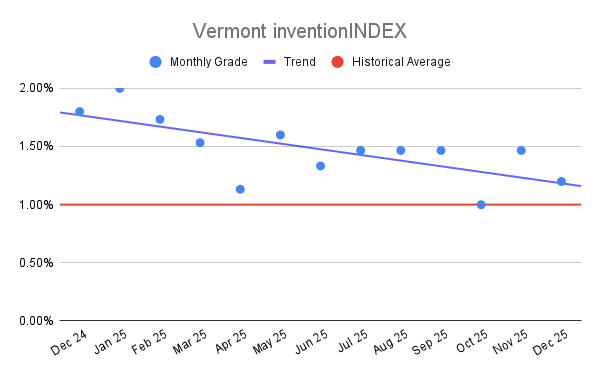 Vermont inventionINDEX December 2025:
  Vermont inventionINDEX November
