

How do partnerships qualify for the Vermont R&D Tax Credit?
[cite_start]
Partnerships qualify for the Vermont R&D tax credit as pass-through entities where tax attributes flow to partners based on their distributive share of income[cite: 3, 4]. [cite_start]To claim the credit, the entity must meet the federal “Four-Part Test” for activities conducted exclusively within Vermont[cite: 3]. [cite_start]The credit is calculated as 27 percent of the hypothetical federal tax credit for eligible expenditures made within the state[cite: 3].
Partnerships are designated as eligible pass-through entities that allow the Vermont Research and Development tax credit to flow directly to owners based on their distributive share of income[cite: 3].
[cite_start]This statutory mechanism enables innovation-driven businesses to leverage federal research standards while confining the financial incentive to qualified expenditures and activities conducted exclusively within Vermont’s borders[cite: 3].
[cite_start]The Vermont Research and Development (R&D) tax credit is a cornerstone of the state’s economic strategy, designed to attract and retain intellectual-property-based companies by lowering the effective cost of technical innovation[cite: 3]. [cite_start]For professional practitioners and business owners, understanding the nuances of how this credit interacts with pass-through entities—specifically partnerships—is essential for effective tax planning and compliance[cite: 3]. [cite_start]Unlike C-corporations, which utilize the credit to offset entity-level corporate income tax, partnerships function as conduits, passing the tax attributes of their research activities through to their partners[cite: 3]. [cite_start]This structure requires a sophisticated understanding of both the federal guidelines under Internal Revenue Code (IRC) Section 41 and the specific administrative requirements of the Vermont Department of Taxes[cite: 3].
Statutory Authority and Legislative Intent
The legal foundation of the Vermont R&D tax credit is found in 32 V.S.A. [cite_start]§ 5930ii, which establishes the eligibility of taxpayers to claim a credit against the tax imposed under Chapter 151 of Title 32[cite: 3]. The statute explicitly defines the credit as 27 percent of the amount of the federal tax credit allowed in the taxable year for eligible research and development expenditures under 26 U.S.C. [cite_start]§ 41(a) that are made within the state of Vermont[cite: 3]. [cite_start]This direct linkage to federal law ensures that Vermont’s definitions of what constitutes “research” remain consistent with national standards, while the “made within this State” provision ensures that the fiscal benefit is tethered to local economic activity[cite: 3].
The legislative intent, as articulated in 32 V.S.A. [cite_start]§ 5813(p), is to encourage business investment in research and development within Vermont and to foster an environment where technology-driven firms can thrive[cite: 3]. [cite_start]Historically, the credit was set at 30 percent, but it was adjusted to 27 percent for tax years beginning on or after January 1, 2014, as part of a broader effort to balance the state’s tax expenditure budget while remaining competitive with neighboring jurisdictions[cite: 3]. [cite_start]The nonrefundable nature of the credit means it can only be used to offset a taxpayer’s liability, making the choice of entity and the residency of the partners critical factors in determining the actual realized value of the incentive[cite: 3].
| Statutory Provision | Function and Application |
|---|---|
| 32 V.S.A. § 5930ii(a) | [cite_start]Establishes the 27% credit rate based on the federal IRC § 41 credit[cite: 3]. |
| 32 V.S.A. § 5930ii(b) | [cite_start]Authorizes a 10-year carryforward for unused credit amounts[cite: 3]. |
| 32 V.S.A. § 5930ii(c) | [cite_start]Mandates the annual publication of a transparency list of all claimants[cite: 3]. |
| 32 V.S.A. § 5813(p) | [cite_start]States the intent to attract and retain intellectual-property-based companies[cite: 3]. |
Defining Partnerships as Eligible Entities
[cite_start]In the context of the Vermont tax code and federal conformity, the term “eligible entity” follows the “check-the-box” regulations promulgated by the U.S. Treasury[cite: 3]. [cite_start]These regulations allow business entities to elect their tax classification, choosing to be treated as a corporation, a partnership, or an entity disregarded as separate from its owner[cite: 3]. [cite_start]For R&D credit purposes, a partnership is any domestic eligible entity that has two or more members and does not affirmatively elect to be treated as a corporation[cite: 3]. [cite_start]This includes traditional general partnerships, limited partnerships (LPs), and limited liability partnerships (LLPs), as well as most multi-member limited liability companies (LLCs)[cite: 3].
[cite_start]For tax purposes, the partnership is not a taxable entity under the Vermont personal income tax or corporate income tax chapters; instead, it is a pass-through entity[cite: 3]. [cite_start]The income and credits generated by the partnership flow through to the partners, who then report these items on their own Vermont tax returns[cite: 3]. [cite_start]Each partner’s share is typically determined by the partnership agreement and is generally allocated in the same proportion as the partner’s share of income or loss[cite: 3]. [cite_start]It is important to note that while the partnership itself does not pay income tax, it is liable for the Vermont Business Entity Tax, which is a minimum annual tax of $250[cite: 3].
The “taxpayer” in the context of 32 V.S.A. [cite_start]§ 5930ii is the person or entity with the actual tax liability[cite: 3]. [cite_start]In a partnership scenario, the partnership calculates the credit, but the individual or corporate partners are the “taxpayers” who ultimately claim the credit to reduce their tax due[cite: 3]. [cite_start]This distinction is critical because the credit’s limitations, such as the nonrefundability and the 10-year carryforward, apply at the partner level[cite: 3].
State Revenue Office Guidance and Administrative Procedures
[cite_start]The Vermont Department of Taxes has established a comprehensive set of forms and instructions to govern the claiming of the R&D tax credit by pass-through entities[cite: 3]. [cite_start]These administrative requirements are designed to ensure that the credit is calculated accurately based on Vermont-specific expenditures and that it is distributed correctly to the individuals who will claim it[cite: 3].
Form BI-471 and the Business Income Tax Return
[cite_start]Most partnerships and LLCs operating in Vermont are required to file Form BI-471, the Business Income Tax Return[cite: 3]. [cite_start]This form serves as the primary filing for the entity and is the mechanism through which the partnership reports its total income, Vermont-sourced income, and the $250 minimum tax[cite: 3]. [cite_start]The Department of Taxes significantly reworked the BI-471 package for tax years 2023 and beyond to improve accountability and efficiency in how pass-through income and credits are tracked[cite: 3]. [cite_start]Partnerships that have only resident owners and simple operations might occasionally qualify for the simplified Form BI-476, but if the entity is claiming or allocating complex credits like the R&D credit, the more robust BI-471 is generally required to accommodate the necessary supporting schedules[cite: 3].
Schedule BA-404: The Core Credit Tracking Mechanism
[cite_start]Schedule BA-404, titled “Tax Credits Earned, Applied, Expired, and Carried Forward,” is the essential form for any partnership engaged in R&D activities[cite: 3]. [cite_start]This form must be attached to the partnership’s income tax return if any tax credits are earned, applied, or carried forward[cite: 3]. [cite_start]For the R&D credit specifically, Line 1 of Schedule BA-404 is used to report the credit amount[cite: 3].
[cite_start]The instructions for BA-404 provide critical guidance on the “hypothetical federal credit” calculation[cite: 3]. [cite_start]If a partnership’s federal R&D credit was earned based on expenditures occurring both inside and outside of Vermont, the entity cannot simply take 27 percent of its total federal credit[cite: 3]. [cite_start]Instead, it must provide a breakdown of the expenditure amounts and a recomputed credit calculation based only on the expenditures that occurred in Vermont[cite: 3]. [cite_start]This recomputation must follow the same method (Regular or Alternative Simplified Credit) used on the federal Form 6765 but must use Vermont-only Qualified Research Expenditures (QREs) and Vermont-only gross receipts for the base period[cite: 3].
Schedule BA-406: The New Credit Allocation Schedule
[cite_start]Beginning in the 2023 tax year, the Vermont Department of Taxes introduced Schedule BA-406, “Credit Allocation Schedule,” which replaced the previous method of reporting credits directly on Schedule K-1VT[cite: 3]. [cite_start]The partnership must prepare a separate Schedule BA-406 for each shareholder, partner, or member to whom a credit is being allocated[cite: 3]. [cite_start]This schedule details the specific type of credit (e.g., R&D), the amount allocated to that specific partner, and whether the credit was earned in the current year or carried forward from a prior period[cite: 3]. [cite_start]This new requirement enhances the Department’s ability to track credits as they move from the entity to the individual taxpayers, reducing the likelihood of errors or double-claiming[cite: 3].
Schedule K-1VT and Reporting to Partners
[cite_start]The final administrative step for the partnership is the issuance of Schedule K-1VT, “Shareholder, Partner, or Member Information,” to each owner[cite: 3]. [cite_start]This form provides the partner with the information needed to file their own Vermont income tax return[cite: 3]. [cite_start]Schedule K-1VT includes the partner’s distributive share of Vermont-source income and now explicitly references the credits allocated via Schedule BA-406[cite: 3]. [cite_start]For partners who are not residents of Vermont, the K-1VT also reports any nonresident withholding payments made by the partnership on their behalf using Form WH-435[cite: 3].
The Four-Part Test in the Vermont Context
[cite_start]Vermont leverages the federal definitions for qualified research activities, which means a partnership must satisfy the IRS “Four-Part Test” for all activities included in the credit calculation[cite: 3]. [cite_start]The Revenue Office focuses its audits on whether these activities truly took place within Vermont and whether the documentation supports the technical nature of the work[cite: 3].
1. [cite_start]Technological in Nature: The research must fundamentally rely on the principles of physical or biological science, engineering, or computer science[cite: 3]. [cite_start]Vermont guidance clarifies that this excludes purely aesthetic or social science research[cite: 3].
2. [cite_start]Permitted Purpose: The activity must be intended to discover information that can be used to develop a new or improved business component, such as a product, process, software, formula, or technique[cite: 3]. [cite_start]The focus is on improving functionality, performance, reliability, or quality[cite: 3].
3. [cite_start]Elimination of Uncertainty: The partnership must intend to discover information that would eliminate technical uncertainty concerning the development or improvement of the business component[cite: 3]. [cite_start]This uncertainty must relate to the capability or method of achieving the result, or the appropriate design of the product[cite: 3].
4. [cite_start]Process of Experimentation: Substantially all of the research activities must constitute a process of experimentation[cite: 3]. [cite_start]This is a systematic process designed to evaluate one or more alternatives to achieve a result, often involving trial and error, modeling, or simulation[cite: 3].
[cite_start]Vermont guidance emphasizes that the credit is not for simple “testing” or “quality control” that occurs after a product is ready for commercial release[cite: 3]. [cite_start]Instead, the innovation must be technical and must involve technical risk at the outset of the project[cite: 3].
Qualified Research Expenditures (QREs) for Vermont Partnerships
[cite_start]Once a partnership has identified its qualified activities, it must quantify the associated expenditures that occurred within Vermont[cite: 3]. [cite_start]Only the following types of costs are eligible for the Vermont R&D credit[cite: 3]:
-
[cite_start]
- Wages: This includes the portion of an employee’s salary attributable to performing, supervising, or directly supporting qualified research in Vermont[cite: 3]. [cite_start]If an employee spends 50% of their time on qualified research in a Vermont facility, 50% of their wages are Vermont QREs[cite: 3]. [cite_start]
- Supplies: These are tangible items (other than land or depreciable property) used or consumed in the research process within Vermont[cite: 3]. [cite_start]Examples include materials for prototypes or chemicals used in laboratory testing[cite: 3]. [cite_start]
- Contract Research: Partnerships often hire third-party contractors to perform specialized research tasks[cite: 3]. [cite_start]Vermont follows the federal rule where only 65 percent of payments to contractors are considered QREs, provided the research is performed in Vermont[cite: 3]. [cite_start]This percentage increases to 75 percent for payments to certain qualified research consortia[cite: 3]. [cite_start]
- Computer Leasing: Costs for computers or equipment leased and used exclusively for research activities within Vermont can also be included[cite: 3].
A significant restriction in the Vermont guidance relates to “Assistance and Grants”[cite: 3]. [cite_start]If a partnership receives a grant from a government agency or a private source to finance its research, the partnership must adjust its expenditure basis downward by the amount of that assistance[cite: 3]. [cite_start]This prevents the state from providing a tax credit on expenditures that the business did not actually bear itself[cite: 3].
| QRE Category | Eligibility Requirements | Percentage Allowed |
|---|---|---|
| Internal Wages | [cite_start]Must be for direct research, supervision, or support in Vermont[cite: 3]. | 100% |
| Internal Supplies | [cite_start]Must be consumed in the research process in Vermont[cite: 3]. | 100% |
| Contract Research | [cite_start]Research must be performed in Vermont by a third party[cite: 3]. | 65% (75% for consortia) |
| Lease of Computers | [cite_start]Equipment must be used exclusively for research in Vermont[cite: 3]. | 100% |
Calculation Methodology: The Hypothetical Federal Credit
[cite_start]The most complex aspect of the Vermont R&D credit for partnerships is the requirement to recompute the federal credit using Vermont-only data[cite: 3]. [cite_start]This is not a simple proration of the final federal credit amount; rather, it is a full recalculation of the IRC Section 41 credit as if Vermont were the only jurisdiction where the partnership operated[cite: 3]. [cite_start]This ensures that the state credit remains proportional to the innovation happening in Vermont, regardless of what is happening in other states[cite: 3].
The Regular Method Recomputation
[cite_start]If a partnership uses the Regular Research Credit method on its federal return, it must calculate its Vermont credit by first determining its “Vermont Base Amount”[cite: 3]. [cite_start]This requires identifying the partnership’s Vermont-sourced gross receipts and Vermont-sourced QREs for the four tax years preceding the current year[cite: 3].
The formula for the hypothetical federal credit under the Regular method is:
$C_{Fed\_VT} = 0.20 \times (QRE_{Current\_VT} – Base_{VT})$
[cite_start]The Vermont Base Amount ($Base_{VT}$) is calculated using the partnership’s fixed-base percentage (capped at 16% for non-startups) multiplied by the average Vermont gross receipts for the prior four years[cite: 3]. [cite_start]Crucially, the base amount cannot be less than 50 percent of the current year’s Vermont QREs[cite: 3].
The Alternative Simplified Credit (ASC) Recomputation
[cite_start]The ASC method is often preferred by partnerships because it does not require historical gross receipts data[cite: 3]. [cite_start]If the ASC method is used, the hypothetical federal credit is 14 percent of the amount by which the current year’s Vermont QREs exceed 50 percent of the average Vermont QREs for the three preceding tax years[cite: 3].
Once the hypothetical federal credit ($C_{Fed\_VT}$) is calculated, the final Vermont credit is:
[cite_start]$C_{VT} = 0.27 \times C_{Fed\_VT}$ [cite: 3]
Pass-Through Mechanics and Individual Partner Application
[cite_start]After the partnership has calculated the total Vermont R&D credit on Schedule BA-404, the credit must be distributed to the partners[cite: 3]. [cite_start]The Vermont Department of Taxes specifies that credits are generally distributed in the same proportion that income or loss is distributed to the partners[cite: 3]. [cite_start]This distribution is documented on Schedule BA-406 and then communicated to the partners on their Schedule K-1VT[cite: 3].
Application by Individual Partners
[cite_start]Individual partners take their allocated credit from the K-1VT and report it on their own Vermont Individual Income Tax Return, Form IN-111[cite: 3]. [cite_start]Specifically, the credit is entered on Schedule IN-119, “Vermont Tax Adjustments and Nonrefundable Credits”[cite: 3]. [cite_start]Because the credit is nonrefundable, it can only reduce the partner’s tax liability to zero[cite: 3]. [cite_start]Any unused credit may be carried forward for up to 10 years[cite: 3].
Composite Filing Considerations
[cite_start]Vermont allows (and in some cases mandates) pass-through entities to file a “composite return” on behalf of their nonresident owners[cite: 3]. [cite_start]Composite filing is mandatory for entities with more than 50 nonresident shareholders, partners, or members[cite: 3]. [cite_start]If a partnership files a composite return, the R&D credit can be applied at the entity level to offset the composite tax liability[cite: 3]. [cite_start]In this case, the partnership enters the amount of credits applied on Schedule BI-473, “Composite Schedule”[cite: 3]. [cite_start]This simplifies filing for nonresident partners but often results in a higher tax rate as composite income is typically taxed at the highest marginal rate[cite: 3].
Nonresident Withholding (WH-435)
[cite_start]Partnerships with nonresident partners who are not included in a composite return must make quarterly estimated tax payments on behalf of those partners using Form WH-435[cite: 3]. [cite_start]The current withholding rate is 6.6 percent of the nonresident partner’s share of Vermont-sourced income[cite: 3]. [cite_start]The R&D credit allocated to these partners does not directly reduce the WH-435 withholding requirement at the partnership level; instead, the partners claim the credit on their personal Form IN-111 to reduce their final tax liability and potentially receive a refund of the withheld taxes[cite: 3].
Detailed Financial Example: Green Mountain Bio-Tech LP
To demonstrate the practical application of the Vermont R&D credit for a partnership, consider the case of “Green Mountain Bio-Tech LP,” a research partnership located in White River Junction, Vermont. [cite_start]The partnership consists of three partners: Partner X (a Vermont resident with 50% interest), Partner Y (a New Hampshire resident with 30% interest), and Partner Z (a Massachusetts resident with 20% interest)[cite: 3].
Phase 1: Identifying Qualified Research Expenditures
[cite_start]In the current tax year, the partnership spent a total of $1,500,000 on research wages and supplies across its multi-state operations[cite: 3]. [cite_start]Through careful tracking, the partnership identifies the following expenditures occurring strictly within Vermont[cite: 3]:
| Category | Vermont-Specific Expenditures |
|---|---|
| Research Wages (VT-based staff) | $600,000 |
| Research Supplies (VT lab) | $150,000 |
| VT-Based Contract Research ($100,000 * 65%) | $65,000 |
| Total Vermont QREs | $815,000 |
The partnership also received a $50,000 grant from a Vermont-based agricultural foundation to support a specific segment of this research[cite: 3]. [cite_start]According to state guidance, this must be subtracted from the total QREs[cite: 3].
Adjusted Vermont QREs = $815,000 – $50,000 = $765,000.
Phase 2: Calculating the Hypothetical Federal Credit
[cite_start]The partnership elects to use the ASC method on its federal Form 6765[cite: 3]. [cite_start]To recompute the credit for Vermont purposes, it looks at its adjusted Vermont QREs for the three preceding tax years[cite: 3]:
- Year -1: $600,000
- Year -2: $550,000
- Year -3: $500,000 [cite_start]
- Average VT QREs (Prior 3 Years) = $550,000 [cite: 3]
Calculating the hypothetical federal credit:
$C_{Fed\_VT} = 0.14 \times (Current\_VT\_QREs – (0.50 \times Avg\_Prior\_3Yr\_VT\_QREs))$
$C_{Fed\_VT} = 0.14 \times ($765,000 – (0.50 \times $550,000))$
$C_{Fed\_VT} = 0.14 \times ($765,000 – $275,000)$
$C_{Fed\_VT} = 0.14 \times $490,000 = $68,600.
Phase 3: Final Vermont Credit and Allocation
[cite_start]The partnership’s total Vermont R&D credit is 27 percent of this recomputed federal amount[cite: 3].
$C_{VT} = 0.27 \times $68,600 = $18,522.
[cite_start]This total is reported on the partnership’s Schedule BA-404, Line 1[cite: 3]. [cite_start]The partnership then allocates the credit to the partners based on their ownership interest[cite: 3]:
| Partner | Interest % | R&D Credit Allocation | Distribution Form |
|---|---|---|---|
| Partner X (Resident) | 50% | $9,261 | Schedule BA-406 & K-1VT |
| Partner Y (Non-Resident) | 30% | $5,557 | Schedule BA-406 & K-1VT |
| Partner Z (Non-Resident) | 20% | $3,704 | Schedule BA-406 & K-1VT |
Phase 4: Individual Claim and Carryforward
[cite_start]Partner X (Vermont Resident) owes $7,000 in Vermont income tax for the year[cite: 3]. [cite_start]They apply $7,000 of their allocated R&D credit to reduce their tax liability to zero[cite: 3]. [cite_start]The remaining $2,261 ($9,261 – $7,000) is carried forward for up to 10 years[cite: 3].
[cite_start]Partner Y (New Hampshire Resident) has Vermont-source income from the partnership and owes $4,000 in Vermont tax[cite: 3]. [cite_start]They apply $4,000 of their $5,557 credit allocation to reduce their tax to zero and carry forward $1,557[cite: 3].
Audit Risks and Compliance Strategy
[cite_start]The Vermont Department of Taxes maintains a rigorous audit program for R&D credits, focusing on the documentation of both the technical eligibility of the activities and the geographic location of the expenditures[cite: 3]. [cite_start]Partnerships are particularly scrutinized because of the complexity of their pass-through mechanics[cite: 3].
Recordkeeping Standards
[cite_start]The Department of Taxes expects partnerships to maintain a “nexus” of documentation for every research project[cite: 3]. [cite_start]This includes technical reports, project plans, lab notebooks, and software version control logs that demonstrate the “process of experimentation” and the “elimination of uncertainty”[cite: 3]. [cite_start]From a financial perspective, the partnership must have payroll records that link specific employees to specific research projects in Vermont, as well as invoices for supplies and contract research that clearly state where the work was performed[cite: 3].
The Recomputation Audit
[cite_start]A common audit pitfall for multi-state partnerships is the failure to properly recompute the federal base amount using Vermont-only data[cite: 3]. [cite_start]Auditors often find that businesses have used their nationwide gross receipts or their total nationwide fixed-base percentage when calculating the Vermont credit[cite: 3]. [cite_start]This results in an incorrect “hypothetical federal credit” and can lead to significant assessments and penalties[cite: 3]. [cite_start]Practitioners must ensure that the “Vermont-only” data used for the BA-404 recomputation is distinct and verifiable[cite: 3].
Public Disclosure and the Transparency List
[cite_start]As part of the annual compliance cycle, partnerships should be aware that their names will be published on the Vermont R&D Tax Credit transparency list[cite: 3]. [cite_start]This list, published by the Department of Taxes by January 15th each year, includes all taxpayers who have claimed the credit during the most recent calendar year[cite: 3]. [cite_start]For partnerships, this means the entity’s name will be public knowledge, which is a factor some closely-held businesses may wish to consider during their tax planning[cite: 3].
Impact of Recent Legislative and Federal Changes
[cite_start]The landscape for the Vermont R&D credit has been significantly influenced by federal tax reform and evolving state regulations[cite: 3].
IRC Section 174 Capitalization
[cite_start]A major change occurring at the federal level is the requirement under the Tax Cuts and Jobs Act (TCJA) to capitalize and amortize R&D expenses over five years (for domestic research) instead of deducting them immediately[cite: 3]. [cite_start]While this change primarily affects the timing of federal deductions, it has a ripple effect on the Vermont R&D credit because the state credit is tied to the federal credit “allowed in the taxable year”[cite: 3]. [cite_start]The Vermont Department of Taxes continues to provide guidance on how to reconcile these federal capitalization requirements with the state’s credit calculation, emphasizing that the “expenditures” used to calculate the credit on federal Form 6765 remain the basis for the Vermont 27% calculation[cite: 3].
Pass-Through Entity Tax (PTET) Workarounds
[cite_start]In response to the $10,000 federal cap on state and local tax (SALT) deductions, Vermont and many other states have enacted elective entity-level taxes for partnerships[cite: 3]. [cite_start]These “PTET workarounds” allow the partnership to pay the state tax at the entity level, which then creates a federal deduction for the entity[cite: 3]. [cite_start]When a partnership elects to be taxed at the entity level, the R&D credit can be used to offset this entity-level tax liability, providing a more direct benefit to the partners by reducing the tax paid by the partnership on their behalf[cite: 3].
Administrative Rework of Form BI-471
[cite_start]The substantial reworking of the BI-471 package in recent years reflects a trend toward more granular tracking of tax credits[cite: 3]. [cite_start]The decoupling of the credit allocation from the K-1VT (moving it to Schedule BA-406) allows the Department of Taxes to build a more sophisticated digital database of credit usage[cite: 3]. [cite_start]Partnerships must ensure that their software providers and internal accounting processes are updated to handle these new form requirements to avoid delays in processing or the denial of credits[cite: 3].
Final Thoughts
[cite_start]The Vermont R&D tax credit is a high-value incentive that requires high-level compliance[cite: 3]. [cite_start]For partnerships, the credit offers a unique opportunity to provide value to their owners while supporting technical growth within the state[cite: 3]. [cite_start]However, the conduit nature of the partnership adds layers of administrative complexity that must be managed carefully[cite: 3].
To maximize the benefit and minimize audit risk, partnerships should:
-
[cite_start]
- Maintain rigorous contemporaneous documentation that satisfies the IRS Four-Part Test for every project[cite: 3]. [cite_start]
- Isolate Vermont-specific expenditures (wages, supplies, and contract research) from multi-state operations[cite: 3]. [cite_start]
- Accurately perform the “hypothetical federal credit” recomputation required by Schedule BA-404[cite: 3]. [cite_start]
- Properly document the allocation of credits to partners using Schedule BA-406 and Schedule K-1VT[cite: 3]. [cite_start]
- Monitor the 10-year carryforward window to ensure no credits expire unused[cite: 3].
By treating the Vermont R&D credit as a technical compliance project rather than a simple accounting entry, partnerships can ensure they are fully leveraging this significant state incentive to drive innovation and support their owners’ financial health. [cite_start]The credit remains a vital part of the Vermont tax landscape, bridging the gap between high-level research and localized economic impact[cite: 3].
Who We Are:
Swanson Reed is one of the largest Specialist R&D Tax Credit advisory firm in the United States. With offices nationwide, we are one of the only firms globally to exclusively provide R&D Tax Credit consulting services to our clients. We have been exclusively providing R&D Tax Credit claim preparation and audit compliance solutions for over 30 years. [cite_start]Swanson Reed hosts daily free webinars and provides free IRS CE and CPE credits for CPAs. [cite: 4]
What is the R&D Tax Credit?
The Research & Experimentation Tax Credit (or R&D Tax Credit), is a general business tax credit under Internal Revenue Code section 41 for companies that incur research and development (R&D) costs in the United States. The credits are a tax incentive for performing qualified research in the United States, resulting in a credit to a tax return. For the first three years of R&D claims, 6% of the total qualified research expenses (QRE) form the gross credit. [cite_start]In the 4th year of claims and beyond, a base amount is calculated, and an adjusted expense line is multiplied times 14%. [cite: 4]
R&D Tax Credit Preparation Services
Swanson Reed is one of the only companies in the United States to exclusively focus on R&D tax credit preparation. [cite_start]Swanson Reed provides state and federal R&D tax credit preparation and audit services to all 50 states. [cite: 4]
If you have any questions or need further assistance, please call or email our CEO, Damian Smyth on (800) 986-4725. [cite_start]Feel free to book a quick teleconference with one of our national R&D tax credit specialists at a time that is convenient for you. [cite: 4]
R&D Tax Credit Audit Advisory Services
creditARMOR is a sophisticated R&D tax credit insurance and AI-driven risk management platform. [cite_start]It mitigates audit exposure by covering defense expenses, including CPA, tax attorney, and specialist consultant fees—delivering robust, compliant support for R&D credit claims. [cite: 4]
Our Fees
Swanson Reed offers R&D tax credit preparation and audit services at our hourly rates of between $195 – $395 per hour. We are also able offer fixed fees and success fees in special circumstances. Learn more at https://www.swansonreed.com/about-us/research-tax-credit-consulting/our-fees/[/vc_column_text]
[/vc_column][/vc_row]


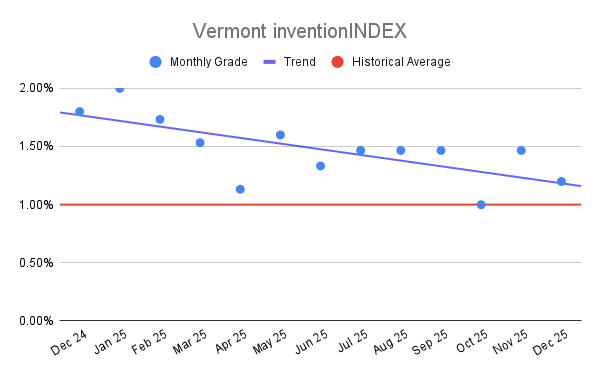 Vermont inventionINDEX December 2025:
  Vermont inventionINDEX November
