

Analytical Framework of Physical and Biological Sciences within the Vermont Research and Development Tax Credit
The Vermont Research and Development tax credit defines activities relying on physical or biological sciences as those fundamentally utilizing the principles of hard sciences to achieve a discovery. This standard ensures that qualifying innovation is grounded in tangible scientific experimentation rather than aesthetic design, routine engineering, or the application of soft sciences.
The Legislative Foundation and Statutory Intent of 32 V.S.A. § 5930ii
The Vermont Research and Development (R&D) Tax Credit is an essential instrument of the state’s economic policy, specifically engineered to cultivate a high-tech ecosystem and ensure the retention of intellectual-property-based companies within the Green Mountain State. The primary legal authority for this incentive is found in 32 V.S.A. § 5930ii, a statute that has evolved significantly to meet the shifting needs of the modern industrial landscape. Under the current legislative framework, a taxpayer is eligible for a credit against Vermont state taxes in an amount equal to 27 percent of the federal tax credit allowed for the taxable year. This specific percentage, which was adjusted from 30 percent in 2014, represents one of the highest state-level prorated rates in the United States, positioning Vermont as a competitive destination for scientific investment.
The statutory purpose of the credit is explicitly articulated in 32 V.S.A. § 5813, which emphasizes the state’s desire to encourage business investment in research and development and to attract and retain companies that drive the innovation economy. This goal is achieved by piggybacking on the rigorous standards established by Section 41 of the Internal Revenue Code (IRC). By leveraging federal definitions, Vermont maintains a consistent and predictable environment for taxpayers, while narrowing the credit’s application to expenditures made specifically within the state. The credit applies broadly across the tax code, available for use against personal income tax, business income tax, and corporate income tax.
Historically, the R&D credit landscape in Vermont was governed by different sections, including the now-repealed 32 V.S.A. § 5930z, which was phased out in 2019. The transition to § 5930ii consolidated the credit’s mechanics and aligned it more closely with the federal Credit for Increasing Research Activities. This alignment requires that any entity claiming the Vermont credit must first be eligible for and claim the federal R&D credit under IRC § 41. This dual-layer requirement ensures that only high-quality, scientifically valid research activities—those that meet the stringent federal Four-Part Test—benefit from the state’s fiscal support.
The administrative oversight of this program is managed by the Vermont Department of Taxes, which enforces strict transparency requirements. Unlike many other states that keep tax credit data confidential, Vermont law requires the Department to publish an annual list of all taxpayers who have claimed the R&D credit. This list, updated every January 15, includes the names of companies and individuals, providing the public with a clear view of how these tax expenditures are utilized to bolster the state’s technological base.
The Meaning of Physical or Biological Sciences in a Tax Context
The requirement that research be technological in nature serves as the primary gateway for physical and biological sciences into the R&D tax credit framework. For an activity to meet this criterion, the process of experimentation used to discover information must fundamentally rely on the principles of the hard sciences. This distinction is critical as it excludes activities based on the soft sciences, such as economics, sociology, or psychology, which are deemed ineligible for the credit.
Physical Sciences: Matter, Energy, and Material Transformation
In the context of the Vermont R&D credit, the physical sciences encompass disciplines that study non-living systems, including physics, chemistry, and materials science. For a manufacturing firm in Vermont, the application of physical science often involves the study of matter and its changes. When a company experiments with new chemical compositions to create a more durable polymer or utilizes thermodynamic principles to optimize the heat-transfer efficiency of a heating system, they are engaging in physical science.
The federal Treasury Regulations under § 1.41-4 clarify that a taxpayer may satisfy the technological in nature requirement by employing existing technologies and relying on established principles of the physical sciences. This means that the company does not need to invent a new law of physics; rather, it must apply physical laws to resolve a specific technical uncertainty regarding a product’s design or capability.
| Physical Science Discipline | Application in Vermont R&D | Technical Uncertainty Examples |
|---|---|---|
| Chemistry | Polymer synthesis, chemical coating development, and metallurgical refinement. | Will the new chemical bond maintain stability at extreme temperatures? |
| Physics | Optical sensor development, quantum computing research, and structural acoustics. | Can the sensor detect light at the required nanometer resolution in high-noise environments? |
| Materials Science | Developing high-purity alloys for aerospace or advanced composite materials. | Is the material’s fatigue life sufficient for the intended cyclical stress load? |
| Thermodynamics | Optimizing internal combustion for efficiency or cooling systems for electronics. | What is the optimal heat sink geometry to prevent thermal throttling under peak load? |
The distinction between physical science and routine engineering is often the focal point of state audits. Routine engineering, which relies on standard calculations, existing data, and known codes, is generally excluded. To qualify, the activity must move beyond the common knowledge of skilled professionals in the sense that the answer to the technical problem is not readily available through standard practice and requires a dedicated process of experimentation.
Biological Sciences: Life Processes and Molecular Innovation
Biological sciences, frequently referred to in tax guidance as Life Sciences, involve the study of living organisms and their biological processes. Vermont has a robust life sciences sector, ranging from agricultural biotechnology to pharmaceutical development. For these firms, the biological science requirement is met when research focuses on agriscience, biology, botany, zoology, microbiology, or biochemistry.
In the biological realm, the Process of Experimentation often takes the form of laboratory trials, genomic sequencing, or protein analysis. When a Vermont agriscience company seeks to develop a new strain of cold-hardy crops, the research fundamentally relies on the biological principles of genetics and botany. This research is intended to discover information that is not currently known to the taxpayer regarding the biological interaction of the plant with its environment.
| Biological Science Discipline | Application in Vermont R&D | Technical Uncertainty Examples |
|---|---|---|
| Microbiology | Fermentation process optimization for enzyme production or vaccine development. | Will the specific microbial strain produce the desired yield of metabolite? |
| Biochemistry | Investigating molecular interactions for drug delivery systems or metabolic engineering. | Does the protein-ligand binding occur with sufficient affinity for therapeutic effect? |
| Agriscience/Botany | Genetic modification for pest resistance or drought tolerance in Vermont crops. | Can the plant survive a hard frost after its genetic markers have been altered? |
| Physiology | Developing medical devices that interact with human cardiovascular or nervous systems. | Will the biocompatible material provoke an immune response in the subject? |
The integration of biological sciences into the R&D credit also extends to the Orphan Drug Tax Credit at the federal level, though Vermont’s 27 percent credit focuses on the qualified research expenditures (QREs) associated with these biological discoveries. For biotech startups in Vermont that may not yet have an income tax liability, the federal government allows a payroll tax offset; however, Vermont’s state credit remains nonrefundable and must be carried forward to future years when the company becomes profitable.
State Revenue Office Guidance and Compliance Framework
The Vermont Department of Taxes provides detailed guidance on how to claim and sustain an R&D tax credit. This guidance is primarily communicated through instructions for Form BA-404, technical bulletins, and administrative rulings. The overarching theme of this guidance is alignment and apportionment.
Filing Procedures and Form BA-404
To claim the credit, a taxpayer must complete and attach Schedule BA-404, Vermont Research and Development Tax Credit, to their Vermont income tax return. The guidance for this form is explicit: the taxpayer must first determine their total federal QREs and then apportion those expenses to Vermont.
Direct Apportionment: Only R&D conducted within the state of Vermont qualifies. This means that if a company has a research lab in Burlington and another in Boston, only the wages paid to the Burlington employees, the supplies used in the Burlington lab, and 65 percent of the contract research performed in Vermont can be included.
Recomputing the Credit: The Vermont credit is not simply 27 percent of the total federal credit. Instead, the taxpayer must recompute a hypothetical federal credit using only the Vermont-apportioned QREs. This requires applying the federal Regular Method or Alternative Simplified Credit (ASC) rules specifically to the Vermont data.
Grant Offsets: One of the most critical guidance points from the Department of Taxes is the requirement to adjust the expenditure amount downward if the taxpayer received grants or financial assistance from any public or private source. This ensures that the state does not provide a tax credit for research that has already been subsidized by external funding.
Technical Bulletin and Administrative Insights
While the Department of Taxes publishes various technical bulletins, such as TB-45 for solar energy and TB-44 for bonus depreciation, the R&D credit guidance remains heavily reliant on the piggyback principle. The Department emphasizes that for an expenditure to be eligible for the Vermont credit, it must be eligible for and receive the federal tax credit. This means that the IRS’s interpretation of physical or biological science becomes the de facto standard for Vermont.
| Administrative Requirement | Description | Vermont Filing Reference |
|---|---|---|
| Federal Form 6765 | A copy of the federal R&D claim must be included with the state return. | Form BA-404 Attachment |
| QRE Breakdown | Documentation showing the split between Vermont and non-Vermont expenses. | Schedule RD / BA-404 |
| Carryforward Tracking | Credits can be carried forward for 10 years; taxpayers must track the vintage of each credit. | Schedule BA-404, Column D |
| Public Disclosure | Acknowledgement that the taxpayer’s name will appear on the annual transparency list. | 32 V.S.A. § 5930ii(c) |
The “Substantially All” Rule and Documentation
Vermont’s revenue office guidance aligns with the federal Substantially All requirement. This rule stipulates that at least 80 percent of a research activity must constitute a process of experimentation to satisfy the credit requirements. If more than 20 percent of a researcher’s time is spent on non-qualifying activities—such as administrative work, market research, or routine quality control—the entire project may be at risk of being disqualified upon audit.
Revenue office guidance emphasizes that accurate records are the only defense against credit disallowance. Taxpayers are encouraged to maintain:
- Payroll records detailing time spent on specific R&D projects.
- General ledgers showing supply costs linked to research activities.
- Project descriptions that articulate the technical uncertainties and the scientific principles applied.
Application of the Four-Part Test to Physical and Biological Sciences
To qualify for the Vermont R&D credit, every research project must survive the Four-Part Test derived from IRC § 41(d). This test acts as a filter, separating routine business activity from genuine scientific discovery.
Part 1: The Section 174 Test (Elimination of Uncertainty)
Research must be undertaken to discover information that would eliminate uncertainty concerning the development or improvement of a business component. In the physical sciences, this uncertainty often involves the capability or method of achieving a result. For instance, a company might know it wants to create a lighter-weight engine block, but it may be uncertain if a specific aluminum-scandium alloy has the physical properties to withstand the required combustion pressure.
Part 2: The Technological in Nature Test
As previously analyzed, this part requires that the research fundamentally rely on the principles of the hard sciences. This is the specific point where the definition of physical or biological science is invoked. If the research relies on the principles of common knowledge—such as basic arithmetic or standard drafting techniques—it fails this test. It must involve the application of engineering, physics, chemistry, or biology.
Part 3: The Process of Experimentation Test
The taxpayer must engage in a systematic process designed to evaluate one or more alternatives. This is not a linear design process; it is an iterative one. It must involve the identification of uncertainty, the identification of alternatives, and the evaluation of those alternatives through testing, modeling, or simulation.
In the biological sciences, this process is often evidenced by systematic trial and error in a laboratory setting. For example, a brewery in Vermont experimenting with different yeast strains to achieve a specific flavor profile and alcohol content is conducting a process of experimentation rooted in microbiology.
Part 4: The Permitted Purpose Test
The research must be intended for a qualified purpose, which includes improving the function, performance, reliability, or quality of a business component. It specifically excludes research related to style, taste, cosmetic, or seasonal design factors. This creates a fine line in Vermont’s food and beverage industry: research into extending the shelf life of a yogurt product (a functional improvement based on microbiology) qualifies, whereas research into a new packaging color (an aesthetic change) does not.
Interaction with the Vermont Enterprise Zone (EZ) Program
A nuanced area of Vermont tax law is the interaction between the general R&D credit and the Enterprise Zone (EZ) Research and Development Tax Credit. While the general credit is 27 percent of the federal amount, the EZ credit operates on a different logic.
The 3% Incremental Credit
Eligible businesses located in one of Vermont’s 16 designated Enterprise Zones may qualify for an R&D credit equal to 3 percent of the increase in their annual research and development expenses compared to the previous two years.
- Location Requirement: The business must be located in an EZ and have a presence there for at least three years.
- Claim Installments: This credit is not claimed all at once; it must be claimed in 25 percent increments over four years.
- Purpose: The EZ program is targeted at areas with low per capita income or slow population growth, providing a specialized incentive for localized investment.
Most modern tech firms and life sciences companies focus on the § 5930ii statewide credit because it offers a significantly higher benefit (27% vs 3%) and does not require the 3-year residency or the 4-year installment claim period. However, for a long-standing manufacturer in a rural Vermont REAP zone, the EZ credit may provide an additional layer of tax relief.
Comprehensive Example: The Development of a Biocompatible Surgical Implant
To illustrate the application of physical and biological sciences within the Vermont R&D tax credit framework, consider the case of a medical device manufacturer located in Colchester, Vermont. The company is attempting to develop a new type of surgical screw used for bone fractures that is designed to be absorbed by the human body over time, eliminating the need for a second surgery to remove the hardware.
The Scientific Challenge
The project fundamentally relies on both Materials Science (Physical Science) and Physiology (Biological Science). The engineering team must identify a magnesium-based alloy that has the structural integrity (Physical Science) to hold a fracture in place but will safely degrade through metabolic processes (Biological Science) once the bone has healed.
Applying the Four-Part Test
1. Elimination of Uncertainty: At the project’s inception, the company is uncertain about the appropriate design of the screw threads to maintain grip during the degradation process. They are also uncertain about the method of controlling the degradation rate so it does not fail before the bone is 80% healed.
2. Technological in Nature: The team utilizes principles of metallurgy and thermodynamics to model the alloy’s corrosion. They also apply biochemistry to understand how the human body’s pH levels will interact with the magnesium. This satisfies the Hard Science requirement.
3. Process of Experimentation: The company develops five different alloy prototypes. They conduct systematic trial and error by placing these prototypes in a simulated physiological environment (a saline solution that mimics human blood) and measuring the mass loss over 12 weeks. They use CAD modeling to simulate the mechanical stress on the screw at different stages of degradation.
4. Permitted Purpose: The goal is to improve the functionality and reliability of the surgical implant by making it bio-absorbable, which is a significant functional advancement over traditional stainless steel screws.
The Tax Credit Calculation
The company spends $500,000 on the project in the current tax year, all of which is incurred in Vermont.
| Expense Category | Vermont Amount | Eligibility Reasoning |
|---|---|---|
| Scientist/Engineer Wages | $350,000 | Employees performing the research and direct supervision. |
| Lab Supplies | $100,000 | Materials consumed during the iterative prototype testing. |
| Contract Lab Testing | $50,000 | Payments to a Vermont-based lab for biocompatibility analysis (65% of $76,923). |
| Total Vermont QRE | $500,000 |
The company uses the Alternative Simplified Credit (ASC) method. If their average Vermont QRE for the prior three years was $300,000, the calculation is as follows:
- Incremental QRE: $500,000 – (0.5 * $300,000) = $350,000.
- Hypothetical Federal ASC: 14% * $350,000 = $49,000.
- Vermont State R&D Credit: 27% * $49,000 = $13,230.
The company will file Form BA-404 and claim a $13,230 nonrefundable credit, which they will carry forward if they do not have sufficient Vermont tax liability in the current year.
Documentation and Audit Risks: A Judicial Perspective
In recent years, both federal and state tax authorities have increased their scrutiny of R&D credit claims. Several landmark court cases have redefined the documentation standards required to prove that research is truly technological in nature and involves a process of experimentation.
The “Shrink Back” Rule
A critical concept for Vermont taxpayers is the Shrink Back rule found in Treasury Regulation § 1.41-4(b)(2). This rule states that if an entire product fails the Four-Part Test, the taxpayer can shrink back the analysis to a sub-component of that product to see if that specific part qualifies.
For example, if a Vermont-based aerospace company fails to qualify the R&D for an entire new aircraft (because much of the work was routine assembly), they can shrink back their claim to just the research involved in developing a new type of carbon-fiber wing spar. However, as highlighted in Little Sandy Coal Co. v. Commissioner (2023), the company must have documentation at the sub-component level to support this. If their records only track the project as a whole, the entire credit may be denied.
Common Audit Pitfalls in the Physical and Biological Sciences
| Audit Risk Factor | Description of Failure | Mitigation Strategy |
|---|---|---|
| Routine Engineering | Treating standard design and drafting as R&D. | Clearly document the technical uncertainty that standard design could not solve. |
| Lack of Iteration | Following a linear design process without evaluating alternatives. | Maintain records of failed prototypes and the reasons for their failure. |
| Inadequate Science | Relying on social science or market data rather than hard science. | Ensure project narratives explicitly link activities to physics, chemistry, or biology. |
| Funding Issues | Claiming credits for research that was funded by a third party. | Review contracts to ensure the taxpayer retains the financial risk and substantial rights. |
The 2024 ruling in Phoenix Design Group, Inc. v. Commissioner underscored the danger of routine engineering. The court disallowed credits because the engineering firm relied on standard calculations and historical data and could not demonstrate a credible technical uncertainty. For Vermont taxpayers, this means that merely having a team of engineers or biologists is not enough; those professionals must be engaged in work that pushes the boundaries of their internal technical capability.
The Strategic Importance of the 10-Year Carryforward
Unlike some state tax credits that must be used in the year they are earned or within a short 3-to-5-year window, Vermont offers a generous 10-year carryforward period. This provision is strategically significant for companies in the biological and physical sciences, which often face long development cycles before achieving commercial profitability.
Supporting the Life Science “Valley of Death”
In biotechnology, the “Valley of Death” refers to the period between initial discovery and commercialization, during which companies burn through capital without generating revenue. Vermont’s 10-year carryforward allows these startups to accumulate R&D credits during their research-intensive early years. Once they achieve FDA approval or launch their product and begin generating Vermont-source income, they can apply those banked credits to dramatically reduce their tax burden.
Comparison with Neighboring States
| State | R&D Credit Rate | Carryforward Period | Refundability |
|---|---|---|---|
| Vermont | 27% of federal | 10 Years | No |
| New York | 18% – 50% (QETC) | 15 Years | Yes (for some) |
| New Hampshire | 10% of wages | 5 Years | No |
| Massachusetts | 5% – 15% | 15 Years | No |
While Vermont’s credit is not refundable (unlike some New York programs), its 27 percent rate is substantially higher than the rates offered in Massachusetts or New Hampshire, making it a powerful tool for established companies and growing mid-market firms.
Final Thoughts and Future Outlook
The Vermont Research and Development Tax Credit remains a cornerstone of the state’s efforts to incentivize scientific exploration. By anchoring the credit’s definition in the Hard Sciences—physics, chemistry, biology, and computer science—Vermont ensures that its tax expenditures are targeted at high-value activities that promote genuine technological advancement.
For the professional peer, the primary challenge in navigating this credit lies in the precision of documentation and the accuracy of state-level apportionment. As federal courts continue to raise the bar for what constitutes a Process of Experimentation, Vermont taxpayers must ensure that their research records are as rigorous as the scientific experiments they describe. The state’s unique transparency mandate further highlights the importance of compliance, as every claimant’s participation is a matter of public record.
Looking forward, the continued evolution of the Vermont R&D credit will likely track federal changes to IRC Section 174, particularly regarding the amortization of research expenses. As companies adjust to these new federal tax realities, the 27 percent Vermont credit will continue to provide a vital buffer, encouraging the next generation of physical and biological discoveries within the state’s borders. For any organization conducting research in Vermont, the message from the Department of Taxes is clear: grounded science, documented uncertainty, and systematic experimentation are the keys to unlocking one of the most competitive R&D incentives in the nation.





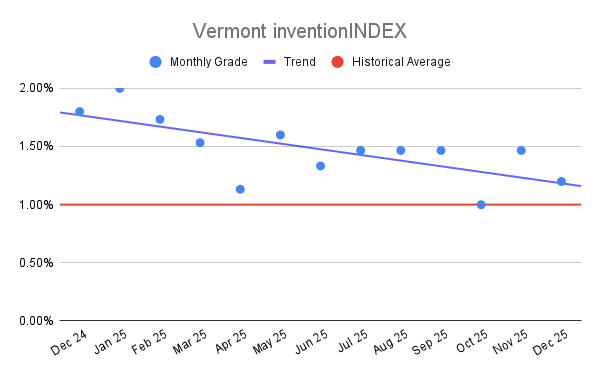 Vermont inventionINDEX December 2025:
  Vermont inventionINDEX November
