

What is the Vermont R&D Tax Credit Publication Requirement?
The publication of claimant names is a mandatory annual disclosure by the Vermont Department of Taxes as codified under 32 V.S.A. § 5930ii. It requires the department to publish a list of all entities and individuals utilizing the Research and Development Tax Credit on or before January 15 of each year. This statutory requirement overrides standard tax confidentiality to ensure public transparency and legislative oversight of the state’s fiscal investment in private-sector innovation.
Publication of claimant names refers to the mandatory annual disclosure by the Vermont Department of Taxes of the identities of all entities and individuals utilizing the Research and Development Tax Credit. This statutory requirement functions as a transparency mechanism that overrides standard tax confidentiality, allowing public and legislative oversight of the state’s significant fiscal investment in private-sector innovation.
The Evolution of Vermont’s Innovation Incentives: Statutory Foundations
The Vermont Research and Development (R&D) Tax Credit, as codified under 32 V.S.A. § 5930ii, represents a cornerstone of the state’s economic development strategy. Enacted to foster a climate of technological advancement and high-wage employment, the credit provides a nonrefundable tax offset for businesses engaged in qualified research activities within the state’s borders. To appreciate the specific mechanism of claimant publication, one must first understand the broader statutory structure from which it arises. The credit is calculated as 27 percent of the portion of the federal R&D tax credit—allowed under Internal Revenue Code (IRC) § 41—that is attributable to expenditures made specifically within Vermont.
This tethering to federal law is a critical design feature. Vermont leverages the definitions and rigorous “four-part test” established by the Internal Revenue Service (IRS) to ensure that the state is not subsidizing routine business activities, but rather true scientific and technological experimentation. However, the state introduces its own layers of administrative oversight, the most prominent of which is the transparency requirement found in subsection (c) of the statute. This subsection mandates that on or before January 15 of each year, the Department of Taxes must publish a list containing the names of the taxpayers who claimed the credit during the most recent completed calendar year.
Table: Statutory Summary of 32 V.S.A. § 5930ii
| Feature | Statutory Description | Administrative Authority |
|---|---|---|
| Enactment | Added 2009, No. 2 (Sp. Sess.), § 22 | Vermont General Assembly |
| Credit Rate | 27% of federal credit (attributable to VT) | Department of Taxes |
| Carryforward | 10 years for unused portions | 32 V.S.A. § 5930ii(b) |
| Publication | Mandatory annual name disclosure | 32 V.S.A. § 5930ii(c) |
| Deadline | January 15 of each year | Department of Taxes |
| In-State Rule | Limited to expenditures within Vermont | IRC § 41 Standards |
The legislative history of this provision reflects a shift in Vermont’s approach to tax expenditures. In 2009, the credit was initially set at 30 percent of the federal amount, reflecting an aggressive stance in competing with other states for tech-sector investments. By 2014, under Act 174, the rate was adjusted to 27 percent, a change that coincided with heightened reporting requirements to ensure the credit remained a cost-effective tool for the state’s General Fund. The publication requirement was not a peripheral addition; it was a central component of the compromise between economic incentive proponents and transparency advocates in the legislature.
The Legal Conflict: Tax Confidentiality versus Public Disclosure
The requirement to publish claimant names sits in a delicate tension with the foundational principles of Vermont tax law. Generally, 32 V.S.A. § 3102 provides broad protections for “return information,” which includes a taxpayer’s identity, the nature of their income, and the specifics of any deductions or credits they claim. The unauthorized disclosure of such information is a criminal offense, carrying penalties of fines and potential imprisonment.
The Scope of 32 V.S.A. § 3102
The general rule established by the Department of Taxes is one of total secrecy. This ensures that taxpayers can provide full and honest accounts of their financial affairs to the Commissioner without fear of public exposure or competitive disadvantage. Under § 3102(3), “Return information” is defined expansively to include not only the financial figures on a return but also identifying information such as a person’s name, address, and federal identification number.
However, the legislature has created specific “carve-outs” where the public interest in transparency is deemed to exceed the private interest in confidentiality. The R&D tax credit publication is one of these rare, mandatory exceptions. While most disclosures under § 3102 are discretionary or reserved for other government agencies—such as sharing fuel tax data with the Public Utility Commission or the Department of Public Service—the R&D disclosure is a public-facing requirement.
Table: Comparison of Confidentiality Exceptions under 32 V.S.A. § 3102
| Exception Category | Mandatory or Discretionary | Recipient of Information |
|---|---|---|
| R&D Tax Credit | Mandatory (by Jan 15) | General Public |
| Judicial Orders | Mandatory | Courts/Parties to Litigation |
| Fuel Tax Data | Discretionary/Permanent | Agency of Natural Resources |
| Hazardous Waste Tax | Mandatory | Agency of Natural Resources |
| Debt Collection | Discretionary | Third-party collection agents |
| Good Standing | Mandatory (upon inquiry) | Public (limited to status) |
The implication of § 5930ii(c) is that by electing to claim the R&D credit, a taxpayer effectively waives their right to anonymity regarding their status as a beneficiary of this specific state incentive. This is a crucial distinction: while the amount of the credit claimed remains confidential under the general umbrella of § 3102, the fact of the claim is public knowledge. This creates a “dual-status” for R&D tax information where the claimant’s identity moves into the public domain while their underlying financial data stays protected.
Detailed Analysis of Revenue Office Guidance and Reports
The Vermont Department of Taxes fulfills its statutory obligation through the publication of the annual “Vermont Research and Development Tax Credit Report,” identified internally and in archives as report number RP-1298. This report is the primary artifact of the publication requirement and serves as the official state record of claimants.
Mechanics of the RP-1298 Report
Guidance from the Department indicates that the report must be released by January 15, covering the most recently completed calendar year. For example, a report published on January 15, 2025, would list the names of taxpayers who claimed the credit during the 2024 calendar year. The Department’s administrative reports typically take the form of statistical tables, but the R&D report specifically includes the roster of names required by law.
The Department of Taxes uses these reports not just for transparency, but as a component of its biennial report to the General Assembly. Under 32 V.S.A. § 3101, the Commissioner is charged with providing assistance and instruction to taxpayers while simultaneously coordinating with other agencies to integrate the administration of taxes. The publication of the claimant list is thus an administrative task that serves both a public notice function and a policy analysis function.
Historical Context of Official Reporting
A review of the Department’s recent publications shows consistent adherence to the RP-1298 series:
| Report Code | Title and Subject Year | Publication Date |
|---|---|---|
| RP-1298-2024 | 2024 R&D Credit Report (Claims in CY 2023) | January 2024 |
| RP-1298-2023 | 2023 R&D Credit Report (Claims in CY 2022) | January 2023 |
| RP-1298-2022 | 2022 R&D Credit Report (Claims in CY 2021) | January 2022 |
| RP-1298-2021 | 2021 R&D Credit Report (Claims in CY 2020) | January 2021 |
These reports are frequently cited by legislative economists and the Joint Fiscal Office when preparing the biennial “Tax Expenditure Report” required under 32 V.S.A. § 312. Because the R&D credit represents a significant “foregone revenue” item—often totaling millions of dollars annually—the list of names allows the state to track whether the credit is achieving its purpose of supporting specific industries, such as software development or advanced manufacturing.
The “Four-Part Test” and Qualified Research Expenditures (QREs)
To appear on the publication list, a taxpayer must have successfully navigated the federal and state requirements for identifying qualified research. Vermont guidance aligns strictly with the standards set by IRC § 41, which defines qualified research through a four-part test.
The Technological in Nature Requirement
Research must fundamentally rely on the principles of physical or biological science, engineering, or computer science. This excludes activities rooted in the social sciences, arts, or humanities. In the context of Vermont’s economy, this often applies to firms in the aerospace, green energy, and biotechnology sectors.
The Permitted Purpose Requirement
The activity must be intended to discover information that can be used to develop a new or improved business component. A “business component” refers to any product, process, computer software, technique, formula, or invention to be held for sale, lease, or license, or used by the taxpayer in their trade or business. The research must aim to improve the functionality, performance, reliability, or quality of this component.
The Elimination of Uncertainty Requirement
At the outset of the research, there must be a degree of technical uncertainty regarding the capability or method for developing or improving the business component, or the appropriate design of that component. This means the developer cannot simply be following a known blueprint; they must be venturing into the unknown.
The Process of Experimentation Requirement
The taxpayer must engage in a systematic process of evaluating alternatives to achieve the desired result. This typically involves testing, modeling, simulating, and systematic trial and error. Documentation of this process is essential for compliance and to justify the credit if challenged by state or federal auditors.
Table: Summary of Eligible and Ineligible Activities
| Eligible R&D Activities | Ineligible Activities |
|---|---|
| Development of new software algorithms | Routine data collection or market research |
| Designing more efficient wind turbine blades | Aesthetic or cosmetic improvements |
| Testing new chemical compounds for medicine | Quality control testing of existing products |
| Engineering prototypes for electric vehicles | Adaptation of existing components for specific clients |
| Modeling advanced manufacturing techniques | Management studies or efficiency surveys |
Calculation and Proration: The In-State Nexus
A defining feature of the Vermont R&D credit is its “in-state” limitation. Unlike the federal credit, which applies to research conducted anywhere in the United States, the Vermont credit is strictly limited to research expenditures made within the state of Vermont.
The Proration Formula
For companies operating in multiple states, the calculation of the Vermont credit requires a precise proration of the federal credit. The state credit is determined by the following formula:
CreditVT = 0.27 × (CreditFederal × (QREVT / QRETotal))
In this equation:
- CreditVT is the Vermont state R&D credit.
- CreditFederal is the total federal credit allowed under IRC § 41.
- QREVT represents the Qualified Research Expenditures incurred within Vermont.
- QRETotal represents the total Qualified Research Expenditures used to calculate the federal credit.
This proration is a primary focus of state audits. Taxpayers must be able to demonstrate that the wages, supplies, and contract research costs they attributed to Vermont were actually incurred in-state. For instance, if a software engineer works remotely from New Hampshire for a Burlington-based firm, their wages may qualify for the federal credit but not for the Vermont state credit, as the research activity was not “made within this State”.
Carryforward and Long-term Value
Because the R&D credit is nonrefundable, it can only be used to offset tax liability. It cannot result in a check being mailed to the taxpayer if their liability is zero. However, to account for the long-term nature of research projects—which often involve high upfront costs and delayed profitability—Vermont allows a 10-year carryforward period. Unused credits from one year can be applied to future tax liabilities for up to a decade, ensuring that companies can eventually realize the full value of the incentive as they scale.
Application of Guidance: The Unitary Group and Pass-Through Entities
The publication of claimant names also requires an understanding of how different business structures interact with the Department of Taxes. The name appearing on the January 15 list depends on which entity is technically “claiming” the credit.
Pass-Through Treatment
For S-Corporations, Partnerships, and Limited Liability Companies (LLCs), the R&D credit is earned at the entity level but “flows through” to the owners or partners via Schedule K-1VT. These individuals then claim the credit on their personal income tax returns (Form IN-111) using Schedule IN-119.
In these cases, the Department of Taxes must determine whether to publish the name of the entity or the names of the individual owners. Based on the statutory language of § 5930ii(c), which requires the names of “taxpayers who have claimed a credit,” the Department typically lists the name of the legal entity that generated the research activity, though the individual claimants are the ones who ultimately receive the tax benefit on their personal filings.
Unitary Combined Reporting
Vermont requires unitary corporate groups—groups of related corporations with common ownership and integrated operations—to file combined returns. For these groups, the credit is managed through Form BA-404 (Tax Credits Earned, Applied, and Carried Forward) and Form BA-402 (Apportionment and Allocation Schedule).
Within a unitary group, the credit may be earned by one subsidiary but used by another member of the group that has a Vermont tax liability. The publication list will generally reflect the name of the entity that is the primary filer of the combined return or the specific subsidiary with Vermont nexus that is associated with the credit claim. This ensures that the public can identify the corporate family benefiting from the state’s investment.
The Role of Technical Bulletins and Administrative Fact Sheets
The Department of Taxes frequently issues Technical Bulletins (TBs) to clarify the application of tax law. While there is not a single TB solely dedicated to the R&D publication requirement, several bulletins provide context for how credits are handled and disclosed.
Technical Bulletin 66 (TB-66)
TB-66 focuses on the Vermont Higher Education Investment Plan credit but serves as a template for how the Department views credit documentation and disclosure. It emphasizes that while documentation (such as contribution statements) should be kept for audit purposes, it should not always be included with the initial return. This mirrors the R&D credit’s approach: the taxpayer submits a claim, their name is published, but the underlying proof of expenditures remains a confidential matter between the taxpayer and the Department, unless an audit is triggered.
Technical Bulletin 70 (TB-70)
TB-70 addresses Corporate and Business Income Tax Nexus and filing requirements. This is critical for R&D claimants because it defines which out-of-state companies have sufficient activity in Vermont to be subject to its taxes and, by extension, eligible for its credits. A company that appears on the RP-1298 list is publicly declaring it has nexus in Vermont and is engaging in qualifying activities within the state.
Practical Example: GreenMountain MedTech, Inc.
To illustrate the lifecycle of the R&D tax credit and the resulting publication of claimant names, consider the case of GreenMountain MedTech, Inc. (GMM), a C-Corporation headquartered in Colchester, Vermont.
Year 1: Research and Expenditure
In 2023, GMM began developing a new, non-invasive blood glucose monitoring system. This project required a team of specialized biomedical engineers and significant investment in sensor technology.
- Federal QREs: $2,000,000 (total research across all locations).
- Vermont QREs: $1,500,000 (75% of the research was performed at the Colchester facility).
- Federal Credit Allowed: $200,000 (assuming a 10% federal rate under IRC § 41).
Year 2: Calculation and Filing
In April 2024, GMM filed its 2023 Vermont Corporate Income Tax Return (Form CO-411). To claim the R&D credit, the company completed the following steps:
- Computed the Vermont Portion: GMM determined that its Vermont activities accounted for 75% of its federal credit.
CreditBase = $200,000 × 0.75 = $150,000 - Applied the Vermont Multiplier: Using the 27 percent rate mandated by 32 V.S.A. § 5930ii(a), GMM calculated its state credit.
CreditVT = $150,000 × 0.27 = $40,500 - Submitted Documentation: GMM filed Form BA-404 and Schedule RD along with its federal Form 6765.
Year 3: Publication and Public Notice
On January 15, 2025, the Vermont Department of Taxes published its annual report (RP-1298-2024).
The Publication Entry:
The report contains an alphabetical list of names. Under the letter ‘G’, the following entry appears:
GreenMountain MedTech, Inc.
Implications for GMM:
- Public Awareness: Investors, competitors, and the local community now know that GMM is utilizing the R&D tax credit. This serves as a public indicator of GMM’s commitment to innovation.
- Confidentiality Maintained: The public does not know that GMM claimed exactly $40,500. They only know that GMM is a claimant.
- Regulatory Compliance: By being listed, GMM has satisfied the transparency requirement of § 5930ii(c). If GMM were not listed despite claiming the credit, it would indicate an administrative error by the Department or a failure in the company’s filing process.
Strategic Considerations for Taxpayers and Practitioners
For professional tax advisors and corporate executives, the publication requirement introduces a layer of strategic consideration that goes beyond simple mathematics. Because the claimant list is public, it can be used by third-party analysts to infer a company’s financial health or strategic direction.
Competitive Intelligence and Risk
A company that suddenly appears on the R&D claimant list may be signaling to its competitors that it has moved from a maintenance phase into a heavy research and development phase. Conversely, a company that disappears from the list after years of inclusion may be seen as scaling back its innovation efforts in Vermont. Taxpayers must be prepared for these perceptions.
Audit Readiness and Transparency
The very existence of the publication list makes the R&D credit a “high-visibility” item. The Department of Taxes, under the direction of the Taxpayer Advocate and state auditors, uses these lists to ensure compliance. Given that the credit is nonrefundable and carries forward for 10 years, the documentation must be “audit-proof” for a significant duration.
Advisors should recommend:
- Contemporaneous Documentation: Maintain project logs, time-tracking for engineers, and supply receipts in real-time.
- Detailed Proration Workpapers: Keep clear records of why certain expenses were classified as Vermont-specific versus federal-general.
- Nexus Verification: Ensure the company maintains sufficient nexus in Vermont to justify the state credit claim, as outlined in TB-70.
Tax Expenditure Accountability: The Macro-Economic View
The requirement to publish names is part of Vermont’s broader effort to treat tax credits as a form of government spending. The “Tax Expenditure Report” produced by the Legislative Joint Fiscal Office and the Department of Taxes categorize these credits alongside direct appropriations.
Table: R&D Credit in the Context of Other Vermont Expenditures
| Expenditure Category | Purpose | Fiscal Mechanism | Disclosure Level |
|---|---|---|---|
| R&D Tax Credit | Support In-state Innovation | 27% Federal Offset | High (Individual Names) |
| VEGI (Growth Incentive) | Job Creation/Capital Invest | Cash Payments | High (Company Specific) |
| Affordable Housing | Lower Income Housing | 25% Qualified Basis | Medium (Project Based) |
| EITC | Poverty Alleviation | 38% Federal Match | Low (Aggregate Only) |
The high level of disclosure for the R&D credit—publishing names annually—reflects the legislature’s belief that while corporate innovation is desirable, the public has a right to know which specific private interests are being supported by the state’s tax base. This transparency is intended to prevent the “hidden” accumulation of tax benefits by a small number of large actors without public knowledge.
Final Thoughts: The Integrated Meaning of Publication
In the final analysis, the publication of claimant names under 32 V.S.A. § 5930ii(c) is more than an administrative hurdle; it is a fundamental characteristic of the Vermont Research and Development Tax Credit. It transforms a private tax filing into a public record of economic policy. By reconciling the need for corporate privacy with the necessity of public oversight, Vermont has created a system where innovation is incentivized, but transparency is non-negotiable.
For the claimant, appearing on the RP-1298 list is a badge of participation in the state’s technological economy. For the state revenue office, it is a tool for compliance and policy evaluation. For the public, it is a window into how millions of dollars in potential revenue are being deployed to shape the future of the Vermont business landscape. Taxpayers must navigate this environment with a clear understanding that their scientific achievements and their tax benefits will, to some degree, be shared with the public they serve.
Who We Are:
Swanson Reed is one of the largest Specialist R&D Tax Credit advisory firm in the United States. With offices nationwide, we are one of the only firms globally to exclusively provide R&D Tax Credit consulting services to our clients. We have been exclusively providing R&D Tax Credit claim preparation and audit compliance solutions for over 30 years. Swanson Reed hosts daily free webinars and provides free IRS CE and CPE credits for CPAs.
Are you eligible?

Why choose us?

Pass an Audit?

What is the R&D Tax Credit?
The Research & Experimentation Tax Credit (or R&D Tax Credit), is a general business tax credit under Internal Revenue Code section 41 for companies that incur research and development (R&D) costs in the United States. The credits are a tax incentive for performing qualified research in the United States, resulting in a credit to a tax return. For the first three years of R&D claims, 6% of the total qualified research expenses (QRE) form the gross credit. In the 4th year of claims and beyond, a base amount is calculated, and an adjusted expense line is multiplied times 14%. Click here to learn more.
Never miss a deadline again

Stay up to date on IRS processes

Discover R&D in your industry

R&D Tax Credit Preparation Services
Swanson Reed is one of the only companies in the United States to exclusively focus on R&D tax credit preparation. Swanson Reed provides state and federal R&D tax credit preparation and audit services to all 50 states.
If you have any questions or need further assistance, please call or email our CEO, Damian Smyth on (800) 986-4725.
Feel free to book a quick teleconference with one of our national R&D tax credit specialists at a time that is convenient for you.
R&D Tax Credit Audit Advisory Services
creditARMOR is a sophisticated R&D tax credit insurance and AI-driven risk management platform. It mitigates audit exposure by covering defense expenses, including CPA, tax attorney, and specialist consultant fees—delivering robust, compliant support for R&D credit claims. Click here for more information about R&D tax credit management and implementation.
Our Fees
Swanson Reed offers R&D tax credit preparation and audit services at our hourly rates of between $195 – $395 per hour. We are also able offer fixed fees and success fees in special circumstances. Learn more at https://www.swansonreed.com/about-us/research-tax-credit-consulting/our-fees/



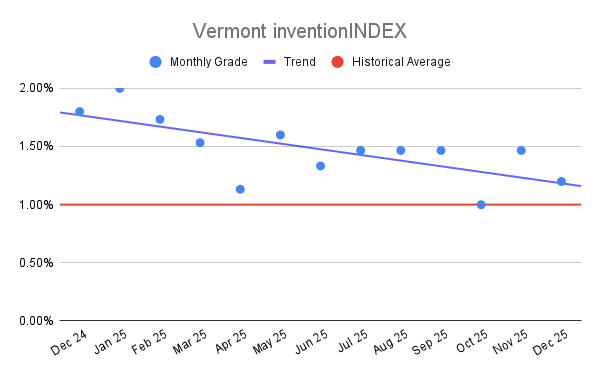 Vermont inventionINDEX December 2025:
  Vermont inventionINDEX November
