

The "Calendar Year for Publication" in Vermont tax law refers to the "intake year"—the period from January 1 to December 31—during which a taxpayer’s Research and Development tax credit claim is received and processed by the Department of Taxes. This designation determines when the taxpayer’s identity and credit amount are included in the annual public transparency report (RP-1298), regardless of the fiscal year in which the research expenses were actually incurred.
The Calendar Year for Publication within the Vermont Research and Development tax credit framework denotes the twelve-month period in which a taxpayer’s credit claim is officially filed and processed by the Department of Taxes. This specific temporal designation determines the mandatory inclusion of the taxpayer’s identity and specific credit amount in the subsequent annual transparency report released to the public and the General Assembly.
The Statutory Genesis and Evolution of 32 V.S.A. § 5930ii
The Research and Development (R&D) tax credit in Vermont is governed by the provisions of 32 V.S.A. § 5930ii, a statute that emerged from a broader legislative effort to balance aggressive economic incentives with unprecedented fiscal transparency. Enacted during the 2009 Special Session via Act No. 2, the credit was designed to align Vermont’s tax code with federal innovation incentives while ensuring that the "tax expenditures" associated with such programs remained visible to the public. The statute was subsequently amended in 2013 to refine its effective date and reporting requirements, further solidifying the state's commitment to disclosure.
The core of the credit’s functionality is its parasitic relationship with federal tax law. Under 32 V.S.A. § 5930ii(a), any taxpayer of the state is eligible for a credit against their income tax liability in an amount equal to 27 percent of the federal tax credit allowed under 26 U.S.C. § 41(a) for research and development expenditures made specifically within the borders of Vermont. This 27 percent rate represents a significant state-level subsidy, but it is accompanied by a unique reporting mandate found in subsection (c) of the statute, which requires the Department of Taxes to publish a list of claimants annually on or before January 15th.
| Statutory Subsection | Provision Type | Legal Mandate and Description |
|---|---|---|
| 32 V.S.A. § 5930ii(a) | Eligibility & Calculation | Grants a credit equal to 27% of the federal R&D credit for VT-based expenditures. |
| 32 V.S.A. § 5930ii(b) | Carryforward | Allows unused portions of the credit to be carried forward for up to 10 years. |
| 32 V.S.A. § 5930ii(c) | Transparency | Mandates annual publication of claimant names and amounts by January 15th. |
Defining the Calendar Year for Publication
The concept of the "Calendar Year" as it relates to publication is often a point of confusion for corporate tax departments and individual filers alike. In the context of the Vermont Department of Taxes' reporting cycle, the "Calendar Year" does not refer to the tax year in which the research was conducted, nor does it necessarily align with the taxpayer’s fiscal year. Instead, it refers to the "intake year"—the period from January 1 to December 31 during which the taxpayer’s return, including the R&D credit claim, was received and processed by the state revenue office.
The Department of Taxes implements this mandate through the RP-1298 report series. For instance, the report titled "2025 Vermont Research and Development Tax Credit Report: Companies that Filed a Claim in Calendar Year 2024" (RP-1298-2024) is scheduled for publication in January 2025. This illustrates that the "Calendar Year for Publication" is the most recently completed calendar year preceding the January 15th deadline. If a company performs research in 2023, files its return in April 2024, the "Calendar Year for Publication" is 2024, and the data will be released in early 2025.
This administrative lag is purposeful. It allows the Department of Taxes to aggregate all claims filed throughout the prior year—regardless of whether they were for the 2023 tax year, amended returns for 2021, or fiscal year returns ending in mid-2024. By using the filing date as the trigger, the state ensures that the annual January report provides a comprehensive snapshot of the revenue impact for the state's most recent administrative cycle.
The Three Temporal Pillars of the R&D CreditTo fully understand the meaning of the Calendar Year for Publication, one must distinguish between three distinct temporal phases in the life of an R&D tax credit claim.
- The Expenditure Year: This is the taxable year in which the qualified research expenses (QREs) were paid or incurred. For a calendar-year taxpayer, this is typically January 1 through December 31 of a given year. The activities performed during this window must meet the federal "Four-Part Test" to qualify for the 27% Vermont piggyback credit.
- The Claim/Filing Year: This is the calendar year in which the taxpayer submits their Form IN-111 (Individual) or CO-411 (Corporate) along with Schedule IN-119. This is the "Calendar Year" referenced in 32 V.S.A. § 5930ii(c).
- The Publication Year: This is the year in which the report is physically or digitally released to the public. By statute, this must occur on or before January 15th.
Administrative Guidance and the RP-1298 Reporting Structure
The Vermont Department of Taxes provides operational clarity on these requirements through its annual report series. The RP-1298 reports are the primary source of guidance for how the state interprets "claimed a credit". Official summaries of these reports indicate that the Department lists both the names of the taxpayers and the specific dollar amounts of the credits claimed. This level of granularity is rare in state tax administration, where 32 V.S.A. § 3102 usually mandates strict confidentiality for return information.
The decision to include specific amounts in the R&D report (RP-1298) distinguishes it from other tax transparency measures, such as the disclosure of the top 100 delinquent taxpayers, which is governed by 32 V.S.A. § 3102(m). While the delinquency list is a tool for enforcement, the R&D list is a tool for policy evaluation. The Department's guidance clarifies that the report provides a detailed breakdown of credits earned during the reporting period, including aggregate data on the total number of taxpayers and the cumulative fiscal impact on the state budget.
The Mechanics of "Claiming" the CreditIn the eyes of the Department of Taxes, a credit is "claimed" when it is first reported on an original or amended return. This is significant because 32 V.S.A. § 5930ii(b) allows for a 10-year carryforward of unused credits. If a company has a massive R&D expenditure in 2023 but no tax liability, it may still "claim" the credit on its 2023 return to establish the carryforward amount. Because the return was filed in 2024, the company will appear in the January 2025 publication.
If the company subsequently utilizes a portion of that carryforward in 2025, 2026, and 2027, the question arises whether they will appear in the publication list for each of those years. Current administrative practice and the wording of the statute suggest that the publication mandate focuses on the initial "claim" of the credit amount, rather than the year-by-year exhaustion of a carryforward, although the Department retains the authority to report on the "credits awarded to date" as seen in other economic development programs.
| Report Identification | Subject Period | Publication Date | Key Data Disclosed |
|---|---|---|---|
| RP-1298-2022 | Claims filed in CY 2022 | Jan 2023 | Names, Individual Amounts, Aggregates |
| RP-1298-2023 | Claims filed in CY 2023 | Jan 2024 | Names, Individual Amounts, Aggregates |
| RP-1298-2024 | Claims filed in CY 2024 | Jan 2025 | Names, Individual Amounts, Aggregates |
The Application of Federal 26 U.S.C. § 41 to Vermont Law
Because the Vermont R&D tax credit is calculated as 27 percent of the federal credit, the meaning of "expenditures" and "credits" is deeply rooted in federal law. The federal "Four-Part Test" is the gatekeeper for any entry on the Vermont publication list. To qualify, and thus to eventually be listed in the RP-1298 report, the research must:
- Relate to a New or Improved Business Component: The research must be for a product, process, computer software, technique, formula, or invention to be held for sale, lease, or license, or used in a trade or business.
- Be Technological in Nature: The process of experimentation must rely on the principles of physical or biological sciences, engineering, or computer science.
- Eliminate Uncertainty: The research must be intended to discover information that would eliminate uncertainty concerning the development or improvement of the business component. Uncertainty exists if the information available to the taxpayer does not establish the capability or method for development, or the appropriate design of the component.
- Involve a Process of Experimentation: Substantially all of the activities must constitute a process of experimentation involving the evaluation of alternatives to eliminate the uncertainty.
Vermont-specific guidance emphasizes that only the portion of the federal credit attributable to Vermont-based expenditures is eligible for the 27 percent state credit. This requires a rigorous "sourcing" of research activities. If a multinational corporation conducts research in both Vermont and Massachusetts, it must bifurcate its federal credit calculation to isolate the Vermont QREs. The resulting figure is then multiplied by 0.27 to arrive at the amount that will be "claimed" and subsequently published in the January report.
Transparency and the 32 V.S.A. § 3102 Confidentiality Shield
Vermont’s tax laws are generally characterized by a high degree of confidentiality. Under 32 V.S.A. § 3102(a), any officer or employee of the Department of Taxes who discloses return information can be fined, imprisoned, and dismissed from their post. This makes the R&D credit’s publication requirement a significant legal exception.
The legislature’s intent, as reflected in the biennial Tax Expenditure Reports and communications from the Joint Fiscal Office, is to ensure that the public can audit the effectiveness of tax "expenditures"—revenue that the state chooses not to collect to incentivize specific behaviors. The R&D credit is viewed as an investment of public funds in private innovation. Consequently, the "Calendar Year for Publication" serves as the disclosure window for this investment.
Unlike many other credits, such as the Charitable Contribution Tax Credit or the Child and Dependent Care Credit, which are reported only in the aggregate to protect individual privacy, the R&D credit’s statutory design (32 V.S.A. § 5930ii(c)) specifically overrides the confidentiality of the taxpayer’s name. This applies regardless of whether the claimant is a large C-corporation like GlobalFoundries or a small startup operating as an S-corporation, where the "taxpayer" listed might be an individual shareholder.
| Credit Type | Disclosure Authority | Level of Detail |
|---|---|---|
| Research & Development | 32 V.S.A. § 5930ii(c) | High: Individual Names and Exact Amounts |
| Economic Development (VEGI) | Annual DECD Reports | High: Name, Region, Commitments, Awards |
| Affordable Housing | 32 V.S.A. § 5930u | Moderate: Project-based, Agency-led |
| Standard Individual Credits | 32 V.S.A. § 3102 | Low: Anonymized Aggregates in JFO Reports |
Regional Comparison: Vermont’s Place in the Transparency Landscape
Vermont is often cited as a leader in tax credit disclosure. According to a 2012 report by the Connecticut Office of Legislative Research, Vermont is one of only two states (along with Texas) that report company-specific information on their single key tax incentive programs. While other states like Rhode Island and New York have since expanded their reporting, Vermont’s R&D reporting remains distinct for its focus on the "Calendar Year" of the claim.
In Rhode Island, a 2008 law requires the Division of Taxation to report annually the names and addresses of those who received six specific state tax credits in the preceding year. However, Rhode Island’s system often focuses on "awards" or "credits received," whereas Vermont’s RP-1298 focuses on the act of "claiming" a credit on a return. This subtle difference means Vermont’s list is often more expansive, catching every taxpayer who requests the credit, whereas other states might only list those who successfully ran the gauntlet of a state agency approval process.
Administrative Procedures: From Filing to January 15th
The Department of Taxes follows a strict internal protocol to move from a taxpayer’s filing to the public list. This process is essentially the "meaning" of the Calendar Year for Publication in practice.
- Reception and Data Entry: As returns arrive during the tax season (primarily February through April) and the extension season (ending in October), the Department flags any return containing Schedule IN-119 with an R&D claim.
- Verification: Before publication, the Department may perform preliminary checks to ensure the claim is not facially invalid. However, the statute requires the publication of those who claimed the credit, which often means the list is generated from the raw filing data before a full audit is completed.
- Aggregation: Following the end of the calendar year on December 31, the Department’s IT and policy divisions extract the names and amounts for all R&D claims processed during the year.
- Reporting: On or before January 15, the report (RP-1298) is finalized and transmitted to the legislative committees on Ways and Means and Finance, and then posted to the Department’s website.
This cycle explains why a taxpayer who files an extension and submits their 2023 return in October 2024 is included in the 2025 report. They "claimed" the credit in the 2024 calendar year, making 2024 their "Calendar Year for Publication".
Detailed Example: The Lifecycle of an R&D Claim
To illustrate these principles, consider the hypothetical case of "Lakeside Aerospace Components," a Vermont-based manufacturer specializing in high-tolerance satellite parts.
Step 1: Qualified Research (2023)Throughout 2023, Lakeside Aerospace spends $1,000,000 on qualifying research activities conducted at its facility in Burlington. These expenses consist of:
- $600,000 in W-2 wages for aeronautical engineers.
- $200,000 in supplies for prototype construction.
- $200,000 in contract research for specialized stress testing.
Lakeside calculates its federal R&D credit based on these $1,000,000 in QREs. Applying the Vermont 27% piggyback, Lakeside identifies a potential state tax credit of $270,000.
Step 2: The Filing (May 2024)Lakeside Aerospace is a fiscal-year corporation whose tax year ends on December 31. They request an extension and eventually file their Vermont Corporate Income Tax Return (CO-411) on May 15, 2024. On Schedule IN-119, they claim the $270,000 R&D tax credit.
- Identifying the Calendar Year: Because this filing occurred on May 15, 2024, the "Calendar Year for Publication" for this claim is 2024.
In December 2024, the Vermont Department of Taxes prepares the report RP-1298-2024. This report compiles all R&D claims made between January 1, 2024, and December 31, 2024. On January 14, 2025, the Department publishes the report on its website and submits it to the Vermont General Assembly.
- The Disclosure: The report includes the entry: "Lakeside Aerospace Components — $270,000".
Suppose Lakeside Aerospace only had a tax liability of $70,000 in 2023. They utilize $70,000 of the credit and carry forward the remaining $200,000 for up to 10 years as permitted by 32 V.S.A. § 5930ii(b).
Under current guidance, Lakeside appeared on the 2025 list (for the 2024 calendar year) because that is when the $270,000 credit was first claimed on a return. If they do not make any new R&D investments in 2024, they will not file a new claim in 2025. Consequently, they will not appear in the January 2026 report, even though they are still carrying $200,000 in credits on their books. The "Calendar Year for Publication" is tied to the event of claiming, not the status of being a credit holder.
Implications of Amendments and Audits on the Publication Year
A complex aspect of the "Calendar Year for Publication" involves amended returns. Under Vermont law, a taxpayer has three years from the due date of the return to file an amendment. If Lakeside Aerospace discovered in 2025 that it had missed $100,000 in research wages from 2023, it could file an amended return in July 2025.
This amendment would trigger a new entry in the January 2026 report (for the 2025 calendar year). The report would list the additional credit amount claimed in that year. This creates a cumulative record across multiple publication years that analysts must synthesize to understand the total credit awarded to a single entity.
Similarly, if the Department of Taxes audits a claim and reduces it, the publication mandate in 32 V.S.A. § 5930ii(c) does not explicitly require the Department to publish a "correction." The list is a historical record of what was claimed during that calendar year. While the Department’s biennial Tax Expenditure Report might adjust the aggregate "foregone revenue" figures to reflect audit results, the individual RP-1298 reports remain as snapshots of the taxpayer’s assertions at the time of filing.
The Role of Pass-Through Entities and Individual Publication
One of the most nuanced areas of Vermont R&D guidance concerns S-corporations, Partnerships, and LLCs. In these cases, the entity itself does not pay income tax; instead, the credits "pass through" to the individual shareholders or partners on a pro-rata basis.
When an S-corp shareholder claims their portion of an R&D credit on their Vermont Form IN-111, they become a "taxpayer who has claimed a credit" under 32 V.S.A. § 5930ii. This means that the individual's name—not just the business name—will appear in the RP-1298 report. For high-net-worth individuals or owners of private family businesses, the "Calendar Year for Publication" represents a significant loss of tax privacy that is not present with almost any other individual tax credit in Vermont.
| Entity Type | Reporting Event | Published Name |
|---|---|---|
| C-Corporation | Filing Form CO-411 | The Corporation’s Legal Name |
| S-Corporation | Shareholder filing Form IN-111 | The Individual Shareholder’s Name |
| Partnership | Partner filing Form IN-111 | The Individual Partner’s Name |
| Sole Proprietorship | Owner filing Form IN-111 | The Individual Owner’s Name |
The Department of Taxes guidance for business and corporate taxpayers emphasizes that even if an individual has no Social Security Number (SSN) or Individual Taxpayer Identification Number (ITIN), they must follow specific procedures to claim these credits, and they remain subject to the transparency rules of the program.
Historical Context: Why the R&D Credit is Disclosed
To understand why the "Calendar Year for Publication" is so strictly defined, one must look at the climate in which the law was created. In the mid-2000s, Vermont faced criticism from groups like Good Jobs First regarding the "hidden" nature of business subsidies. The 2009 legislation (Act No. 2) was a direct response to these concerns, aiming to make Vermont one of the most transparent states in the nation for economic incentives.
The R&D credit was singled out because it represents a "non-incremental" expenditure in many cases—meaning the state might be subsidizing research that would have happened anyway. By mandating publication of names and amounts, the legislature provided a mechanism for the public and rival businesses to see exactly who was benefiting from the state’s tax code. This transparency is intended to create a "check" on the program’s cost; if the total amount of credits claimed in a "Calendar Year" spikes unexpectedly, the legislature has the data ready by January 15th to consider a cap or a rate reduction during the session.
Data Integrity and the RP-1298-2024 Cycle
The upcoming RP-1298-2024 report (to be published in January 2025) is expected to reflect the ongoing impact of federal changes to R&D accounting. The 2017 Tax Cuts and Jobs Act (TCJA) introduced a requirement under IRC Section 174 that R&D expenses be capitalized and amortized over five years, rather than deducted immediately.
While this is a federal deduction issue, it affects the calculation of the federal R&D credit because the credit is often calculated based on the same pool of expenses. Vermont’s 27 percent credit will naturally follow these federal fluctuations. For the "Calendar Year for Publication," this may mean that the amounts listed in the January 2025 report look different than in previous years as companies adjust to the amortization rules. The Department of Taxes remains the final arbiter of how these federal shifts translate to the state claim that is ultimately published.
Property Tax Credits vs. R&D Credits: A Study in Disclosure Contrast
The meaning of "Calendar Year" in Vermont tax law can vary wildly depending on the program. For the Property Tax Credit, a claim is filed based on household income from the prior calendar year, and the credit is applied to the current year's property tax bill. Crucially, a tax bill containing a property tax credit is not a public document and can only be shared with specific parties named in 32 V.S.A. § 3102(k).
In contrast, the R&D credit's "Calendar Year for Publication" is an inherently public designation. The legislature has essentially created a two-tiered system:
- Individual Social Welfare Credits: High privacy, "Calendar Year" refers to the income period (e.g., Earned Income Tax Credit, Renter Credit).
- Economic Development Credits: High transparency, "Calendar Year" refers to the publication/claim period (e.g., R&D Credit, VEGI).
This distinction is vital for practitioners. Filing an R&D claim is an elective act that waives the default privacy protections of Title 32 for that specific data point.
Compliance and Voluntary Disclosure
For taxpayers who may have missed claiming the R&D credit in previous years, the Vermont Voluntary Disclosure Program (VDP) offers a path to compliance, though its primary focus is on taxpayers who owe back taxes rather than those seeking unclaimed credits. However, the guidelines for VDP emphasize that once a taxpayer is under audit or has been contacted by the Department, they lose certain benefits of voluntary reporting.
If a taxpayer uses a VDP agreement or an amended return to claim R&D credits for several back years at once, the "Calendar Year for Publication" will be the year that the settlement or amended return is finalized. This could lead to a single large "catch-up" amount being published in the January report, which might not accurately reflect the company's annual R&D activity but rather its administrative reconciliation.
The Role of the Joint Fiscal Office (JFO) in Publication Analysis
While the Department of Taxes publishes the RP-1298, the Joint Fiscal Office (JFO) is the primary "consumer" of this data on behalf of the legislature. The JFO produces the biennial Tax Expenditure Report, which evaluates the R&D credit alongside every other exemption and deduction in the state code.
In the 2025 Tax Expenditure Report, the JFO utilizes the data from the 2023 and 2024 "Calendar Years for Publication" to estimate the "foregone revenue" for the state. This highlights that the publication list is the bedrock of Vermont's fiscal planning. Without the names and amounts provided by the RP-1298 series, the JFO would have to rely on anonymized, high-level data that might obscure the true concentration of tax benefits.
| JFO Expenditure Category | Statutory Purpose | Estimated Revenue Impact (Approx.) |
|---|---|---|
| Research & Development | Incentivize innovation and high-tech jobs | Significant (varies by year) |
| Charitable Contributions | Support non-profit sector | ~$20M+ |
| Child Tax Credit | Financial support for families | ~$32M |
Final Thoughts: The Finality of the January 15th Deadline
The "Calendar Year for Publication" is a cornerstone of Vermont's tax policy, representing the bridge between private corporate strategy and public fiscal accountability. It is defined by the moment of transparency—the filing of the claim—and is solidified by the mandatory January 15th reporting deadline. By understanding that the "Calendar Year" refers to the administrative window of the claim's intake, taxpayers can better prepare for the public nature of the incentive.
For the Department of Taxes, this cycle is an exercise in rigorous data management, ensuring that every claim made between January 1 and December 31 is captured and accurately presented to the General Assembly. For the public, the RP-1298 report is a testament to the state's commitment to "Good Jobs First" principles, ensuring that if tax dollars are used to subsidize private research, those dollars are accounted for by name and amount.
The R&D credit is thus unique in the Vermont Statutes Annotated. It is a powerful tool for economic growth that demands a powerful commitment to openness. As innovation continues to drive the Vermont economy, from aerospace to biotechnology, the "Calendar Year for Publication" will remain the vital temporal marker for the state's investment in its own future.
Who We Are:
Swanson Reed is one of the largest Specialist R&D Tax Credit advisory firm in the United States. With offices nationwide, we are one of the only firms globally to exclusively provide R&D Tax Credit consulting services to our clients. We have been exclusively providing R&D Tax Credit claim preparation and audit compliance solutions for over 30 years. Swanson Reed hosts daily free webinars and provides free IRS CE and CPE credits for CPAs.
Are you eligible?

Why choose us?

Pass an Audit?

What is the R&D Tax Credit?
The Research & Experimentation Tax Credit (or R&D Tax Credit), is a general business tax credit under Internal Revenue Code section 41 for companies that incur research and development (R&D) costs in the United States. The credits are a tax incentive for performing qualified research in the United States, resulting in a credit to a tax return. For the first three years of R&D claims, 6% of the total qualified research expenses (QRE) form the gross credit. In the 4th year of claims and beyond, a base amount is calculated, and an adjusted expense line is multiplied times 14%. Click here to learn more.
Never miss a deadline again

Stay up to date on IRS processes

Discover R&D in your industry

R&D Tax Credit Preparation Services
Swanson Reed is one of the only companies in the United States to exclusively focus on R&D tax credit preparation. Swanson Reed provides state and federal R&D tax credit preparation and audit services to all 50 states.
If you have any questions or need further assistance, please call or email our CEO, Damian Smyth on (800) 986-4725.
Feel free to book a quick teleconference with one of our national R&D tax credit specialists at a time that is convenient for you.
R&D Tax Credit Audit Advisory Services
creditARMOR is a sophisticated R&D tax credit insurance and AI-driven risk management platform. It mitigates audit exposure by covering defense expenses, including CPA, tax attorney, and specialist consultant fees—delivering robust, compliant support for R&D credit claims. Click here for more information about R&D tax credit management and implementation.
Our Fees
Swanson Reed offers R&D tax credit preparation and audit services at our hourly rates of between $195 – $395 per hour. We are also able offer fixed fees and success fees in special circumstances. Learn more at https://www.swansonreed.com/about-us/research-tax-credit-consulting/our-fees/



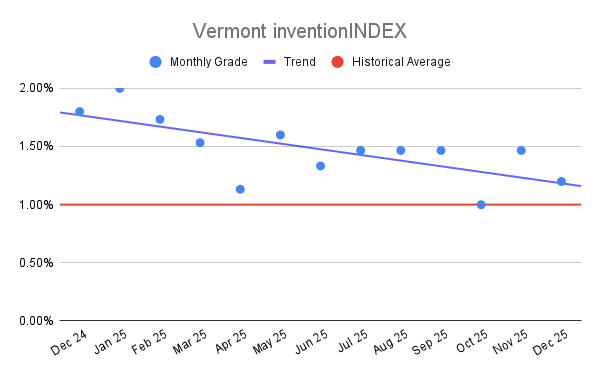 Vermont inventionINDEX December 2025:
  Vermont inventionINDEX November
