

Vermont QREs are specific costs incurred for activities physically performed within Vermont that qualify for the state’s Research and Development Tax Credit. These expenses typically include Qualified Wages for employees conducting, supervising, or supporting research; Qualified Supplies used in the research process; and Contract Research Expenses (subject to statutory limitations). The Vermont credit is calculated as 27% of the federal credit attributable to these in-state expenses.
Qualified Research Expenses (QREs) are the direct costs—comprising wages, supplies, and contract research—incurred during activities that satisfy federal eligibility standards for innovation while being physically performed within Vermont. These expenses serve as the quantitative base for a nonrefundable tax credit equal to 27% of the federal credit amount apportioned to the state’s jurisdiction.
The Statutory Architecture of the Vermont Research and Development Tax Credit
The Vermont Research and Development (R&D) Tax Credit represents a significant policy instrument designed to incentivize high-wage employment and technological advancement within the state’s borders. Codified under 32 V.S.A. § 5930ii, the credit is structured as a “piggyback” on the federal research credit established by Section 41 of the Internal Revenue Code (IRC). The primary legislative intent, as evidenced by its enactment in 2009 and subsequent amendments in 2013, is to provide a competitive fiscal environment for businesses engaged in the “hard sciences,” manufacturing, and software development.
The statute explicitly mandates that a taxpayer eligible for the federal credit under 26 U.S.C. § 41(a) may claim a credit against Vermont income tax in an amount equal to 27 percent of the federal tax credit allowed in the taxable year for eligible research and development expenditures made within Vermont. This percentage is notably one of the highest in the United States, positioning Vermont as an aggressive competitor for research-intensive industries.
Legislative Evolution and Intent
The credit was introduced during a special legislative session in 2009 (No. 2, Sp. Sess., § 22) and was refined through Act 174 in 2013 to ensure better alignment with federal standards while maintaining a strict geographical nexus. Unlike other incentives that may focus on capital investment or facility construction, the R&D credit is primarily aimed at human capital and the iterative processes of experimentation that lead to new intellectual property.
The state’s reliance on the federal IRC ensures a level of stability for taxpayers, as the definitions of qualified activities do not fluctuate independently of federal tax law. However, the requirement that expenses be “made within this State” introduces a unique administrative burden: the necessity of the “hypothetical federal credit” calculation.
| Key Statutory Component | Citation | Description |
|---|---|---|
| Eligibility | 32 V.S.A. § 5930ii(a) | Taxpayers must qualify for the federal R&D credit under 26 U.S.C. § 41. |
| Credit Rate | 32 V.S.A. § 5930ii(a) | 27% of the federal credit amount attributable to Vermont QREs. |
| Carryforward | 32 V.S.A. § 5930ii(b) | Unused credits may be carried forward for up to 10 years. |
| Transparency | 32 V.S.A. § 5930ii(c) | Department of Taxes must publish an annual list of all claimants. |
| Effective Date | Act 174 (2013) | Current 27% rate and rules apply to tax years beginning on or after Jan 1, 2014. |
Defining Qualified Research Expenses (QREs)
The bedrock of any R&D tax claim is the identification of Qualified Research Expenses. Under Vermont’s administrative guidance and the federal IRC § 41, these expenses are categorized into four distinct buckets: qualified wages, qualified supplies, computer rental/lease costs, and contract research expenses.
Qualified Wages
Wages typically constitute the largest portion of any R&D credit claim, often accounting for 60% to 75% of the total QRE base. To be considered a QRE, wages must be paid to an employee for “qualified services” performed within the state of Vermont.
Direct Research Activities
Qualified services include the actual conduct of research. This encompasses the hands-on work of engineers, scientists, and software developers who are testing hypotheses, writing code for experimental software, or designing prototypes. For the wage to qualify as a Vermont QRE, the physical performance of these duties must occur within Vermont, which has become a focal point of recent audits given the rise of remote and hybrid work models.
Direct Supervision and Support
The statute also permits the inclusion of wages for direct supervision and direct support of research activities. Direct supervision involves the immediate management of individuals performing qualified research. For example, a Chief Technology Officer (CTO) who spends 40% of their time reviewing technical specifications and directing the experimental path of a new product may have 40% of their W-2 Box 1 wages included as a QRE.
Direct support activities include the work of lab technicians who clean experimental equipment, machinists who fabricate prototype parts, or administrative staff who exclusively document technical research data. It is important to note that general administrative support—such as human resources, payroll, or general legal counsel—does not qualify even if it supports the R&D department indirectly.
The “Substantially All” Rule
A critical administrative convenience is the “substantially all” rule. Under IRC § 41(b)(2)(B), if at least 80% of an employee’s services during the taxable year consist of qualified services, 100% of the wages paid to that individual are treated as qualified research expenses. This rule significantly simplifies time-tracking requirements for lead researchers and dedicated developers, though contemporaneous documentation of their work remains essential to survive a Vermont Department of Taxes audit.
Qualified Supplies
Supplies are defined as any tangible property, other than land or improvements to land and property of a character subject to depreciation, that is used in the conduct of qualified research.
In the context of Vermont’s manufacturing sector, this frequently includes raw materials used to create experimental batches of a product, components for “beta” versions of machinery, and chemicals used in laboratory testing. To be eligible as a Vermont QRE, the supplies must be consumed within Vermont during the research process. A notable exclusion from this category is the cost of the research facility itself or any equipment that would be capitalized and depreciated over time; only consumable materials are eligible.
Computer Rental and Lease Costs
This category traditionally applied to the leasing of mainframe computers for complex simulations. In the modern era, the Vermont Department of Taxes and the IRS have expanded this interpretation to include cloud computing costs. Payments to providers like Amazon Web Services (AWS) or Microsoft Azure for hosting development and testing environments are considered QREs, provided they are not used for production environments or general business operations.
Contract Research Expenses
When a Vermont company lacks the internal capacity to perform a specific research task, it may engage a third party. Payments to these contractors are eligible as QREs, but they are subject to a statutory haircut to prevent the state from subsidizing the contractor’s profit and overhead.
| Entity Type | Eligible Percentage of Payment | Statutory Context |
|---|---|---|
| Standard Third-Party Contractor | 65% | General research services performed on behalf of the taxpayer. |
| Qualified Research Consortia | 75% | Research conducted by qualifying nonprofit scientific organizations. |
| Eligible Universities | 100% | Specific basic research payments (federal rule often mirrored in state calculations). |
For these expenses to qualify as Vermont QREs, the taxpayer must maintain the “substantial rights” to the research findings and must bear the “economic risk” of the project. If the contractor is paid only upon a successful result, the IRS and Vermont auditors may argue the risk was not borne by the taxpayer, potentially disqualifying the expense.
The Four-Part Test: The Qualitative Gateway to Eligibility
The Vermont Department of Taxes adheres strictly to the IRS “Four-Part Test” to determine whether an activity—and its associated expenses—qualifies for the R&D credit. This test serves as a qualitative filter, ensuring that only genuine technological innovation is subsidized.
The Permitted Purpose Test
The objective of the research must be to develop or improve a “business component” of the taxpayer. A business component is defined as any product, process, computer software, technique, formula, or invention that is held for sale, lease, or license, or used by the taxpayer in their trade or business. The research must seek to improve functionality, performance, reliability, or quality. For example, a Vermont dairy processor developing a new pasteurization technique that extends shelf life while maintaining nutrient density would satisfy this test.
The Elimination of Uncertainty Test
The taxpayer must demonstrate that they encountered a degree of technical uncertainty at the beginning of the research project. Uncertainty exists if the information available to the taxpayer does not establish the capability of developing the component, the method for doing so, or the appropriate design of the component. Administrative guidance clarifies that “uncertainty” refers to technical challenges, not commercial or market uncertainty.
The Process of Experimentation Test
Substantially all of the activities must involve a systematic process of experimentation. This entails evaluating one or more alternatives to achieve a result through testing, modeling, simulation, or systematic trial-and-error. If a company simply follows a known recipe or standard engineering manual to solve a problem, it fails this test, as the solution was not discovered through an iterative experimental process.
The Technological in Nature Test
The process of experimentation must fundamentally rely on the principles of the “hard sciences”. These include:
- Physical or biological sciences.
- Engineering.
- Computer science.
Research based on social sciences, economics, business management, or aesthetic design is expressly excluded from the definition of qualified research. In Vermont, this means that while the technical development of a new furniture joint would qualify, the artistic design of the chair would not.
Vermont Revenue Office Guidance and Administrative Procedures
The Vermont Department of Taxes provides specific administrative frameworks for claiming the credit, primarily through the use of supplemental forms and technical bulletins. Because the Vermont credit is nonrefundable and contains a geographical limitation, the filing process is more rigorous than a simple percentage application.
The Role of Form BA-404 and Form RD-111
For corporations and business entities, the primary vehicle for claiming the credit is Schedule BA-404, “Tax Credits Earned, Applied, Expired, and Carried Forward”. This form acts as the master ledger for all Vermont tax credits, including R&D.
Taxpayers who are individuals or who receive the credit via a pass-through entity (such as an S-Corp or LLC) typically report the credit on Schedule IN-119, which is then summarized on the main income tax return, Form IN-111. While older guidance occasionally mentions “Form RD-111,” current filing systems utilize the BA-404 and IN-119 series to track the specific R&D amounts.
The “Hypothetical Federal Credit” Mechanism
Vermont revenue office guidance requires a specific apportionment methodology for companies that have QREs in multiple states. A taxpayer cannot merely take their total federal credit and apply the Vermont 27% rate to it. Instead, they must perform a “hypothetical federal computation”:
- Identify total QREs: Determine the nationwide QREs for the tax year.
- Apportion to Vermont: Identify the subset of those QREs that were physically incurred in Vermont (the “Vermont-only” data).
- Recompute Federal Credit: Using the federal rules (either the Regular Method or ASC), calculate what the federal credit would have been if the company only had the Vermont QREs.
- Apply Vermont Multiplier: Multiply this hypothetical federal credit by 27%.
This ensures that the Vermont credit is strictly tied to in-state innovation and prevents the state from subsidizing research conducted in other jurisdictions.
Pass-Through Treatment and Allocation
Vermont mirrors federal law in allowing the R&D credit to flow through to owners of S-Corporations, Partnerships, and LLCs. The entity calculates the credit and then allocates it to shareholders or members via Schedule K-1VT. Each recipient then claims their proportional share on their personal Vermont return, subject to the same 10-year carryforward limitations.
| Entity Type | Reporting Form | Mechanism |
|---|---|---|
| C-Corporation | CO-411 / BA-404 | Direct claim against corporate income tax. |
| S-Corp / Partnership | BI-471 / BA-406 | Credit is earned at entity level, allocated to owners via K-1VT. |
| Individual | IN-111 / IN-119 | Used to offset personal income tax liability. |
Comparative Calculation Methodologies
Vermont permits the use of both major federal calculation methods, provided the taxpayer uses the same method consistently on both their federal and state returns.
The Regular Research Credit Method
The Regular Research Credit (RRC) equals 20% of the taxpayer’s current-year QREs that exceed a “base amount”. The base amount is calculated by multiplying the taxpayer’s “fixed-base percentage” by the average annual gross receipts for the preceding four years.
For the Vermont recomputation, the company must use Vermont-specific gross receipts and Vermont-specific QREs to establish the base. The Vermont credit then becomes:
$$Credit\_{VT} = 0.27 \ imes$$
The base amount cannot be less than 50% of the current year’s QREs, which serves as a floor to prevent windfall credits for massive spending spikes.
The Alternative Simplified Credit (ASC) Method
The ASC method is increasingly popular due to its simpler data requirements, as it does not require decades of historical gross receipts data. It is calculated as 14% of the current year’s QREs that exceed 50% of the average QREs for the three preceding years.
The Vermont recomputation formula for ASC is:
$$Credit\_{VT} = 0.27 \ imes$$
If a company has no Vermont QRE history for the prior three years, the federal credit rate drops to 6%, and Vermont takes 27% of that 6% amount.
Detailed Example: Green Mountain BioTech, Inc.
To illustrate the interplay of state guidance and statutory law, we examine the hypothetical case of Green Mountain BioTech, Inc., a company with a research facility in Burlington and a sales office in Boston.
Phase 1: Identifying Qualified Activities
In 2024, the company undertook three projects:
- Project A (Burlington): Developing a new enzyme-based filtration system for dairy processing. (Qualifies: Technological, Uncertain, Experimental, Permitted Purpose).
- Project B (Boston): Market research on consumer preferences for non-dairy milk. (Disqualified: Social Science/Market Research).
- Project C (Burlington): Designing a more aesthetic label for the filter. (Disqualified: Aesthetic/Non-technological).
Phase 2: Quantifying Vermont QREs
The company identifies the following costs for Project A:
- Wages: $500,000 paid to Vermont-based researchers.
- Supplies: $100,000 in lab reagents consumed in the Burlington lab.
- Contract Research: $200,000 paid to a University of Vermont (UVM) lab to perform testing.
Total Vermont QRE Calculation:
- Wages: $500,000
- Supplies: $100,000
- Contract Research: $200,000 x 65% = $130,000.
- Total VT QREs: $730,000.
Phase 3: The Hypothetical Federal Credit
Assume Green Mountain BioTech uses the ASC method. Its average Vermont QREs for the years 2021, 2022, and 2023 was $400,000.
- Calculate 50% of 3-Year Average: $400,000 x 0.50 = $200,000.
- Calculate Incremental QREs: $730,000 – $200,000 = $530,000.
- Calculate Hypothetical Federal Credit: $530,000 x 14% = $74,200.
- Calculate Vermont R&D Credit: $74,200 x 27% = $20,034.
Green Mountain BioTech will report $20,034 on Schedule BA-404. If its 2024 Vermont tax liability is $15,000, it will pay $0 and carry forward the remaining $5,034 for use in any year through 2034.
Compliance Corner: Audit Guidelines and Documentation Standards
The Vermont Department of Taxes maintains a rigorous audit program to prevent the abuse of innovation credits. Taxpayers are encouraged to adopt a “compliance-ready” posture by maintaining contemporaneous records that link every dollar of QRE to a specific experimental activity.
Record Retention Requirements
Vermont law 32 V.S.A. § 3201(4) grants the Department broad authority to examine any books, papers, or records bearing upon matters required to be included in a return. For the R&D credit, the Department suggests a retention period that covers the 10-year carryforward plus the open statute of limitations window.
| Documentation Category | Specific Evidence Expected |
|---|---|
| Technical Nexus | Lab notebooks, project charters, design drawings, and technical error logs. |
| Vermont Nexus | Payroll records with work location identifiers, office leases, and employee residency affidavits. |
| Financial Accuracy | General ledgers showing specific R&D cost centers, W-2s (Box 1), and vendor invoices for supplies. |
| Third-Party Contracts | Signed agreements specifying the scope of work and the location where the work was performed. |
Common Audit Triggers and Findings
Department of Taxes auditors frequently focus on the following high-risk areas:
- Remote Workers: Claiming wages for employees who work from out-of-state residences for a Vermont company. Wages only qualify for the Vermont credit if the services are performed within the state.
- First-Run Production: Misclassifying early manufacturing runs as “experimental”. If the primary goal of the run is to produce inventory for sale rather than to test a hypothesis, the associated costs are production, not research.
- Administrative Overhead: Improperly including a portion of utilities, rent, or general supplies in the QRE base. Unlike IRC § 174 amortization rules, which include indirect costs, the § 41 credit rules are strictly limited to direct QREs.
Interactions with IRC Section 174 Amortization
A critical recent development for professional tax practitioners is the change to IRC § 174, which now requires taxpayers to capitalize and amortize R&D expenses over 5 years (for domestic research) or 15 years (for foreign research) rather than expensing them immediately.
While Vermont generally conforms to the IRC, the R&D tax credit calculation remains a separate exercise from the amortization of research expenditures. A taxpayer may be required to capitalize their research costs for income tax purposes while simultaneously claiming the R&D tax credit based on those same expenditures in the year they were incurred. This “timing mismatch” can significantly impact the cash flow of Vermont startups and should be carefully managed during tax planning.
The Transparency Mandate and Public Oversight
Vermont is unique among many states in its commitment to transparency regarding tax expenditures. Under 32 V.S.A. § 5930ii(c), the Department of Taxes must publish an annual list of all companies that claimed the R&D credit during the most recently completed calendar year.
These reports, such as the “2025 Vermont Research and Development Tax Credit Report,” provide the public and the legislature with a list of corporate beneficiaries. The rationale behind this mandate is to ensure that the millions of dollars in foregone tax revenue are supporting genuine, identifiable business activities within the state. For taxpayers, this means that their participation in the R&D credit program is public record, which further incentivizes the maintenance of impeccable documentation and compliance records.
Final Thoughts
The Vermont R&D tax credit remains one of the state’s most powerful tools for economic growth. By providing a 27% credit with a 10-year carryforward, the state effectively de-risks the high-cost, high-uncertainty phase of product development.
For businesses operating in the Green Mountain State, maximizing the credit requires a holistic approach that integrates technical project management with tax accounting. As federal regulations regarding R&D continue to evolve—particularly with the ongoing debates over the immediate expensing of R&E costs—Vermont’s stable, piggyback approach provides a predictable framework for long-term innovation planning.
Ultimately, the meaning of Qualified Research Expenses in Vermont is defined by the intersection of rigorous federal standards and a strict requirement for local economic impact. Companies that can demonstrate a genuine “process of experimentation” conducted by Vermont-based workers will find the credit to be a foundational component of their financial strategy.
Who We Are:
Swanson Reed is one of the largest Specialist R&D Tax Credit advisory firm in the United States. With offices nationwide, we are one of the only firms globally to exclusively provide R&D Tax Credit consulting services to our clients. We have been exclusively providing R&D Tax Credit claim preparation and audit compliance solutions for over 30 years. Swanson Reed hosts daily free webinars and provides free IRS CE and CPE credits for CPAs.
Are you eligible?

Why choose us?

Pass an Audit?

What is the R&D Tax Credit?
The Research & Experimentation Tax Credit (or R&D Tax Credit), is a general business tax credit under Internal Revenue Code section 41 for companies that incur research and development (R&D) costs in the United States. The credits are a tax incentive for performing qualified research in the United States, resulting in a credit to a tax return. For the first three years of R&D claims, 6% of the total qualified research expenses (QRE) form the gross credit. In the 4th year of claims and beyond, a base amount is calculated, and an adjusted expense line is multiplied times 14%. Click here to learn more.
Never miss a deadline again

Stay up to date on IRS processes

Discover R&D in your industry

R&D Tax Credit Preparation Services
Swanson Reed is one of the only companies in the United States to exclusively focus on R&D tax credit preparation. Swanson Reed provides state and federal R&D tax credit preparation and audit services to all 50 states.
If you have any questions or need further assistance, please call or email our CEO, Damian Smyth on (800) 986-4725.
Feel free to book a quick teleconference with one of our national R&D tax credit specialists at a time that is convenient for you.
R&D Tax Credit Audit Advisory Services
creditARMOR is a sophisticated R&D tax credit insurance and AI-driven risk management platform. It mitigates audit exposure by covering defense expenses, including CPA, tax attorney, and specialist consultant fees—delivering robust, compliant support for R&D credit claims. Click here for more information about R&D tax credit management and implementation.
Our Fees
Swanson Reed offers R&D tax credit preparation and audit services at our hourly rates of between $195 – $395 per hour. We are also able offer fixed fees and success fees in special circumstances. Learn more at https://www.swansonreed.com/about-us/research-tax-credit-consulting/our-fees/



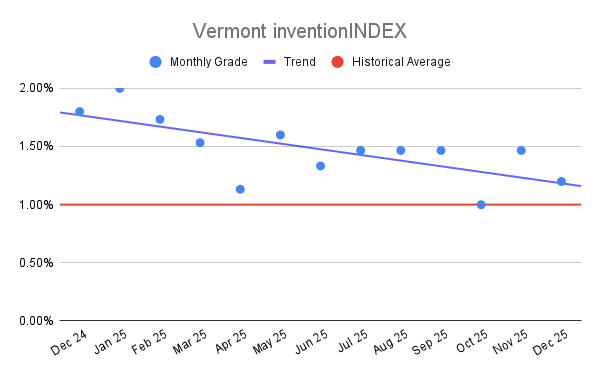 Vermont inventionINDEX December 2025:
  Vermont inventionINDEX November
