

The Vermont Research and Development (R&D) Tax Credit (32 V.S.A. § 5930ii) provides a nonrefundable tax credit equal to 27% of the federal research credit for qualified expenditures incurred within Vermont. To qualify, activities must satisfy the federal “Four-Part Test” (IRC § 41(d)): 1) Elimination of Uncertainty, 2) Technological in Nature, 3) Permitted Purpose (Business Component), and 4) Process of Experimentation. The credit is claimed using Schedule BA-404 and has a 10-year carryforward period.
Qualified research under the Vermont Research and Development tax credit represents scientific and engineering activities conducted within state borders that satisfy the federal four-part test by seeking to eliminate technical uncertainty through a structured process of experimentation. This standard enables eligible businesses to claim a nonrefundable credit equal to 27 percent of the federal research credit amount attributable to Vermont-based expenditures.
The Statutory Architecture of Vermont’s Research and Development Incentive
The Vermont Research and Development (R&D) Tax Credit is an economic instrument codified under 32 V.S.A. § 5930ii, designed to foster a climate of innovation by providing a substantial tax offset for businesses engaged in high-level scientific and technical inquiry. Unlike many other state credits that utilize an independent calculation of base amounts and expenditure thresholds, the Vermont statute is characterized by its high degree of “conformity” or “coupling” with federal tax law, specifically Section 41 of the Internal Revenue Code (IRC). This regulatory alignment creates a framework where the definition of “Qualified Research” is inextricably linked to federal jurisprudential and administrative standards, yet remains distinct in its geographic application and fiscal proration.
The credit is fundamentally a “prorated share” incentive. It offers a credit amount equal to 27 percent of the federal tax credit that would be allowed if the taxpayer’s research and development expenditures were limited to those made specifically within the State of Vermont. This proration mechanism is critical because it forces a “de-coupling” of the taxpayer’s national or global research footprint from their Vermont-specific activities, requiring a meticulous apportionment of wages, supplies, and contract research costs. The 27 percent rate is among the most aggressive in the United States, positioning Vermont as a competitive jurisdiction for technology-driven enterprises.
Administratively, the credit is nonrefundable, meaning it cannot result in a cash payout if it exceeds the taxpayer’s liability for a given year. However, to accommodate the long-term horizons of research projects and the initial unprofitability of many startups, the legislature has provided a 10-year carryforward period. This allows unused credits to be banked and applied against future Vermont personal income, business, or corporate income tax liabilities for a decade following the year the credit was earned.
| Statutory Provision | Detail and Regulatory Citation | Legal Effect |
|---|---|---|
| Governing Statute | 32 V.S.A. § 5930ii | Establishes the credit, the 27% rate, and the 10-year carryforward. |
| Federal Coupling | 26 U.S.C. § 41(a) | Adopts federal definitions for “Qualified Research” and “Qualified Research Expenses”. |
| Carryforward Window | 10 Years | Prevents the expiration of credits for early-stage or pre-revenue firms. |
| Public Accountability | 32 V.S.A. § 5930ii(c) | Mandates annual publication of a list of all claimants by the Department of Taxes. |
| Reporting Form | Schedule BA-404 | Used to report the earning, application, and carryforward of the credit. |
The Four-Part Test: Federal Standards in the Vermont Context
To achieve the status of “Qualified Research” for the Vermont credit, an activity must navigate the rigors of the “Four-Part Test” established under IRC § 41(d). This test serves as a qualitative filter, separating routine business expenditures from those that represent a genuine advancement in the “experimental or laboratory sense”. For Vermont businesses, failing even a single prong of this test disqualifies the associated expenses from the state-level 27 percent credit.
The Business Component and Permitted Purpose Test
The first prong of the analysis requires that the research be undertaken for a “permitted purpose” and must relate to a specific “business component”. A business component is defined as any product, process, computer software, technique, formula, or invention that is held for sale, lease, or license, or used by the taxpayer in their trade or business. The permitted purpose must be to improve the functionality, performance, reliability, or quality of that business component.
In Vermont’s diverse economy, this applies broadly. For a software developer in Burlington, the business component might be a new data encryption tool; for a manufacturer in Rutland, it could be a more durable alloy for high-precision components. The critical distinction made by revenue guidance is that research related to aesthetics—such as the style, taste, or cosmetic design of a product—does not constitute a permitted purpose. The research must target the functional heart of the component rather than its superficial presentation.
The Elimination of Uncertainty Test
The second prong, often referred to as the “Section 174 Test,” mandates that the taxpayer be seeking to discover information that would eliminate “technical uncertainty”. Uncertainty exists when the information available to the taxpayer at the beginning of the project does not establish the capability or method for developing or improving the business component, or the appropriate design of that component.
Revenue office guidance emphasizes that the uncertainty must be technical in nature, not economic. A business cannot claim research credits for a project where the only uncertainty is whether the product will sell in the market (marketing research) or whether the project is commercially feasible. Instead, the uncertainty must center on whether the product can be built (capability), how it will be built (method), or the specific specifications of its build (appropriate design).
The Technological in Nature Test
The third prong requires that the process of experimentation fundamentally rely on the principles of the physical or biological sciences, engineering, or computer science. This is the “Hard Science” requirement. Vermont’s guidance clarifies that while many innovative business practices exist, only those rooted in these specific scientific domains qualify for the R&D credit.
This requirement effectively excludes research in the “soft sciences,” such as economics, management studies, behavioral sciences, and social sciences. Furthermore, the IRS and state auditors do not require the information discovered to be “new to the world”; it merely needs to be new to the taxpayer. However, the approach to discovering that information must be scientific.
The Process of Experimentation Test
The final prong is perhaps the most scrutinized during state audits. It requires that substantially all—statutorily defined as 80 percent or more—of the research activities constitute elements of a “process of experimentation”. This process is defined as the systematic evaluation of one or more alternatives to achieve a result where the capability, method, or design is uncertain at the outset.
The Vermont Department of Taxes, following federal lead, looks for a structured methodology: identifying the uncertainty, formulating a hypothesis, testing and evaluating alternatives, and refining or discarding those alternatives through trial and error, modeling, or simulation. If a taxpayer achieves their result through routine data collection or ordinary testing for quality control, the activity fails this test. The “experimentation” must be the core mechanism by which the technical solution is reached.
Qualified Research Expenditures: The Geographic Nexus
Once an activity is identified as qualified research, the taxpayer must quantify the “Qualified Research Expenditures” (QREs) that have a direct nexus to Vermont. Under Vermont law, only those expenses incurred for activities conducted within the state are eligible for the 27 percent credit.
Wage-Based Expenditures
Wages typically form the bedrock of an R&D claim. In Vermont, these include any wages paid or incurred to an employee for “qualified services” performed in the state. Qualified services are categorized into three levels of involvement:
- Direct Research: The actual “hands-on” conduct of the experimentation (e.g., a chemist in a lab or a software engineer coding a new algorithm).
- Direct Supervision: The immediate management of those performing direct research.
- Direct Support: Activities that facilitate the research, such as a lab assistant cleaning test tubes or a machinist building a prototype for a researcher.
Vermont follows the “substantially all” rule for wages: if an employee spends at least 80 percent of their time on qualified research activities, 100 percent of their Box 1 W-2 wages may be included as QREs. However, for a multi-state company, these wages must be carefully apportioned based on where the work was physically performed.
Supplies and Consumables
The cost of tangible property (excluding land, improvements, and depreciable property) used in the conduct of qualified research in Vermont is eligible. This often includes materials used to construct prototypes, chemicals, and laboratory supplies. For instance, a Vermont aerospace firm developing a new satellite component can include the cost of materials destroyed during stress testing, provided those materials were consumed during research conducted in the state.
Contract Research Expenses
Taxpayers may include 65 percent of any amount paid or incurred to a non-employee for qualified research services performed in Vermont. This rate increases to 75 percent for payments to qualified research consortia. A critical administrative nuance in Vermont is the requirement that the contractor must perform the work in Vermont for the expense to be included in the state credit calculation. Furthermore, the taxpayer must bear the “economic risk” of the research; if the contract guarantees a result or a refund for failure, it may be classified as “purchased research” and excluded.
Computer Leasing and Cloud Infrastructure
With the rise of the software industry, “computer rental” costs have become a significant QRE category. This includes payments for the right to use computers in the conduct of qualified research. In the modern regulatory environment, this is interpreted to include cloud computing costs (such as AWS or Azure) used specifically for development and testing environments, though not for general hosting or production.
| QRE Category | Inclusion Percentage | Vermont-Specific Residency Rule |
|---|---|---|
| In-House Wages | 100% | Work must be physically performed in Vermont. |
| Supplies | 100% | Property must be used/consumed in Vermont. |
| Contract Research | 65% | Services must be performed on-site or in Vermont. |
| Research Consortia | 75% | Must be a qualified non-profit or educational entity. |
| Computer Rentals | 100% | Costs must be for research-specific cloud/server time. |
Local Revenue Office Guidance and Documentation Requirements
The Vermont Department of Taxes does not merely observe federal findings; it maintains its own administrative requirements and filing procedures that must be strictly followed to secure the credit. Failure to comply with state-specific reporting can lead to the disallowance of the credit even if the federal research is valid.
The Hypothetical Federal Credit Methodology
Vermont’s 27 percent credit is not applied directly to the QREs. Instead, the taxpayer must perform a “recomputed” or “hypothetical” federal credit calculation. The steps mandated by state guidance are:
- Isolation: Identify all QREs for the tax year that occurred specifically in Vermont.
- Calculation: Compute the federal credit (using either the Regular Method or the Alternative Simplified Credit method) as if the Vermont QREs were the only QREs the company had.
- Application: Multiply that hypothetical federal credit by 27 percent.
This methodology is unique because it forces companies to track Vermont-specific “base amounts” or “prior year averages”. For the Alternative Simplified Credit (ASC), the taxpayer must use a three-year average of only Vermont QREs to determine the current year’s state credit.
Mandatory Filing: Schedule BA-404 and BA-406
To claim the credit, a taxpayer must file Schedule BA-404, Vermont Tax Credits Earned, Applied, Expired, and Carried Forward. This form acts as the ledger for the credit, tracking its origin in Column B (Amount Earned Current Year) and its utilization in Column C (Amount Applied Current Year).
For pass-through entities such as S-Corporations, Partnerships, or LLCs, the entity earns the credit at the business level, but the benefit flows through to the individual owners. In these instances, the entity must also file Schedule BA-406, Credit Allocation Schedule, which details exactly how much of the R&D credit is being passed to each shareholder or partner. The individual owners then claim their portion on their personal income tax return using Schedule IN-119.
The Documentation Audit Trail
Vermont revenue office guidance emphasizes that taxpayers must maintain “contemporaneous” documentation. This means records should be created at the time the research is performed, not reconstructed years later during an audit. Key documentation required for a Vermont R&D audit includes:
- Project Summaries: Detailed narratives for each project explaining how it satisfies the Four-Part Test.
- Payroll Records: W-2s and time-tracking data that link specific employee hours to specific research projects.
- Invoices and Receipts: Proof of purchase for research supplies and payments to third-party contractors.
- Technical Proof: Prototypes, design sketches, lab test results, and emails discussing technical challenges and solutions.
The Department of Taxes recommends keeping these records for at least the 10-year carryforward window plus the standard statute of limitations (typically 3 to 7 years), creating a 13-to-17-year retention horizon for active R&D claimants.
Transparency and Public Oversight: The RP-1298 Reports
One of the most distinctive aspects of Vermont’s R&D tax credit is the transparency requirement codified in 32 V.S.A. § 5930ii(c). By January 15 of each year, the Department of Taxes must publish a list of every taxpayer that claimed the credit during the prior calendar year.
These reports, categorized as “RP-1298” documents, are public records. For example, the 2024 Vermont Research and Development Tax Credit Report (RP-1298-2023) lists companies that filed a claim in the 2023 calendar year. This level of disclosure is rare in state taxation and serves as a public audit of the program’s efficacy, though it also means that businesses cannot keep their participation in the R&D program confidential.
Industry-Specific Applications and Exclusions
The interpretation of the Four-Part Test varies significantly by industry. Vermont revenue office guidance and federal audit techniques provide specific frameworks for how “Qualified Research” is applied in key state sectors.
Software Development: Internal Use vs. Commercial
For Vermont’s burgeoning software sector, the “Process of Experimentation” test is the primary hurdle. Guidance states that “routine” software development, such as debugging, updating tax tables, or creating simple user interfaces, does not qualify. To be qualified research, the software development must involve the resolution of “software development uncertainties” that fundamentally rely on the principles of computer science, such as developing new algorithms, improving data encryption, or creating new communication protocols.
A critical distinction exists for “Internal Use Software” (IUS). If a Vermont company develops software for its own internal administrative functions (e.g., a payroll system or an internal HR portal), the threshold for qualification is significantly higher. IUS must meet an “additional three-part test,” proving that the software is innovative, involves significant economic risk, and is not commercially available.
Manufacturing and Material Science
In manufacturing, research often centers on the development of new products or the improvement of manufacturing processes. Qualified activities include the design and development of prototypes, trials and analysis of data to reproducibility standards, and testing hypotheses in the laboratory.
However, the “Commercial Production” exclusion is a major pitfall. Research conducted after the beginning of commercial production of a business component is strictly excluded. For example, if a Vermont factory spends six months developing a new automated assembly line, those costs are likely qualified. But once the line begins producing units for sale, any subsequent “tweaks” or routine maintenance are excluded.
Green Energy and Environmental Technology
Vermont leads the nation in many “Green” initiatives, and the R&D credit is a primary driver. Qualified research in this sector includes the development of new battery storage technologies, high-efficiency solar components, and advanced wood-heating systems. While the installation of solar panels may qualify for an Investment Tax Credit (ITC), the scientific development of those panels or the smart-grid software used to manage them constitutes Qualified Research for the 27 percent credit.
| Industry Sector | Example of Qualified Activity | Common Reason for Exclusion |
|---|---|---|
| Software / IT | Developing a new machine learning algorithm for predictive logistics. | Routine bug fixes or functional enhancements to existing UIs. |
| Manufacturing | Prototyping a CNC machine with novel precision capabilities. | Research conducted after the start of commercial production. |
| Biotech / Life Sciences | Developing a new method for stabilizing organic dairy proteins. | Social science research or market feasibility studies. |
| Green Energy | Optimizing smart grid protocols for home battery discharge. | Routine installation of off-the-shelf solar or wind hardware. |
Comprehensive Case Study: Green Mountain Aerospace, Inc.
To illustrate the interplay of state law, revenue guidance, and the Four-Part Test, consider a detailed example of a Vermont-based firm, “Green Mountain Aerospace” (GMA).
The Technical Challenge
In 2024, GMA sought to develop a new, ultra-lightweight thermal shield for small satellites. The engineering team was uncertain whether a specific ceramic-fiber composite could maintain structural integrity at temperatures exceeding 1,200 degrees Celsius while remaining under a specific weight threshold.
Applying the Four-Part Test
- Permitted Purpose: The goal was to improve the “performance” and “reliability” of the thermal shield (the business component).
- Elimination of Uncertainty: The team did not know the “appropriate design” or the “method” of layering the ceramic fibers to achieve the weight-to-heat ratio.
- Technological in Nature: The project relied on the principles of materials science and aerospace engineering.
- Process of Experimentation: GMA built five different prototypes with varying fiber densities and orientations. They performed stress tests and thermal vacuum chamber simulations, analyzing the data from each failure to refine the next design.
Financial and Geographic Apportionment
GMA is headquartered in South Burlington but has a secondary lab in Massachusetts. For the Vermont credit, they must isolate their Vermont-specific QREs.
- Vermont Wages: Three engineers worked exclusively in the South Burlington lab. Their total qualifying wages were $300,000.
- Vermont Supplies: Materials consumed in the South Burlington lab totaled $50,000.
- Contract Research: GMA paid a Vermont-based testing facility $40,000 to perform specialized heat-shield tests.
- Total Vermont QREs: $300,000 (Wages) + $50,000 (Supplies) + $26,000 (65% of $40,000 Contract) = $376,000.
The 27% Credit Calculation
GMA elects to use the Alternative Simplified Credit (ASC) method. For simplicity, assume their average Vermont QREs for the prior three years were $200,000.
- Identify Base Amount: 50% of the three-year average = $100,000.
- Incremental QREs: Current QREs ($376,000) – Base ($100,000) = $276,000.
- Hypothetical Federal Credit: 14% of $276,000 = $38,640 (Note: The ASC rate is typically 14% of the excess QREs).
- Vermont R&D Tax Credit: 27% of $38,640 = $10,432.80.
GMA will report $10,432.80 on Schedule BA-404, Line 1, Column B. They will attach their Federal Form 6765 and a recomputed schedule showing how they isolated the $376,000 in Vermont expenses.
Second and Third-Order Strategic Insights
The Vermont R&D credit, while a tax instrument, functions as a powerful tool for corporate strategy and regional economic development. Understanding the deeper implications of the program allows firms to maximize their long-term value.
The “Innovation Capital” Multiplier
The 27 percent proration acts as a multiplier on the federal incentive, significantly lowering the “after-tax cost” of research. In a high-tax state like Vermont, this can be the difference between a project having a positive or negative Net Present Value (NPV). For venture-backed firms, these credits represent a “non-dilutive” form of capital; by using the 10-year carryforward to offset future taxes, they increase the eventual exit valuation of the company without giving up additional equity to investors.
The Geopolitical Competition for Talent
By offering one of the highest state proration rates in the country (27% vs. significantly lower rates in neighboring jurisdictions), Vermont is actively using the tax code to compete for high-wage scientific talent. This creates a “talent cluster” effect. As more firms relocate their research labs to Vermont to capture the credit, the local pool of skilled engineers and scientists grows, making it even more attractive for the next firm to move there.
The Impact of Federal Amortization (IRC § 174)
A critical recent development is the federal requirement to capitalize and amortize R&D expenses over 5 years (for domestic research) instead of deducting them immediately. This change has effectively increased the taxable income of many tech firms. In this environment, the Vermont R&D credit has become even more essential; it is one of the few remaining mechanisms to mitigate the “cash crunch” caused by the loss of immediate federal R&D expensing.
Audit Risk and the “Transparency Trap”
The annual publication of claimants (RP-1298) creates a unique audit risk profile. Because every claimant is publicly listed, the Department of Taxes has an easy roadmap for targeted audits. Firms that claim large credits but do not have a corresponding physical presence in Vermont (e.g., a “mailbox” research lab) are easily identified through public records and employment data. This makes the residency of the QREs the “front line” of any R&D tax defense in Vermont.
Final Thoughts
The Vermont Research and Development Tax Credit is a highly structured, federal-conformity incentive that rewards technical risk-taking within state borders. By anchoring the definition of “Qualified Research” in the federal Four-Part Test, the state ensures a rigorous standard of scientific inquiry while offering a competitive 27 percent fiscal kicker.
For the modern Vermont enterprise—whether in software, aerospace, or green energy—mastering the administrative nuances of Schedule BA-404 and the qualitative requirements of the Process of Experimentation is not merely a tax exercise; it is a fundamental component of financial and competitive strategy. As the state continues to move toward an innovation-based economy, those who can successfully bridge the gap between scientific uncertainty and statutory compliance will be the primary beneficiaries of Vermont’s commitment to technical advancement.
Who We Are:
Swanson Reed is one of the largest Specialist R&D Tax Credit advisory firm in the United States. With offices nationwide, we are one of the only firms globally to exclusively provide R&D Tax Credit consulting services to our clients. We have been exclusively providing R&D Tax Credit claim preparation and audit compliance solutions for over 30 years. Swanson Reed hosts daily free webinars and provides free IRS CE and CPE credits for CPAs.
Are you eligible?

Why choose us?

Pass an Audit?

What is the R&D Tax Credit?
The Research & Experimentation Tax Credit (or R&D Tax Credit), is a general business tax credit under Internal Revenue Code section 41 for companies that incur research and development (R&D) costs in the United States. The credits are a tax incentive for performing qualified research in the United States, resulting in a credit to a tax return. For the first three years of R&D claims, 6% of the total qualified research expenses (QRE) form the gross credit. In the 4th year of claims and beyond, a base amount is calculated, and an adjusted expense line is multiplied times 14%. Click here to learn more.
Never miss a deadline again

Stay up to date on IRS processes

Discover R&D in your industry

R&D Tax Credit Preparation Services
Swanson Reed is one of the only companies in the United States to exclusively focus on R&D tax credit preparation. Swanson Reed provides state and federal R&D tax credit preparation and audit services to all 50 states.
If you have any questions or need further assistance, please call or email our CEO, Damian Smyth on (800) 986-4725.
Feel free to book a quick teleconference with one of our national R&D tax credit specialists at a time that is convenient for you.
R&D Tax Credit Audit Advisory Services
creditARMOR is a sophisticated R&D tax credit insurance and AI-driven risk management platform. It mitigates audit exposure by covering defense expenses, including CPA, tax attorney, and specialist consultant fees—delivering robust, compliant support for R&D credit claims. Click here for more information about R&D tax credit management and implementation.
Our Fees
Swanson Reed offers R&D tax credit preparation and audit services at our hourly rates of between $195 – $395 per hour. We are also able offer fixed fees and success fees in special circumstances. Learn more at https://www.swansonreed.com/about-us/research-tax-credit-consulting/our-fees/



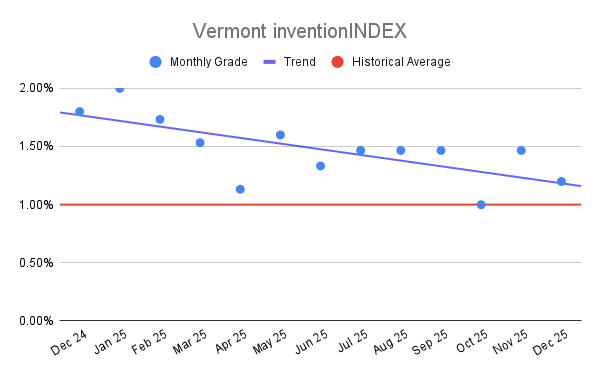 Vermont inventionINDEX December 2025:
  Vermont inventionINDEX November
